July 19, 2026
Updated: September 24, 2026
An evidence-led procurement guide to separating fixable ambiguity from high-risk vendor warning signs and hard stops.

Mohammed Khalil
This guide is for organizations hiring an external penetration testing company, not for employers interviewing candidates for an internal penetration tester position.
The biggest red flags are impossible guarantees, unknown assigned testers, scanner-only work sold as a human-led pentest, and vague scope or methodology. Missing authorization, unsafe controls, undefined data handling, weak report evidence, unclear retesting, or sales promises absent from the contract may be more serious. One signal is not proof of bad faith: request proportionate evidence, consider explanations, then clarify, document a contract condition, escalate, or stop.
After screening out red flags, buyers can compare leading penetration testing companies in the USA based on testing depth, reporting quality, retesting, and scope fit.
A penetration testing vendor red flag is a statement, omission, contradiction, or proposed practice that may reduce testing value, obscure responsibility, or create legal, security, operational, data-handling, or governance risk. It is a signal to verif ot proof of incompetence or dishonesty.
The useful question is not simply, “Does this look suspicious?” It is: Signal → Explanation → Evidence → Severity → Buyer Action.
Record the exact signal, ask for a plain-language explanation, and request evidence proportionate to the engagement without seeking another client’s confidential information. Judge severity against the assets, applicable requirements, organizational policy, and contract.
An early omission may be harmless if documented promptly; the same gap at kickoff can become material. Correctable qualification errors differ from essential claims that remain contradictory.
The DeepStrike Red-Flag Triage Matrix is an editorial decision aid, not an industry standard, certification, legal test, or guarantee.
| Level | Use It When | Buyer Action |
|---|---|---|
| Level 1 — Clarify | Information is incomplete, ambiguous, or may have a reasonable explanation. | Request a specific explanation and supporting evidence. |
| Level 2 — Contract Condition | The answer is acceptable only if it is documented in the scope, SOW, rules of engagement, data terms, staffing terms, or acceptance criteria. | Add an explicit written condition before approval. |
| Level 3 — High Risk | Evidence remains weak, answers conflict, material responsibility is unclear, or the provider resists proportionate due diligence. | Escalate internally and require resolution before selection. |
| Level 4 — Hard Stop | Authorization, safety, third-party permission, material representations, or sensitive-data controls remain seriously unresolved. | Do not sign or authorize testing until the condition is resolved. |
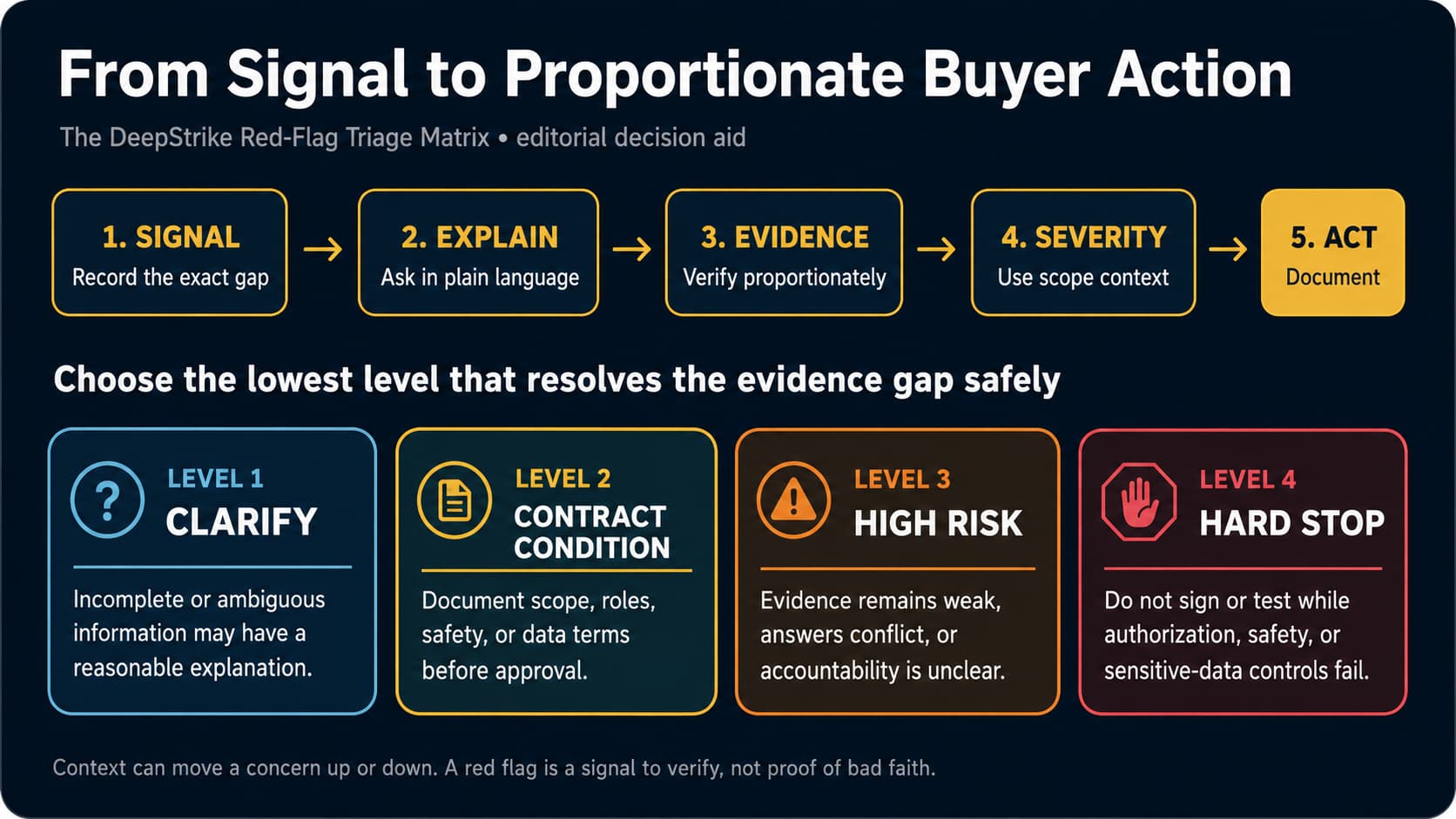
The default levels below are starting points. A concern can move up or down when the provider supplies evidence, the engagement changes, or organizational requirements make the issue more consequential.
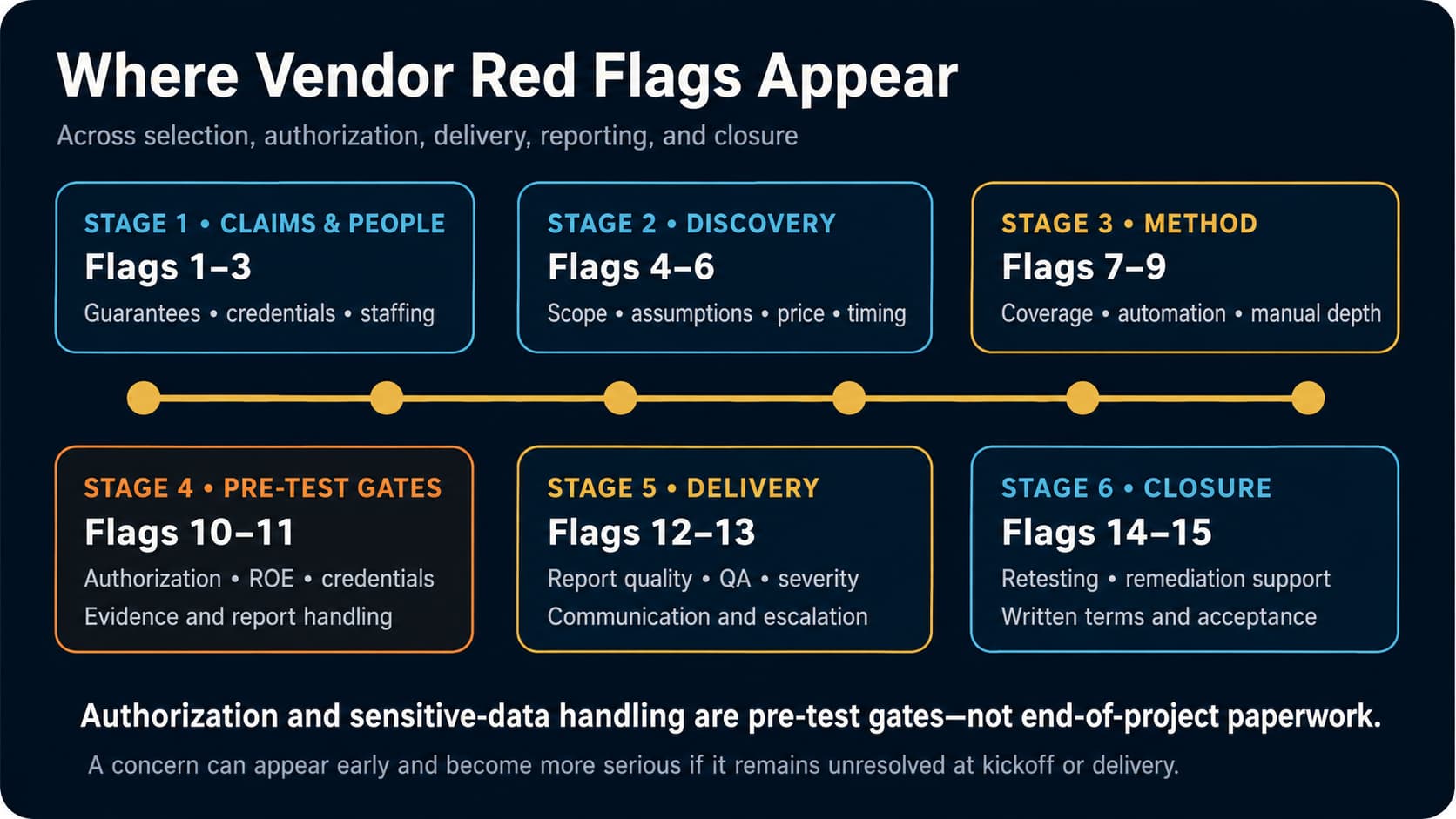
| # | Red Flag | Evidence to Request | Default Triage Level | Buyer Action |
|---|---|---|---|---|
| 1 | Impossible security or compliance guarantees | Written limitation and exact service commitment | Level 3 | Remove or correct the claim |
| 2 | Unverifiable qualifications or prestige claims | Issuer record and assigned-team evidence | Level 1 | Verify relevance and status |
| 3 | Unknown testers, reviewers, or subcontractors | Delivery roles, bios, locations, substitution terms | Level 2 | Document access and accountability |
| 4 | Quote before meaningful discovery | Assumptions, asset basis, effort model | Level 1 | Re-scope before comparing |
| 5 | Vague scope, exclusions, or change triggers | Asset list, boundaries, dependencies, approvals | Level 2 | Correct the SOW and ROE |
| 6 | Price or timeline does not reconcile | Effort, roles, deliverables, fees | Level 1 | Normalize the proposal |
| 7 | Methodology name-dropping | Scope-to-coverage mapping | Level 1 | Require a relevant test plan |
| 8 | Scanner-only or AI-only work sold as a pentest | Human validation and analysis workflow | Level 3 | Redefine or reject the service |
| 9 | Manual depth cannot be explained | Safe examples tied to the scope | Level 3 | Require capability evidence |
| 10 | Missing authorization or safety controls | Signed scope, ROE, contacts, stop rules | Level 4 | Do not begin testing |
| 11 | Undefined credential and evidence handling | Access, storage, retention, deletion, incident terms | Level 3 | Resolve before access is granted |
| 12 | No sample report or credible alternative | Sanitized sample, template, or walkthrough | Level 3 | Validate deliverable quality |
| 13 | Unclear QA, severity, or critical escalation | Reviewer role, QA steps, notification process | Level 2 | Add delivery conditions |
| 14 | Undefined retesting or remediation support | Window, rounds, eligibility, output, fees | Level 2 | Document the terms |
| 15 | Sales promises missing from written terms | Reconciled proposal, SOW, ROE, and data terms | Level 3 | Pause signature and reconcile |
What the signal looks like. The provider promises to find every vulnerability, guarantee compliance or an audit pass, prevent breaches, or make the system secure after the engagement.
Why it matters. A penetration test is bounded by time, scope, access, assumptions, and the techniques permitted under the rules of engagement. NIST SP 800-115 describes security testing as part of a broader assessment process and emphasizes both the benefits and limitations of testing techniques. A test can provide valuable evidence; it cannot prove the absence of every weakness or guarantee a regulatory, certification, insurance, or breach outcome.
When it may have a legitimate explanation. A clear service commitment such as a delivery date, defined coverage, report format, or retest window is not an impossible security guarantee. Marketing language may also be corrected once its limits are raised.
Evidence to request. Ask for the exact commitment, its assumptions, exclusions, acceptance criteria, and the limitations that will appear in the proposal and report.
Recommended severity and buyer action. Level 3 High Risk. Require correction. Escalate to Level 4 Hard Stop if an unsupported guarantee is essential to the sale, cannot be corrected, or conflicts with an applicable requirement.
What the signal looks like. Company certifications are presented as if every tester holds them; credentials belong to people who will not perform the work; accreditation applies to another legal entity, geography, service, or scheme; or awards, reviews, logos, and rankings are offered as substitutes for relevant delivery evidence.
Why it matters. Qualifications matter only when they are current, applicable, and connected to the people and service being purchased. PCI SSC’s supplemental penetration-testing guidance treats certifications as possible indicators, not universal requirements, and also points buyers toward experience with comparable technologies and constraints. Reviews may provide context, but they rarely prove technical depth. In the United States, the FTC publishes separate guidance on reviews and endorsements; buyers should avoid drawing legal conclusions and verify claims proportionately.
When it may have a legitimate explanation. Confidentiality may prevent client disclosure. Accreditation may be irrelevant to the engagement. A newer provider may still assign experienced, verifiable testers.
Evidence to request. Request assigned-tester biographies, issuer verification, a current directory entry where relevant, and an anonymized comparable example or permitted reference.
Recommended severity and buyer action. Level 1 Clarify. Move to Level 3 if claims remain materially inconsistent or to Level 4 if an essential qualification is misrepresented and unresolved.
What the signal looks like. Sales biographies replace delivery-team details; no lead tester or reviewer is identified; external specialists may access systems without disclosure; substitutions can occur without notice; or no one can explain where testing and report access will occur.
Why it matters. Buyers need to evaluate capability, accountability, conflicts, access, location, and data exposure. A strong proposal distinguishes the engagement lead, testers, quality reviewer, escalation owner, and any subcontractors. CREST’s guide for running an effective penetration testing programme identifies tester roles, skills, experience, qualifications, timing, location, and report requirements as relevant planning details.
When it may have a legitimate explanation. Contractors and small specialist teams are not automatically red flags. Staffing can change between proposal and start date. The issue is undisclosed access, uncontrolled substitution, unclear accountability, or skills that do not match the scope.
Evidence to request. Ask for role-based or named biographies, reviewer responsibility, employment or subcontractor status, work and data-access locations, security obligations, substitution rules, and notice or approval requirements.
Recommended severity and buyer action. Level 2 Contract Condition. Document who may access systems and evidence, how substitutions work, and who remains accountable. Treat concealed material access as Level 3 or 4.
What the signal looks like. The provider gives a final price without asking about objectives, assets, environments, roles, APIs, cloud accounts, networks, production constraints, sensitive data, third parties, timing, deliverables, or retesting.
Why it matters. Effort and safety depend on the work being purchased. A web application with one role is not the same as a multi-tenant platform with several roles, APIs, mobile clients, cloud control planes, and fragile production processes. A quote built on unknowns can later produce shallow coverage, exclusions, delays, or change fees.
When it may have a legitimate explanation. A narrow, standardized engagement can be quoted quickly when the assumptions and limits are explicit. A specialist may also estimate efficiently from a concise but complete asset profile.
Evidence to request. Ask for the discovery inputs used, asset counts, assumed complexity, test roles, environments, effort allocation, deliverables, dependencies, exclusions, and change assumptions.
Recommended severity and buyer action. Level 1 Clarify. Re-run scoping before comparing the quote. Move to Level 2 if the assumptions must become contractual conditions.
What the signal looks like. The proposal says “test everything” but has no asset inventory, in-scope/out-of-scope distinction, role or tenant coverage, environment boundary, API or backend coverage, prohibited actions, third-party permission, client dependency, or objective change criteria.
Why it matters. Scope is both a value boundary and an authorization boundary. Ambiguity can leave important assets untested, expose third parties, create unsafe activity, or allow unilateral expansion of cost. Buyers can use DeepStrike’s penetration testing scope guide and penetration testing RFP guide to define those documents without turning this red-flag guide into a full scoping template.
When it may have a legitimate explanation. An early estimate may intentionally remain high-level. Some asset details may be shared only after an NDA or through a secure channel.
Evidence to request. Request asset and environment lists, roles, tenants, trust boundaries, exclusions, prohibited techniques, permissions, dependencies, deliverables, and objective change-order approval criteria.
Recommended severity and buyer action. Level 2 Contract Condition. Correct the scope, SOW, and rules of engagement. Refusal to define an authorized boundary is Level 4 Hard Stop.
What the signal looks like. Delivery is extremely fast without an explanation; effort for testing, reporting, QA, and retesting is unclear; important scope elements disappear after signing; or rush, platform, travel, mandatory change, and retest fees appear late.
Why it matters. Buyers cannot compare proposals until they describe materially similar work. A low headline price may reflect fewer roles, less manual analysis, a narrower scope, or no retesting. A high price may reflect specialist effort or complex coordination but price alone proves neither quality nor value.
When it may have a legitimate explanation. The cheapest quote is not automatically weak, and the most expensive is not automatically best. Specialists may work efficiently, reuse safe testing infrastructure, or price a deliberately narrow engagement.
Evidence to request. Ask for testing and reporting effort, assigned roles, assumptions, included deliverables, QA, meetings, travel, platforms, retesting, rush terms, change fees, and taxes where relevant.
Recommended severity and buyer action. Level 1 Clarify. Normalize the proposals. Use Level 2 when price assumptions or exclusions must be documented before selection.
What the signal looks like. The provider says “we follow OWASP,” “we use NIST,” or “we follow industry best practices” but cannot connect those references to the assets, roles, trust boundaries, technology, threats, business logic, constraints, evidence, or report limitations.
Why it matters. A methodology name does not reveal what will actually be tested. The OWASP Web Security Testing Guide provides a broad framework for web application and web-service testing, while NIST SP 800-115 addresses wider technical assessment planning and execution. Neither label automatically creates complete or scope-relevant coverage.
When it may have a legitimate explanation. A proposal may summarize the approach and reserve detailed test cases for kickoff. Providers may combine several methods or maintain an internal methodology. No single public methodology is universally required.
Evidence to request. Ask for a safe scope-to-coverage map showing objectives, asset types, roles, trust boundaries, manual focus areas, exclusions, evidence expectations, and limitations.
Recommended severity and buyer action. Level 1 Clarify. Require a relevant test plan. Use Level 2 if minimum coverage or reporting must be an acceptance condition.
What the signal looks like. The output resembles raw scanner findings with new branding; there is no manual confirmation, false-positive process, business-logic or authorization testing, tenant-isolation review, attack-path reasoning, or explanation of human oversight behind “autonomous” or PTaaS language.
Why it matters. Automated tools are excellent for discovery, repeatability, and breadth. They do not independently understand every workflow, privilege boundary, business rule, or chained risk. PCI SSC’s supplemental guidance says automated output is a baseline indication of potential attack surface and must be interpreted to determine what further testing is needed. DeepStrike’s vulnerability assessment versus penetration testing guide explains the broader distinction.
When it may have a legitimate explanation. “100% manual” can also be misleading: credible testers normally use tools. AI or automation may support reconnaissance, test generation, correlation, documentation, or regression checks while skilled people direct, adapt, validate, and analyze the work.
Evidence to request. Ask where human judgment occurs, which findings are validated, how false positives are handled, how logic and authorization are assessed, and who signs off on conclusions.
Recommended severity and buyer action. Level 3 High Risk. Redefine the service accurately or select a provider that can evidence human-led depth.
What the signal looks like. The provider claims manual testing but cannot describe, even at a safe and non-operational level, how assigned testers evaluate authentication, authorization, business logic, multi-tenant boundaries, cloud IAM, API object access, identity paths, configuration interactions, chained findings, or evidence quality.
Why it matters. Manual depth is not a slogan or a count of tool-free hours. It is the tester’s ability to form and revise hypotheses, understand intended behavior, compare roles and boundaries, validate impact, and explain limitations. Different assets require different expertise.
When it may have a legitimate explanation. Providers should not disclose confidential client details, proprietary test cases, exploit code, or operational procedures. A high-level example can still demonstrate relevant reasoning without creating security risk.
Evidence to request. Ask for safe examples tied to your scope, the lead tester’s relevant experience, a coverage walkthrough, how edge cases are selected, how findings are chained, and how evidence is validated and reviewed.
Recommended severity and buyer action. Level 3 High Risk. Require capability evidence before selection. Reduce the level only when the assigned team not merely the company can demonstrate suitable depth.
What the signal looks like. Testing is expected to begin on verbal approval, without a signed scope, rules of engagement, testing windows, stop conditions, emergency contacts, critical-finding notification process, production safeguards, or third-party permission. High-impact activities such as social engineering, denial-of-service, physical access, or testing sensitive systems are not expressly controlled.
Why it matters. NIST defines rules of engagement as the detailed guidelines and constraints established before testing that authorize defined activities. The older but still useful PTES pre-engagement material also emphasizes scope, permissions, communication, and pre-engagement expectations. Cloud and hosted environments may have provider-specific testing policies that also need review.
When it may have a legitimate explanation. The authorization letter, SOW, and ROE may be separate documents and may not be final during early procurement. What matters is that they are complete before testing.
Evidence to request. Request signed authorization, confirmed asset-owner permission, scope, ROE, windows, prohibited actions, stop rules, contacts, critical escalation, third-party permissions, and relevant cloud-policy review.
Recommended severity and buyer action. Level 4 Hard Stop. Do not allow testing to begin until authorization and safety controls are approved.
What the signal looks like. The provider cannot explain how credentials are transferred and stored, who can access them, where evidence and reports reside, which subprocessors are involved, how delivery is encrypted, what is redacted, how long data is retained, how backups are handled, when deletion occurs, or how an incident is reported.
Why it matters. Testers may receive privileged accounts, architecture details, source code, vulnerability evidence, and sensitive data. Poor controls can create a new concentration of risk. PCI SSC’s supplemental guidance recommends minimizing acquired sensitive data and documenting evidence retention and destruction before testing; its PCI-specific examples should not be treated as a universal retention rule.
When it may have a legitimate explanation. The provider may use a secure portal or subprocessors, and different engagements legitimately require different retention periods. The correct period depends on risk, contract, applicable requirements, and client policy.
Evidence to request. Ask for transfer, encryption, access, location, subprocessor, retention, backup, deletion, incident-notification, and client deletion-confirmation processes.
Recommended severity and buyer action. Level 3 High Risk. Resolve the data terms before granting access. Escalate to Level 4 when no secure credential or evidence process can be established.
What the signal looks like. The provider refuses to show any output example or acceptance walkthrough. Available examples resemble scanner exports, omit affected-asset context and limitations, provide generic remediation, assign severity without rationale, or lack executive and retest views.
Why it matters. The report is a principal deliverable. It should help leadership understand risk and help technical teams reproduce, prioritize, and remediate validated findings. A buyer can compare the provider’s example with DeepStrike’s penetration testing report guide.
When it may have a legitimate explanation. Refusing to share another client’s unredacted report is responsible. A provider may instead offer a purpose-built sanitized sample, fictional but realistic template, anonymized section, controlled walkthrough, or a description of report acceptance and quality review.
Evidence to request. Review scope and limitation statements, executive summary, affected assets, evidence quality, impact, severity rationale, remediation, report security, QA, and retest status.
Recommended severity and buyer action. Level 3 High Risk. Require a credible alternative before accepting an unseen deliverable. Do not demand confidential client material.
What the signal looks like. No reviewer role is defined; findings are not validated; severity comes only from a tool; critical issues wait for the final report; communication is undefined; or there is no draft factual-review process, limitation statement, or distinction between technical remediation and the buyer’s separate risk-acceptance decision.
Why it matters. A technically correct finding can still be misleading if the affected asset, exploit preconditions, business context, compensating controls, or limitations are wrong. Critical findings may require rapid, secure escalation while testing continues. CREST guidance addresses report requirements and follow-up, while PCI SSC’s supplemental guidance calls comprehensive and consistent reporting a critical phase.
When it may have a legitimate explanation. A one-day test does not need the same meeting cadence as a multi-week programme. Reviewer identity may be role-based rather than named. The process should scale to scope, duration, sensitivity, and risk.
Evidence to request. Ask for QA steps, reviewer responsibility, validation criteria, severity method, critical notification channel and timing, status cadence, draft review, factual-correction process, and limitation reporting.
Recommended severity and buyer action. Level 2 Contract Condition. Define these delivery controls. Use Level 3 where critical escalation or QA remains materially inadequate.
What the signal looks like. A “free retest” has no window, eligible-finding definition, round limit, scheduling assumption, status output, or treatment of changed code, architecture, or newly discovered issues. Debriefing is unclear, remediation is a mandatory upsell, or the same provider remediates and validates without explaining how decisions remain controlled.
Why it matters. Retesting can range from a narrow check of an unchanged fix to a broader reassessment after material redesign. Undefined terms create mismatched expectations and make proposals difficult to compare. PCI SSC’s supplemental guide offers a useful example of retest-report elements, but individual engagements may need different outputs.
When it may have a legitimate explanation. Remediation services are not automatically a conflict. The relevant independence requirement depends on the engagement, scheme, assessor expectations, organizational policy, and who controls validation. Some providers reasonably charge for changes that create new scope.
Evidence to request. Ask for the retest window, rounds, eligible findings, scheduling, output, fees, changed-scope treatment, new-finding handling, debriefing, and any independence safeguards.
Recommended severity and buyer action. Level 2 Contract Condition. Document the terms before comparing value or accepting a remediation arrangement.
What the signal looks like. Commitments about assigned people, manual effort, scope, deliverables, data residency, subcontractors, retesting, formats, deadlines, compliance qualifications, independence, required insurance, incident handling, liability, change orders, or acceptance criteria appear in sales discussions but not in the controlling documents. The buyer is pressured to sign before resolving the gap.
Why it matters. Not every sales detail belongs in a contract, but material buying assumptions should appear in the SOW, ROE, data terms, or another appropriate agreement. DeepStrike’s penetration testing SOW guide explains how these documents fit together without replacing legal review.
When it may have a legitimate explanation. Documents may be drafted by different teams, and a proposal can contain non-material background information. The provider should be willing to reconcile material inconsistencies.
Evidence to request. Create a written list of material assumptions and map each one to the proposal, SOW, ROE, data terms, or other controlling document. Ask who can approve changes.
Recommended severity and buyer action. Level 3 High Risk. Pause signature and reconcile the documents. Seek appropriate procurement and legal review; this guide does not provide legal advice or contract clauses.
Evidence-based due diligence avoids treating normal business differences as proof of poor quality.
| Signal | Why It Is Not Automatically a Red Flag | What Still Needs Verification |
|---|---|---|
| Small specialist firm | A focused team may offer strong scope-specific expertise and direct senior involvement. | Capacity, continuity, QA, insurance if required, and escalation coverage. |
| Newer company with experienced named testers | Company age does not erase the team’s relevant experience. | Assigned-team evidence, governance, references where permitted, and delivery process. |
| Disclosed subcontractors | External specialists can add expertise or coverage. | Approval, accountability, access, location, security obligations, and substitutions. |
| Automation or AI supporting testers | Tools improve breadth, repeatability, and efficiency. | Human direction, validation, adaptation, logic testing, and final accountability. |
| Lower price | Narrow scope, specialization, low overhead, or efficiency can reduce cost. | Comparable scope, effort, deliverables, QA, exclusions, and retesting. |
| Refusal to share an unredacted client report | Protecting client confidentiality is responsible. | Sanitized sample, fictional template, anonymized section, or controlled walkthrough. |
| No public client logos | Contracts and confidentiality may prevent public disclosure. | Relevant anonymized experience or a permitted reference where appropriate. |
| No particular certification or accreditation | No single credential is universally required. | Relevant skills, experience, scheme requirements, and assigned-tester capability. |
| No remediation service | Organizational independence or a focused service model may favor testing only. | Actionable remediation guidance, debriefing, and retesting availability. |
| Refusal to guarantee findings or compliance | Responsible providers acknowledge the limits of a scoped, time-bound test. | Clear objectives, coverage, limitations, and deliverables. |
| Scope-change request after the environment changes | New assets, roles, or architecture can require more effort and authorization. | Objective trigger, impact, approval, timeline, and pricing. |
| Report without excessive screenshots | More screenshots can increase sensitive-data exposure without improving evidence. | Sufficient, secure, attributable, and reproducible evidence. |
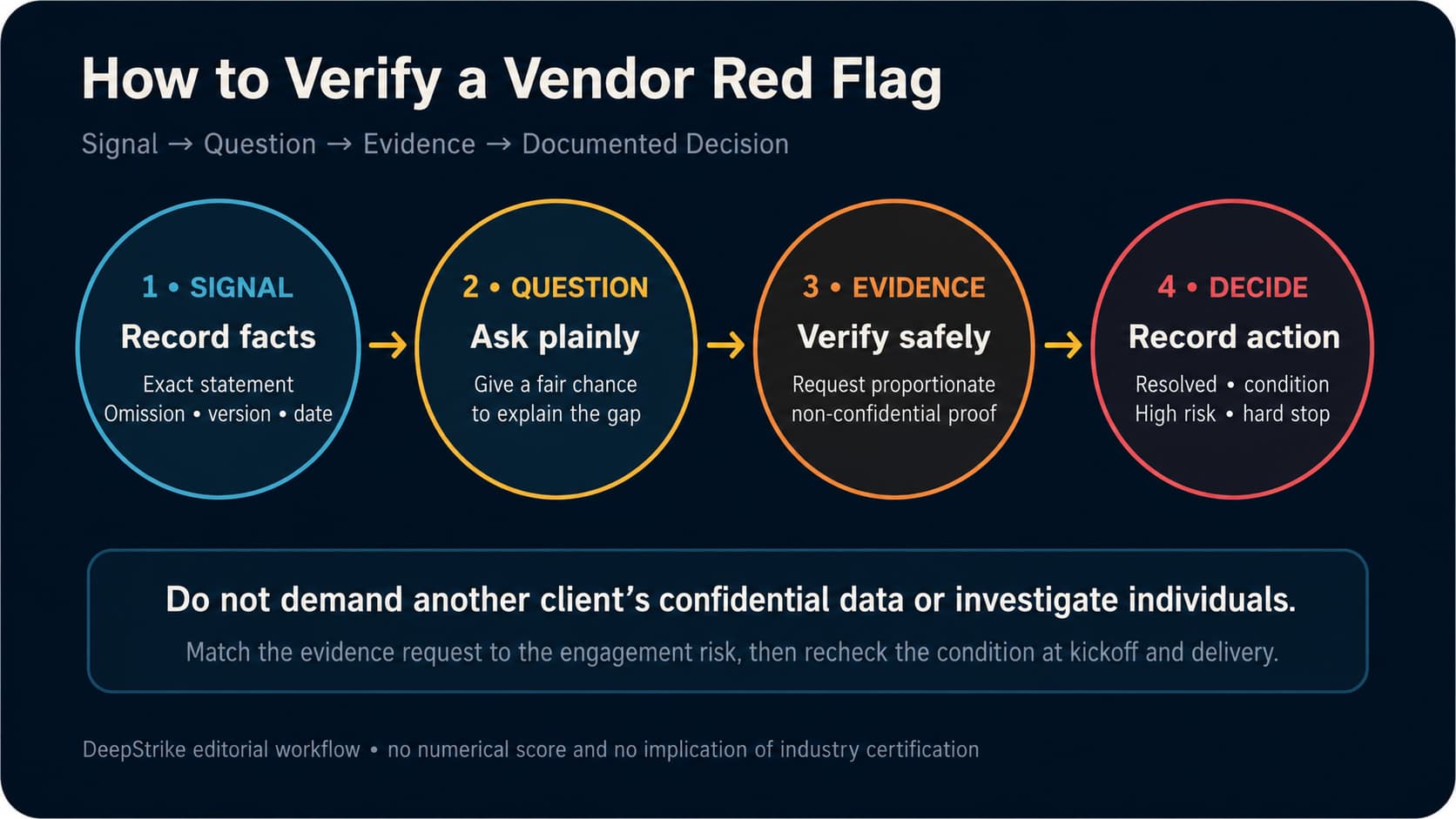
Record the exact signal. Capture the statement, omission, version, and date.
Ask for a plain-language explanation. Give the provider a fair chance to correct assumptions.
Request proportionate evidence. Match it to risk; never demand confidential client data.
Distinguish confidentiality from avoidance. Accept sanitized or issuer-verified alternatives.
Compare the answer with the documents. Check the proposal, SOW, ROE, and data terms.
Classify the issue. Mark it resolved, a contract condition, high risk, or a hard stop.
Document the decision and owner. Record accepted evidence and approved exceptions.
Recheck the condition. Confirm staffing, access, safety, reporting, and retesting at kickoff and delivery.
This process is procurement due diligence, not an invitation to harass individuals, target social-media accounts, dox staff, or seek another client’s confidential information.
Do not authorize testing while any serious, unresolved condition below remains:
Professional judgment, organizational policy, contractual obligations, jurisdiction, asset criticality, and applicable scheme rules still determine the final decision.
For the complete question set and evidence rubric, use DeepStrike’s 25-question provider evidence checklist.
Testing without clear written authorization, scope, and safety controls is the most serious warning. Impossible guarantees, concealed access, or insecure data handling can also justify a hard stop.
Ask where human judgment changes the work. A human-led pentest validates findings, adapts to the environment, assesses relevant roles and business logic, explains impact, and documents limitations not a rebranded scanner export.
No. Lower pricing can reflect narrow scope, specialization, efficiency, or lower overhead. Treat it as a warning only when scope, effort, people, deliverables, fees, or retesting cannot be reconciled.
A provider should offer a sanitized sample or a credible alternative such as a fictional template or controlled walkthrough. It should never disclose another client’s unredacted report.
No. Disclosed, controlled subcontractors can add expertise. Verify access, location, security obligations, substitution rules, and who remains accountable.
There is no universal credential list. Prioritize scope fit, relevant experience, safe working practices, report quality, and the assigned team; confirm any credential required by your contract, assessor, or framework.
No. CREST accreditation may matter for particular buyers, schemes, or engagements, but it is not universal. Verify the requirements that apply and the assigned team’s delivery evidence.
No. A pentest can provide evidence for defined requirements, but it cannot alone guarantee compliance, certification, or an audit pass.
List each material mismatch and reconcile it in the relevant written document before signing. Involve procurement, security, and legal reviewers as appropriate.
Pause or walk away when authorization, scope, ROE, safety, third-party permission, sensitive-data handling, material representations, or approval pressure remain unresolved.
Evaluate each red flag as a signal that needs context and evidence. Clarify harmless ambiguity, document controllable risk, escalate material contradictions, and stop when authorization, safety, data handling, or essential representations remain unresolved.
A defensible decision depends on who performs the work, what they may test, how judgment is applied, how data is protected, and which promises are written.
DeepStrike can discuss an authorized penetration testing engagement and provide a scope-specific proposal. Whether you evaluate DeepStrike or another provider, apply the same evidence standard and resolve hard gates before testing begins.
Mohammed Khalil is a Cybersecurity Architect at DeepStrike specializing in advanced penetration testing and offensive security. His certifications include CISSP, OSCP, and OSWE. His work focuses on application security, API security, cloud security, identity exposure, attack-path validation, and remediation-focused security testing.

Stay secure with DeepStrike penetration testing services. Reach out for a quote or customized technical proposal today
Contact Us
