July 9, 2026
Updated: August 10, 2026
A practical guide to writing and reviewing a penetration testing statement of work, including scope, assets, exclusions, rules of engagement, deliverables, retesting, acceptance criteria, and compliance boundaries.

Mohammed Khalil
A penetration testing statement of work should be approved before testing begins. It is commonly used as part of the contractual work agreement for an authorized security assessment, but this article is a planning framework, not final legal language. A SOW should define the business objective, scope, assets, exclusions, assumptions, responsibilities, timeline, rules of engagement reference, deliverables, data handling, retesting, and acceptance criteria.
The SOW is related to, but not the same as, a technical scope document, rules of engagement, request for proposal, master services agreement, NDA, written authorization letter, or final penetration test report. Legal, procurement, security, operations, and compliance stakeholders should review the final SOW before signature. This article is educational and does not provide legal advice.
A penetration testing statement of work is a written planning and procurement document that defines the agreed work for an authorized security assessment. It explains the business objective, in-scope and out-of-scope assets, assumptions, constraints, buyer and provider responsibilities, testing windows, rules of engagement reference, written authorization requirement, deliverables, reporting format, data handling, retesting terms, timeline, and acceptance criteria. It should help all stakeholders understand what will be tested, what will not be tested, how testing will be controlled, what evidence will be delivered, and how the engagement will close. It is not a substitute for legal review or a permission-to-test letter.
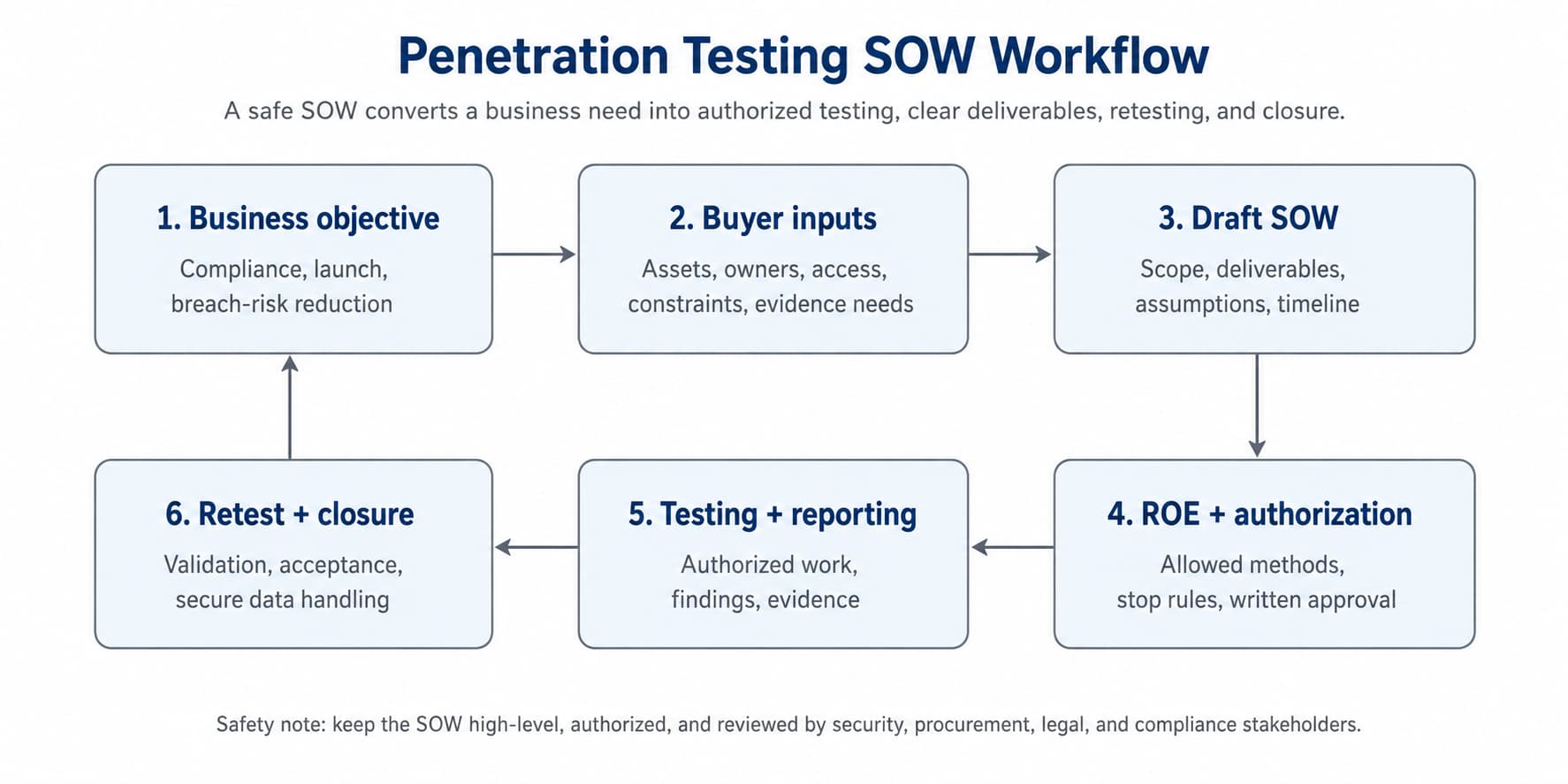
Figure 1. Penetration testing SOW workflow from business objective through SOW approval, authorization, testing, reporting, retesting, and closure.
A penetration testing statement of work is the agreed work plan for a security testing engagement. It connects the buyer’s business need with the provider’s testing activities and the final deliverables. In practice, it helps answer: what is being tested, why it is being tested, who is responsible for each dependency, when testing can occur, how results will be delivered, and what counts as completion.
The SOW is not the same as technical scope. Scope defines the authorized assets and boundaries. The SOW includes scope, but also covers responsibilities, deliverables, timeline, communication, data handling, retesting, and acceptance criteria. It is also not the same as an RFP, which is used before vendor selection, or the final report, which documents what was found after testing.
A strong SOW is especially important when production systems, regulated data, cloud accounts, third-party services, internal networks, identity systems, or social engineering are involved. It gives the buyer, provider, legal, procurement, and security teams a shared reference before any testing starts.
A clear SOW reduces ambiguity. If the document only says “test our environment,” the provider may not know which assets are authorized, which systems are fragile, which credentials should be used, or how the final report will be judged. That creates cost, safety, and trust problems.
For buyers, the SOW supports procurement clarity, project governance, scope control, and audit evidence. For testing teams, it sets boundaries and dependencies so work can be performed safely and efficiently. For legal and compliance reviewers, it documents the intended work without turning the article itself into legal advice.
The value of a SOW is not paperwork. It is alignment. A good SOW helps prevent missed systems, unauthorized testing, unclear deliverables, open-ended retesting, unsafe production activity, weak evidence handling, and disputes over whether the engagement is complete.
These documents often overlap, but they do different jobs. The SOW should reference related documents where needed instead of trying to replace them all.
| Document | What It Defines | When It Is Used | Why It Matters |
|---|---|---|---|
| Statement of Work (SOW) | The agreed work plan: objective, scope summary, responsibilities, timeline, deliverables, retesting, acceptance criteria, and operational assumptions. | After vendor selection and before testing begins. | Turns the engagement into a clear buyer-provider work agreement. |
| Technical Scope | The exact assets, roles, environments, exclusions, and test boundaries. | During scoping and SOW preparation. | Prevents unauthorized testing and missed assets. |
| Request for Proposal (RFP) | The buyer’s requirements, evaluation criteria, and procurement questions. | Before vendor selection. | Helps compare providers and collect proposals. |
| Proposal / Quote | The provider’s response: approach, proposed scope, timeline, assumptions, and pricing basis. | During vendor evaluation. | Shows how the provider plans to meet the buyer’s need. |
| Master Services Agreement (MSA) | General commercial and legal terms between buyer and provider. | Before or alongside the SOW. | Keeps general legal terms separate from engagement-specific work. |
| NDA / Data Handling Agreement | Confidentiality and handling of sensitive information, evidence, credentials, source code, logs, and reports. | Before sensitive information is shared. | Protects data exchanged during scoping and testing. |
| Rules of Engagement (ROE) | Operational testing rules: allowed methods, prohibited actions, windows, escalation, rate limits, and stop conditions. | Before testing starts, often as SOW appendix. | Controls operational risk during authorized testing. |
| Authorization Letter | Written approval from the asset owner or authorized leadership to test defined assets under agreed boundaries. | Before any testing starts. | Helps establish that testing is authorized, scoped, and accountable. |
| Final Report | Findings, evidence, severity, impact, remediation guidance, and any agreed compliance mapping. | After testing. | Documents results and supports remediation decisions. |
| Retest Validation Summary | Whether agreed findings were remediated during the retest window. | After remediation, if retesting is included. | Supports closure without turning the retest into a new assessment. |
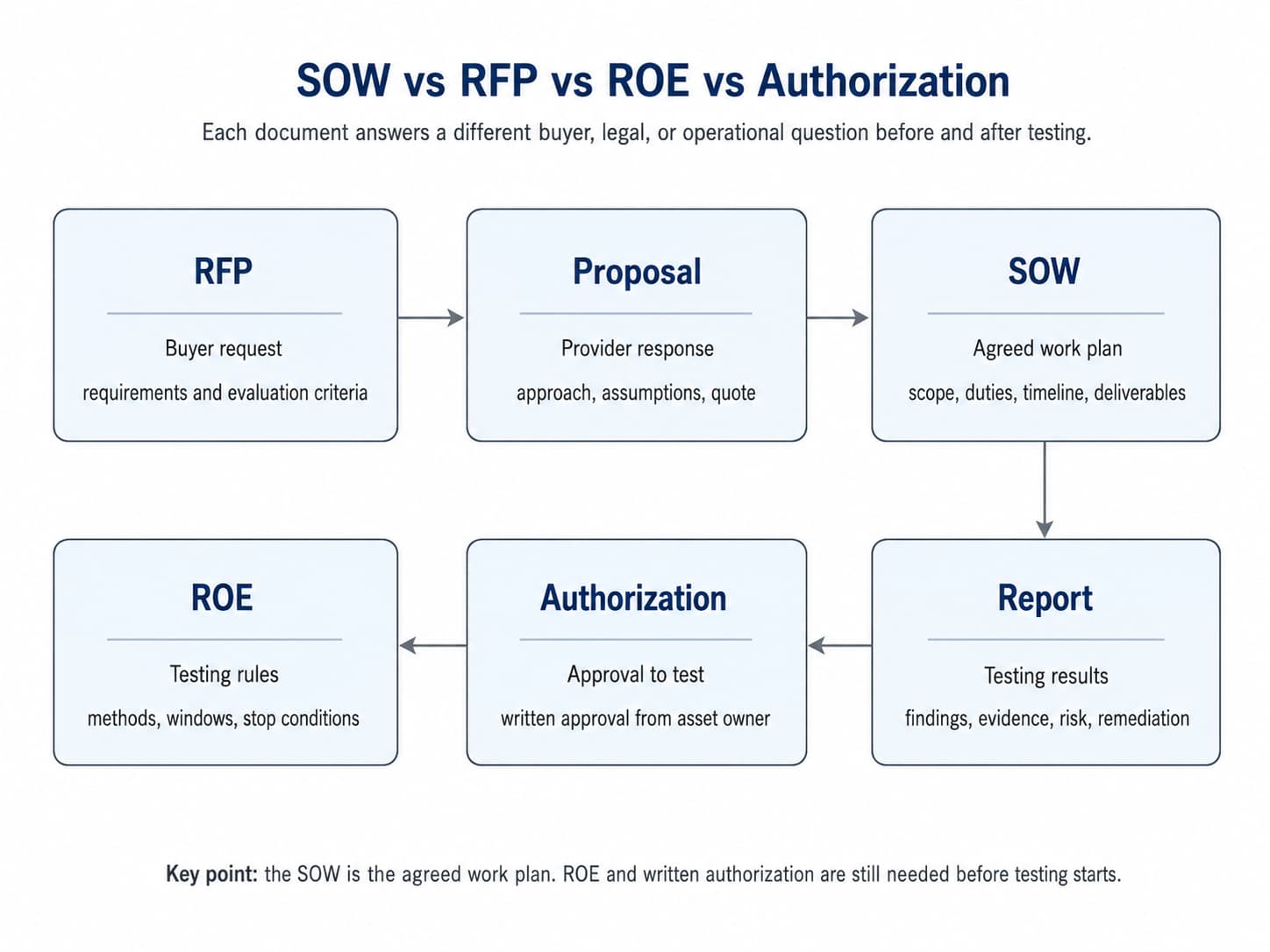
Figure 2. Document comparison showing how RFP, proposal, SOW, ROE, authorization, and final report support different stages of a penetration testing engagement.
To make the article more useful than a generic template, review every penetration testing SOW across six layers: commercial agreement, authorized scope, operational safety, deliverables and evidence, retesting and closure, and compliance/procurement review. A SOW can look complete but still fail if one of these layers is vague.
| Layer | What to Check | Common Failure |
|---|---|---|
| Commercial agreement | Objective, responsibilities, milestones, acceptance criteria, and change process. | The document lists services but does not define completion. |
| Authorized scope | Exact assets, exclusions, assumptions, environments, ownership, and third-party approvals. | “All systems” language creates overreach or gaps. |
| Operational safety | ROE reference, testing windows, blackout periods, rate limits, emergency stop, escalation contacts. | Testing is approved commercially but not safe operationally. |
| Deliverables and evidence | Report format, severity model, evidence rules, data handling, audience needs. | Buyer receives a generic report that does not support remediation or audit review. |
| Retesting and closure | Retest window, number of rounds, eligible findings, client evidence, closure criteria. | Retesting becomes open-ended or disputed. |
| Compliance and procurement review | Framework mapping, source verification, legal/procurement review, no guarantees. | SOW overclaims compliance or omits required evidence. |
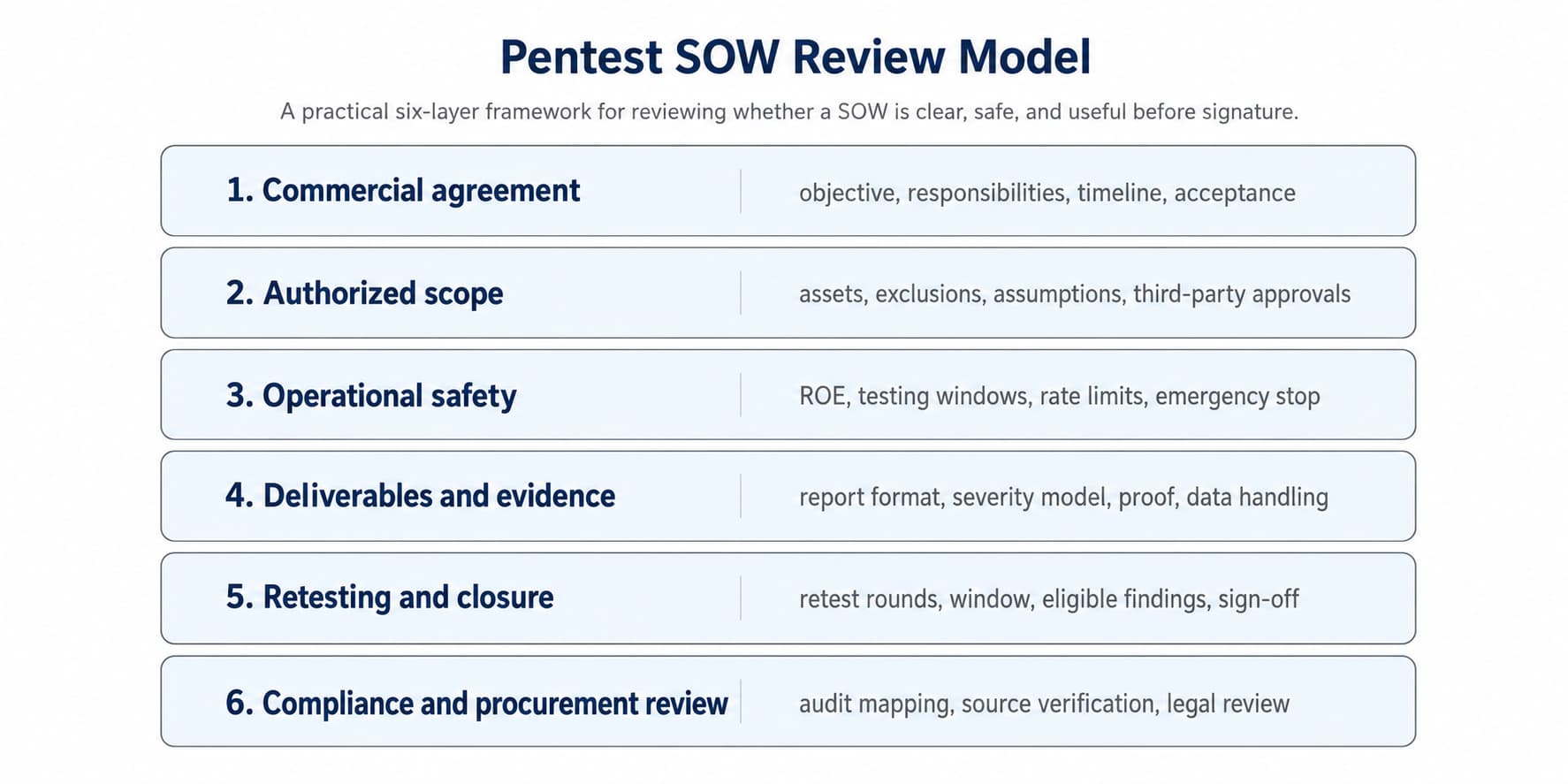
Figure 3. Pentest SOW Review Model: a six-layer framework for reviewing whether a penetration testing SOW is clear, safe, and procurement-ready.
A comprehensive SOW should define the work in practical terms. The buyer should be able to read it and understand what systems are covered, what evidence will be delivered, what the provider needs from the client, and how scope changes will be handled.
| SOW Section | What to Define | Why It Matters |
|---|---|---|
| Engagement objective | Business reason for the assessment: compliance evidence, product launch, breach-risk reduction, vendor assurance, M&A, cloud migration, or red team simulation. | Keeps the test aligned with business goals. |
| Scope summary | A plain-English summary of the in-scope test type and environment. | Frames detailed scope for non-technical stakeholders. |
| In-scope assets | Domains, URLs, IP ranges, API base URLs, cloud account IDs, mobile builds, internal ranges, AD domains, user roles, environments. | Prevents missed assets and unauthorized testing. |
| Out-of-scope assets | Excluded systems, third-party services, fragile infrastructure, customer tenants, production data, physical locations, or social engineering methods. | Protects systems that are not approved. |
| Assumptions | Conditions assumed true, such as working test accounts, asset ownership, environment stability, documentation availability, and whitelisting. | Identifies dependencies before delays occur. |
| Constraints | Rate limits, blackout windows, no DoS, no destructive changes, no real payment abuse, no unapproved phishing, no production data extraction. | Controls operational and legal risk. |
| Client responsibilities | Access provisioning, accounts, documentation, approvals, contacts, test data, infrastructure readiness. | Prevents project delays caused by missing inputs. |
| Provider responsibilities | Perform authorized testing, communicate issues, protect evidence, deliver agreed reports, follow ROE. | Clarifies expected professional conduct. |
| ROE reference | Where the operational testing rules are defined. | Connects the SOW to safe execution controls. |
| Written authorization | Testing should not begin without approval from the asset owner or authorized leadership. | Establishes authorized testing boundaries. |
| Deliverables | Executive summary, technical report, evidence, remediation guidance, compliance mapping, retest summary, closeout call if included. | Defines what the buyer receives. |
| Retesting | Included rounds, eligible findings, retest window, client evidence, output, expiry. | Prevents open-ended remediation disputes. |
| Data handling | How credentials, screenshots, logs, reports, source code, PII, PHI, cardholder data, secrets, and cloud exports are handled. | Protects sensitive evidence. |
| Timeline and milestones | Kickoff, access deadline, testing window, draft report, review, final report, retest, closeout. | Keeps expectations and dependencies visible. |
| Acceptance criteria | What must be delivered or accepted for project closure. | Defines completion without relying on vague expectations. |
| Change control | How new assets, additional testing, schedule changes, or retest extensions are approved. | Controls scope creep and budget impact. |
Use this SOW template as a planning framework, not as final legal language. Legal and procurement teams should adapt the final contract language to the organization’s policies and risk tolerance.
| SOW Section | Example Language Direction | Notes |
|---|---|---|
| Project title | Name the engagement clearly, such as “External Web and API Penetration Test for ExampleCorp.” | Keep it short and specific. |
| Objective | State the business goal: pre-launch validation, compliance evidence, vendor assurance, cloud review, breach-risk reduction. | Avoid vague “test security” wording. |
| Background | Briefly describe relevant changes: new application, cloud migration, prior incident, audit cycle, acquisition, or architecture change. | Adds context without replacing methodology. |
| Scope summary | Summarize the test type and environment in one short paragraph. | Detailed assets should follow. |
| In-scope assets | List exact domains, IP ranges, apps, APIs, cloud accounts, mobile builds, roles, and environments. | Use asset IDs where possible. |
| Out-of-scope assets | List excluded systems and activities, including third-party services, DoS, social engineering, physical access, or production data extraction if not approved. | Do not rely on assumptions. |
| Assumptions | State buyer-provided inputs: accounts, MFA support, diagrams, API docs, test data, VPN access, whitelisting, cloud roles. | Assumptions should be testable. |
| Dependencies | Define what must be ready before testing begins. | Missing dependencies can pause the schedule. |
| Testing approach | Describe high-level authorized approach and references, such as NIST, OWASP, PTES, or cloud-provider policies where relevant. | Do not include exploit steps in the public article. |
| ROE reference | Reference an attached ROE or appendix covering allowed methods, prohibited actions, windows, contacts, stop conditions, and escalation. | ROE controls how testing occurs. |
| Written authorization | State that testing should not start until written authorization is approved by the asset owner or authorized leadership. | The SOW should not replace authorization. |
| Roles and responsibilities | Separate buyer duties from provider duties. | Prevents access and approval delays. |
| Testing windows | Define allowed dates, hours, blackout periods, and maintenance conflicts. | Protects production operations. |
| Data handling | Define evidence minimization, redaction, encrypted transfer, access controls, retention, and deletion. | Align with NDA and privacy requirements. |
| Deliverables | List executive summary, technical report, remediation guidance, compliance mapping, retest output, and presentation if included. | Do not promise unverified DeepStrike deliverables. |
| Reporting | Define format, severity model, review cycle, and delivery method. | Controls report quality expectations. |
| Retesting | Define included rounds, eligible findings, retest window, evidence needed, and output. | Avoid “retest if needed” ambiguity. |
| Timeline | List kickoff, access, test period, draft report, final report, retest, and closeout dates. | Tie milestones to dependencies. |
| Acceptance criteria | Define project completion: deliverables submitted, review completed, retesting delivered if included, or client acceptance. | Prevents open-ended closure. |
| Change management | Define written approval for new assets, schedule changes, or additional services. | Controls scope creep. |
| Compliance mapping | Define whether findings will be mapped to PCI DSS, SOC 2, ISO 27001, HIPAA, FedRAMP, GDPR, or cyber insurance evidence needs. | Use cautious wording and verify sources. |
The SOW should list assets with enough precision that the provider does not need to guess. Every unclear asset becomes a possible gap, delay, or authorization problem. The table below keeps the original article’s useful comparison structure while replacing vague examples with safer, publish-ready wording.
| Item | Good SOW Example | Weak SOW Example | Risk |
|---|---|---|---|
| Web domains | app.example.com and admin.example.com in production; staging excluded unless separately approved. | Company web app | Missed apps or accidental testing of unrelated domains. |
| IP ranges | 203.0.113.0/27 public perimeter range owned by the client. | External network | Scanning non-owned IPs or skipping real exposure. |
| API endpoints | api.example.com/v1 with OpenAPI specification and provided test tokens. | APIs | Hidden endpoints or authorization paths may be missed. |
| Cloud accounts | AWS account 123456789012 and Azure subscription ABC, regions listed in appendix. | Cloud resources | Unclear tenant boundaries and provider-policy risk. |
| Mobile apps | Android build 2.3 and iOS TestFlight build 5.1 with test accounts. | Mobile app | Wrong build, platform, or backend may be tested. |
| Environments | Production web app and staging API; development tenant excluded. | All environments | Testing unstable or unauthorized systems. |
| Active Directory | EXAMPLE.LOCAL domain with approved test account and listed domain controllers. | Domain controllers | Unsafe AD activity or incomplete identity coverage. |
| Third-party systems | Payment gateway sandbox approved; live gateway excluded. | Not mentioned | Vendor policy violations or accidental third-party testing. |
| Test accounts | Buyer provides standard user, admin, support, and API service-role accounts before kickoff. | Provider will create accounts | Delays or inaccurate business-logic testing. |
| Assumptions | Environment remains stable during the test; release freeze during active testing window. | No assumptions | Findings may be invalidated by unplanned changes. |
| Dependencies | Buyer provides VPN, allowlisting, architecture diagram, API docs, and test data by kickoff. | Access will be provided | Schedule slips and incomplete coverage. |
Rules of engagement define how the approved testing can occur. The SOW may summarize or reference the ROE, but it should not replace a detailed ROE when operational risk is significant. Written authorization should be approved before testing starts and should align with the approved scope and ROE.
Written authorization helps establish that testing is approved by the asset owner and bounded by the agreed scope and rules of engagement. Avoid casual legal phrases. For a B2B cybersecurity article, use precise language: testing should be authorized, documented, time-bounded, and controlled.
| ROE / Authorization Item | Should the SOW Mention It? | Why |
|---|---|---|
| Authorized targets | Yes | The SOW should list or reference exact assets approved for testing. |
| Allowed methods | Yes | Clarifies high-level testing categories without publishing operational exploit detail. |
| Prohibited actions | Yes | DoS, destructive changes, unapproved phishing, production data extraction, physical access, or password spraying may be excluded. |
| Testing windows | Yes | Keeps testing aligned with operational risk and business blackout periods. |
| Emergency stop | Yes | Defines who can pause testing and how escalation occurs. |
| Critical finding escalation | Yes | Prevents critical findings from waiting until final report delivery. |
| Data handling | Yes | Protects evidence such as screenshots, credentials, logs, and sensitive records. |
| Cloud and third-party approvals | Yes | Buyer approval may not authorize testing against vendor or cloud-provider systems. |
| Out-of-scope discovery | Yes | Defines what testers do if they discover an unlisted asset or dependency. |
| Authorization letter | Yes | Confirms that testing should not begin without written approval from the appropriate asset owner or authorized leadership. |
Deliverables should be defined before testing begins. A buyer should not accept a vague line item that says only “penetration test report.” The SOW should describe the audience, format, evidence expectations, severity model, remediation guidance, and any compliance mapping required.
| Deliverable | Audience | SOW Detail to Define |
|---|---|---|
| Executive summary | Leadership, board, security management | Risk themes, business impact, top findings, remediation priorities, scope caveats. |
| Technical report | Security, engineering, DevOps, AppSec | Affected assets, evidence, impact, reproduction context, remediation guidance, severity. |
| Compliance mapping | Compliance, audit, GRC | Framework or control mapping where relevant, without implying full compliance. |
| Severity model | All stakeholders | CVSS or internal risk model, business impact adjustment, severity definitions. |
| Evidence package | Security and engineering | Screenshots, logs, request/response excerpts, configuration evidence, redaction rules. |
| Remediation tracker | Engineering, project owners | Finding ID, severity, owner, remediation status, due date, retest status. |
| Retest validation summary | Security, compliance, engineering | Which original findings were retested, result, date, evidence, unresolved items. |
| Closeout call | Mixed stakeholder group | Review scope, key findings, remediation priorities, and next steps if included. |
Retesting should be explicit. Buyers often assume remediation validation is included, while providers may treat it as a separate service. The SOW should define retesting before the report is delivered.
| Retesting Term | Clear SOW Wording Direction | Common Risk |
|---|---|---|
| Included or separate | State whether retesting is included and under what conditions. | Buyer expects free validation that provider did not price. |
| Number of rounds | Define one or more agreed retest cycles, or state that retesting is separate. | Open-ended retesting creates disputes. |
| Eligible findings | Define whether all findings or only critical/high findings are included. | Low-risk issues consume retest time without agreement. |
| Retest window | Define the time period after final report or fix submission. | Fixes arrive months later and require a new assessment. |
| Client evidence | State what proof the client must provide before retesting begins. | Provider spends time validating unready fixes. |
| Retest boundary | Clarify that retesting validates original findings, not a full new penetration test. | Retest becomes uncontrolled new testing. |
| Output | Define whether the provider delivers an updated report, validation summary, or closure note. | Buyer lacks audit-ready evidence. |
| Failed fixes | State how unresolved findings are documented. | No shared understanding of closure. |
A penetration testing SOW should address evidence handling because testing may expose credentials, PII, PHI, cardholder data, source code, internal architecture, cloud configuration exports, logs, and vulnerability details. The article should remain educational; exact retention and contractual language should be reviewed by legal and procurement.
| Data Type | SOW / Data Handling Requirement | Risk if Missing |
|---|---|---|
| Credentials and test accounts | Secure transfer, restricted access, rotation or revocation after testing. | Stale accounts or leaked credentials remain usable. |
| PII, PHI, or cardholder data | Minimize collection, use test data where possible, redact evidence, encrypt reports. | Privacy, compliance, and trust risk. |
| Source code | Limit access, prevent unnecessary downloads, encrypt storage, define retention and deletion. | Intellectual property exposure. |
| Screenshots and logs | Mark as sensitive, redact secrets, control distribution. | Accidental disclosure of systems or data. |
| Cloud exports and secrets | Treat as sensitive credentials; encrypt, restrict, and delete according to agreement. | Cloud account compromise risk. |
| Reports | Deliver via secure channel or portal, restrict recipients, define retention. | Vulnerability details could be exposed. |
| Raw data | Only include if necessary and approved; define secure deletion. | Unnecessary storage of sensitive artifacts. |
The SOW should make responsibilities visible. Many engagement delays come from missing accounts, unclear approvers, unavailable owners, or confusion between security, cloud, application, and procurement teams.
| Role | Responsibility | Why It Matters |
|---|---|---|
| Client project owner | Owns schedule, approvals, access coordination, and sign-off. | Creates a single decision path. |
| Security owner | Defines objective, scope, severity expectations, escalation, and report needs. | Keeps testing tied to risk priorities. |
| Application owner | Provides app details, accounts, test data, business workflow context. | Improves authenticated and business-logic coverage. |
| Cloud / infrastructure owner | Provides account boundaries, access, network diagrams, provider-policy constraints. | Prevents cloud and network ambiguity. |
| SOC / incident contact | Knows testing window, handles alerts, receives urgent notifications. | Avoids confusing test activity with incidents. |
| Legal / procurement | Reviews contract terms, data handling, purchasing, and approval workflow. | Ensures the SOW fits policy and risk tolerance. |
| Provider lead | Coordinates testing team, communication, reporting, and escalation. | Creates accountability on delivery. |
| Communication channel | Shared channel, email thread, status call cadence, critical escalation path. | Reduces surprises during live testing. |
A SOW should tie schedule to dependencies. If access is late, test accounts fail, or the environment changes during testing, the timeline may need formal adjustment. This avoids turning delivery dates into unrealistic commitments.
| Milestone | Dependency | Acceptance Criteria |
|---|---|---|
| Kickoff | SOW, stakeholders, and initial scope confirmed. | Project plan, communication path, and schedule agreed. |
| Access provisioning | Accounts, VPN, allowlisting, API docs, cloud roles, test data delivered. | Provider confirms access to in-scope assets. |
| Testing window | ROE and authorization approved. | Testing completed within approved windows and constraints. |
| Critical finding escalation | Emergency contacts and escalation rules available. | Urgent findings communicated according to SOW/ROE. |
| Draft report | Active testing complete. | Draft contains findings, evidence, severity, and remediation guidance. |
| Report review | Buyer reviews draft and submits corrections or context. | Agreed changes incorporated where appropriate. |
| Final report | Draft review complete. | Final deliverable matches SOW reporting expectations. |
| Retesting | Fixes submitted within agreed window. | Eligible original findings verified and documented. |
| Closeout | Deliverables complete. | Project accepted under agreed criteria. |
A SOW should explain cost drivers qualitatively without inventing prices. Scope size, technical complexity, role coverage, cloud boundaries, reporting depth, retesting, compliance mapping, data sensitivity, and time constraints all affect effort.
| SOW Detail | Impact on Cost / Timeline | Quality Consideration |
|---|---|---|
| Asset count | More applications, APIs, hosts, and cloud resources require more tester time. | Too broad a scope can reduce depth. |
| User roles | Each role adds authentication, authorization, and workflow testing. | Role coverage is essential for access-control findings. |
| API complexity | Endpoint count, tenants, tokens, schemas, and abuse cases add effort. | Good documentation improves test quality. |
| Cloud complexity | Multiple accounts, IAM paths, containers, serverless, and CI/CD expand scope. | Cloud scope must respect provider and tenant boundaries. |
| Reporting depth | Executive, technical, compliance, and retest outputs require different work. | Good reporting improves remediation. |
| Retesting | Included retest rounds require reserved time after fixes. | Retesting improves closure confidence. |
| Testing windows | Narrow windows can extend the calendar. | Safety may require slower testing. |
| Compliance mapping | Framework mapping adds review and documentation effort. | Audit value improves when scope maps to evidence needs. |
| Red team / social engineering | Planning, approvals, HR/legal coordination, and stop rules add time. | Controls are necessary to avoid unsafe testing. |
| Test Type | SOW Details to Add | Common Mistake |
|---|---|---|
| Web application | URLs, domains, auth flows, user roles, admin areas, file uploads, payment flows, linked APIs, test data, rate limits. | Only listing the homepage or marketing domain. |
| API | Base URLs, endpoints, methods, OpenAPI/Postman docs, tokens, tenants, roles, schemas, rate limits, third-party integrations. | Saying “test the API” without endpoint inventory. |
| Cloud | AWS/Azure/GCP account IDs, subscriptions, projects, regions, IAM roles, services, provider-policy constraints, logging, storage, CI/CD. | Using “all cloud” without account boundaries. |
| External network | Public IP ranges, domains, exposed services, scan windows, fragile hosts, third-party hosting boundaries. | Unowned IPs or hosted systems are not verified. |
| Internal network / AD | Subnets, VPN access, AD domains, test accounts, domain controllers, segmentation, sensitive systems, credential handling. | Assuming all internal systems are safe to test. |
| Mobile | iOS/Android builds, devices, OS versions, accounts, backend APIs, local storage, rooted/jailbroken device policy. | Testing the wrong build or ignoring backend APIs. |
| Wireless | SSIDs, locations, APs, bands, encryption, time windows, physical boundaries. | Testing nearby networks or causing interference. |
| Red team | Objectives, allowed paths, target groups, duration, detection coordination, stop conditions, data handling. | Writing a vague “red team” SOW without success criteria. |
| Social engineering | Approved methods, target groups, volume, pretext review, HR/legal approvals, stop conditions. | Running social testing without explicit approval. |
| Compliance pentest | Audit boundary, control mapping, evidence requirements, retesting, report format. | Treating compliance testing like a generic pentest. |
| Continuous testing | Asset change triggers, cadence, retesting model, notification path, reporting periods. | New assets are added without scope governance. |
A web application SOW should list exact domains, URLs, authentication flows, user roles, admin areas, upload functions, payment paths, staging or production environment, linked APIs, test data, allowed methods, rate limits, and exclusions. It may reference OWASP WSTG or ASVS for coverage expectations, but the written scope still needs exact assets and roles. Avoid wording such as “test our website” because risk often lives behind login, in admin workflows, in file upload logic, or in API calls behind the user interface.
An API SOW should identify base URLs, endpoint inventory, HTTP methods, OpenAPI or Postman documentation, authentication mechanisms, tokens, roles, tenants, rate limits, schemas, abuse cases, and third-party integrations. REST, GraphQL, gRPC, and WebSocket APIs may require different inputs. The SOW should define test data and prohibit destructive production actions unless explicitly approved. OWASP API Top 10 can guide risk coverage, but it does not replace endpoint-level scope.
A cloud SOW should define exact AWS accounts, Azure subscriptions, GCP projects, regions, IAM roles, storage, databases, serverless functions, containers, Kubernetes clusters, logging, key management, secrets, and CI/CD boundaries. It should state that testing must respect cloud-provider policies and tenant boundaries. Avoid claims about current cloud-provider rules unless verified immediately before publication because provider testing policies can change.
Network SOWs should identify public IP ranges, internal subnets, VPN or onsite access, Active Directory domains, test accounts, segmentation boundaries, domain controllers, fragile systems, and prohibited actions. Internal testing can affect authentication, endpoints, file servers, and productivity, so the SOW should define credential handling, lockout safety, service scan limits, and emergency contacts.
A mobile SOW should identify the exact iOS and Android builds, devices, OS versions, backend APIs, authentication flows, test accounts, local storage review, rooted or jailbroken device policy, third-party SDKs, and payment flows. If the mobile app relies on APIs, the SOW should align mobile and API scope so the assessment does not miss server-side authorization and data exposure paths.
Red team SOWs should be objective-based and tightly governed. They should define goals, target groups, allowed techniques, prohibited techniques, HR/legal approvals, detection coordination, payload safety, data handling, stop conditions, and escalation. Do not include phishing templates, evasion steps, payloads, or operational abuse instructions in public content. Social engineering should never be treated as a casual add-on.
Compliance-driven SOWs should map tested systems to audit boundaries and evidence needs. The wording should remain cautious: penetration testing can support security validation and audit evidence, but it does not automatically satisfy an entire framework, guarantee certification, or replace policy, governance, risk analysis, or remediation work.
| Compliance Context | SOW Details to Define | Evidence to Preserve | Caveat |
|---|---|---|---|
| PCI DSS | Cardholder data environment, connected systems, segmentation where used, internal and external testing boundaries. | Asset list, network diagrams, report, segmentation evidence, retest evidence. | Verify current PCI DSS wording from PCI SSC. In PCI DSS v4.0, penetration testing is primarily associated with Requirement 11.4. |
| SOC 2 | Systems supporting relevant Trust Services Criteria and customer-data environment. | Scope list, report date, tested systems, findings, remediation evidence. | SOC 2 does not impose one universal pentest requirement. Testing can support control evidence depending on control design and auditor expectations. |
| ISO 27001 | Systems inside the ISMS scope and technical security review processes. | Risk treatment links, technical test evidence, remediation tracking. | Control references differ by ISO version. Avoid old control numbering unless the version is stated. |
| HIPAA | Systems that process or support ePHI, access controls, audit controls, transmission security, backup and incident workflows. | Risk analysis support, testing evidence, remediation records, safeguard review. | HIPAA does not universally name a penetration test cadence. Frame testing as support for risk analysis and security evaluation. |
| FedRAMP | Cloud service authorization boundary, testing rules, evidence needs, reporting expectations. | ROE, authorization boundary, final report, POA&M updates where applicable. | Verify current FedRAMP penetration test guidance and agency-specific requirements before publication. |
| GDPR Article 32 | Systems processing EU personal data and technical controls for confidentiality, integrity, availability, and resilience. | Evidence of security testing, remediation, and technical control review. | Testing can support security diligence but does not guarantee GDPR compliance. |
| Cyber insurance | Externally exposed systems, identity controls, ransomware resilience, backup and incident response evidence. | Test report, remediation evidence, asset coverage, insurer-requested artifacts. | Policy wording varies. Do not claim testing guarantees coverage or approval. |
| Review Question | Why It Matters | Owner |
|---|---|---|
| Is the business objective clear? | Aligns the assessment to risk, audit, launch, or procurement needs. | Security / procurement |
| Are assets listed exactly? | Prevents missed systems and unauthorized testing. | Security / engineering |
| Are exclusions explicit? | Protects third-party, fragile, or unapproved systems. | Security / legal |
| Are assumptions realistic? | Avoids hidden dependencies that delay testing. | Project owner |
| Are buyer responsibilities clear? | Ensures accounts, docs, access, and approvals are available. | Security / IT |
| Are provider responsibilities clear? | Defines expected work and communication. | Procurement / security |
| Is written authorization referenced? | Testing should not start without approved authorization. | Legal / security |
| Is ROE included or referenced? | Operational safety rules should be clear before testing. | Security operations |
| Are testing windows and blackout periods defined? | Protects production operations. | Operations |
| Are data handling rules clear? | Protects sensitive evidence. | Privacy / legal |
| Are deliverables defined? | Prevents generic or incomplete reporting. | Security / compliance |
| Is retesting defined? | Clarifies validation, rounds, windows, and closure. | Engineering / security |
| Are acceptance criteria included? | Defines project completion. | Procurement |
| Are third-party approvals identified? | Avoids vendor or cloud-provider policy issues. | Vendor management |
| Are compliance evidence needs mapped? | Supports audit review without overclaiming compliance. | GRC / audit |
| Is there a change process? | Controls added assets, dates, or deliverables. | Procurement |
| Has legal/procurement reviewed it? | Ensures final terms fit the organization’s policies. | Legal / procurement |
| Mistake | Why It Hurts | Better Approach |
|---|---|---|
| Vague scope language | Creates gaps, overreach, and pricing disputes. | List exact assets, roles, environments, and exclusions. |
| “All systems” without asset list | Sounds broad but is not actionable. | Use a risk-based asset inventory. |
| No exclusions | Unsafe activities may be assumed allowed. | List prohibited actions clearly. |
| No written authorization reference | Testing may be commercially agreed but not formally approved by the asset owner. | Require written authorization before testing. |
| No ROE reference | Operational safety rules are unclear. | Attach or summarize ROE. |
| No data handling rules | Sensitive evidence may be mishandled. | Define minimization, redaction, retention, and deletion. |
| Unclear deliverables | Buyer may receive an unusable report. | Define report format, severity model, evidence, and remediation guidance. |
| No retesting terms | Fix validation becomes disputed. | Define rounds, window, eligible findings, and output. |
| Compliance overclaiming | Creates trust and legal risk. | Say testing supports evidence, not certification. |
| Using vendor boilerplate only | Misses company-specific risk, data, and procurement needs. | Review with security, legal, procurement, and compliance. |
| Under-scoping to reduce cost | Critical systems may be excluded. | Prioritize high-risk systems rather than arbitrary cuts. |
| Over-scoping without enough time | Coverage becomes shallow. | Phase the work or increase depth where risk is highest. |
A penetration testing statement of work is a written planning and procurement document for an authorized security assessment. It defines the business objective, scope, exclusions, responsibilities, deliverables, testing windows, data handling, retesting, and acceptance criteria before testing begins.
SOW means Statement of Work. In penetration testing, it describes the agreed work for the engagement. It is broader than a technical scope because it also covers responsibilities, timeline, deliverables, assumptions, retesting, and completion criteria.
A SOW should include the objective, scope summary, in-scope assets, exclusions, assumptions, constraints, roles, testing windows, ROE reference, authorization requirement, deliverables, data handling, retesting, timeline, acceptance criteria, and change control process.
Scope defines the assets and boundaries that may be tested. The SOW includes scope, but also covers responsibilities, deliverables, schedule, assumptions, data handling, retesting, and acceptance criteria. Scope says what can be tested; the SOW defines the agreed work.
Rules of engagement define how testing may occur, including allowed methods, prohibited actions, windows, escalation, and stop conditions. The SOW may reference the ROE, but also covers commercial and project delivery terms.
No. An RFP is a buyer document used to collect proposals before selecting a provider. A SOW is the work plan used after the provider and scope are agreed. The RFP can inform the SOW, but it is not the same document.
No. A SOW should reference written authorization, but testing should not begin until the asset owner or authorized leadership approves testing under the agreed scope and rules of engagement.
The SOW should define the executive summary, technical report, evidence expectations, severity model, remediation guidance, compliance mapping if needed, retest validation output, delivery format, and any closeout presentation or review call.
Retesting should define whether it is included, how many rounds are covered, which findings are eligible, the retest window, what evidence the client must provide, and whether the output is an updated report or validation summary.
The SOW drives effort through asset count, complexity, user roles, API endpoints, cloud boundaries, reporting depth, compliance mapping, testing windows, and retesting. Clear scope helps prevent hidden assumptions and change orders.
It should identify the relevant audit boundary, systems in scope, evidence needs, framework mapping, retesting expectations, and limitations. It should not say that a pentest alone guarantees compliance, certification, or audit approval.
Security, engineering, cloud or infrastructure owners, legal, procurement, finance, and compliance stakeholders should review the SOW. The final contract language should be approved by qualified legal and procurement teams.
A clear penetration testing statement of work helps security, engineering, procurement, legal, finance, and compliance teams agree on the work before testing begins. It defines the objective, authorized scope, exclusions, assumptions, rules of engagement reference, written authorization requirement, deliverables, data handling, retesting, timeline, and acceptance criteria.
The strongest SOWs are specific enough to guide real work but cautious enough to avoid unsafe or unsupported claims. Web applications, APIs, cloud environments, mobile apps, networks, internal identity systems, red team scenarios, and compliance-driven engagements each need different SOW details. A vague SOW can create missed risk, uncontrolled scope, unsafe production testing, weak reports, and procurement disputes.
If vendor selection is not yet complete, compare top U.S. penetration testing providers before turning the chosen proposal into the final SOW.
DeepStrike can support authorized SOW discussions for web application, API, cloud, mobile, network, internal, red team, and compliance-supportive penetration testing. The final SOW should be reviewed by the organization’s legal, procurement, security, operations, and compliance stakeholders before signature and before any testing begins.
Mohammed Khalil is a Cybersecurity Architect at DeepStrike, specializing in advanced penetration testing and offensive security operations. With certifications including CISSP, OSCP, and OSWE, he has led red team and application security engagements across technology, finance, healthcare, cloud, and regulated environments. His work focuses on real-world attack path validation, application vulnerabilities, API security, cloud security, identity exposure, breach-risk reduction, and adversary emulation.

Stay secure with DeepStrike penetration testing services. Reach out for a quote or customized technical proposal today
Contact Us
