September 15, 2025
Updated: September 14, 2026
A research-driven ranking of Canada’s leading pentest firms for enterprises, SMBs, and regulated industries.

Mohammed Khalil
Penetration testing ethical hacking is essential in 2026. Cyber attacks are surging and evolving: nearly 86% of breaches now involve stolen or weak credentials, up from previous years. In Canada, about 44% of organizations experienced a cyberattack last year, with average breach costs around C$6.32 million. Threat actors increasingly exploit identity based vulnerabilities for example, they leverage authentication weaknesses and launch credential stuffing attack patterns against login systems. Likewise, modern malware infostealers enable massive password harvesting. These trends mean pentesting must cover everything from web/cloud apps to API and identity flaws, and deliver actionable remediation guidance.
This article is an independent, research driven ranking of Canada’s top penetration testing firms. We applied a transparent methodology below and evaluated each provider holistically on technical skill, manual testing quality, service scope, industry expertise, compliance focus, reporting clarity, regional presence, client reputation, and innovation. We do not rate by arbitrary scores; instead, each company’s rank is justified by multiple criteria to mirror real procurement decisions. Readers comparing other markets can apply the same lens to the penetration testing companies in France.
We vetted many Canadian and Canada active vendors on many dimensions, prioritizing the factors that matter in practice:
Each company was assessed across all these factors. No single criterion dictated the ranking; instead, we weighed each provider’s overall strengths against your potential needs. The final order reflects our judgment of who is best positioned to serve Canadian organizations in 2026 under a variety of scenarios.
Why They Stand Out: DeepStrike is an offensive security focused firm founded by elite hackers. Its in-house team consists of highly certified experts OSCP, OSWE, CISSP, SANS etc.. The company’s manual first philosophy an offense driven philosophy, means testers use creative, adversarial approaches that many others miss. They offer full spectrum services cloud, mobile, network, even OT and modern continuous pentesting delivery: clients get real time dashboards and tooling integrations to see results immediately. They also commit to clear pricing one off or subscription with free retests and boast glowing 5★ reviews for thoroughness and communication. Notably, DeepStrike’s clientele spans high growth startups to large enterprises e.g. Carta, Klook, Mural, showing they can scale.
Key Strengths:
Potential Limitations:
Best For: Organizations of all sizes that want deep, hacker style testing. Excellent for tech companies and any environment seeking cutting edge, continuous security validation.
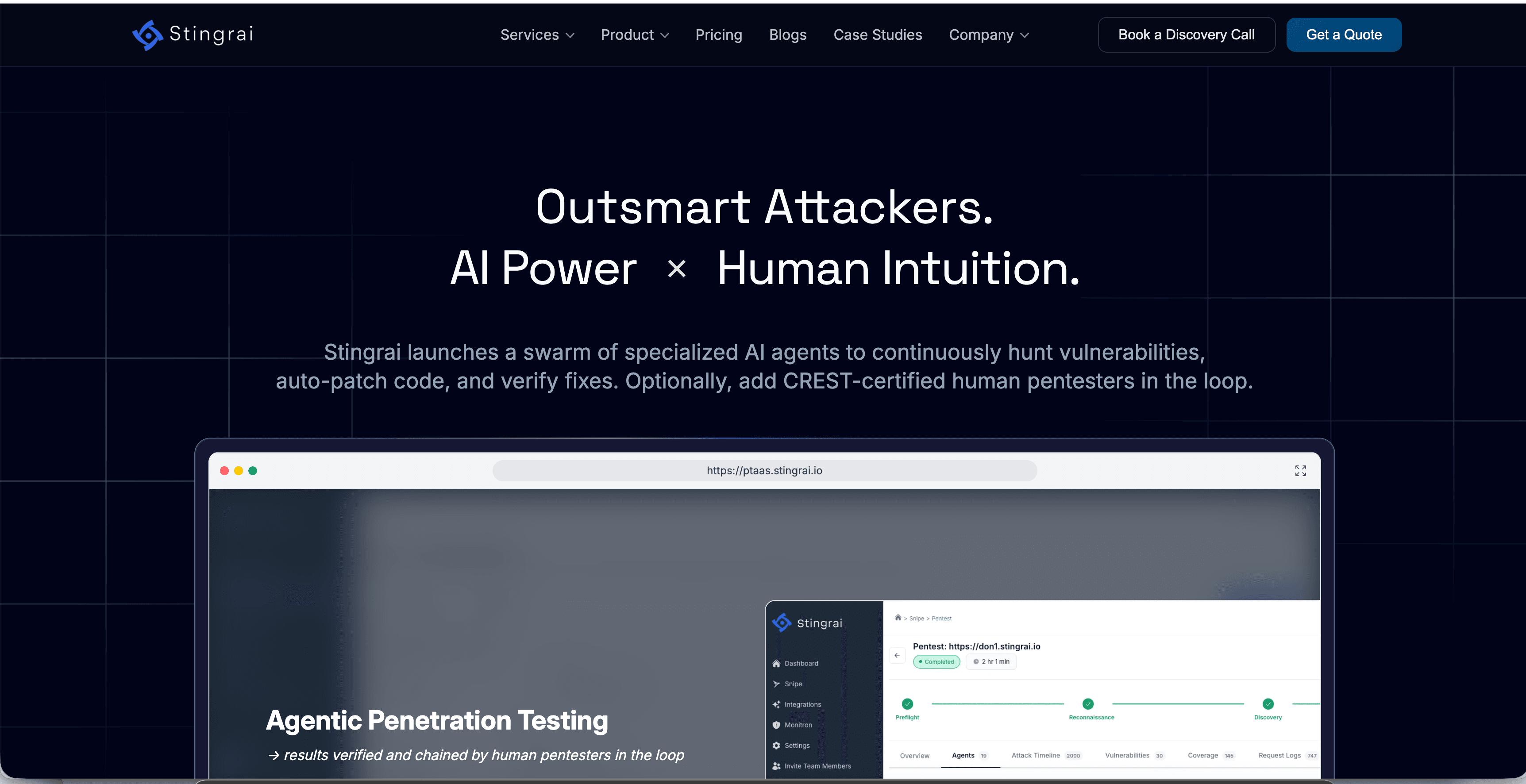
Stingrai is one of the strongest penetration testing companies to consider in 2026 for organizations looking for expert-led manual testing without being locked into a single delivery model. The company offers both one-time and annual penetration tests, as well as continuous penetration testing programs for teams that deploy frequently.
Both engagement models are delivered by the same senior testing team and include audit-ready reporting and remediation evidence.
Stingrai was founded in 2021 and is headquartered in Toronto, Canada, with an additional office in London, UK.
Headquarters
Toronto, Canada, with an office in London, UK
Founded
2021
Delivery Models
One-time and annual penetration tests, plus continuous testing programs
Certifications
OSCE3, OSCP, OSWE, OSED, OSEP, CREST CRT, CISSP, CRTO, GCPN, CRTE, eWPTX. Stingrai Inc is also a CREST-accredited Penetration Testing service provider at the company level.
Published Research
18 CVEs across the research team, including research presented at DEFCON and BSIDES
Reputation
5.0/5.0 across 19 Clutch reviews
Methodology
Manual-first testing aligned with OWASP WSTG, OWASP MASVS, NIST SP 800-115, and MITRE ATT&CK
AI Tooling
Snipe, Stingrai's proprietary autonomous web application security agent
Integrations
Jira, GitHub, Slack
Retesting
Free retesting included
Compliance Support
SOC 2, ISO 27001, HIPAA, PCI DSS 4.0, NIST SP 800-53 / 800-171, DORA, NIS2, and related programs
Pricing
Publicly available packages on Stingrai's pricing page
Flexible engagement models without sacrificing tester quality.
Stingrai supports traditional one-time and annual penetration tests alongside continuous security testing. Organizations can select the model that fits their development cycle while working with the same senior offensive security team.
Strong independent evidence of technical expertise.
The research team has published 18 CVEs and reported vulnerabilities affecting major organizations. Team members have also presented security research at conferences including DEFCON and BSIDES. Stingrai's firm-level CREST accreditation provides an additional procurement and quality-assurance signal beyond individual certifications.
A strong focus on difficult vulnerability classes.
Stingrai's proprietary AI security agent, Snipe, is designed to complement human penetration testers rather than replace them. It focuses on vulnerability classes such as IDOR, broken authorization, access-control weaknesses, and business logic flaws that are frequently missed by conventional automated scanners.
Snipe performs black-box dynamic testing and white-box source-code analysis, can generate remediation pull requests, and can be integrated into development workflows as a security check before vulnerable code is merged. Human pentesters work alongside the platform to validate findings, investigate complex behavior, and develop deeper exploit chains.
Free retesting is included.
Stingrai includes remediation validation as part of its engagements, allowing teams to confirm that vulnerabilities have been properly resolved without requiring a separate testing contract.
Developer-friendly workflows.
Integrations with Jira, GitHub, and Slack allow findings to move directly into engineering workflows instead of remaining isolated inside a final PDF report.
Compliance-ready reporting.
Engagements can provide penetration testing evidence suitable for security and compliance programs including SOC 2, ISO 27001, HIPAA, PCI DSS 4.0, and NIST-based frameworks.
Stingrai is particularly well suited to organizations looking for enterprise-grade penetration testing or PTaaS that combines experienced human pentesters with proprietary AI-assisted testing.
It is especially relevant for SaaS and technology companies, regulated organizations, and development teams that want deeper coverage of authorization and business logic vulnerabilities while also requiring audit-ready evidence for frameworks such as SOC 2, ISO 27001, PCI DSS, and CMMC.
Why They Stand Out: eSentire is best known for its always on security monitoring MDR, and they leverage that expertise in their pentesting engagements. Their security analysts often simulate realistic attacker behaviors gleaned from live threat hunts. For example, they combine automated scanning with rigorous manual techniques to identify vulnerabilities, then correlate findings with threat intelligence to add realism. Clients praise the clarity of their reports actionable remediation guidance is a hallmark of eSentire’s service. With a large, certified team, they have deep experience in regulated sectors like finance and healthcare they list many banking and legal clients. Because they already handle incident response, eSentire’s tests often mimic the same tools and TTPs tactics, techniques, and procedures real attackers use, making the pentests more threat informed.
Key Strengths:
Potential Limitations:
Best For: Established businesses, especially in regulated industries or finance/healthcare, that want a premium, proactive approach. Ideal if you also need ongoing monitoring MDR from the same trusted provider.
Why They Stand Out: The Herjavec Group part of Cyderes is a veteran Canadian security firm with deep enterprise credentials. Its pentest team is large and credentialed, handling very complex, large scale projects for Fortune level clients. They blend industry standard tools with expert manual testing to ensure thorough coverage. As part of Cyderes/Optiv, they draw on global threat intelligence feeds and have partnerships with major technology vendors. Decades of experience give them a solid methodology and a track record in high stakes situations. Herjavec’s engagements often go beyond a one off test, integrating with broader security programs e.g. security audits, red teaming, compliance initiatives. In short, they bring full service capability and credibility; if you have a massive network or critical infrastructure, they can mobilize a large team.
Key Strengths:
Potential Limitations:
Best For: Medium to very large Canadian organizations that need a full service cybersecurity partner. Ideal for enterprises wanting a trusted, full scale consultancy, especially those already using Cyderes/Optiv services.
Why They Stand Out: KPMG’s penetration testing sits within a broad risk advisory service. This means KPMG can leverage global toolsets and methodologies, giving clients a formal and well documented process. Their security team is large and carries top credentials CISSP, CEH, OSCP. KPMG is known for integrating pentests into bigger risk or compliance projects for example, you can combine a pentest with a SOC 2 readiness audit seamlessly. For organizations under heavy regulation, KPMG’s stamp of approval can be reassuring to boards and auditors. They usually emphasize clarity and polish: detailed reports with executive summaries, linked to broader governance topics.
Key Strengths:
Potential Limitations:
Best For: Large Canadian enterprises and highly regulated organizations that need pentesting as part of a comprehensive audit or compliance program. Also for companies that value the cachet of a Big Four consultancy in risk management.
Why They Stand Out: Like KPMG, Deloitte is a Big Four leader with an enormous cybersecurity practice. Deloitte Canada’s team is vast, with a deep bench of specialists across all technologies. They offer full spectrum penetration testing infrastructure, applications, OT, even niche areas like container or blockchain security complemented by automated scans. With their global intel network, Deloitte can handle complex projects e.g. testing a national power grid’s cyber defenses and provide highly polished, professional deliverables. Smaller clients may note that Deloitte’s corporate structure means a thorough and formal process. Large organizations get value in return: for instance, clients can tie a pentest into a full security assessment or audit.
Key Strengths:
Potential Limitations:
Best For: Very large enterprises and government bodies that require deeply comprehensive testing as part of an overall cyber risk strategy. Excellent for critical infrastructure, banks, and any organization that wants the resources of a global consultancy behind their pentest.
Why They Stand Out: Security Compass was born from a team of penetration testers and has grown into a leader in secure software development. Their pentesting focus is heavily on application and API security. What distinguishes them is developer centric service they integrate security testing into your software development lifecycle, often using their own platform SD Elements to manage fixes. Reports are tailored for development teams with clear steps to remediate. Security Compass mixes automation with expert manual testing to simulate sophisticated app attacks often covering broken authentication, business logic flaws, etc.. The company’s culture is very agile and consultative clients note the personalized attention and flexibility.
Key Strengths:
Potential Limitations:
Best For: SMBs and mid market tech firms that need expert application and cloud security testing. Ideal for companies that want security integrated into development dev teams with in house engineering resources.
Why They Stand Out: CGI is a massive IT consulting firm with a full cybersecurity practice. Its pentesting service is one part of a broad portfolio alongside cloud, systems integration, etc.. They apply standard tools and methodologies to uncover vulnerabilities in both network and applications. Their strength lies in scale and reliability: CGI has plenty of certified security pros and a well established process from decades of serving government agencies and financial institutions. For organizations already using CGI for other IT services, it can be convenient to have pentesting under the same contract. CGI also explicitly offers compliance oriented testing e.g. PCI DSS, ISO 27001 as part of larger engagements.
Key Strengths:
Potential Limitations:
Best For: Large enterprises especially those already partnered with CGI that need a full service IT/security provider. Good for ongoing partnerships where pentesting is bundled with other IT/security services.
| Company | Specialization | Best For | Region | Compliance | Ideal Size |
|---|---|---|---|---|---|
| DeepStrike | Full spectrum pentesting, red teaming, continuous PTaaS | Tech driven enterprises & SMBs | Canada global clients | PCI DSS, SOC 2, ISO 27001 | SMB to Enterprise |
| eSentire | Managed Detection & Response, pentesting | Regulated enterprise, finance | Canada North America | SOC 2, HIPAA, PCI DSS | Enterprise |
| Herjavec Cyderes | Network/app pentesting, MSOC | Mid large enterprises | Canada | PCI DSS, HIPAA, SOC 2, ISO | Mid to Large |
| KPMG Canada | Cyber risk advisory, pentesting | Compliance driven orgs | Global | PCI DSS, SOC 2, ISO 27001 | Large |
| Deloitte Canada | Cybersecurity consulting, pentesting | Large enterprise & critical infra | Global | PCI DSS, SOC 2, ISO, NIST etc. | Large |
| Security Compass | Application & cloud security, SDLC | SMBs, dev centric businesses | Canada | PCI DSS, ISO 27001, SOC 2 | SMB, Mid market |
| CGI | IT consulting & pentesting | Enterprise especially existing clients | Global Canada centric | PCI DSS, ISO 27001, SOC 2 | Large |
Buying a pentest service is a critical decision. Here are key tips to avoid common procurement pitfalls:
Choosing the right partner means balancing cost, expertise, and trust. A firm that offers realistic advice not just hype, listens to your requirements, and shows proven methodology is often more valuable in the long run than the lowest bid.
Many organizations make assumptions that can backfire when selecting a pentesting vendor. Common misconceptions include:
The size and risk profile of your organization dictate what kind of pentest partner is right for you:
In summary: Large enterprises should weigh the thoroughness and compliance integration of big consultancies against cost, whereas SMBs and startups may find better fit with focused security boutiques offering hands-on testing. Evaluate not just price but responsiveness and the match to your development cycle and risk profile.
The price varies widely based on scope. Small tests e.g. one web app or network segment might start around C$5,000–$10,000. A comprehensive enterprise assessment multiple apps, infrastructure, or red teaming can run C$20,000 to $50,000 or more. Hourly/daily rates typically range from about $1,000–$2,000 CAD per day. Compliance driven tests PCI, SOC 2, etc. often cost more due to extra reporting. Importantly, don’t choose by price alone a very low quote may imply a superficial scan rather than a rigorous pentest. Always clarify what is included scope of assets, manual effort, retest before signing.
Certifications are a strong indicator of a tester’s skill. A vendor with staff holding recognized certs OSCP, OSCE, SANS GPEN/GWAPT, CISSP, etc. shows commitment to professional standards. Tools matter too scanners, exploit frameworks, but they are tools, not a substitute for experience. For instance, Infosec Institute advises clients to make certain the staff is experienced and highly trained, noting top providers have multiple industry certifications. In short: prioritize expertise and judgment first, and then check what tools the team uses to support that expertise.
Timelines depend on scope. A basic pentest of a single application might take a few days of actual testing plus time for planning and report writing, so total turnaround could be 2–4 weeks. Larger engagements multiple systems, complex networks, red team can span several weeks to a month or more. Scheduling can also be a factor many firms have a lead time to queue your test. Plan ahead: inform vendors of your timelines and ask for a schedule. If you need faster results, discuss limited scope tests e.g. only critical assets or engage a provider with rapid turnaround offerings.
Look for a clear report with at least two layers of detail: 1 An executive summary highlighting critical risks and overall security posture, 2 Detailed technical findings for your engineers. According to experts, pen test reports should document every exploited vulnerability proof of concept, impact and include prioritized remediation recommendations. The report needs to be understandable to non technical stakeholders as well as to IT staff. OffSec emphasizes that the value of a pentest comes from effective report writing: a great report documents all identified vulnerabilities… and provides actionable recommendations for fixing them. Don’t expect just a list of CVE numbers the report should explain how an attacker exploited each flaw and how to stop it.
At minimum, penetration testing is typically done annually to meet common standards e.g. PCI DSS requires at least yearly testing. Many organizations do a full scope pentest once a year. However, more frequent testing is advisable if your risk profile is high or your systems change often. For example, web apps under active development might be tested twice a year, or after major releases. Some companies adopt continuous penetration testing through a platform or retainer model to get near continuous coverage. Also always test after major changes e.g. deploying a new app, cloud migration, or after a security incident. Remember: new vulnerabilities emerge daily, so treat pentesting as an ongoing process. Standards like PCI DSS mandate tests on significant changes, and many security leaders now view continuous validation as the best practice.
A vulnerability assessment is mostly automated scanning for known issues; it generates a list of potential vulnerabilities based on databases of bugs and misconfigurations. In contrast, a penetration test goes further skilled security professionals actively try to exploit those vulnerabilities to determine real impact. As one expert summary puts it: vulnerability testing finds security weaknesses without exploiting them, whereas penetration testing simulates the attacks to detect hidden weaknesses. In short, a vulnerability scan is a useful baseline check, but a penetration test is a hands on verification step often required by auditors to show whether those issues are truly exploitable and what data could be compromised.
Choosing a penetration testing provider is a balance of expertise, fit, and trust. Our analysis shows that no single firm is perfect for every buyer: large consultancies deliver extensive scale and compliance rigor, while boutique specialists offer deeper, hands-on testing and flexibility. The best choice depends on your organization’s size, industry, and security priorities.
Regardless of who you consider, base your decision on the evaluation criteria outlined above: team certifications and skills, manual testing depth, reporting quality, and relevant experience. Verify each vendor’s claims e.g. by asking for client references or sample reports and ensure they align with your use case enterprise vs SMB, compliance needs, continuous vs periodic testing.
Above all, remain objective and procurement minded: a vendor’s reputation, methodology, and demonstrable results matter far more than sales talk. This guide equips you with a clear methodology and vendor profiles, but ultimately the right partner is the one that meets your specific risk management objectives. We encourage you to use this information to make an informed, criteria based decision on the penetration testing provider that best secures your business in 2026 and beyond. If your requirement goes wider than offensive testing into MDR, consulting, and managed security, our list of the top cybersecurity companies in Canada covers the broader local market.
Ready to Strengthen Your Defenses? The threats of 2026 demand more than just awareness; they require readiness. If you're looking to validate your security posture, identify hidden risks, or build a resilient defense strategy, DeepStrike is here to help. Our team of practitioners provides clear, actionable guidance to protect your business. Explore our Penetration Testing Services to see how we can uncover vulnerabilities before attackers do. Drop us a line, we’re always ready to dive in.
About the Author: Mohammed Khalil is a Cybersecurity Architect at DeepStrike, specializing in advanced penetration testing and offensive security operations. With certifications including CISSP, OSCP, and OSWE, he has led numerous red team engagements for Fortune 500 companies, focusing on cloud security, application vulnerabilities, and adversary emulation. His work involves dissecting complex attack chains and developing resilient defense strategies for clients in the finance, healthcare, and technology sectors.

Stay secure with DeepStrike penetration testing services. Reach out for a quote or customized technical proposal today
Contact Us
