August 19, 2026
Updated: August 19, 2026
A buyer's guide to Ukraine's offensive-security market: who specializes in what, which credentials to verify, and how to shortlist.
Abdalla Mohamed
The top penetration testing companies in Ukraine combine deep offensive-security talent with a rare kind of experience: many of these teams have defended live systems under some of the most intense cyber pressure any country has faced. Ukraine's technology sector has produced boutique appsec shops, Web3 audit specialists, and large enterprise consultancies, and this guide profiles the strongest of them alongside honest guidance on how to pick one. Whether you need a one-off web application test, continuous coverage, or a blockchain audit, the shortlist below explains who does what, what credentials to check, and how to match a provider to your risk.
Updated: August 2026. Company details are drawn from each vendor's own site and public profiles; verify current scope and certifications directly before you sign, because service lines change.
Ukraine has been one of Europe's largest software-engineering hubs for two decades, and cybersecurity grew alongside that base. The country hosts active OWASP chapters in Kyiv and Lviv, a strong bug-bounty and CTF culture, and a talent pool certified in the same credentials buyers look for anywhere: OSCP, OSEP, CREST, CISSP, and GPEN.
What sets the market apart in 2026 is operational experience. Since 2022, Ukrainian defenders have worked through sustained, real-world attacks on critical infrastructure, government, and private industry, coordinated in part through the State Service of Special Communications and Information Protection. That pressure has hardened a generation of practitioners who understand how attackers actually behave, not just how they behave in a lab. For a buyer, that translates into testers who think adversarially rather than running a scanner and exporting the results.
Two practical caveats belong up front. First, wartime conditions mean you should confirm a provider's delivery continuity, data-residency arrangements, and where its team physically operates, since many firms now run distributed across Ukraine, Poland, and the wider EU. Second, "based in Ukraine" and "serves Ukrainian companies" are different things. Some of the strongest options for a Ukrainian business are international penetration testing services providers that deliver remotely, which is why the list below includes both.
We prioritized providers with a demonstrable penetration testing practice (not just a security-adjacent IT shop), verifiable certifications, and a public track record. The criteria that matter most when you compare vendors:
The comparison below is a snapshot to orient your shortlist; the profiles that follow add the detail.
| Company | Founded | Base | Best for | Notable credential |
|---|---|---|---|---|
| DeepStrike | 2016 | International (serves Ukraine remotely) | Continuous PTaaS, web/API, cloud, LLM/AI | Human-led PTaaS with retesting |
| Berezha Security Group (BSG) | 2014 | Kyiv | AppSec and social engineering | Core of OWASP Kyiv/Ukraine, OSCP team |
| Iterasec | 2019 | Kyiv / Poland | Web, mobile, IoT, automotive, cloud | OSCP, OSEP, OSWP, CISSP |
| Hacken | 2017 | Ukrainian-founded, global | Web3 and smart-contract audits | HackenProof bug-bounty platform |
| TechMagic | 2014 | Lviv | Web/mobile app and cloud testing | CREST-accredited pentesting |
| Infopulse | 1991 | Kyiv | Enterprise-scale security programs | 2,300+ specialists, global delivery |
| ISSP | 2008 | Kyiv | Critical infrastructure and MSSP | Operates in 20+ countries |
| ESKA | 2015 | Kyiv | Network, wireless, and web testing | SOC and audit alongside pentest |
| H-X Technologies | 2016 | Kyiv | Red/Blue/Purple teaming, Web3 | Full-spectrum offensive services |
| Pakurity | 2014 | Kyiv | SMB and mid-market assessments | Pentest plus vulnerability management |
| N-iX | 2002 | Lviv | Enterprise engineering with security | Large-scale delivery capacity |
DeepStrike is included as our editor's recommendation, and we are transparent about what it is: an international penetration-testing-as-a-service provider that serves Ukrainian and wider European companies remotely, rather than a Ukraine-headquartered firm. We list it first because the delivery model suits how many businesses now want to buy testing.
The core of the offering is human-led, manual testing delivered through a PTaaS platform, so findings surface in real time on a dashboard instead of arriving weeks later in a static PDF. Coverage spans web application and API testing, external and internal network, cloud, mobile, and newer LLM and AI application testing. Engagements include remediation guidance and a retest to confirm fixes hold, and findings map to the compliance frameworks most buyers report against, including SOC 2, ISO 27001, PCI DSS, HIPAA, and GDPR.
Best for: Teams that want continuous or scheduled testing with a modern reporting workflow, and Ukrainian companies that specifically want an independent, outside partner rather than a local firm.
Why it makes our list: Human-led testing delivered through a PTaaS platform with real-time findings, an included retest, and compliance mapping across SOC 2, ISO 27001, PCI DSS, HIPAA, and GDPR. If you want to understand the engagement types before you buy, our guide to the penetration testing methodology breaks them down.
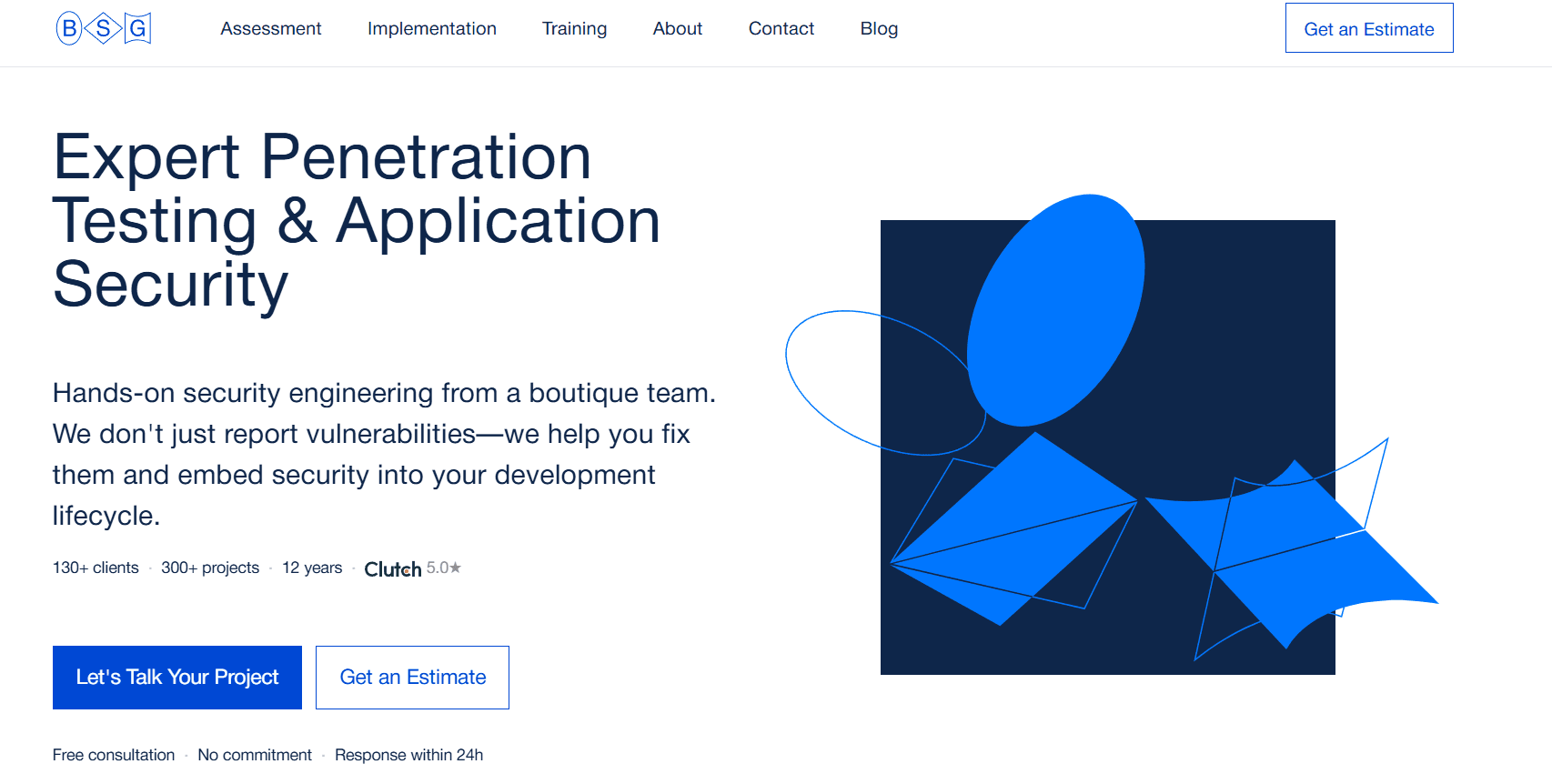
Berezha Security Group is one of Ukraine's most respected pure-play security firms. Founded in 2014 and based in Kyiv, BSG specializes in application security, infrastructure testing, and social engineering, and its people sit at the core of the OWASP Kyiv and OWASP Ukraine communities, with co-founder Vlad Styran a well-known name in the local scene.
The firm reports delivering more than 300 projects for over 130 clients across IT, software, banking, fintech, retail, healthcare, and other sectors.
Best for: Companies that want deep, methodology-driven application and social-engineering testing from a boutique that lives and breathes appsec.
Why it makes our list: Most mid- and senior-level testers are OSCP-certified, the team leans on current OWASP methodologies, and its people sit at the core of the OWASP Kyiv and Ukraine communities — a rare depth of application-security pedigree.
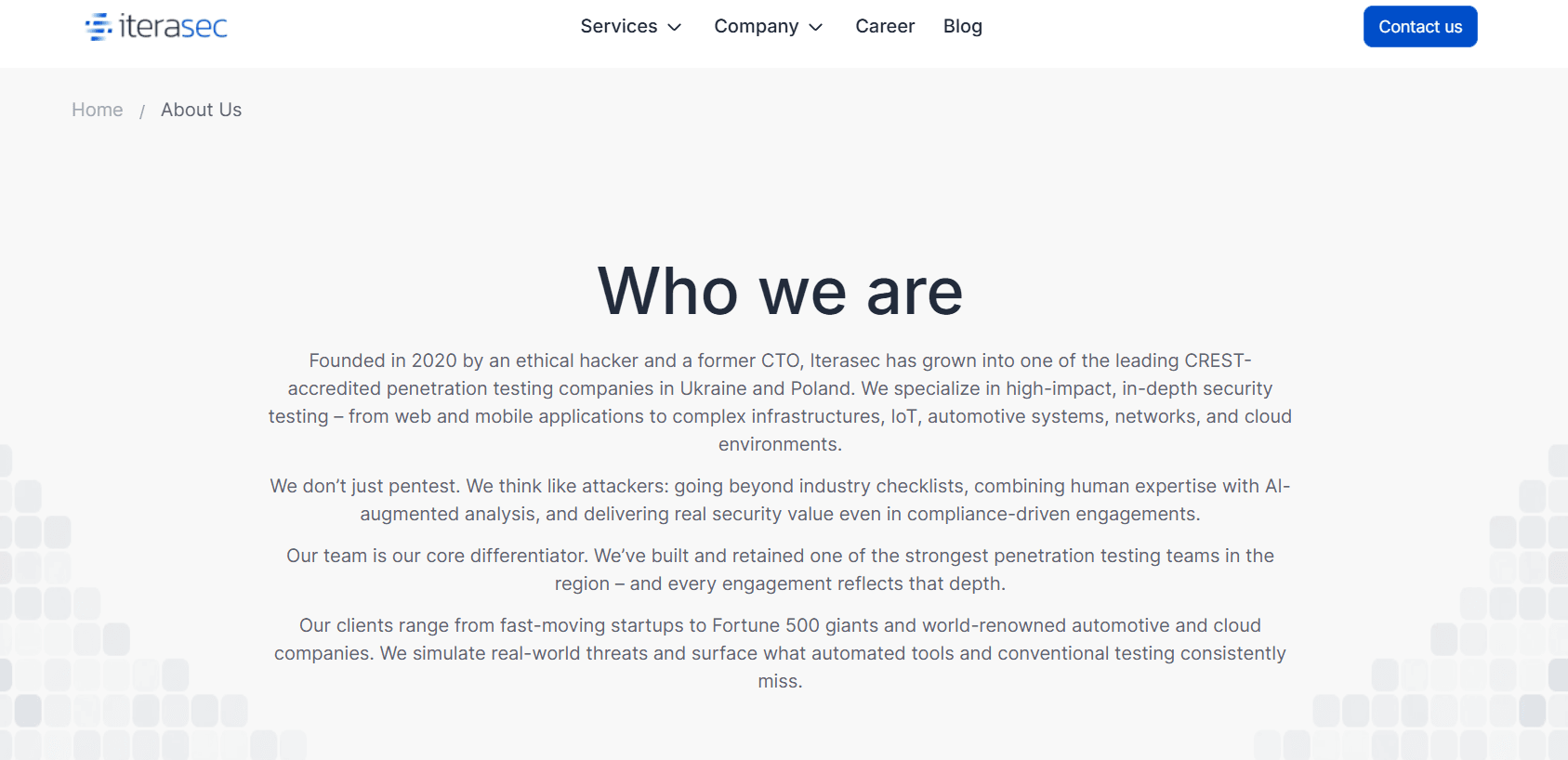
Iterasec is a bootstrapped boutique founded around 2019 by an ethical hacker and a former CTO, operating across Ukraine and Poland. Its focus is high-impact, in-depth testing that stretches beyond the usual web and mobile scope into infrastructure, IoT, automotive systems, networks, and cloud.
Its client base ranges from fast-moving startups to Fortune 500 names and well-known automotive and cloud companies.
Best for: Products with unusual attack surface, such as connected devices, IoT, or vehicle systems, where generalist pentest shops are out of their depth.
Why it makes our list: A broad certification stack, including OSCP, OSWP, OSEP, CISA, CISSP, GPEN, and GWAPT, backing in-depth testing that reaches well beyond standard web and mobile scope.
Hacken is the name to know for Web3. Founded in 2017 by a group of Ukrainian security researchers and white-hat hackers, Hacken specializes in blockchain security: smart-contract audits, penetration testing for crypto and Web3 projects, and vulnerability assessments. It also runs HackenProof, a bug-bounty platform that connects projects with vetted ethical hackers.
Best for: Web3 risk: smart contracts, DeFi protocols, and crypto exchanges, where its specialization is hard to match among Ukrainian firms.
Why it makes our list: A dedicated blockchain-security focus plus HackenProof, its own bug-bounty platform connecting projects with vetted ethical hackers. For traditional web, network, or infrastructure testing, though, one of the appsec-focused firms will be a closer fit — match the specialist to the asset.
TechMagic, launched in 2014 and rooted in Lviv, is a software-engineering company with a dedicated, CREST-accredited penetration testing practice. That accreditation matters: CREST is an independent standard that assesses a provider's methodology and its testers' competence, and it is one of the clearest external signals a buyer can check.
TechMagic's testing covers web and mobile applications, cloud environments, networks, and social engineering, and it frames assessments around continuous-compliance goals so results support audits as well as risk reduction.
Best for: Companies that want a pentest partner who also understands product engineering, and buyers who value an independent accreditation they can verify.
Why it makes our list: CREST accreditation, an independent standard that assesses both methodology and tester competence, is one of the clearest external quality signals a buyer can check.
Infopulse is one of Ukraine's oldest and largest technology firms, founded in 1991 and headquartered in Kyiv with a team of more than 2,300 specialists and offices across Europe and the Americas. Its security practice sits inside a broader end-to-end digital services and advisory business.
Best for: Large organizations that need penetration testing as one component of a wider security and IT program, with the delivery capacity for sustained, multi-workstream engagements.
Why it makes our list: Founded in 1991 with 2,300+ specialists and offices across Europe and the Americas, Infopulse offers enterprise reach that most boutiques cannot. Smaller companies wanting a nimble, testing-only shop may find a specialist a better fit.
ISSP was founded in 2008 and has operated internationally since 2012, serving public- and private-sector clients in more than 20 countries while remaining a recognized leader in Ukraine's own cybersecurity industry. Its portfolio spans managed detection and response, a security operations center, integration, and offensive testing.
Best for: Organizations in regulated or high-stakes sectors that want penetration testing as part of a longer-term security partnership rather than a standalone project.
Why it makes our list: Deep experience with critical infrastructure and government, backed by managed detection and response and a security operations center, so testing sits alongside real monitoring and incident-response muscle.
ESKA is a Kyiv-based cybersecurity company founded in 2015 that offers a practical spread of offensive services: network, web application, wireless, and mobile penetration testing, alongside security audits and SOC coverage. It positions itself for mid-sized organizations that want dependable, standards-based testing without enterprise-scale complexity.
Best for: Mid-sized organizations needing broad coverage across several asset types from one provider, particularly network and wireless assessments that app-focused boutiques treat as secondary.
Why it makes our list: A practical spread of network, web, wireless, and mobile testing alongside security audits and SOC coverage, giving standards-based breadth without enterprise-scale complexity.
H-X Technologies, founded in 2016, delivers a full-spectrum offensive and defensive portfolio, including Red Team, Blue Team, and Purple Team engagements, incident investigation, digital forensics, and security across financial, healthcare, industrial, and blockchain environments. Its Web3 and AI-security lines make it one of the more forward-leaning Ukrainian firms on emerging attack surface.
Best for: Organizations that already have some security operations in place and want to test not just whether they can be breached, but whether they would notice and respond.
Why it makes our list: A full-spectrum Red/Blue/Purple team portfolio plus forensics and Web3/AI-security lines. Purple teaming, where offensive and defensive teams work together to sharpen detection and response, is a maturity step beyond a standard pentest.
Pakurity is a Kyiv boutique founded in 2014 that concentrates on small and mid-market businesses, pairing penetration testing with vulnerability assessment, IT-strategy consulting, and data-protection work. For a smaller company taking security seriously for the first time, that combination is useful: the same partner can test your systems and help you build the program around the findings.
Best for: Small and mid-market businesses taking security seriously for the first time, who want a right-sized engagement and clear, actionable guidance rather than an enterprise-scale program.
Why it makes our list: It pairs penetration testing with vulnerability assessment, IT-strategy consulting, and data-protection work, so one partner can test your systems and help build the program around the findings. Confirm the depth of manual testing on offer before committing.
N-iX is a large, Lviv-founded software-engineering and consulting company (established in 2002) with a cybersecurity practice that includes security assessments and penetration testing within its broader services. Like Infopulse, its strength is scale and the ability to embed security testing inside larger engineering and digital-transformation programs.
Best for: Enterprises already building or modernizing software with an outside partner, who want security testing delivered by the same organization.
Why it makes our list: Founded in 2002, N-iX brings large-scale delivery capacity and the ability to embed security testing inside broader engineering and digital-transformation programs. For a dedicated, testing-first boutique, look to the specialists higher on this list.
Use the shortlist as a starting point, then narrow it with a structured comparison rather than a gut call.
If you are still mapping the basics, our primer on vulnerability assessment and penetration testing (VAPT) explains how scanning and manual testing fit together, and our penetration testing companies in Poland page shows how the same evaluation logic applies in another European market.
The failure modes are the same whether a provider sits in Kyiv or anywhere else, and spotting them early saves you from paying for a report that changes nothing. Watch for these:
None of these are unique to Ukrainian firms; they are the universal tells of a weak engagement. Use them as a checklist against every shortlisted vendor, local or international.
Ukraine offers a deep, battle-tested pool of penetration testing talent, from appsec boutiques like Berezha Security Group and Iterasec to Web3 specialists like Hacken and enterprise consultancies like Infopulse and ISSP. The right choice depends on your asset, your compliance needs, and whether you want a local boutique or an international PTaaS partner delivering remotely. Shortlist two or three from the profiles above, ask each for a sample report and a scoped proposal, and choose on the evidence rather than the marketing.
There is no single best; the right firm depends on what you are testing. For application security, Berezha Security Group and TechMagic are standouts. For Web3 and smart contracts, Hacken specializes. For enterprise-scale programs, Infopulse and ISSP have the reach. For continuous, remotely delivered PTaaS, DeepStrike is our recommendation. Match the specialist to your asset.
Many are, but you should confirm delivery continuity and data handling explicitly. Numerous Ukrainian firms now operate distributed across Ukraine, Poland, and the wider EU, and Ukrainian defenders have extensive real-world experience against active threats. Ask each provider where its team operates and how it guarantees continuity before you sign.
Look for hands-on offensive certifications on the individual testers, such as OSCP, OSEP, and GPEN, and firm-level standards such as CREST accreditation, ISO 27001, and SOC 2. Certifications are a filter, not a guarantee, so pair them with a sample report and references.
Cost depends on scope, asset complexity, and the depth of manual testing, not the country. A focused web-application test is far cheaper than a multi-asset program with red teaming. Get scoped, fixed quotes from two or three providers and compare what is included, especially whether a retest is part of the price.
Both are valid. A local boutique can offer close collaboration and deep regional knowledge; an international PTaaS provider offers independent, remotely delivered testing with a modern reporting workflow and continuous options. Decide based on your asset, your compliance requirements, and how you prefer to work, then compare shortlisted providers on the same criteria.

Stay secure with DeepStrike penetration testing services. Reach out for a quote or customized technical proposal today
Contact Us
