September 22, 2025
Updated: September 14, 2026
NIS2/ISO 27001/GDPR alignment, PTaaS vs one-off tests, pricing, and vendor comparisons.

Mohammed Khalil
Belgium has a mature penetration-testing market that ranges from independent ethical-hacking boutiques to large enterprise security providers, crowdsourced security platforms, and PTaaS models. This update keeps the original article's core structure and companies, while refreshing the NIS2 context, removing unsupported pricing and certification claims, and adding seven important Belgium-based or Belgium-rooted providers that were missing from the previous list.
Updated: August 2026. DeepStrike publishes this guide and remains #1 in this editorial ranking. Competitor profiles are based on publicly verifiable information. Buyers should independently verify the legal entity, assigned testers, scope, accreditation, onsite capability, retesting, data handling, and commercial terms before procurement.
| Rank | Company | Best For | Belgium Fit | Testing Model / Differentiator |
|---|---|---|---|---|
| 1 | DeepStrike | PTaaS, cloud/API, SaaS, developer remediation | Cross-border remote; no Belgian office evidenced | Manual-first PTaaS + retesting |
| 2 | NVISO | High-end offensive security, red team, enterprise testing | Brussels HQ / Belgium-rooted | Pure-play offensive security + SANS-level expertise |
| 3 | Orange Cyberdefense Belgium | Large enterprise, red team, cloud, critical infrastructure | Belgium office and local ethical-hacking team | Enterprise offensive security + threat intelligence |
| 4 | Cresco Cybersecurity | Belgian boutique pentesting and GRC | Belgium-based | Manual pentesting + OWASP/OSSTMM + local delivery |
| 5 | the Security Factory | Fast-start pentesting with live reporting | Belgium-based | Manual testing + AI-assisted coverage + live portal |
| 6 | Spotit | Mid-market/enterprise pentesting plus network and SOC services | Strong Belgian presence | Structured seven-step pentest + remediation support |
| 7 | PwC Belgium | DORA/TIBER/TLPT and regulated enterprise | Belgium cyber team | Managed pentesting + threat-led red/purple team |
| 8 | Deloitte Belgium | Enterprise ethical hacking and multi-year testing programs | Belgium cyber practice | Dedicated pentest team + research/community activity |
| 9 | Nomios Belgium | Cloud, infrastructure, API and enterprise adversary simulation | Belgium office | Broad enterprise pentesting + red team |
| 10 | Intigriti | Crowdsourced testing, bug bounty, VDP and PTaaS | Belgium-founded | 150K+ ethical-hacker community + platform workflow |
| 11 | BOSSIT | Local manual pentesting and aftercare | Bornem, Belgium | PTES methodology + aftercare / PTaaS-style support |
| 12 | Safebyte | Belgian SMEs and practical manual testing | Belgian team | Direct expert access + manual black/grey-box testing |
| 13 | OFEP | Brussels SMEs, enterprise ICT and OT/SCADA testing | Brussels-based | Pentest + API + OT/SCADA + AD security |
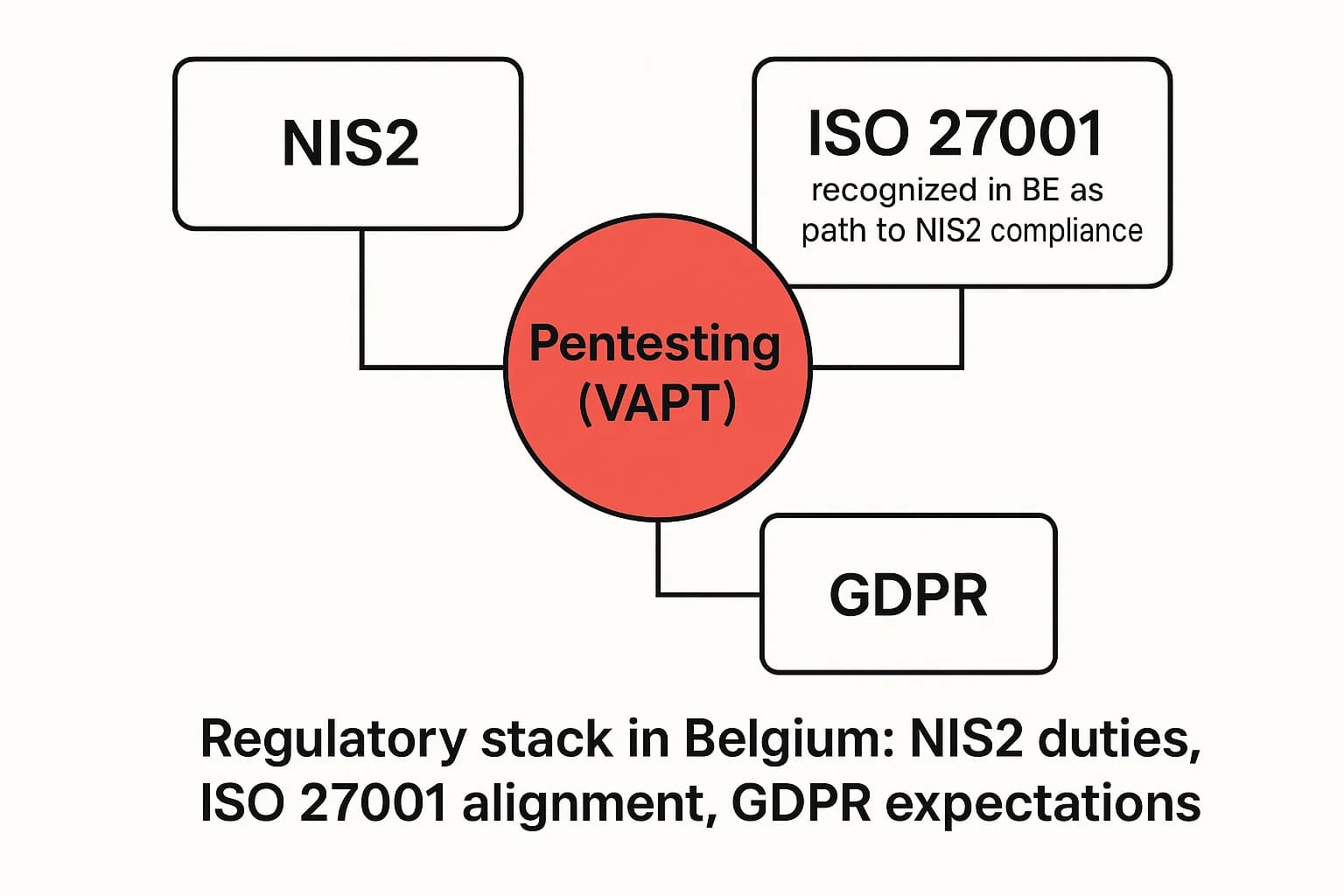
In Belgium's regulated environment, penetration testing is an important security-control validation tool, but the older version of this article overstated the law by saying NIS2, ISO 27001, and GDPR make penetration testing mandatory for all Belgian organizations. Neighbouring teams can also compare penetration testing companies in the Netherlands.
The position is more precise:
Penetration testing supports these obligations by validating whether controls work under realistic attack conditions. It is therefore best described as an important evidence source inside a broader security and compliance program, not as a universal standalone legal requirement.
The ranking favors validated exploitability and technical depth over marketing scale. Providers scored higher where current public evidence showed manual testing, realistic attack simulation, strong application/API/cloud/identity coverage, clear reporting, remediation support, and credible Belgium delivery.
| Evaluation Criterion | Weight |
|---|---|
| Manual penetration-testing depth and exploit validation | 25% |
| Verified provider assurance and tester credentials | 20% |
| Belgium presence, local relevance, or practical EU delivery | 15% |
| Web, API, cloud, identity, infrastructure, mobile, OT and red-team breadth | 15% |
| Reporting, remediation support, and retesting | 10% |
| Delivery model and buyer collaboration | 10% |
| Public evidence, references, and transparency | 5% |
Provider-level assurance and individual credentials are treated separately. ISO certification, CREST company accreditation, CyFun recognition, or other organizational assurance is not the same as practitioner certifications such as OSCP, OSWE, OSEP, GIAC, CISSP, CRTP, or similar credentials.
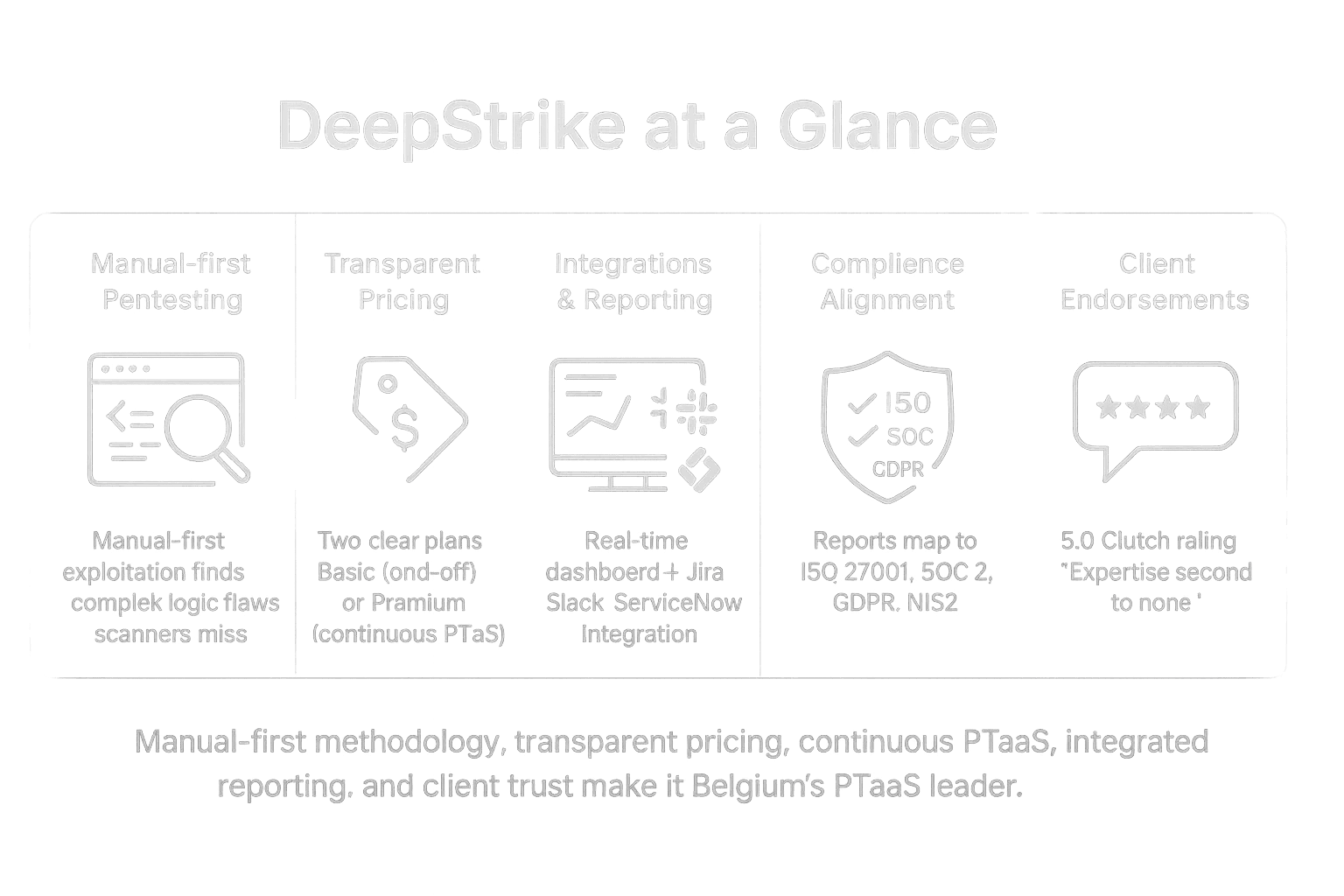
DeepStrike remains #1 in this publisher ranking for Belgian organizations that prioritize manual testing, cloud/API attack-path validation, developer collaboration, continuous testing, and remediation retesting.
DeepStrike offers both one-shot and continuous penetration-testing models. Its strongest differentiator is the combination of manual exploitation with a live dashboard and development-workflow integration.
Potential limitations:
Best For: SaaS, fintech, cloud-native companies, API-heavy platforms, and engineering teams that want continuous remediation feedback.
NVISO is one of the most important Belgian companies missing from the previous version of this article.
Founded in 2013, NVISO describes itself as a pure-play cybersecurity company with more than 150 specialized security experts across Belgium and Germany. Its offensive-security service covers penetration testing and broader ethical-hacking exercises, and the company states that members of its team author SANS cybersecurity and penetration-testing courses.
The company also highlights a structured methodology, interactive client portal, security certifications, and more than 1,000 vulnerabilities discovered annually across engagements.
Testing Depth Model: Manual specialist / advanced offensive security.
Key Strengths:
Potential Limitations:
Best For: Large enterprises, finance, regulated industries, advanced application/infrastructure testing, and red-team-style engagements.
Orange Cyberdefense Belgium remains one of the strongest enterprise options in the country.
Its Belgium penetration-testing offering covers internal infrastructure, external infrastructure, applications, cloud, and red-team assessments. The Belgian team also publishes local material describing privilege escalation, pivoting, OWASP-aligned application assessment, and custom tooling.
The broader Orange Cyberdefense organization combines ethical hacking with threat intelligence, incident response, managed security, and SensePost research and training.
Testing Depth Model: Enterprise manual / threat-led model.
Key Strengths:
Potential Limitations:
Best For: Large enterprise, public sector, telecom, finance, industrial environments, and threat-led testing.
Cresco is a Belgian cybersecurity pure player specializing in penetration testing and GRC.
Its current penetration-testing page states that its methodology is closely aligned with OWASP and OSSTMM and combines manual techniques with automated tooling. Cresco covers servers, endpoints, web applications, wireless networks, internal and external infrastructure, mobile and desktop applications, red teaming, and social engineering.
Cresco also publishes operational scale indicators, including more than 100 pentesting projects per year and more than 5,000 pentesting hours per year on its penetration-testing page.
Testing Depth Model: Manual/hybrid Belgian boutique.
Key Strengths:
Potential Limitations:
Best For: Belgian mid-market and enterprise buyers wanting local ethical hackers and practical remediation guidance.
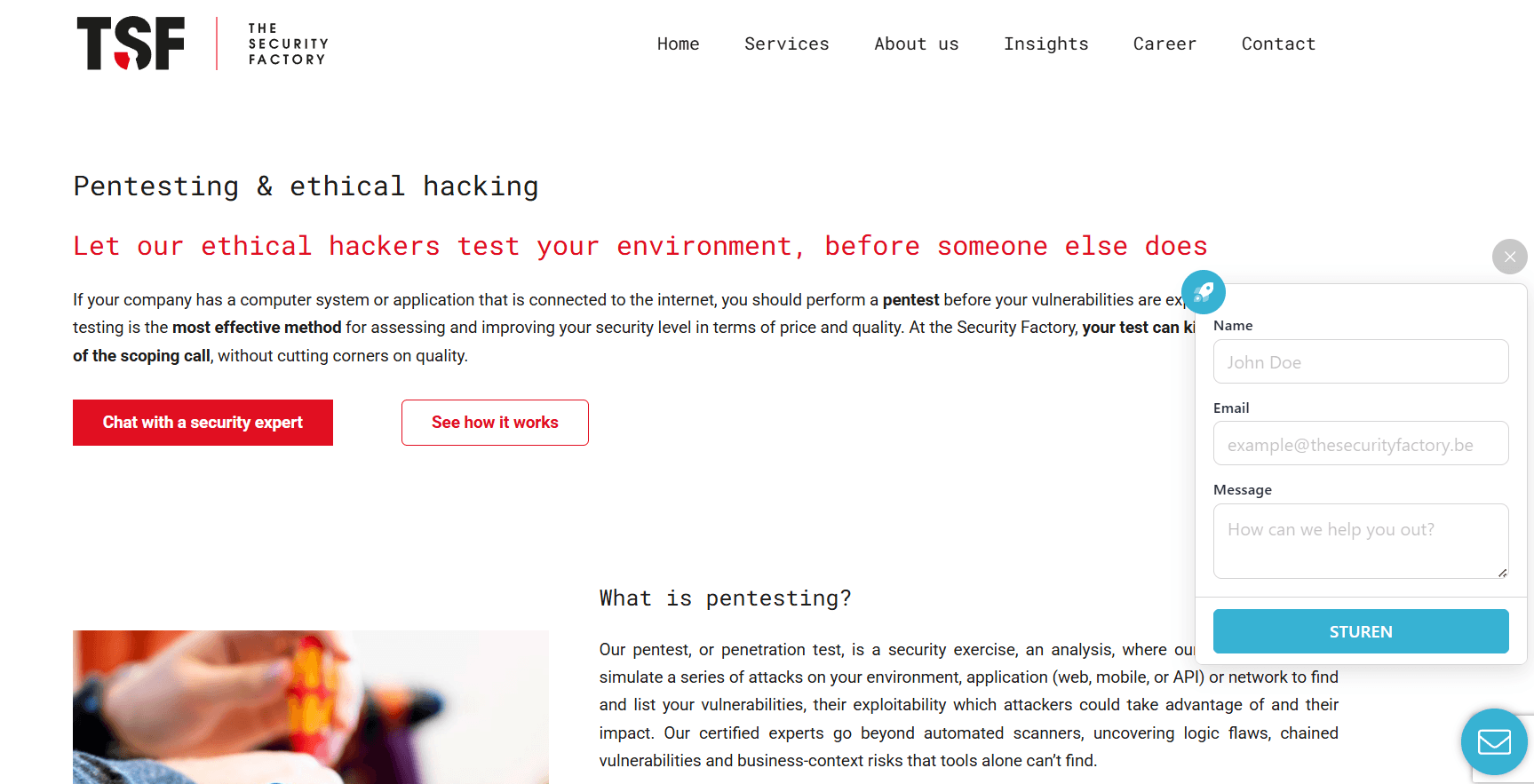
the Security Factory is a Belgian pentesting specialist that was missing from the original article.
Its current service page covers web, mobile, API, network, and infrastructure testing and emphasizes that certified pentesters go beyond automated scanners to find logic flaws, chained vulnerabilities, and business-context risks.
A useful differentiator is its online reporting platform, which lets customers follow findings while testing is still in progress. The company also describes an AI-assisted, expert-validated model where automation expands coverage but human testers validate and exploit findings.
Testing Depth Model: Manual specialist with AI-assisted coverage.
Key Strengths:
Potential Limitations:
Best For: Organizations that want direct tester access, fast-start engagements, live reporting, and manual application/infrastructure testing.
Spotit is a strong Belgian security and networking provider with an established offensive-security team.
Its penetration-testing process is unusually clear in public material:
Spotit also states that its offensive-security team has completed more than 100 pentests and has more than 10 years of experience.
Testing Depth Model: Structured manual/hybrid enterprise model.
Key Strengths:
Potential Limitations:
Best For: Belgian mid-market and enterprise organizations that want pentesting integrated with network and security operations.
PwC Belgium is another major omission from the original list.
Its Belgium cyber practice explicitly offers Managed Penetration Testing Services and Offensive Security, including Threat-Led Penetration Testing aligned with frameworks such as TIBER and DORA, red-team exercises, purple-team engagements, and application-security assessments.
Testing Depth Model: Enterprise assurance / threat-led model.
Key Strengths:
Potential Limitations:
Best For: Banks, insurers, regulated enterprises, and organizations requiring audit-ready offensive-security evidence.
Deloitte Belgium has a dedicated penetration-testing team and public ethical-hacking service material.
The firm describes its approach as realistic attacker simulation and notes that its testers hold recognized industry certifications, participate in security conferences and CTF competitions, and contribute research and open-source work.
Deloitte also offers both packaged penetration testing and multi-year testing programs intended to build a more complete view of an organization's security posture over time.
Testing Depth Model: Enterprise ethical-hacking / multi-year assessment model.
Key Strengths:
Potential Limitations:
Best For: Large Belgian organizations wanting pentesting inside a broader cyber-risk and transformation program.
Nomios remains a relevant Belgium provider and its current public offering is stronger and more detailed than the previous article reflected.
Nomios covers network infrastructure, applications, REST/GraphQL/SOAP APIs, AWS/Azure/GCP cloud environments, IAM and privilege escalation paths, containers and serverless environments, red teaming, physical/social engineering, and detection-response validation.
Testing Depth Model: Enterprise manual/hybrid model.
Key Strengths:
Potential Limitations:
Best For: Large enterprises, cloud-heavy environments, and organizations that want testing integrated with managed security and network expertise.
Intigriti should be included, but it needs to be categorized correctly.
Founded in 2016, Intigriti is a Belgium-founded crowdsourced cybersecurity platform with more than 100 employees and a global community of ethical hackers. It supports vulnerability disclosure programs, bug bounty, and PTaaS-style crowdsourced testing.
Its value comes from scaling access to diverse security researchers and integrating findings into development workflows.
Testing Depth Model: Crowdsourced / platform-led security testing.
Key Strengths:
Potential Limitations:
Best For: SaaS companies, internet-facing products, and organizations that want continuous crowdsourced testing alongside or between traditional pentests.
BOSSIT is a Belgian cybersecurity firm based in Bornem with a clear ethical-hacking and penetration-testing focus.
Its public methodology follows PTES and covers pre-engagement, intelligence gathering, threat modeling, vulnerability analysis, exploitation, post-exploitation, and reporting. BOSSIT offers external, internal, web-application, and wireless pentests, and its current site also describes reporting and aftercare that can extend into a Pentest-as-a-Service-style relationship.
The previous article claimed BOSSIT held “some ISO” certifications and that human error causes 90% of breaches. Those claims were not sufficiently supported in the reviewed public material and have been removed.
Testing Depth Model: Manual Belgian specialist.
Key Strengths:
Potential Limitations:
Best For: Belgian SMEs and mid-market organizations wanting a local manual pentest partner with practical aftercare.
Safebyte is a Belgian cybersecurity provider focused strongly on SMEs and practical hands-on testing.
Its current material emphasizes manual black-box, grey-box, web-application, internal-network, social-engineering, and red-team exercises. Safebyte states that its testers work directly with customers without account-management layers and that findings are translated for both management and IT teams.
Testing Depth Model: Manual local specialist.
Key Strengths:
Potential Limitations:
Best For: Belgian SMEs that want direct contact with ethical hackers and practical remediation advice.
OFEP remains on the list and its current website supports a broader cybersecurity offering than the earlier article described.
Founded in 1981 and based in Brussels, OFEP now lists penetration testing and ethical hacking as part of a wider cybersecurity and ICT portfolio. Current public service listings include web-application and website pentesting, API testing, OT/SCADA testing, infrastructure penetration testing, internal/external vulnerability scanning, and Active Directory security.
Testing Depth Model: Hybrid local ICT/cybersecurity model.
Key Strengths:
Potential Limitations:
Best For: Belgian SMEs and enterprises wanting pentesting alongside broader ICT, OT, and cybersecurity services.
Belgium's NIS2 framework is no longer a future requirement. The law has been in force since 18 October 2024, and 2026 introduced a major supervisory milestone for essential entities.
The Centre for Cybersecurity Belgium stated that by 18 April 2026, essential entities needed to be able to demonstrate effective implementation of cybersecurity risk-management measures and progress through a recognized conformity path.
Depending on the chosen route, organizations may rely on:
Pentesting can contribute evidence to these programs, but the correct claim is that it supports risk validation and assurance. It is not automatically mandatory for every Belgian organization solely because NIS2 applies.
A vulnerability assessment identifies potential weaknesses, often with significant automation.
A penetration test goes further by validating whether weaknesses can actually be exploited, what an attacker can reach, and how multiple issues can be chained.
For Belgian buyers, this distinction matters because a scan-heavy service may satisfy a narrow operational need but will not provide the same assurance as an expert-led pentest that actively tests business logic, authentication, authorization, privilege escalation, and lateral movement.
Traditional pentesting is a point-in-time assessment. PTaaS and continuous-testing models add recurring validation and workflow integration.
| Model | Best For | Strength | Limitation |
|---|---|---|---|
| One-off pentest | Stable environments, audits, annual testing | Deep snapshot of a defined scope | Can age quickly after changes |
| PTaaS / continuous pentest | SaaS, APIs, fast release cycles | Faster feedback and recurring validation | Scope and manual depth vary by provider |
| Crowdsourced security | Internet-facing products and broad discovery | Diverse researcher skillsets | Not always equivalent to a named-team pentest |
| Red team / TLPT | Mature enterprises and regulated sectors | Tests people, process, and detection as well as technology | Higher coordination and cost |
The important procurement question is not the label. Ask exactly how much manual testing is included, who performs it, how findings are validated, and what retesting looks like.
The earlier version of this article quoted €1,200–€1,800 per day as a market norm and warned that anything below €500/day was suspicious. Those claims were too broad to present as Belgium-wide facts and have been removed.
Belgian pricing varies by:
As one concrete public example, Spotit states that most of its penetration tests fall between €5,000 and €15,000, but that is a provider-specific range, not a national benchmark.
The best comparison is a matched statement of work showing manual test days, scope, deliverables, retesting, and exclusions.
Partner with DeepStrike to test your systems before real attackers do. DeepStrike supports Belgian organizations with one-off and continuous penetration testing across applications, APIs, cloud environments, infrastructure, and modern development workflows.
Contact DeepStrike to discuss a scope or request a technical proposal.
Mohammed Khalil is a Cybersecurity Architect at DeepStrike, specializing in advanced penetration testing and offensive security operations. With certifications including CISSP, OSCP, and OSWE, he has led red-team and penetration-testing engagements across cloud, applications, infrastructure, and enterprise environments. His work focuses on realistic attack paths, exploit validation, adversary emulation, and practical remediation.
Technical Review: DeepStrike Offensive Security Team
Last Reviewed: August 2026
Penetration testing is an authorized simulation of cyberattacks against systems, applications, networks, APIs, cloud environments, or other assets. It helps organizations identify exploitable weaknesses before real attackers do.
In Belgium, pentesting can support NIS2 risk-management evidence, CyFun or ISO 27001 assurance programs, DORA testing, PCI DSS requirements, GDPR security assurance, and customer due diligence depending on the organization's scope.
There is no single reliable Belgium-wide price. Cost depends on scope, manual testing effort, environment complexity, tester seniority, reporting, onsite work, and retesting.
Provider-specific public ranges exist, but buyers should compare matched statements of work rather than rely on generic day-rate claims.
This 2026 shortlist includes DeepStrike, NVISO, Orange Cyberdefense Belgium, Cresco Cybersecurity, the Security Factory, Spotit, PwC Belgium, Deloitte Belgium, Nomios Belgium, Intigriti, BOSSIT, Safebyte, and OFEP.
The best choice depends on whether you need a manual boutique, enterprise provider, crowdsourced model, PTaaS, cloud/API depth, OT capability, or regulated TLPT/red-team testing.
Not as a universal standalone requirement for every organization.
Belgium's NIS2 law requires covered entities to implement cybersecurity risk-management measures and, depending on entity type and pathway, demonstrate compliance through CyFun, ISO/IEC 27001, or direct supervision. Pentesting can provide useful evidence that technical controls work, but it is one component of a wider cybersecurity program.
Yes. The Centre for Cybersecurity Belgium recognizes ISO/IEC 27001 as one of the formal conformity pathways under the Belgian NIS2 framework, alongside CyberFundamentals and direct inspection.
That does not mean an ISO 27001 certificate automatically proves every technical control is effective. Pentesting can complement the management-system framework with direct technical validation.
CREST company accreditation and ISO 27001 certification are provider-level assurance signals.
Individual pentester certifications such as OSCP, OSWE, OSEP, CRTP, or GIAC credentials assess practitioner skills. Buyers should look at both the provider's processes and the experience of the actual testers assigned to the engagement.
PTaaS, or Penetration Testing as a Service, uses a platform or recurring service model to make pentesting easier to schedule, track, integrate, and repeat.
A traditional one-time pentest provides a point-in-time snapshot. PTaaS may add live dashboards, recurring testing, direct tester communication, workflow integrations, and ongoing retesting. The exact amount of manual testing varies by provider, so buyers should verify the service definition.
Start with scope and threat model, then compare:
The strongest provider is the one that matches your actual attack surface and gives your team evidence and remediation guidance they can use.

Stay secure with DeepStrike penetration testing services. Reach out for a quote or customized technical proposal today
Contact Us
