- Over 2,200 cyberattacks occur each day worldwide. About one attack every 39 seconds. The United States alone sees roughly 2,000+ cybercrime incidents reported daily. This constant barrage ranges from automated hacking attempts to targeted breaches.
- Most attacks are noise, but a few are serious incidents. Security tools block the vast majority of threats, and only a small fraction of daily attacks succeed. For example, one report analyzed ~16,000 security incidents in a year but only ~5,200 were confirmed data breaches. Separating signal from noise is a major challenge for defenders.
- Attack volumes are surging. Organizations faced a 75% year-over-year increase in weekly attacks by late 2024. Phishing, identity-based hacks, and ransomware-as-a-service RaaS operations have escalated the daily threat count. Early 2025 saw ransomware attacks jump 126% in one quarter in some reports e.g. Check Point research.
- Phishing is the #1 attack type today, flooding inboxes with malicious emails. In 2022, phishing was the most-reported cybercrime with over 300,000 complaints to the FBI. Tech giants like Microsoft intercept billions of email threats 30 billion in one year, or ~82 million per day. Likewise, password attacks hit 50 million per day 579 per second as hackers try to hijack accounts.
- Why it matters: The massive daily volume of attacks means every organization is a target. Even if 99.9% of threats are thwarted, the 0.1% that get through can be disastrous. Understanding these numbers helps businesses justify security investments, combat alert fatigue, and implement strong defenses like multi-factor authentication and Managed Detection and Response to catch the one-in-a-million attack before it causes damage.
How many cyberattacks happen every day? The short answer: a mind-boggling number. Estimates show over 2,200 cyberattacks occur each day worldwide. That’s roughly one attack every 39 seconds ticking by. In the United States, the FBI’s Internet Crime Complaint Center IC3 now logs more than 2,000 cybercrime reports per day. These figures sound alarming and they are but they require context. Does each attack mean a company is getting breached daily? Not exactly. Many of these attacks are like background radiation in cyberspace: constant phishing emails, botnets trying weak passwords, and automated scans looking for any unlocked door online. Most are thwarted silently.
In this article, we’ll break down the real meaning behind the daily cyberattack numbers and why they matter in 2025. You’ll learn what counts as a cyberattack, why different sources report very different numbers, and how to distinguish between the millions of attempted attacks noise and the far fewer successful incidents that cause damage. We’ll also explore the key types of attacks happening every day from ubiquitous phishing waves to surging ransomware and credential-stuffing attacks backed by the latest cybersecurity stats. Most importantly, we’ll translate these big numbers into practical insight: How can organizations defend themselves in an era of relentless cyber bombardment? By the end, you’ll have a clearer picture of the threat landscape and actionable steps to strengthen your security posture against the daily onslaught.
What Is a Cyberattack? Definition & Scope
A cyberattack is any deliberate attempt to compromise the confidentiality, integrity, or availability of a computer system or network. In plain English, it’s when someone, often a criminal hacker, tries to do something malicious with your IT systems or data whether that’s stealing information, installing malware, or knocking services offline. Cyberattacks can take many forms, including:
- Hacking intrusions: Exploiting software vulnerabilities or stolen passwords to break into systems.
- Malware infections: Sending viruses, ransomware, or spyware to infect devices.
- Phishing and social engineering: Tricking users into revealing credentials or clicking malicious links.
- Denial-of-service DoS: Overwhelming a service or network with traffic to cause downtime.
Think of a cyberattack like a burglar trying to break into a house. Sometimes they sneak in through an open window, a vulnerability exploit. Other times they might trick the homeowner into opening the door phishing. And often, they simply go down the street jiggling every door handle to find an unlocked door automated attacks.
What counts as an attack in the daily numbers? It can be as trivial as an automated bot attempting an unsuccessful login, or as serious as a data breach that leaks millions of records. The key is that an attack is an attempt. Whether it succeeds or not moves us into the realm of incidents and breaches which we’ll define next. This broad definition is why the number of cyberattacks per day is so high. We're counting every digital door handle jiggle by attackers across the globe.
Mini-example: Imagine your personal website or blog. Even if it’s not famous, automated bots likely scan it for weaknesses regularly. You might not notice, but your server logs could show dozens of failed login attempts or strange URLs being probed each day. Each of those is a cyberattack in the statistical sense, someone or something trying to find a way in without permission. Most will fail if your site is up-to-date and secured or simply not vulnerable to what they’re probing. But they still count as attacks happening constantly in the background of cyberspace.
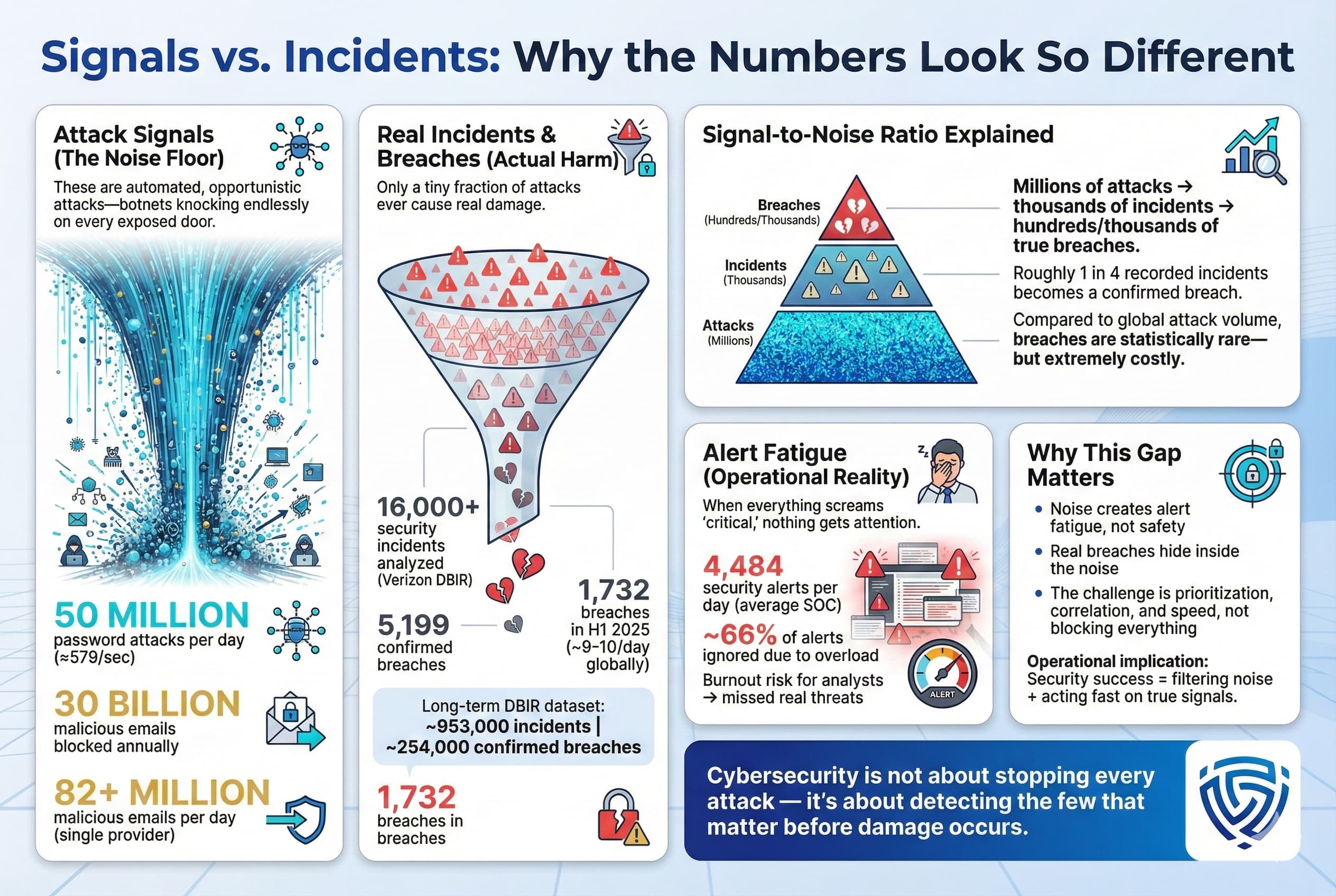
Signals vs Incidents: Why the Numbers Look So Different
One of the first things to clarify is the huge gap between cyberattack signals and actual security incidents or breaches. When you hear 2,200 attacks per day, that includes every malicious knock on the door the vast majority of which are blocked or cause no harm. In contrast, the number of true incidents where an attack results in damage or unauthorized access is much smaller.
- Noise signals: These are the automated, opportunistic attacks hitting networks incessantly. For example, Microsoft observes an average of 50 million password attacks every day, that's 579 per second! largely botnets trying stolen or weak passwords across the internet. Similarly, Microsoft’s email filters intercepted 30 billion email threats in one year. That's over 82 million malicious emails per day being blocked by just one provider’s infrastructure. These numbers are staggering, yet most of these attacks never result in a breach; they’re prevented by security layers, firewalls, spam filters, etc. or they’re aiming at defunct targets. They are attempting the noise floor of the internet.
- Incidents the real harm: These are attacks that succeed when a system is compromised, data is stolen or encrypted, financial fraud is carried out, etc. Incidents are far fewer. For example, Verizon’s authoritative Data Breach Investigations Report DBIR analyzed over 16,000 security incidents and 5,199 confirmed breaches in a year. That’s worldwide across many contributors. The DBIR’s long-term dataset contains ~953,000 incidents recorded over years, of which ~254,000 were confirmed breaches. In other words, only about 1 in 4 recorded incidents were significant enough to count as a data breach, and compared to the millions of attacks launched daily, only a tiny fraction end up as reportable breaches. Another data point the FBI IC3 received ~800,000 cybercrime complaints in 2022 which averages to ~2,190 a day but a large portion of those were online fraud and scams, not system intrusions. The number of major breaches in a year tends to be in the few thousands globally. For instance, one mid-2025 report counted 1,732 data breaches in the first half of 2025 roughly ~9-10 breaches per day if extrapolated.
This discrepancy exists because every breach starts as an attack, but not every attack becomes a breach. Organizations typically repel countless attacks before one slips through. Security teams often talk about the signal-to-noise ratio. There is an overwhelming volume of threat signals noise and it’s a challenge to filter out the false alarms and focus on the real incidents.
Alert Fatigue: A direct consequence of this constant noise is alert fatigue. An average enterprise’s security operations center SOC grapples with thousands of security alerts each day; one study put it at about 4,484 alerts per day on average for SOC teams. No human team can thoroughly investigate that many alerts daily, so analysts get fatigued and start ignoring or missing important alerts. In fact, an estimated two-thirds of daily security alerts are ignored by overwhelmed teams. This is why separating automated background attacks from genuine threats is so critical. If everything is treated as an emergency, defenders burn out and real attacks can slip past unnoticed.
In summary, the phrase X attacks per day usually refers to attempts including mundane probes and blocked exploits whereas the number of meaningful security incidents per day is much lower. When you see wildly different stats from different sources, check whether they mean all attack attempts which will be a huge number or actual breaches / losses a smaller number. Both perspectives are important: the high volume of attempts underscores the constant risk and the need for strong automated defenses, while the incident count highlights the outcomes that really hurt organizations and the need for effective detection and response.
Why Cyberattack Volume Matters in 2025
An Unprecedented Threat Environment
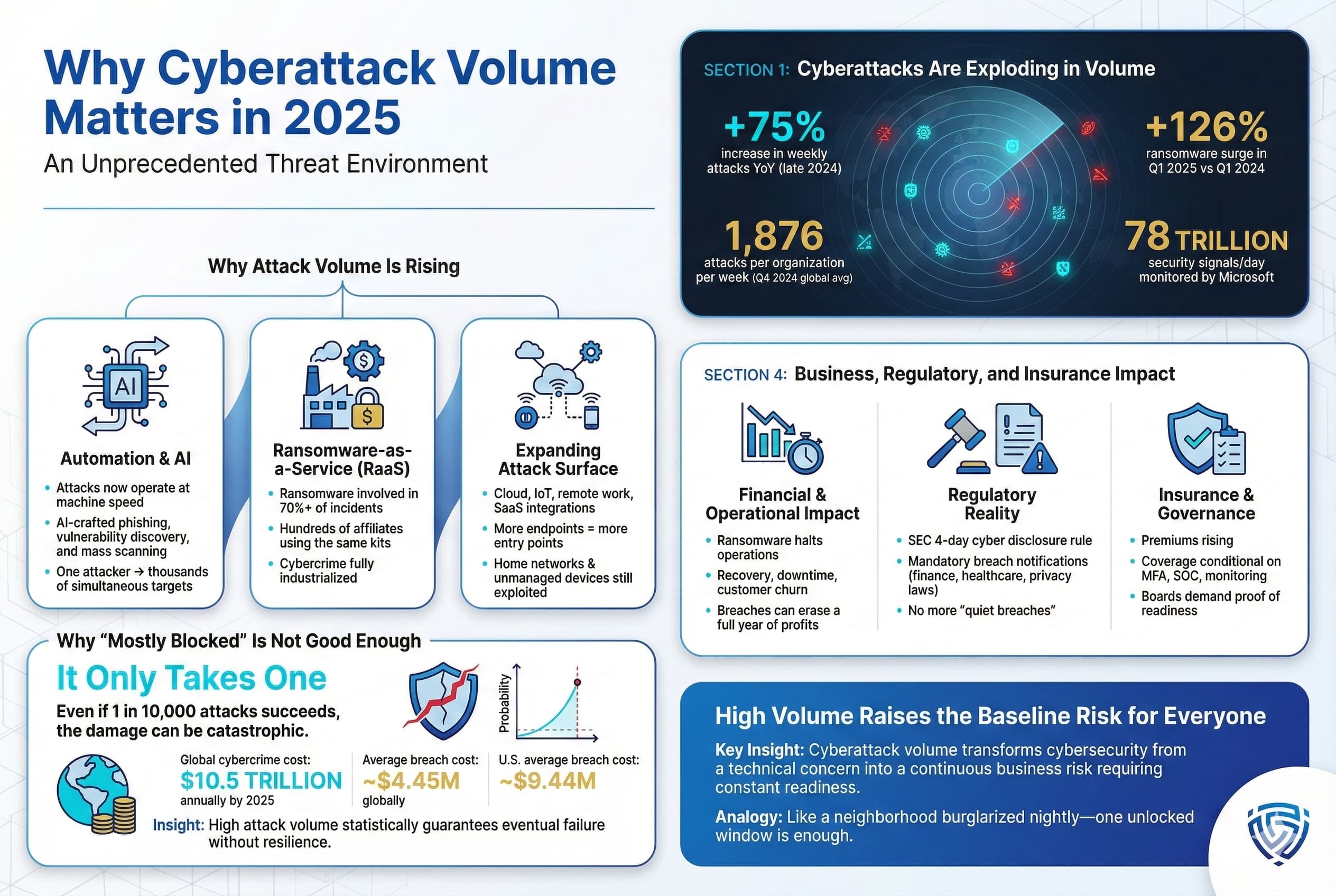
Here in 2025, businesses and individuals face a threat environment that’s busier than ever. The daily cyberattack numbers are not just large, they're growing. Recent data shows that cyberattacks are escalating rapidly year-over-year. In late 2024, organizations saw a 75% increase in weekly attacks compared to the year prior. Check Point Research noted an average of 1,876 attacks per organization per week globally in Q4 2024, a record high. Early 2025 reports continue to show growth, with certain threats like ransomware spiking. One analysis noted ransomware attacks surged 126% in Q1 2025 compared to Q1 2024.
Several factors are driving this explosion in attack volume:
- Automation & AI: Attackers leverage automation just as defenders do. Hacking scripts constantly scan and exploit systems at machine speed. The rise of AI-powered threats is a new concern. For example, generative AI can help bad actors craft more convincing phishing lures or even assist in finding vulnerabilities. The outcome is scale: one hacker can unleash attacks on thousands of targets automatically. Microsoft reports tracking over 78 trillion security signals daily across its systems, an indication of the massive scale of automated malicious activity that modern defenses contend with.
- Ransomware-as-a-Service RaaS: The commercialization of cybercrime means even less-skilled actors can rent or purchase attack tools. Ransomware gangs operate like businesses, offering their malware and services to affiliates. This has led to ransomware being a motive in over 70% of cybersecurity incidents in recent years . With RaaS, the number of attackers increased dramatically; it's not just a few groups; hundreds of affiliates can carry out attacks using the same ransomware kit. The daily frequency of ransomware attempts has climbed accordingly, targeting organizations of all sizes.
- Widening Attack Surface: More of life and business has moved online cloud services, IoT devices, remote work, etc.. This expanded digital footprint means more targets and potential entry points for attackers. The COVID-19 remote work shift, for instance, led to a surge in attacks exploiting home networks and personal devices. In 2025, trends like smart devices and cloud migrations continue to increase the avenues attackers can probe on any given day.
The Cost of Always-Under-Attack
You might wonder: if most attacks are unsuccessful, why worry about the sheer number of them? The answer is because it only takes one successful attack to cause immense damage. The relentless volume of attacks increases the odds that eventually something will slip past defenses. And when they do, the impacts are costly:
- Financial damage: Cybercrime is a multi-trillion-dollar problem. Global cybercrime costs were estimated around $8 -- 9.5 trillion in 2023 and are on track to hit $10.5 trillion annually by 2025. These figures include everything from business losses to restoration costs. At the organizational level, the average cost of a data breach hit $4.45 million in 2023 globally, the highest ever recorded. In the U.S., where regulations and legal damages raise the stakes, the average breach cost is even higher, about $9.44 million per incident. So even if only 1 in 10,000 attacks is successful, that one can potentially cost millions. Frequent attacks also mean companies must spend more on prevention and insurance; it’s an ongoing tax of doing business in the digital age.
- Operational and reputational impact: A successful cyber incident can grind operations to a halt imagine a ransomware attack encrypting your company’s servers. It can also trigger customer distrust, regulatory scrutiny, and legal complications. In 2025, regulatory pressure has ramped up for example, the U.S. Securities and Exchange Commission SEC now requires public companies to disclose material cyber incidents within 4 business days of determining they’re significant, per new rules in effect. Translation: if you get breached, you can’t quietly sweep it under the rug without consequences. Many industries, finance, healthcare, etc. also have breach notification laws. The high frequency of attacks means organizations must assume that at some point an incident will occur and they’ll need to respond transparently and rapidly.
- Cyber insurance and compliance: Insurers and regulators are paying attention to attack frequency. Cyber insurance providers adjust premiums and coverage based on how likely they think you’ll suffer an incident and with daily attacks soaring, insurers demand stronger security controls from policyholders. Meanwhile, industry standards like the NIST Cybersecurity Framework emphasize continuous monitoring and incident response readiness. The heavy volume of daily attacks is often used as evidence in boardrooms and audits to justify why certain security measures, multi-factor authentication, 24/7 monitoring, etc. are not optional but necessary. For instance, boards are asking, Given that X attacks hit us every week, are we adequately staffed and equipped to handle them? If the answer is no, that’s a compliance and governance concern.
In short, the high volume of cyberattacks matters because it raises the baseline risk for everyone. It’s like living in a neighborhood where 100 houses get prowled by burglars every night even if 99 of those houses have alarm systems that scare the burglar off, if yours doesn’t, you’re the one getting robbed. And even if you do have an alarm, the burglar only needs to find one overlooked window to get in. The daily onslaught forces organizations in 2025 to be on constant guard, invest in smarter defenses, and be prepared to react quickly if an incident occurs.
How Daily Cyberattacks Break Down By Type
Not all cyberattacks are created equal; the millions of attacks per day figure is a composite of many different attack types. Let’s break down a few of the most prevalent categories of attacks happening on a daily basis, and how frequently they occur:
Phishing Attacks The Constant Barrage of Scams
Phishing is by far the most common attack vector seen daily. These are those deceptive emails or messages that try to trick people into clicking malicious links, downloading malware, or giving up credentials.
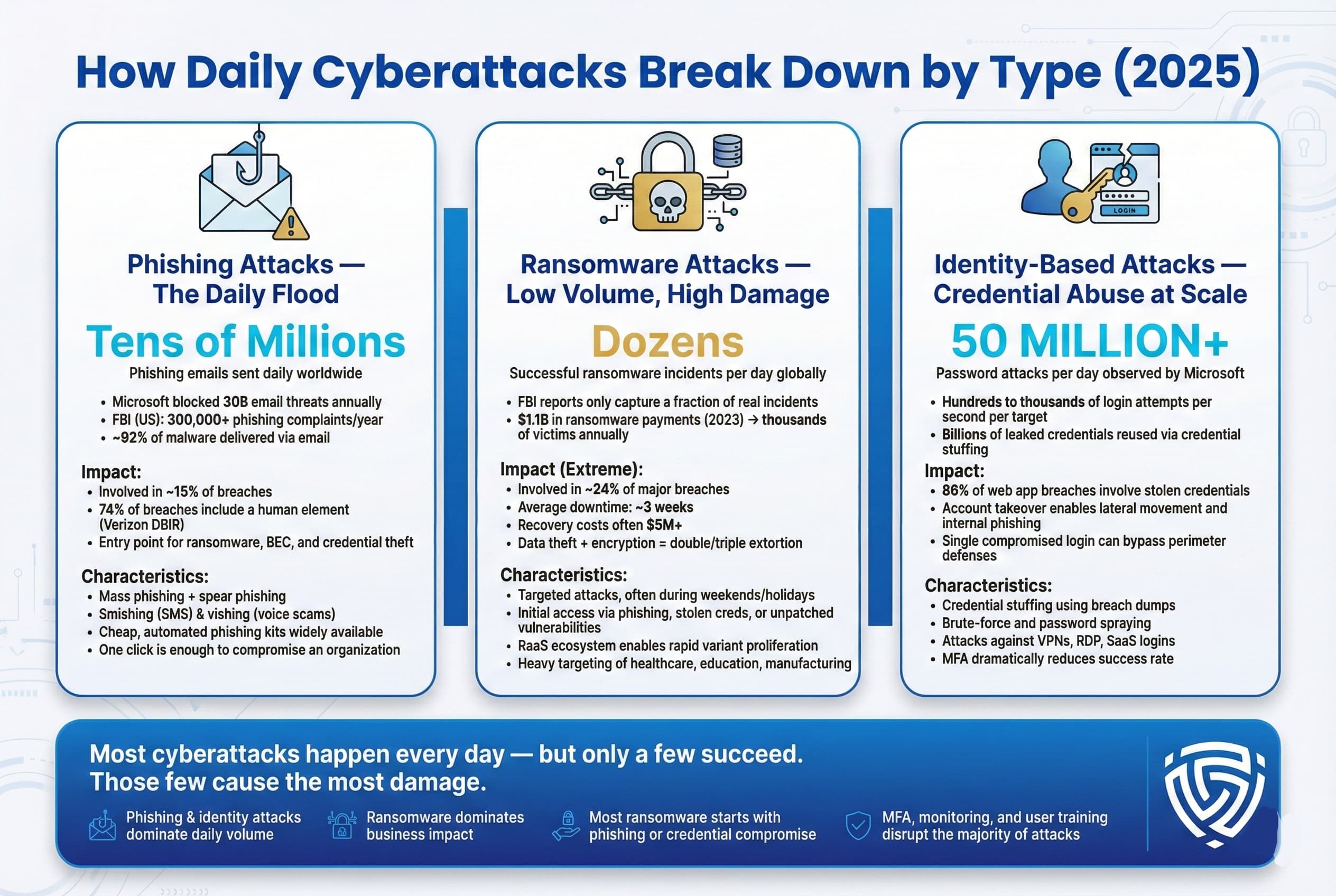
- Volume: The volume of phishing attempts is enormous. In the U.S. for 2022, phishing was the number-one reported cybercrime, with 300,497 complaints logged by the FBI. That's roughly 822 phishing incidents reported per day on average and many more go unreported.fbi.gov. Globally, the number of phishing emails sent daily is in the millions, if not higher. Microsoft’s security report noted they thwarted 30 billion email threats in a year, much of which were phishing or malware-laden emails. That suggests tens of millions of malicious emails are flying around every single day, just from what one company’s filters catch. It’s safe to say phishing attacks occur daily in the high millions worldwide.
- Impact: Phishing is prevalent because it works. It only takes one employee falling for one scam email out of thousands to potentially let attackers in. According to Verizon’s DBIR, 74% of breaches involve the human element, and phishing is a major piece of that; it's one of the top initial breach vectors, responsible for ~15% of breaches in their data. We’ve seen everything from business email compromise scams that trick finance departments into wiring money, to phishing that delivers ransomware payloads. Every day, some percentage of users will click a bad link which is why phishing remains a daily threat companies have to train for and guard against.
- Characteristics: Modern phishing has evolved. Attackers send out mass phishing millions of generic Your account is compromised, click here to fix it emails and more targeted spear-phishing a few highly tailored emails to a specific individual or company. Both happen daily. There are also smishing phishing via SMS texts and vishing voice call scams which piggyback on the same social engineering principles. The daily attack stats usually lump these together as phishing attempts. And alarmingly, phishing kits are cheap and widely available on the dark web, so literally anyone with an internet connection can join the fray of sending malicious emails contributing to the deluge.
About 92% of malware is delivered via email. That means if you’re seeing a malware outbreak or ransomware incident, odds are it started with someone opening a bad email. This underscores why on any given day, your email inbox is the front line of cyber defense.
Ransomware Attacks Fewer in Number, Greater in Consequence
Ransomware is the type of attack where hackers infiltrate a system, encrypt all the data, and demand a ransom payment often in cryptocurrency to unlock it. Unlike phishing, which happens everywhere incessantly, ransomware attacks tend to be more targeted but they’ve become alarmingly frequent in recent years, sometimes measured in attacks per day or week globally.
- Volume: It’s tricky to pin down exactly how many ransomware attacks occur per day, because many unreported victims might quietly pay and not disclose it. However, some figures give a sense of scale. The FBI’s IC3 report for 2022 listed 2,385 ransomware incidents reported that year roughly 6.5 per day but this is likely a severe undercount of actual occurrences. Security firms have estimated higher rates; for example, one mid-2021 report noted 121 ransomware incidents were reported in just the first half of 2021, a big jump from the previous year. And ransomware has only grown since then. In 2023, global ransomware attacks were occurring on the order of dozens per day that hit organizations, when accounting for all the different ransomware gangs operating.To illustrate, by late 2023 there were so many ransomware actors that on a single day, multiple companies might be hit around the world: one hospital in the morning, a school in the afternoon, a small business overnight. Some cybersecurity venture predictions infamously claimed that by 2021, a business will be attacked by ransomware every 11 seconds. While that specific stat is hard to verify, it captures the perception of ubiquity. More concrete: Chainalysis recorded $1.1 billion in ransomware payments in 2023 given that only a fraction of victims pay, you can infer there were likely thousands of ransomware incidents that year globally. It’s not millions per day like phishing, but it’s enough that basically each day, multiple organizations suffer a ransomware breach somewhere.
- Impact: Ransomware attacks are disproportionately damaging relative to their share of attacks. They might be, say, <1% of daily cyberattack attempts, but they cause a huge chunk of the pain. Ransomware was involved in 24% of breaches analyzed in Verizon’s report and is the number one threat to critical infrastructure per the FBI in 2024. A single successful ransomware attack can disrupt operations for days or weeks, incur recovery costs in the millions, and possibly lead to data leaks. Many ransomware gangs now steal data before encrypting, to double-extort victims. The average downtime from a ransomware incident is around 3 weeks for full recovery, and even after paying a ransom, many organizations only get ~65% of their data restored on average.
- Trends: In 2025, ransomware groups are exploiting stolen credentials and zero-day vulnerabilities to gain initial access. They often strike on weekends or holidays when IT staff are thinly spread. The RaaS model means new variants pop up often. We also see sector-specific waves e.g. a surge of attacks on healthcare, then on education, etc. Healthcare has been particularly hammered, with a 128% increase in attacks on the sector in 2023 by one measure, and about 66% of healthcare orgs hit in the past year. So on any given day, the type of ransomware attack might vary, but the threat is persistent. Security experts often wake up to news of another city government hit by ransomware today or a major manufacturer forced offline by ransomware. It’s a drumbeat of incidents that has kept ransomware at the top of global security priorities.
Identity-Based Attacks Credential Stuffing & Brute Force at Scale
Another huge portion of daily attacks comes from attempts to compromise user accounts, often by exploiting weak or stolen credentials. These include credential stuffing using lists of stolen usernames/passwords to try to log in to various services and brute-force attacks automatically guessing passwords or PINs.
- Volume: As mentioned earlier, Microsoft observed an average of 50 million password attack attempts per day across its platforms. That figure alone shows how aggressive attackers are in targeting logins. These attacks are often measured in attacks per second. For instance, 579 attacks per second was Microsoft’s stat, and other sources have similar numbers. One report from 2023 indicated that one particular botnet was attempting an average of 1,300 login attacks per second on various web services. If you multiply that out, that’s over 100 million attempts in a day by one botnet! Every website or system that requires login from banking to email to VPNs will see a baseline of constant unauthorized login attempts. A lot of this is fueled by the billions of stolen credentials floating around on the dark web from past breaches. Attackers don’t need to guess your password if you happen to reuse a password that has already leaked; they just try the known logins on as many sites as possible, a practice called credential stuffing. It’s why we often get those emails like We detected an unusual login attempt on your account that’s likely some bot trying a leaked password.
- Impact: Identity attacks can lead to account takeovers, which are often the first step in a larger breach. For example, if an attacker compromises an employee’s Microsoft 365 login via brute force or by spraying common passwords, they could then send internal phishing emails or move laterally through a company’s cloud services. A single successful login can sometimes bypass a lot of other security measures since logging in with valid credentials isn’t malicious in the system’s eyes. That’s why multi-factor authentication MFA is critical; it renders these stolen password attacks largely ineffective. Without MFA, a significant percentage of accounts will inevitably fall to daily brute-force attacks. There’s a statistic from Verizon’s DBIR 86% of web application breaches involve stolen credentials. Attackers know it’s often easier to log in as a valid user if they crack the password than to exploit a technical vulnerability.
- Examples: A common real-world pattern is when a major breach occurs because of an unprotected remote access interface. For instance, many ransomware incidents start with attackers brute-forcing an RDP Remote Desktop Protocol server that was exposed to the internet with only a password. With automated tools, they might try millions of password combos until one works. That’s an attack that might have taken days or weeks of constant attempts all of which count toward those daily attack stats but it only needed to succeed once. Every day, there are countless bots doing this across the internet. Another example is credential stuffing against consumer websites: let’s say a gaming website gets 100,000 login attempts in a day, but only 1,000 of those are legitimate users and the other 99,000 are bots cycling through username/password lists. The site’s security must distinguish and block those 99,000 malicious attempts. Many will be blocked by rate-limit rules or known bad IP lists, but some may slip through, and even a 0.1% success rate means 99 compromised accounts that day.
In summary, daily cyberattacks consist largely of phishing emails, credential attacks, and exploit attempts with ransomware often the outcome of successful phishing or exploits. There are also plenty of other categories e.g. DDoS attacks somebody is getting hit with denial-of-service floods on any given day as well, supply chain attacks, etc. But phishing, identity attacks, and ransomware are three big ones to understand, since they dominate the threat landscape in terms of frequency and impact in 2025.
What These Numbers Mean for U.S. Businesses
Cyberattacks aren’t just an internet problem, they translate into very real challenges for businesses, especially in the United States, which happens to be one of the top targets of cyber criminals owing to the large economy and wealth. Here’s what the daily barrage of cyberattacks implies for organizations:
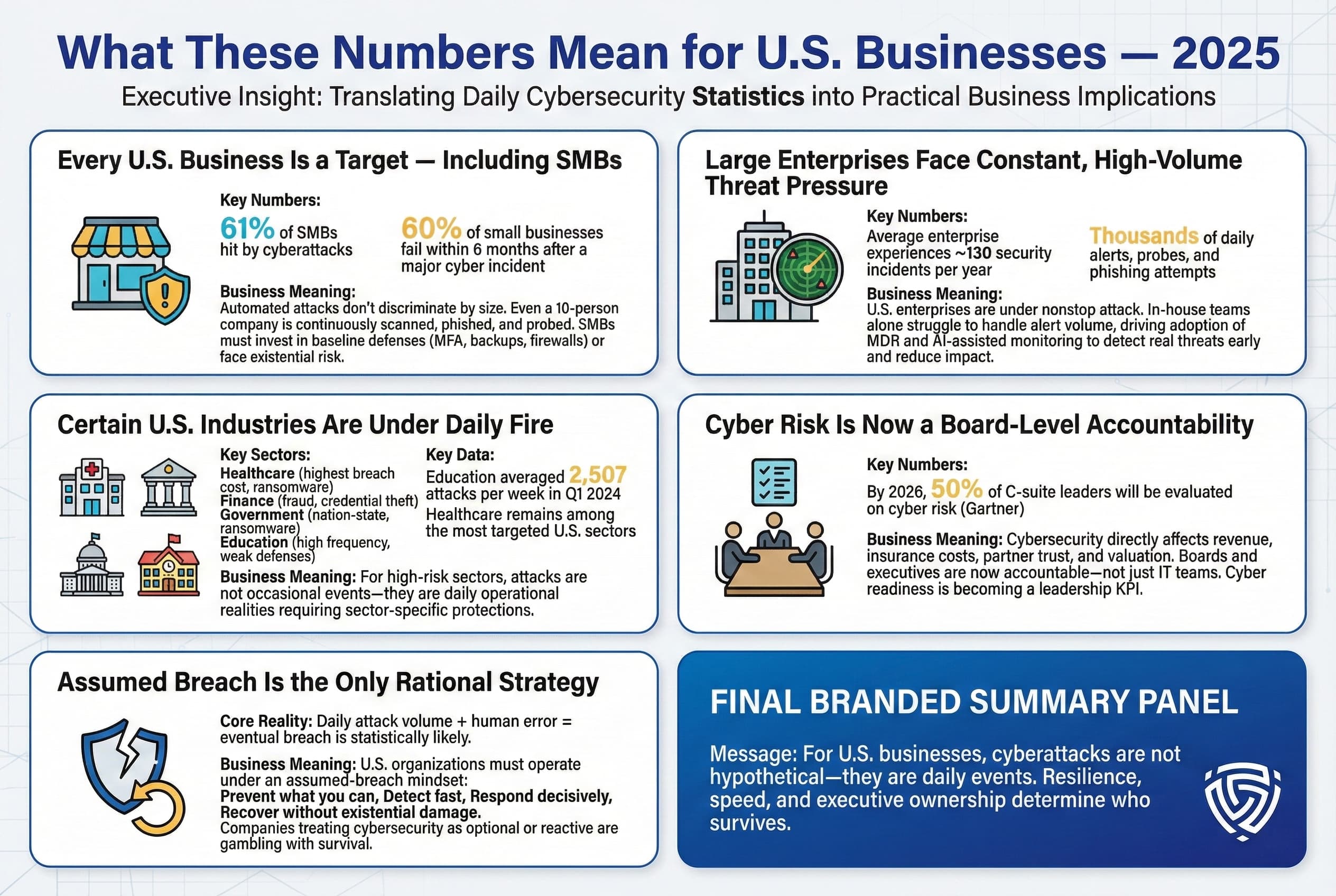
- Every business is a target, regardless of size. Small and mid-sized SMBs should not assume hackers only go after big companies. In fact, SMBs are highly targeted and estimated 61% of SMBs were hit by cyber attacks in 2023. Many attacks are automated and indiscriminate, so even a 10-person company will have bots phishing its employees or scanning its website. The consequence is that even small businesses need to invest in baseline security firewalls, backups, strong passwords with MFA, etc.. Unfortunately, SMBs also suffer the worst outcomes; around 60% of small businesses go out of business within six months of a major cyber attack; various industry stats support this grim figure. The high volume of attacks ensures that some small businesses somewhere in the U.S. are getting breached each day often because they have weaker defenses. It’s a call to action for SMBs to take cybersecurity seriously as a core business risk.
- Large organizations face quantity and quality attacks. Enterprises not only deal with massive volumes of background attacks tens of thousands of probes/alerts per day, but also targeted attacks by sophisticated adversaries e.g. nation-state hackers or organized crime groups. For a Fortune 500 company, it’s virtually guaranteed that right now, as you read this, someone malicious is interacting with their network in some way, maybe a phishing email in an inbox, maybe a web exploit attempt being blocked, maybe an attacker quietly testing a stolen VPN credential. Large U.S. companies often have dedicated Security Operations Centers and still struggle; many are now outsourcing to Managed Detection and Response MDR providers because handling the flood of daily security events in-house is daunting. The idea is to let specialists monitor 24/7, use advanced tools like AI-driven analysis to weed out false positives, and only alert the company when there’s a verified threat. For example, MDR services boast that they can reduce breach impact significantly by catching intrusions early which is increasingly attractive when you realize an average enterprise experiences 130 security breaches per year per one study. That’s a breach every 2-3 days on average! No wonder enterprises are blending tech and services to cope.
- Key industries under fire: U.S. businesses in certain sectors see outsized attack volumes. Financial services always has a target on its back money motivator for attackers, healthcare is heavily attacked both for data like medical records and because hospital downtime can be life-threatening, making them ransomware targets, government agencies and critical infrastructure face nation-state and ransomware actors, and education deals with lots of opportunistic attacks schools often have weaker security. According to data, the healthcare sector is experiencing the highest increase in breach costs and was one of the most targeted sectors in 2023. In Q1 2024, the education sector averaged 2,507 attacks per week around 358 per day, showing how concentrated attacks can be on certain industries. For U.S. organizations in these high-risk sectors, the daily attack stats aren’t abstract; they translate into daily phishing attempts against staff, constant pressure on legacy systems, and the need for sector-specific protections like specialty backup systems for hospitals, or extra fraud monitoring in finance.
- Material risk and board attention: The frequency of attacks has elevated cyber risk to a top-tier business issue. It’s not just an IT problem. Boards and executives are now expected to know about their organization’s cyber readiness. Gartner predicts that by 2026, 50% of C-suite executives will have cybersecurity risk as a part of their performance evaluations meaning leadership is directly accountable. This is happening because regulators and investors realize cyberattacks happen every day and can materially impact business performance. A factory burned down by a fire or knocked offline by a cyberattack either way the company loses money; the latter is just more likely in today’s world. We even see cyber risk impacting cyber insurance premiums and contracts with partners. Businesses now often need to show evidence of security controls to win deals or get insured. All of this is the result of living in an age where on any given day, multiple companies are getting hit. It’s a statistical inevitability that sooner or later, it could be your company.
In essence, the relentless drumbeat of daily attacks means U.S. businesses must adopt an assumed breach mentality. Assume you are being targeted because you likely are, continuously. Assume that at some point, an attack will succeed. From there, plan and invest accordingly: put controls in place to prevent as much as you can, and have robust detection/response for when something slips through. Those companies that treat cybersecurity as optional or purely reactive are playing Russian roulette with their future, given the odds we’re seeing in 2025.
Real-World Examples of the Daily Threat Reality
Let’s look at a few scenarios that illustrate how the high frequency of attacks plays out in practice for organizations:
Example 1: The Never-Ending Phish Mid-Sized Company
A 500-employee manufacturing firm in the Midwest receives upwards of 5,000 inbound emails a day, and about 100 of those on average are phishing or malware-bearing messages. Their email security filters block the vast majority say 98 out of those 100 never reach inboxes. But about 2 phishing emails still get through to employees every day, perhaps a particularly well-crafted spoof that evaded basic filters. On most days, nobody falls for them. Employees have taken security awareness training and are cautious. However, one Tuesday an employee in accounting clicks a link in what looked like a SharePoint file share email from her boss. In reality it was a phishing email that slipped past filters and it asked her to log in to view a document. She unknowingly gave away her Microsoft 365 credentials. Within an hour, attackers used her account to send more phishing emails internally now coming from a trusted employee’s real address and tried to pivot to the company’s financial systems. Fortunately, the company had an MDR service monitoring activity. The unusual access patterns triggered an alert; the MDR analysts spotted the account takeover and remotely triggered a password reset and account lockdown. They contained the incident before any money was stolen or further damage done. This example shows both the pervasive threat of dozens of phishing attempts daily and a positive outcome thanks to vigilant detection. It also highlights that even one click out of thousands of emails can lead to a serious incident, which justifies the layered defenses and constant monitoring.
Example 2: Ransomware One-Two Punch City Government
A small city government IT department is fighting a war on two fronts: they get barraged with generic cyberattacks, daily malware-laden emails, random port scans on their network, etc., and they know they’re a lucrative target for ransomware gangs who have hit many municipalities recently. On an average day, their firewall logs show hundreds of port scan attempts from the internet bots checking if any of the city’s servers have an open door like an old database port or RDP. Their spam filter blocks about 50 phishing emails per day targeting city employees. Most days, that’s enough. But one day in 2025, a zero-day exploit an attack leveraging a previously unknown vulnerability is used by a ransomware group to compromise the city’s unpatched VPN server. There were no alerts the attack was stealthy and not caught by antivirus or firewalls because it was a new technique. The attackers quietly gained access, and a week later after exploring the network, they detonated ransomware across multiple city systems overnight. The city woke up to find police department reports, utility billing systems, and public records all encrypted with a ransom note. This scenario underscores a painful truth: despite blocking thousands of attacks routinely, a single advanced attack that wasn’t stopped in time caused a crisis. For weeks, city services were disrupted. Incident responders from federal agencies had to assist. The mean time to detect the breach was unfortunately long; the attackers had dwelled for days. This example highlights the importance of proactive threat hunting and timely patching in addition to just blocking known threats. It also shows how the daily noise can mask a lethal signal; with so much going on, the city’s IT missed the early signs of an unusual intrusion. The aftermath led to the city investing in a full-time SOC and better network monitoring.
Example 3: Credential Stuffing Chaos Online Retailer
An online retail company with a popular e-commerce site experiences constant login attempts to customer accounts. On a daily basis, they observe something like 200,000 login attempts, but they have only 50,000 legitimate users logging in. This means three-quarters of login attempts are malicious bots trying stolen credentials credential stuffing. The company has implemented multi-factor authentication for administrative accounts, but not for regular customer logins to avoid user friction. One day, a spike in account takeover complaints occurs dozens of customers say their accounts were accessed and fraudulent orders placed. Investigations reveal that a credential list from a recent breach of some other service was used; unfortunately, many customers reused the same email/password on this retail site. The bots cycling through login attempts hit the jackpot for a few hundred accounts that reused credentials. The daily volley of login attacks found its mark. In response, the retailer had to trigger password resets for thousands of users and implement tighter login throttling and anomaly detection e.g., if an IP tries 100 logins in a minute, it gets blocked. This example shows how even when attacks are high-volume and non-targeted, they can hurt if protections aren’t layered. It also demonstrates why mean time to respond MTTR matters the faster the company detected the credential stuffing success and took action locking accounts, etc., the less fraud occurred. For companies with consumer accounts, this is a daily concern: How many fraudulent logins did we block today? Did any succeed? Those metrics are discussed in the boardroom now, and security teams often share stats like we blocked X thousand attacks this week, no confirmed breaches as a measure of success and to stress the importance of their ongoing vigilance.
Comparison Table: Noise vs Successful Attacks
To put daily cyberattack numbers in perspective, the table below compares approximate volumes of malicious activity and the noise with the much smaller numbers of actual breaches or incidents that result. This highlights the funnel effect many attacks at the top, few incidents at the bottom:
| Metric | Estimated Volume Daily | Notes/Source |
|---|
| All Cyberattack Attempts Global | ~2,200+ per day worldwide | ≈1 attack every 39 seconds globally. Broad estimate including all types of malicious attempts. Often cited from UMD research and 2024 stats. |
| Malicious Emails Blocked | Tens of millions per day | e.g. ~82 million email threats blocked daily by Microsoft in 2021. ~30B/year shows the scale of phishing/spam noise. |
| Password Attack Attempts | ~50 million per day | ~579 attempts per second targeting accounts. Mostly automated credential stuffing/brute force attacks. |
| Detected Network Probes/Scans | Millions per day | Global internet-wide scans by bots e.g. 11.5 attacks per minute on one set of honeypots. Constant background scanning for any vulnerable systems. |
| Confirmed Cybercrime Complaints US | ~2,000 per day | ~800k complaints to FBI IC3 in 2022 ~2.2k/day, including fraud, scams, etc.. Over 2,000 daily in the last 5 years.ic3.gov. Shows how much gets reported in the US. |
| Confirmed Data Breaches Global | ~5–10 per day | Roughly 1,800+ breaches in H1 2025 ≈3,600/year worldwide publicly reported, ~10/day. Verizon DBIR analyzed ~5,199 breaches for 2022 ~14/day, but that includes many small incidents. The actual number of significant breaches disclosed is on the order of single digits to low double-digits per day globally. |
| Successful Ransomware Incidents | a few per day globally | Varies by source; FBI had ~6/day reported in 2022, likely more occur unreported. These are among the most disruptive daily incidents. |
| Alerts in a Large Enterprise SOC | ~4,000–5,000 per day per enterprise | Typical daily security alerts generated for a big company. Analysts must triage these to find actual incidents highlighting the noise challenge. |
| Actual Breaches in a Large Enterprise | < 1 per day 0.3 on average | e.g. 130 security breaches per year per large org on avg. Many companies go months without a breach, then have periodic incidents. The goal is to keep this number as close to zero as possible despite the barrage above. |
Table: Daily cyberattack noise versus actual incidents. The vast majority of malicious events each day are filtered out or fail to cause harm. Only a tiny percentage of attacks result in a reportable breach or successful compromise. However, that tiny percentage is enough to inflict serious damage, which is why organizations can’t ignore the millions of daily threats they must be prepared to catch the few that matter.
Benefits & Limitations of Understanding Attack Frequency
Benefits
- Reality Check for Risk Awareness: Knowing that thousands of cyberattacks are happening every day and likely hitting your organization in some form provides a healthy sense of urgency. It moves cybersecurity from a hypothetical to a very real-time concern. This awareness helps stakeholders from IT teams up to the executive board appreciate that security is a continuous process. It justifies investments in protection and detection. For example, when a CISO reports we blocked 50,000 intrusion attempts last quarter, it underscores that the threat is not abstract. The benefit here is improved organizational vigilance. Everyone from employees who might be more cautious with phishing emails to executives who approve budgets are more likely to support strong security measures when they see the volume of attacks.
- Data-Driven Defense Strategy: Tracking attack frequency and patterns can help a company allocate resources more effectively. If 90% of daily attacks are, say, phishing, then it’s clear where to focus training and technical controls. If your logs show constant credential stuffing attempts, that strongly argues for implementing MFA. Basically, understanding what attacks happen every day leads to smarter risk management. Industry-wide statistics like the ones we’ve cited also help justify broader initiatives e.g., if practically every organization is getting barraged by identity attacks, collaborating on better identity protection standards like FIDO2 passwordless tech becomes a priority.
- Benchmarking and Improvement: Companies can use attack data to benchmark their security posture. For instance, if similar organizations see an average of X incidents per year and you’re seeing 5× that, it might indicate a gap to address or vice versa, you might demonstrate your controls are outperforming peers. Also, measuring things like mean time to detect MTTD and mean time to respond MTTR to incidents is easier when you have frequent events to practice on. Many companies now run regular drills simulated attacks because they know real attacks are so frequent that it’s worth being in a constant state of readiness. In other words, the high frequency of attacks can ironically be used as a training ground for teams to refine their processes continuously. Those quick daily jabs by minor threats can reveal weaknesses in monitoring or response that can be fixed before a big incident strikes.
- Advancements in Defensive Technology: The enormous volume of attack data available has a silver lining: it fuels the development of better defensive tools. Modern AI-driven security systems learn from lots of examples. Because there are so many attacks happening, these systems can be trained on real-world data to recognize malicious patterns versus benign activity. For example, an AI-based intrusion detection system improves by analyzing millions of attempted attacks and the noise to reduce false alarms. The benefit here is that heavy attack frequency is actually helping improve the signal processing e.g., discerning a novel attack faster because it looks slightly different from the usual noise. In summary, abundant data courtesy of relentless attacks enables more effective use of machine learning in cybersecurity, which is gradually tilting the scales back toward defenders.
Limitations
- Alert Fatigue and Resource Drain: As discussed, one of the downsides of constant attacks is the overload it creates. Human analysts have limited time and attention, and when faced with thousands of events each day, important signals can be missed. Smaller organizations, in particular, can’t afford large SOC teams so they might simply be ignoring most of the logs, which is dangerous. The limitation here is that a high volume of attacks can paradoxically lead to complacency or helplessness e.g., We see so many port scans, we just assume we’ll get hit eventually and there’s nothing we can do about it. Overcoming this requires investment in automation and perhaps outsourcing; not every company can maintain a 24/7 watch. But not everyone has the budget or skills readily available. Thus, many companies operate in a constant reactive mode, always a step behind, simply due to the overwhelming scale of incoming threats.
- Not All Attacks Matter Equally: Raw counts of how many attacks per day can be misleading without context. One limitation is that it might cause undue panic or mis-prioritization. For example, an SMB might hear 2,000 attacks a day and think they need a fortress, when in reality maybe 1,999 of those attacks are trivial script-kiddie stuff that their basic firewall handles fine, and the real risk is that one targeted phishing email to the CEO. Focusing on quantity over quality can lead to a checkbox mentality. We blocked 1,000 attacks today, so we’re safe! while maybe missing that the one attack that got through was the critical one. Security efforts have to be risk-based, not just volume-based. In practice, that means even if you only get 1 truly sophisticated attack a year, you must be prepared for it and not let the noise lull you into a false sense of security or conversely cause you to chase ghosts.
- Difficulty in Measuring Success: Another limitation of using attack frequency as a metric is that success in cybersecurity is often nothing happens. How do you know if you’re doing well? If you block 1 million attacks this month instead of 500k last month, does that mean you improved or just that attacks increased? There’s an irony that as defenses get better, attackers often send even more attacks spray-and-pray to find a weak spot. So the number of attacks can go up when you harden security, because automated attackers don’t give up they just keep trying. Organizations can’t solely rely on attack counts to gauge their posture. They need additional metrics like breach frequency, response times, and so on. It’s a limitation of the data: attack counts alone don’t equal risk. Context such as what type of attack, did it get through, what did it target is essential.
- Adapting Threats: Attackers adapt to the defenses that high attack volumes necessitate. For example, because companies got good at blocking generic phishing at scale, attackers started doing more low-volume, highly targeted spear phishing. Because password brute-force is harder with account lockouts and MFA, attackers switch to social engineering or token theft. The cat-and-mouse game means that while we’re focused on counting millions of attacks, a clever adversary might bypass our defenses with a totally different approach. In short, an over-emphasis on the numbers might cause us to fight the last war deploying all resources to handle the known flood, while missing a subtle new tactic that doesn’t show up in those big statistics.
Overall, understanding daily cyberattack frequency is valuable for awareness and planning, but it has to be tempered with nuance. Quality over quantity, context over raw data. The goal isn’t to drive the number of attempted attacks to zero, unless we shut off the internet!, but to ensure that regardless of how many come in, none of the important ones succeed.
Best Practices & Actionable Steps to Defend Against the Daily Onslaught
Faced with millions of cyberattacks every day globally, what can an organization do to protect itself? Here are some practical steps and best practices that significantly reduce the risk that your organization becomes the day’s next victim:
- Implement Multi-Layered Defense Defense in Depth Don’t rely on a single security control. Given the variety and volume of attacks, you need layers: a strong firewall, up-to-date anti-malware on endpoints, email filtering, web filtering, etc. For example, have an email security gateway to block phishing, a web application firewall to stop common web attacks, and network monitoring to catch suspicious traffic. Think of it like overlapping shields if one layer misses something, another can catch it. Many daily attacks like automated malware or known exploits will be stopped cold by these basic layers if they’re properly configured and updated.
- Use Strong Authentication Everywhere With so many password-based attacks happening constantly, enable Multi-Factor Authentication MFA on all accounts and systems that support it, especially for email, VPNs, admin accounts, remote access tools, etc.. MFA, such as requiring a code from a phone in addition to a password, defeats the vast majority of credential stuffing and brute-force attacks, because even if the password is guessed or stolen, the attacker can’t login without the second factor. This step alone is considered one of the most effective measures Microsoft has noted it can prevent 99.9% of automated account attacks. Also enforce strong, unique passwords or passphrases via a password manager policy to minimize the chance of easy guessing or reuse problems.
- Keep Systems Updated and Patch Known Vulnerabilities A lot of automated attacks per day are actually just scanners looking for unpatched software like a router with old firmware or a server missing last month’s critical update. By regularly updating and patching your systems operating systems, applications, devices, you remove many of the low-hanging fruit vulnerabilities that bots prey on. In other words, you might still be targeted by 100 exploit attempts a day, but if you’ve patched those vulnerabilities, those attempts will fail. Prioritize critical patches for instance, if there’s a new flaw being actively exploited in the wild, patch that within days, not months. A robust vulnerability management program, including periodic scans of your own network, helps ensure you’re not unknowingly exposing an old flaw that everyday attackers are hunting for.
- Train and Phish-Test Your Employees Technology alone isn’t enough, because phishing and social engineering remain huge daily threats. Conduct regular security awareness training so employees can spot phony emails, suspicious links, and other common attack tactics. Simulate phishing campaigns internally there are services that will send fake phishing emails to your staff and report who clicks not to shame anyone, but to identify who might need more training and to keep everyone on their toes. When employees are more skeptical and savvy, the success rate of those daily phishing emails drops dramatically. Make it easy for staff to report potential phishes e.g., a Report Phishing button in email clients so your security team can analyze and warn others if needed. An aware workforce turns what could be thousands of opportunities for attackers each day into a much smaller number.
- Deploy Continuous Monitoring and Detection Assume that some attacks will evade preventive measures, so set up detective controls to catch intrusions early. This could mean running a Security Information and Event Management SIEM system that aggregates logs and flags anomalies, using Endpoint Detection and Response EDR agents on devices to spot suspicious behavior like a process executing code from memory often a sign of malware, and even implementing User and Entity Behavior Analytics UEBA to detect when a user’s activity deviates from their norm could indicate a stolen account in use. Given alert fatigue issues, consider managed detection and response MDR if you don’t have a full in-house team these services provide expert eyes-on-glass to investigate alerts 24/7. The key is: don’t just rely on blocking; also have systems that will alert you when something might have gotten through. Early detection can turn a potentially major breach into a contained incident. Remember, the average time to detect a breach is still on the order of ~118 days in many cases you want to be much faster than that. Strive to detect in hours or minutes what others might take months to notice.
- Have an Incident Response Plan and Practice It In the event that an attack is successful which could happen any day, you need a well-defined incident response plan. This is a playbook of what to do when, say, ransomware is detected or a database breach is discovered. Identify your incident response team including roles like who communicates with management or public relations, have backups and disaster recovery processes in place and tested!, and ensure logs and forensic data are preserved during an incident. Conduct tabletop exercises where you simulate an attack scenario and walk through the response steps. The daily barrage of attacks means any day could be game day, and you don’t want the first time your team is figuring out how to handle it to be during a real crisis. Companies that respond effectively tend to have practiced and refined their plans. For example, if a phishing email leads to malware on a PC, does your helpdesk know what to do? Do they disconnect it, capture evidence, wipe it? All that should be pre-decided. An incident response retainer access to cybersecurity experts on-call is also worth considering for serious incidents many firms offer this, and it’s like having insurance where you can speed-dial breach specialists when needed.
- Reduce Your Attack Surface Finally, take proactive steps to reduce the number of doors and windows an attacker can jiggle. This means turning off or internet-restricting services you don’t need. If you have cloud workloads, use tools to ensure no databases are accidentally left open to the internet. Employ network segmentation so that even if an attack hits one part, it can’t freely propagate everywhere. Use principles of Zero Trust don’t inherently trust activity just because it originates from inside your network verify explicitly each time. Also, keep an eye on third-party risk: a lot of attacks happen through supply chain and partners. So audit the security of vendors who have access to your systems. By shrinking what is exposed and hardening what must be exposed, you might drop the number of viable attacks significantly. For instance, if you force VPN for all remote access and that VPN has MFA, you’ve eliminated all those direct RDP brute-force attacks on your servers that bots can try all day and get nowhere. It’s much easier to defend a smaller, well-fortified castle than a sprawling, porous one.
By following these steps, organizations greatly improve their odds against the ceaseless tide of cyberattacks. It transforms the situation from we’re being attacked constantly and we hope nothing bad happens to we’re attacked constantly but we have confidence in our shields and alarms, and we’re ready to act when something’s amiss. It’s about moving from reactive to proactive and making security an ongoing business process, which in 2025 is as essential as accounting or customer service just part of keeping the business running.
FAQs
- How many cyberattacks happen every day worldwide?
Estimates put the number at over 2,200 cyberattacks per day worldwide, which translates to about one attack every 39 seconds on average. This figure encompasses all types of cyber incidents, from network probes and malware attempts to phishing attacks across the globe. It’s a general estimate often cited from a University of Maryland study and updated industry stats and the real number could be even higher when including every single malicious scan or login attempt. The key point is that cyberattacks are a constant, global occurrence, literally thousands per day.
- How many cyberattacks happen in the US each day?
The United States experiences a significant share of cyberattacks. One indicator is the FBI’s Internet Crime Complaint Center IC3, which in recent years has been receiving over 2,000 cybercrime reports per day on average. In 2022, the IC3 got a total of 800,944 complaints, about 2,190 per day. Keep in mind this includes all sorts of cyber incidents reported by victims from hacking and fraud to ransomware. Not every victim reports to the FBI, so the true number of attacks targeting U.S. entities is likely higher. But roughly speaking, at least a couple thousand noteworthy cyber incidents, scams, breaches, etc. hit Americans or U.S. organizations each day. The U.S. is frequently the #1 target country in terms of volume and losses from cyberattacks.
- Are cyber attacks increasing in 2025?
Yes, all signs point to cyber attacks increasing in frequency and in some cases sophistication in 2025. For example, Check Point observed a 30% increase in overall weekly cyber attacks in Q2 2024 vs Q2 2023, and an even higher jump of 75% by Q4 2024. Early data and industry experts suggest this upward trend is continuing in 2025. Factors like the expansion of ransomware-as-a-service, more devices coming online, and geopolitical tensions contribute to more attacks. We’re also seeing new attack vectors like AI-driven phishing emerging. So not only are attacks more frequent, but the variety is broadening. It’s a safe bet that 2025 will set records for cyberattack volumes, unfortunately. Many organizations are reporting that every year the number of incidents/alerts they handle increases. The upward trend has been pretty consistent over the past decade, and there’s no indication of a slowdown.
- What is the most common cyber attack today?
The most common cyber attack today is phishing, specifically phishing emails. Phishing, which attempts to deceive users into clicking malicious links or divulging information, is the top way attackers cast a wide net. The FBI confirmed phishing as the #1 reported cybercrime by volume in 2022 300k+ incidents, and Verizon’s DBIR shows the human element often via phishing is present in the majority of breaches. Practically every organization and individual gets phished regularly. It’s cheap, easy, and exploits the human factor, which is why it remains so widespread. Beyond phishing, other very common attack types include malware infections often delivered by phishing and credential stuffing/brute force attacks against online accounts. But if we have to pick one, phishing takes the crown as the most ubiquitous attack method in use today.
- How many ransomware attacks happen per day?
Ransomware attacks happen daily, but the exact number per day is hard to pin down because many are not publicly disclosed. Based on available data, at least a few organizations fall victim to ransomware each day worldwide. For instance, in 2022 the FBI received roughly 6-7 ransomware reports per day, which is a conservative figure. Security analysts suspect the true number including unreported cases is higher perhaps on the order of 10–20 successful ransomware incidents globally per day. And if we count attempted ransomware attacks, ones that were detected and stopped, that number would be far larger. Some networks fend off ransomware attempts weekly or even daily. But for successful attacks, think of it this way: each week in the news you hear about several big ransomware incidents: hospital here, city there, company here, which implies daily activity. In sum, ransomware is not as omnipresent as phishing, but it’s common enough that on any given day, multiple entities are dealing with ransomware somewhere.
- What percentage of cyber attacks are successful?
Only a very small percentage of cyber attacks are successful in breaching a target, most fail or are blocked. While it’s hard to give a precise percentage, it’s well under 1% in most contexts. For example, one dataset showed large enterprises averaged ~1,876 attacks per week but only about 130 security incidents breaches per year. That implies far below 1% of hostile attempts lead to a breach. Another way: Verizon tracked ~16,000 incidents vs ~5,000 confirmed breaches in a year Again around 30% of incidents became breaches, but if we include all the countless minor attacks not in that dataset, the success rate of attacks overall is tiny. Essentially, thanks to security measures, the vast majority of generic attacks, phishing emails, port scans, and malware do not succeed. However, attackers often only need one success. So while 99.9% of attacks might fail, that 0.1% can still cause damage. Thus, defenders aim to make that success rate as close to zero as possible by layering defenses.
- What is alert fatigue in cybersecurity?
Alert fatigue refers to when security teams become desensitized or overwhelmed by the enormous number of alerts and warnings generated by security tools. Modern security systems firewalls, intrusion detection, antivirus, etc. can produce thousands of alerts per day. For example, a SOC might get ~4,000+ alerts daily. Many are false positives or low-priority, but analysts have to triage them. Over time, the team can suffer fatigue; they might start silencing or overlooking alerts because there are just too many. This is dangerous because a real threat could be missed in the noise. Studies show a majority of alerts go uninvestigated due to volume, and analysts report feeling burnt out. Alert fatigue is essentially information overload in cybersecurity operations, and it’s why there’s a push for smarter prioritization using AI and better correlation of events so that analysts only see the truly important alerts. It’s also a reason many companies outsource to MDR or use automated response, to cope with the flood of daily alerts without relying solely on human eyeballs.
- How do companies stop millions of attacks?
Companies employ a combination of technology, processes, and people to stop millions of attacks, most of which are automated. Key approaches include:
- Automated filtering/blocking: Firewalls, intrusion prevention systems, email spam filters, and web filters can automatically block known bad traffic and malware. This stops a huge chunk of attacks without human intervention. For example, anti-virus will quarantine known malware, and rate-limiting on logins will thwart basic brute-force attempts.
- Strong authentication: As mentioned, widespread use of multi-factor authentication makes credential attacks largely futile, eliminating a whole class of successful breaches.
- Network segmentation and least privilege: By limiting access within systems, even if an attack gets in, it can’t freely spread, containing the damage.
- Security monitoring and incident response: Companies have SOC teams or services that continuously watch for signs of intrusion. They use SIEMs and EDR tools to correlate events and investigate suspicious activity among millions of benign events. When a threat is confirmed, they isolate affected systems, block IP addresses, or take other action to stop it from progressing.
- Regular updates and threat intelligence: Staying patched and informed about emerging threats ensures defenses are up-to-date against the latest attack methods. In essence, companies don’t manually watch a million attacks; they rely on layered defenses and smart automation to handle the bulk. Humans step in for the subtle or high-impact threats that slip past the initial layers.
- Do most cyber attacks fail?
Yes, the vast majority of cyber attacks fail to achieve their objectives thanks to security measures in place. Most attacks are opportunistic and target known vulnerabilities or common human errors; if an organization has even halfway decent security hygiene, those attacks get blocked. Think of all the spam emails caught in filters, or malware stopped by antivirus. Those attacks failed. Even though many attacker scans come up empty, they don’t find the hole they were looking for. However, it’s important to note that we often don’t celebrate these failures because they’re routine. We tend to hear only about the ones that succeed. So it can create a perception that breaches are everywhere, when in reality they’re a small fraction of total attacks. That being said, attackers are persistent and only need to succeed occasionally. So while most attacks fail, enough succeed hundreds to thousands globally per year that the threat remains very serious. The goal of cybersecurity is to keep the failure rate of attacks as high as possible ideally, make 100% of attacks against you fail.
- How long does it take to detect a cyber attack on average?
The average time to detect a cyber intrusion often called dwell time or part of Mean Time to Detect, MTTD is still on the order of months for many organizations. Some reports put the average around ~118 days about 4 months before detection. This number can vary: targeted attacks that don’t cause obvious disruption can remain hidden for a long time, whereas ransomware makes itself known immediately. Leading companies and those with robust SOCs have driven detection times down to days or even hours, especially for obvious incidents like phishing leading to an endpoint malware infection that might be caught within hours. But less obvious breaches like data exfiltration or espionage might go 6+ months unnoticed if no alarms were triggered. The trend is improving slowly as detection tools get better, but on average, breaches are often measured in months between initial compromise and discovery. This is why emphasis is placed on continuous monitoring and why assume breach is preached; you might be compromised right now and not know it for some time unless you’re actively hunting for signs.
In 2025, the sheer number of cyberattacks happening every day is astounding on the order of thousands globally, touching all industries and regions. We’ve learned that while over 2,200 attacks per day occur on average, only a fraction of those become truly damaging incidents. However, that fraction is enough to cost the world trillions of dollars and cause serious disruption in businesses large and small. The key takeaways are:
- Not all attacks are created equal: Most are background noise automated bots rattling locks, but organizations must be vigilant for the signal amidst the noise, the phishing email that lands, the one login that succeeds, the malware that slips in.
- Volume is rising: Cyberattack frequency continues to grow, meaning the likelihood that every organization will face some kind of incident is also rising. It’s no longer if but when, so preparation is non-negotiable.
- Defense is possible: Through layered security, good practices like MFA and patching, and proactive monitoring, we can thwart the vast majority of attacks. Even though attackers only need to be right once, defenders are getting better at minimizing impact, catching intrusions faster and building resilience so that a breach doesn’t mean catastrophe.
- Knowledge is power: Understanding the landscape e.g., phishing is your most likely foe, ransomware your most dangerous, etc. allows you to allocate resources smartly. It turns fear of big numbers into actionable strategy.
Ultimately, asking "How many cyberattacks happen every day? " is a starting point that leads to deeper questions: Are we prepared for the attacks that come our way? How quickly can we react? By learning from both industry statistics and one’s own security telemetry, organizations can stay one step ahead. The daily onslaught of attacks is daunting, but it’s also a motivation to maintain strong defenses and not become the easy prey. In the digital Wild West of 2025, diligence and smart security investments are what keep your name out of tomorrow’s breach headlines.
Stay safe out there and remember, while you only hear about cyberattacks when they succeed, it’s the countless unsuccessful attacks every day that truly tell the story of defenders doing their job. Keep making those attacks fail.
If you want help evaluating your current security posture or dealing with the constant barrage of threats, DeepStrike’s cybersecurity services can walk you through practical next steps. We’re here to help you strengthen your defenses and respond effectively just reach out for a consultation.
About the Author
Mohammed Khalil is a Cybersecurity Architect at DeepStrike, specializing in advanced penetration testing and offensive security operations. With certifications including CISSP, OSCP, and OSWE, he has led numerous red team engagements for Fortune 500 companies, focusing on cloud security, application vulnerabilities, and adversary emulation. His work involves dissecting complex attack chains and developing resilient defense strategies for clients in the finance, healthcare, and technology sectors.