November 5, 2026
Updated: November 5, 2026
Gartner, CISA, OMB, NIST, DoD and Verizon data on zero trust adoption, maturity, federal progress by pillar and how to test zero trust controls.

Mohammed Khalil

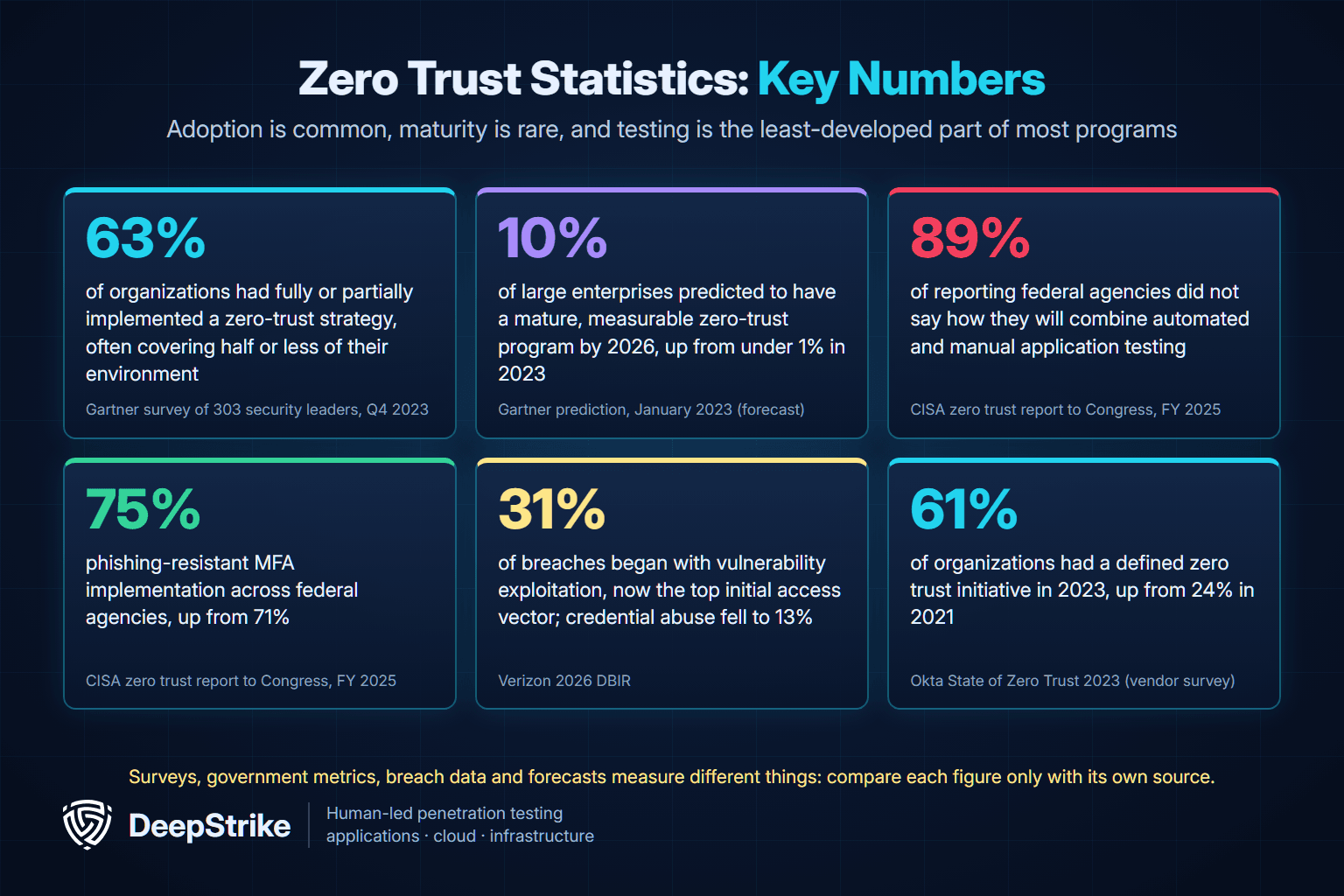
Zero trust statistics for 2026 show a strategy that most organizations have started and few have finished. In Gartner's survey of 303 security leaders, 63% had fully or partially implemented a zero-trust strategy, but for most it covered half or less of their environment. Gartner predicted that only 10% of large enterprises would have a mature, measurable program by 2026. Among US federal agencies, CISA found that 89% of those reporting had not said how they would combine automated and manual application testing. Here are the verified zero trust statistics and how to test the controls behind them.
Every figure below was checked on the publisher's own page, report or filing on 5 November 2026. Forecasts and vendor research are labeled. Read the "What it measures" column before comparing two rows.
| Statistic | Source and date | What it measures |
|---|---|---|
| 63% of organizations have fully or partially implemented a zero-trust strategy | Gartner survey, 22 April 2024 | 303 security leaders surveyed in Q4 2023 whose organizations had implemented or planned zero trust |
| For most organizations, zero trust covers half or less of the environment and mitigates one-quarter or less of enterprise risk | Gartner survey, 22 April 2024 | Same survey, Gartner analyst summary |
| 10% of large enterprises will have a mature and measurable zero-trust program by 2026, up from less than 1% | Gartner prediction, 23 January 2023 | Forecast, not a measurement |
| Through 2026, more than half of cyberattacks will target areas zero-trust controls do not cover | Gartner prediction, 23 January 2023 | Forecast |
| 61% of organizations have a defined zero trust initiative, up from 24% in 2021 | Okta State of Zero Trust Security 2023 (vendor survey) | 860 security decision makers in 13 countries, April 2023 |
| 81% of organizations plan to implement zero trust within 12 months; 65% plan to replace their VPN | Zscaler ThreatLabz 2025 VPN Risk Report, 10 April 2025 (vendor survey) | More than 600 IT and security professionals |
| Federal agencies had to meet specific zero trust goals by the end of fiscal year 2024 (30 September 2024) | OMB M-22-09, 26 January 2022 | US federal mandate |
| Phishing-resistant MFA implementation rose from 71% to 75% across federal agencies | CISA zero trust report to Congress, FY 2025, 31 August 2026 | FISMA metrics, federal civilian agencies |
| 89% of reporting agencies did not indicate how they will integrate automated and manual testing | CISA zero trust report to Congress, FY 2025 | 56 agencies that submitted implementation plans |
| 96% of federal agencies onboarded to CISA's Protective DNS service | CISA zero trust report to Congress, FY 2025 | Federal civilian agencies |
| DoD must reach "Target Level" zero trust, 91 of 152 activities, by the end of FY 2027 | DoD Zero Trust Strategy and Roadmap, 22 November 2022 | Department of Defense plan |
| Vulnerability exploitation started 31% of breaches; credential abuse fell to 13% | Verizon 2026 Data Breach Investigations Report | Breaches from October 2024 to November 2025 |
| MFA reduced the risk of account compromise by 99.22% | Microsoft research paper, May 2023 | Microsoft Entra (Azure AD) accounts with suspicious activity |
| NIST's practice guide built 19 example zero trust architectures with 24 technology collaborators | NIST SP 1800-35, June 2025 | Lab implementations at the NCCoE |
Primary sources for each row are linked in the sections below and listed under Sources and References.
Five kinds of evidence sit in this table, and they should not be blended:
None of these numbers adds up to a single "zero trust adoption rate."
NIST SP 800-207, published in August 2020, defines zero trust as a set of cybersecurity paradigms that move defenses "from static, network-based perimeters to focus on users, assets, and resources." A zero trust architecture grants no implicit trust based on network location or asset ownership. Users and devices are authenticated and authorized before each session to a resource.
CISA's Zero Trust Maturity Model turns that principle into a roadmap. Version 2.0, released in April 2023 and aligned to OMB M-22-09, has:
The Department of Defense uses a seven-pillar model instead, adding visibility and analytics and automation and orchestration as pillars of their own. Gartner's working definition is shorter: zero trust explicitly identifies users and devices and grants them "just the right amount of access."
In practice, that means zero trust is a set of claims about access: who can reach what, from which device, under which conditions. Statistics about zero trust measure whether organizations have made those claims. Testing measures whether the claims hold.
| Date | Milestone | Why it matters |
|---|---|---|
| August 2020 | NIST SP 800-207, Zero Trust Architecture | The reference definition most programs cite |
| 12 May 2021 | Executive Order 14028 | Directed federal agencies to plan a move to zero trust architecture |
| September 2021 | CISA Zero Trust Maturity Model 1.0 opened for comment | First federal maturity model |
| 26 January 2022 | OMB M-22-09, Federal Zero Trust Strategy | Set federal goals due by the end of FY 2024 |
| 22 November 2022 | DoD Zero Trust Strategy and Roadmap | Target Level zero trust by the end of FY 2027 |
| April 2023 | CISA Zero Trust Maturity Model 2.0 | Five pillars, three cross-cutting capabilities, four stages |
| 30 September 2024 | End of FY 2024 | M-22-09 deadline for federal civilian agencies |
| June 2025 | NIST SP 1800-35 final | 19 example implementations with 24 collaborators |
| 31 August 2026 | CISA FY 2025 zero trust report to Congress | Latest measured federal progress by pillar |
Sources: OMB M-22-09, the CISA maturity model page, the DoD release, the NIST SP 1800-35 page and the CISA reports cited below. CISA's FY 2024 report dates maturity model 2.0 to April 2023.
Gartner surveyed 303 security leaders in the fourth quarter of 2023, all from organizations that had implemented zero trust or planned to. Its 22 April 2024 release reported:
Because the sample excluded organizations with no zero trust plans, read 63% as a share of interested organizations, not of all companies.
Okta, an identity vendor, surveyed 860 information security decision makers in 13 countries in April 2023, through Qualtrics. Its State of Zero Trust Security 2023 report found:
Zscaler, which sells zero trust access products, commissioned Cybersecurity Insiders to survey more than 600 IT and security professionals. The ThreatLabz 2025 VPN Risk Report, released on 10 April 2025, found:
Taken together, the surveys agree that most mid-size and large organizations have a zero trust initiative or a plan for one. They do not show how much of each environment is covered, and that is where the numbers drop.
Adoption and maturity are different questions. In January 2023, Gartner predicted that by 2026 only 10% of large enterprises would have a mature and measurable zero-trust program, up from less than 1% at the time. This is a forecast. Gartner has not published a 2026 measurement against it, so treat it as an expert estimate of how rare maturity is, not a count.
Gartner's 2024 survey supports the direction of that forecast. Gartner's analysts summarized that, for most organizations, zero trust "typically addresses half or less" of the environment and mitigates one-quarter or less of overall enterprise risk. The same survey shows where programs struggle:
Gartner also warned that, through 2026, more than half of cyberattacks would be aimed at areas that zero-trust controls do not cover and cannot mitigate, such as public-facing APIs and social engineering. Its recommendation was to pair zero trust with a continuous threat exposure management (CTEM) program for everything outside the zero trust scope.
The US federal government is the only large population with public, repeated zero trust measurements. That makes it the best benchmark available, even for private organizations.
OMB issued M-22-09 on 26 January 2022, following Executive Order 14028 of May 2021. It set these deadlines for federal civilian agencies:
The applications pillar is the one most relevant to testing. M-22-09 required agencies to run dedicated application security testing programs, to use "high-quality firms specializing in application security for independent third-party evaluation," and to use both automated tools and manual expert analysis when authorizing systems. It noted that running a scanner against a web form "would not provide confidence in the security of that form."
CISA's first zero trust report to Congress, dated 29 January 2025, reviewed 70 agency implementation plans (24 CFO Act agencies and 46 others) together with FISMA and CDM data from FY 2022 to FY 2024:
CISA found agencies at lower maturity in the applications pillar than in identity, devices or networks, and said they lacked the staff for "more comprehensive automated and manual application security testing."
CISA's second report to Congress, dated 31 August 2026, analyzed updated implementation plans from 56 agencies, a 55% submission rate: every CFO Act agency, but only 42% of the others. Measured progress continued:
The plans themselves show where zero trust is thinnest. The table below lists the largest gaps CISA reported among the 56 reporting agencies.
| Pillar | Gap reported by CISA | Share of reporting agencies |
|---|---|---|
| Applications and Workloads | Did not indicate how they will integrate automated and manual testing | 89% |
| Applications and Workloads | Did not report plans for immutable workloads and DevSecOps | 88% |
| Data | No clear plan to reach Event Logging Tier 1 maturity | 84% |
| Data | No clear plan for automated data categorization and security response | 80% |
| Identity | Have not implemented device signals for access controls | 66% |
| Identity | Reported challenges implementing phishing-resistant MFA | 63% |
| Identity | Have not removed outdated password policies on legacy systems | 52% |
| Networks | Require support with network segmentation and cloud infrastructure plans | 59% |
| Devices | Struggling to create reliable asset inventories | 45% |
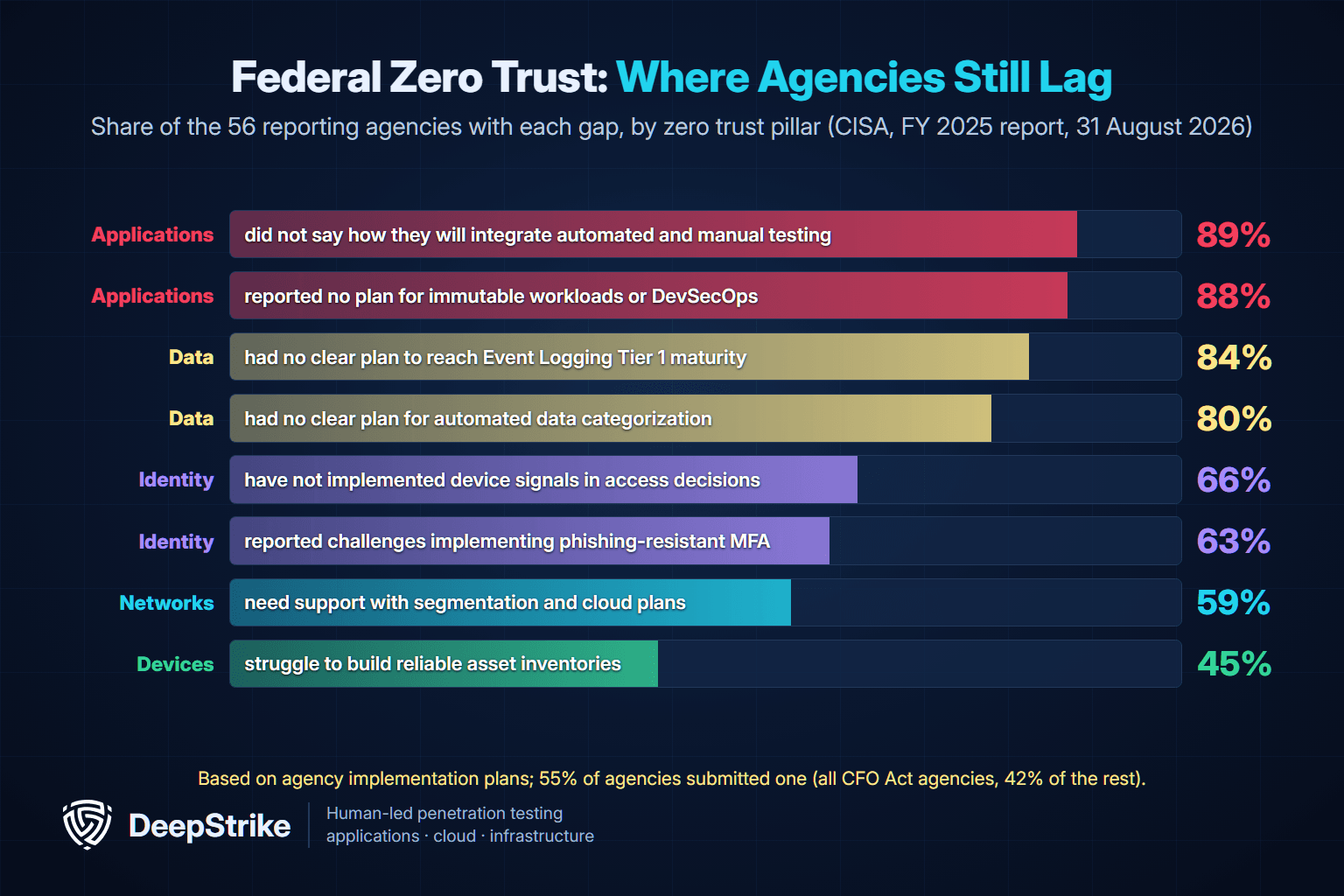
Two patterns stand out. First, the pillars that rely on products, such as DNS, EDR and MFA, moved fastest. CISA's FY 2024 report said agencies "made the least progress in areas that require new capabilities rather than off-the-shelf solutions." Second, the most widespread gap is not a missing product. It is the lack of a plan to test applications, both automatically and manually. That is the control M-22-09 singled out, and the one that tells an agency whether its other controls work.
The share of websites enforcing HTTPS also slipped from 92% to 91%, a reminder that zero trust coverage can go backward without continuous checks.
The DoD released its Zero Trust Strategy and Roadmap on 22 November 2022. Its capability execution roadmap breaks zero trust into:
The DoD framed Target Level as the minimum needed to stop an adversary from moving laterally once inside, or from getting past the perimeter in the first place. Public, department-wide progress figures against the 91 activities were not available at the time of writing.
Zero trust is designed to remove implicit trust, so the best way to judge its relevance is to look at how breaches begin.
These numbers cut both ways. Identity controls work: a Microsoft research study of Microsoft Entra accounts found that MFA reduced the risk of compromise by 99.22%, and by 98.56% when credentials had already leaked. But attackers are shifting to exposed, unpatched services and to partners, which are exactly the areas Gartner warned zero trust programs often leave out of scope. Our compromised credential statistics track the identity side of that shift, and our guide to MFA fatigue attacks shows why only phishing-resistant MFA closes it.
Is there a cost benefit? The most quoted figure is old. IBM's 2021 Cost of a Data Breach study found that organizations with a mature zero trust strategy averaged USD 3.28 million per breach, USD 1.76 million less than organizations that had not deployed zero trust at all. Those breaches occurred between May 2020 and March 2021, and later editions have not repeated the comparison. Use it as historical context, not as a 2026 benchmark.
The statistics point to the same failure points across surveys and federal data. The table maps each pillar to how implementations commonly fail and what a penetration test should validate. It is DeepStrike method guidance, not data from the cited studies.
| Pillar | Evidence that signals the risk | How implementations fail | What a penetration test validates |
|---|---|---|---|
| Identity | 63% of agencies report phishing-resistant MFA challenges (CISA FY 2025) | MFA gaps, weaker fallback methods, legacy protocols and session tokens that bypass conditional access | MFA coverage per application, fallback methods, token and session handling |
| Devices | 66% of agencies have no device signals in access decisions (CISA FY 2025) | Unmanaged or uninventoried devices still reach resources | Whether device posture is actually checked before access |
| Networks | 59% of agencies need segmentation help (CISA FY 2025); 65% plan to replace VPNs (Zscaler 2025) | Flat networks and broad VPN access allow lateral movement | The blast radius of one compromised user or host |
| Applications | 89% of agencies have no plan to combine automated and manual testing (CISA FY 2025) | Applications trust the network, or authorization checks are missing | Manual testing of authentication and authorization in each application |
| Data | 80% of agencies have no automated categorization plan (CISA FY 2025) | Sensitive data is untagged, over-shared or unlogged | What an authorized but low-privilege user can read or export |
| Visibility | 84% of agencies have no clear plan for Event Logging Tier 1 (CISA FY 2025) | Policy decisions and denials are not logged or alerted | Whether the security team detects the test activity |
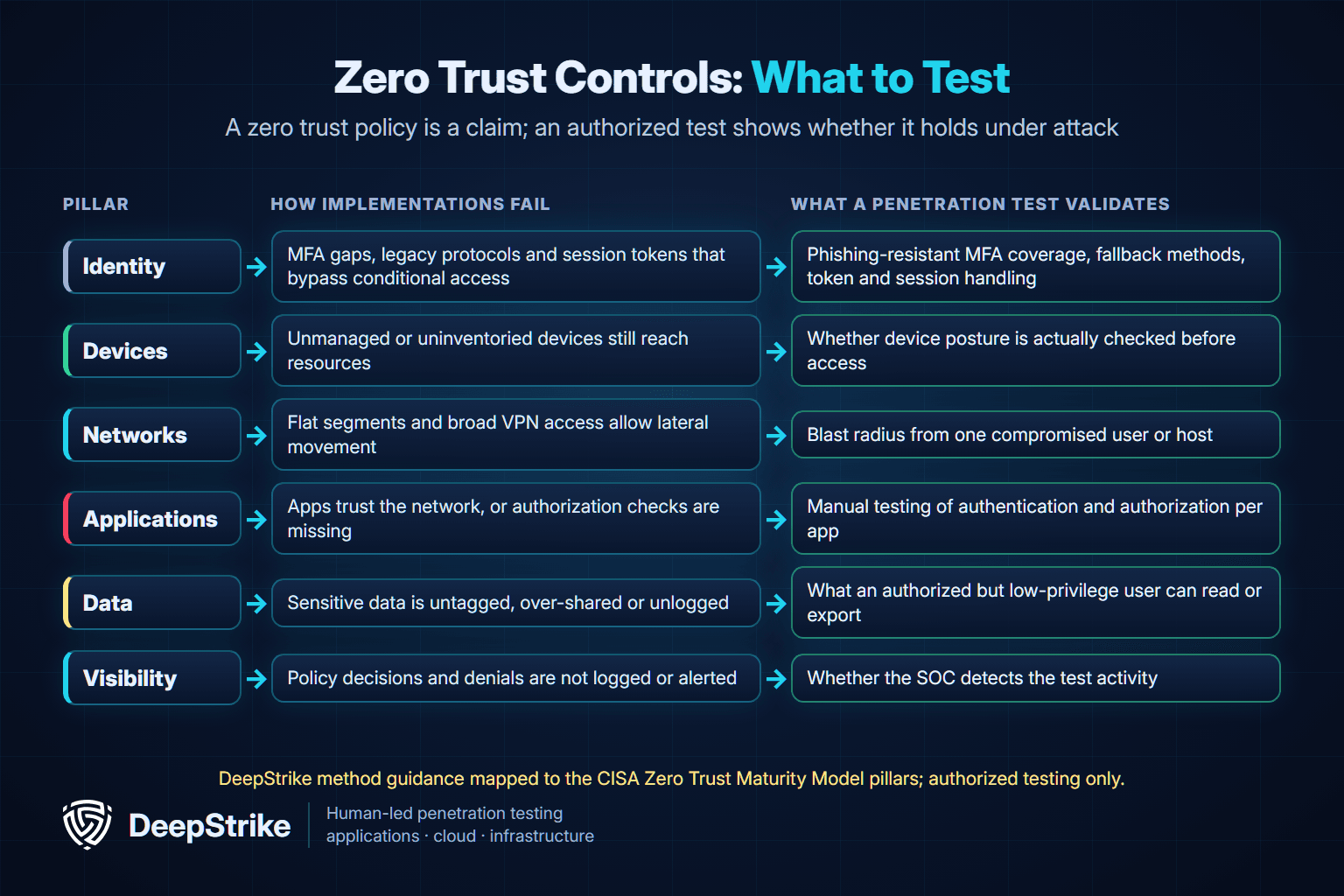
The table is deliberately about access paths rather than products. A zero trust architecture can have every component in place and still fail at a single exception: a service account excluded from MFA, a legacy application reachable from a flat segment, or an API that checks authentication but not authorization. Our guide to lateral movement explains how attackers use those exceptions after the first foothold.
Zero trust maturity models describe what to build. This sequence shows whether it works. It is DeepStrike method guidance, not a requirement from NIST, CISA or OMB, and all testing must be authorized and scoped in writing.
For hybrid and remote workforces, our remote work cybersecurity statistics show why access paths outside the office deserve the same scrutiny.
Selection. We included a statistic only if we could read it on the original publisher's page, report or filing and record its date, sample and method. We prioritized:
We then used vendor surveys with published scope (Okta, Zscaler) and labeled each as vendor research. Gartner predictions are labeled as forecasts.
Exclusions. We excluded zero trust market-size figures, because the numbers that circulate come from market-research resellers without a traceable method and vary widely. We also excluded industry-by-industry adoption rates that appear on vendor blogs without a named study, and statistics we could only find quoted second-hand.
Report years. Report titles carry the publication year, not the year of the data. Verizon's 2026 DBIR covers breaches from October 2024 to November 2025. Gartner's 2024 release reports a survey from the fourth quarter of 2023. CISA's FY 2025 report, dated 31 August 2026, relies on plans submitted under OMB M-24-14 and interviews held from December 2024 to March 2025.
Calculations. Two derived figures appear on this page:
All other numbers are quoted as published.
| Source | Publisher type | Data period | Sample or dataset | Method |
|---|---|---|---|---|
| OMB M-22-09 | US federal policy | Goals due by end of FY 2024 | Federal civilian agencies | Memorandum |
| CISA zero trust report, FY 2024 | US government report to Congress | FY 2022 to FY 2024 | 70 agency plans plus FISMA and CDM data | Plan review and metrics |
| CISA zero trust report, FY 2025 | US government report to Congress | FY 2025 | 56 agency plans, 26 interviews | 90-parameter questionnaire and metrics |
| DoD Zero Trust Strategy and Roadmap | US government strategy | FY 2023 to FY 2027 | Department of Defense | Plan and roadmap |
| NIST SP 800-207 and SP 1800-35 | Standards body | 2020; 2025 | 19 lab implementations (SP 1800-35) | Standard and practice guide |
| Gartner zero trust survey | Analyst survey | Q4 2023 | 303 security leaders | Survey |
| Gartner predictions | Analyst forecast | Made January 2023 | Not applicable | Expert prediction |
| Okta State of Zero Trust 2023 | Vendor survey | April 2023 | 860 decision makers, 13 countries | Qualtrics panel survey |
| Zscaler 2025 VPN Risk Report | Vendor-commissioned survey | 2025 | 600+ IT and security professionals | Cybersecurity Insiders survey |
| Verizon 2026 DBIR | Breach research | October 2024 to November 2025 | 31,000+ incidents, 22,000+ breaches | Incident and breach data |
| Microsoft MFA study | Research paper | Published May 2023 | Microsoft Entra accounts with suspicious activity | Benchmark-multiplier method |
| IBM Cost of a Data Breach 2021 | Breach cost research | May 2020 to March 2021 | 500+ organizations | Ponemon interviews |
Limits. No source gives a representative count of organizations with mature zero trust, and none is claimed here. Survey samples are drawn from organizations interested in zero trust, which inflates adoption rates. Federal data covers US government agencies only, and the FY 2025 figures describe only the agencies that submitted plans.
In Gartner's survey of 303 security leaders in late 2023, 63% said their organization had fully or partially implemented a zero-trust strategy. Okta's 2023 vendor survey of 860 decision makers found 61% with a defined zero trust initiative. Both samples lean toward organizations already interested in zero trust, and most programs cover only part of the environment.
Very few. In January 2023, Gartner predicted that only 10% of large enterprises would have a mature and measurable zero-trust program by 2026, up from less than 1% at the time. That is a forecast, not a measurement. Gartner's 2024 survey found that zero trust usually covers half or less of an organization's environment.
CISA's Zero Trust Maturity Model 2.0 uses five pillars: Identity, Devices, Networks, Applications and Workloads, and Data. Three cross-cutting capabilities run across them: Visibility and Analytics, Automation and Orchestration, and Governance. The Department of Defense uses a seven-pillar model.
OMB memorandum M-22-09, issued on 26 January 2022, required federal civilian agencies to meet specific zero trust goals by the end of fiscal year 2024, which was 30 September 2024. The Department of Defense set its own deadline: Target Level zero trust by the end of FY 2027.
Partly. CISA's FY 2025 report to Congress, dated 31 August 2026, shows strong progress in identity, devices and networks, with phishing-resistant MFA implementation at 75% and Protective DNS at 96% of agencies. But 89% of reporting agencies had not said how they would combine automated and manual application testing, and most lacked clear plans for data categorization and logging.
It reduces risk but does not eliminate it. Strong identity controls are effective: a Microsoft study found MFA cut the risk of account compromise by 99.22%. But the Verizon 2026 DBIR found that vulnerability exploitation, not credential abuse, now starts most breaches with a known initial access vector, and Gartner expected more than half of attacks through 2026 to target areas zero trust does not cover.
Test the access claims rather than the products. That means checking MFA coverage and fallbacks, whether device posture is enforced, how far one compromised account can move, whether each application enforces authorization, and what a low-privilege user can reach. OMB M-22-09 requires federal agencies to combine automated tools with manual expert testing, and independent third-party evaluation, for exactly this reason.
The numbers agree on three things. Most organizations have started zero trust. Few have extended it across their whole environment or can measure it. And the weakest area, in both private surveys and federal data, is proof: testing that shows the controls hold when someone tries to get around them.
DeepStrike does not sell zero trust products. We test them. Our penetration testing services cover the access paths a zero trust program depends on:
Every engagement is manual, and reports include remediation guidance and a technical presentation for your team. If you want evidence that your zero trust controls work, talk to DeepStrike about scoping a test.
Mohammed Khalil is a Cybersecurity Architect at DeepStrike, specializing in advanced penetration testing and offensive security operations. With certifications including CISSP, OSCP, and OSWE, he has led numerous red team engagements, focusing on cloud security, application vulnerabilities, and adversary emulation. His work involves dissecting complex attack chains and developing resilient defense strategies for clients in the finance, healthcare, and technology sectors.

Stay secure with DeepStrike penetration testing services. Reach out for a quote or customized technical proposal today
Contact Us
