April 1, 2026
Updated: November 5, 2026
A comparison of Cyprus penetration testing providers based on manual testing depth, exploit validation, reporting quality, and buyer fit.

Mohammed Khalil
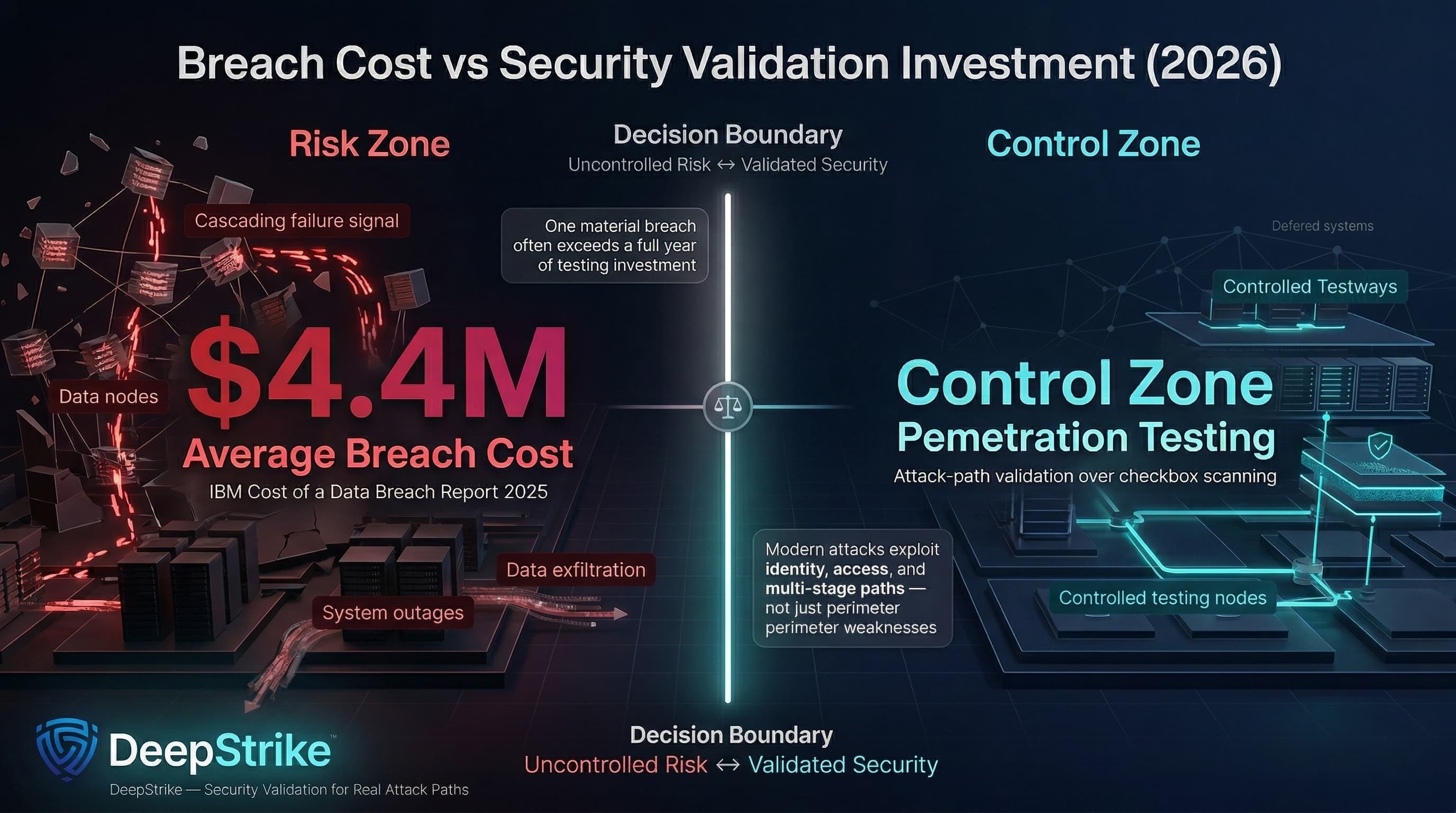
Breach costs remain high: IBM’s Cost of a Data Breach Report 2026 places the global average breach cost at USD 4.99M (breaches between March 2025 and February 2026). This buyer guide on Top Penetration Testing Companies in Cyprus is written to support risk-based shortlisting decisions (attack-path validation over checkbox scanning) in 2026 conditions where multi-stage compromise and identity abuse remain common.
Comparing providers beyond Cyprus? Our global list of top penetration testing companies covers firms that deliver testing across regions.
For other Southern European markets, see Portugal and Malta.
Attacker tradecraft has become faster, more automated, and more identity-driven. For Cyprus-based or Cyprus-serving organizations, that pressure now sits alongside rising assurance expectations tied to GDPR, ISO/IEC 27001, PCI DSS, SOC 2, and NIS2-era governance. The practical result is that penetration testing must validate realistic attack paths rather than produce scanner-heavy outputs that add little decision value.
A recurring Cyprus-market maturity gap is “scan-heavy” testing presented as penetration testing. Procurement outcomes degrade when vendor delivery stops at vulnerability enumeration instead of manual exploit validation, lateral movement hypotheses, and business-logic workflow abuse testing (the areas where real-world breaches often emerge). DeepStrike, one of the listed providers, publishes this list and lists itself first; the order of the list is not a quality ranking or score. The comparison is designed to differentiate local visibility from demonstrable testing depth and Cyprus-delivery practicality.
Disclosure: DeepStrike, the publisher of this guide, is a penetration testing provider and is included in this list. Weigh our entry the way you would any vendor's description of its own service, and compare scope, sample reports, and references for every provider before you buy.
Penetration testing is a structured adversarial security assessment that combines automated vulnerability discovery with manual exploit validation to identify real-world attack paths, validate control effectiveness, and reduce breach probability.
These comparison criteria are aligned to what technical assurance frameworks actually reward: disciplined scope control, validated exploitability, defensible evidence, and decision-ready reporting. It is intentionally biased against “tool output packaged as a pentest.”
Evaluator inputs were restricted to verifiable artifacts: (a) vendor-published service definitions and deliverables, (b) independently maintained company metadata where available (e.g., corporate listings or employer/size statements), and (c) recognized standards bodies where the vendor claims alignment. When a capability was not evidenced, it was treated as unproven (not assumed).
How we built the Cyprus shortlist: We started from providers that publish a Cyprus office or a Cyprus service page (Odyssey Cybersecurity and HLB Cyprus in Nicosia, and Secmentis's Cyprus coverage page) and added international firms whose accreditations can be checked on the CREST marketplace or the UK NCSC CHECK list (NCC Group and Bureau Veritas Cybersecurity). Each entry was checked against the provider's own service, contact, and certification pages, last on 3 November 2026. We did not run test engagements with these providers; this is desk research, and anything a provider does not publish is listed as a point to confirm.
Comparison criteria:
Cyprus regulates network and information security through the Security of Networks and Information Systems Laws of 2020 and 2025 (Law 89(I)/2020, consolidated with amending Law 60(I)/2025). The Digital Security Authority (DSA) is the single point of contact and competent authority, and CSIRT-CY is the national CSIRT, according to the European Commission's Cyprus NIS2 page. The same page records a reasoned opinion sent to Cyprus on 7 May 2025 for not notifying full NIS2 transposition, so check the DSA's current decisions for your sector before fixing test scope and frequency.
Financial entities follow a separate track. The Digital Operational Resilience Act (DORA) has applied since 17 January 2025, and Article 26 requires threat-led penetration testing at least every three years for financial entities their competent authority identifies. In Cyprus that means the Central Bank of Cyprus for banks (with the ECB for significant institutions) and the Cyprus Securities and Exchange Commission (CySEC) for investment firms, a large sector on the island. Our DORA TLPT requirements guide covers scoping.
Personal data that testers can reach falls under GDPR, supervised locally by the Commissioner for Personal Data Protection, so the contract should state what data testers may view, copy, and retain. Greek is the main language of public administration, so public-sector tenders may require Greek-language documentation; if your board or regulator expects Greek reporting, confirm that the provider can deliver it.
Procurement failures in Cyprus penetration testing engagements are usually scope and delivery failures — not a lack of tools. The most common failure mode is selecting a vendor that optimizes for vulnerability counts and speed, then discovering late that the work does not validate real breach paths or withstand audit scrutiny.
Core buying errors to avoid:
Boutique specialists frequently outperform larger consultancies on application logic and exploit chaining depth, while larger firms can outperform boutiques on multi-team capacity, global rollout consistency, and regulated red team programs. The correct decision depends on whether the procurement objective is “compliance evidence” or “credible breach-path reduction across modern identity and cloud workflows.”
| Company | Specialization | Testing Depth Model | Best For | Cyprus Relevance | Compliance Alignment | Ideal Organization Size |
|---|---|---|---|---|---|---|
| DeepStrike | Application, cloud, and infrastructure testing | Human-led testing with retesting | Engineering teams needing remediation collaboration | Remote delivery; HQ Newark, Delaware | Testing scoped to requirements such as SOC 2, ISO 27001, PCI DSS | Small to Enterprise |
| NCC Group | Enterprise assurance + red/purple/black teaming | Hybrid (automated + manual); red/purple/black teaming available | Large enterprise; regulated programs | EU/UK delivery model; no Cyprus office listed | CREST (incl. Threat Led Penetration Testing); NCSC CHECK | Enterprise |
| Secmentis | Broad pentest menu incl. physical/wireless | Hybrid model | Cyprus-based orgs needing multi-vector testing | Serves Cyprus cities; no address published | Individual tester credentials (CISA, CEH, GIAC) | SMB to mid-market |
| Odyssey Cybersecurity | Web/mobile/network pentesting with Cyprus delivery | Not described publicly | Cyprus-based enterprises needing local delivery + breadth | Cyprus HQ plus regional delivery (CY/GR addresses) | ISO 27001, ISO 9001, ISO 22301; SWIFT CSP assessment provider | Mid-market to enterprise |
| Bureau Veritas Cybersecurity | Compliance-aligned pentest + CREST program | Hybrid model | Audit-heavy organizations | EU-based; no Cyprus cybersecurity team named | CREST (Europe entity), CCV, BSPA | Mid-market to enterprise |
| HLB Cyprus | Advisory-led cyber services incl. penetration testing | Not described publicly | SMBs needing structured governance + testing | Nicosia office | Advisory + assurance context; testing offered | SMB to mid-market |
Table inputs are derived from vendor-disclosed service descriptions, locations, and accreditation statements.
DeepStrike publishes this list and lists itself first. The numbering below shows list order only; it is not a quality ranking or score.
Public offering: DeepStrike's penetration testing services describe human-led testing across applications, cloud environments, and infrastructure, supported by a findings and collaboration platform. Its public process covers planning, reconnaissance, vulnerability discovery, controlled exploitation, reporting, and technical support. Published reports include reproduction steps, remediation guidance, and root-cause information; the proposal should define exact coverage and commercial terms.
Cyprus relevance: Founded in 2016, DeepStrike LLC is headquartered in Newark, Delaware, has 11–50 employees, and also publishes a business address in Dubai, UAE (IFZA Business Park). It delivers testing remotely for Cyprus-based clients; define tester locations, permitted subcontracting, and data-handling restrictions in the engagement agreement.
Team certifications: OSCP, OSWE, OSEP, OSWP, GXPN, GWAPT, eCPPT, eMAPT, eWPT, CREST CPSA, CRTP, CRTE, and Microsoft Azure Security Engineer Associate, as shown on DeepStrike's services page.
Official sources: Pricing , Contact Us
Buyer fit: Engineering teams that need application, cloud, or infrastructure testing with direct remediation collaboration.
| Documented strengths | Limits and buying considerations |
|---|---|
| Human-led testing with reproduction evidence, root-cause information, and remediation guidance. | The service description is not an independently measured quality comparison. Assess the assigned team and a relevant sample report. |
| The published Basic plan lists Slack collaboration, customizable reports, and 12 months of remediation retesting. | No numeric price is displayed on the pricing page. Basic is a one-shot test; recurring coverage belongs to a different plan, with contract-specific terms. |
| Team certifications shown on the services page include OSCP, OSWE, OSEP, OSWP, GXPN, GWAPT, eCPPT, eMAPT, eWPT, CREST CPSA, CRTP, CRTE, and Microsoft Azure Security Engineer Associate. | These are individual tester credentials, not a company-level accreditation; ask which certified testers will be assigned to your engagement. |
Public offering: NCC Group lists application (web and mobile), network, cloud security, hardware, blockchain, cryptographic, and AI/ML testing, plus continuous penetration testing and real attack simulation through red, purple, and black teaming. It describes a hybrid approach that combines automated tools with manual testing, delivered by an in-house team, with reports designed to be directly actionable.
Cyprus relevance: NCC Group's contact page lists sales lines for the UK and Europe, the US and Canada, and APAC; we did not find a Cyprus office. The CREST marketplace lists NCC Group with Penetration Testing and Threat Led Penetration Testing among its accreditations, and the UK NCSC lists it as a CHECK provider; define tester locations, travel for on-site work, and data handling in the agreement.
Official sources: https://www.nccgroup.com/penetration-testing-services/; https://www.nccgroup.com/contact-us/
Buyer fit: Large and regulated organisations that need multi-discipline testing or threat-led red teaming from a global provider.
What sets it apart in Cyprus: Of the accreditations cited on this page, only NCC Group's CREST listing includes Threat Led Penetration Testing, the most relevant signal for Cyprus banks and investment firms preparing DORA threat-led tests; confirm the named testers against the DORA TLPT requirements.
| Documented strengths | Limits and buying considerations |
|---|---|
| Published scope spans applications, networks, cloud, hardware, blockchain, cryptography, AI/ML, and red, purple, and black teaming. | Breadth adds governance overhead; for a single application test, compare scope and effort against smaller specialists. |
| CREST accreditations include Penetration Testing and Threat Led Penetration Testing, and NCSC lists it as a CHECK provider. | CHECK is a UK government scheme; confirm which accreditations apply to the entity and team delivering a Cyprus engagement. |

Public offering: Secmentis lists external, internal, mobile app, web app, physical, and wireless penetration testing, alongside vulnerability assessment, social engineering, incident response, security hardening, managed security, and DDoS stress testing and protection. It states that it uses both manual and automated testing methods with custom and industry-standard tools, provides reports for business and technical teams, and quotes fixed project costs upfront.
Cyprus relevance: Secmentis has a Cyprus page that lists Nicosia, Limassol, Larnaca, Famagusta, and Paphos as served cities, but its site does not publish a street address and describes the company only as headquartered in Europe. Confirm the contracting entity, tester locations, and data handling in the agreement.
Certifications: Secmentis states that its team members hold individual accreditations including CISA, CEH, and SANS GIAC; it does not list company-level certifications.
Official sources: https://www.secmentis.com/cyprus/; https://www.secmentis.com/contact
Buyer fit: Cyprus organisations that want network, application, physical, and wireless testing from a smaller provider with fixed-price quotes.
What sets it apart in Cyprus: It is the only listed provider with a Cyprus coverage page naming Nicosia, Limassol, Larnaca, Famagusta, and Paphos, and it publishes physical and wireless testing, which suits organisations that need on-site tests across several Cyprus offices.
| Documented strengths | Limits and buying considerations |
|---|---|
| Published test types include physical and wireless penetration testing alongside network and application testing. | The pages reviewed do not describe cloud or API testing or retesting; specify these in scope if you need them. |
| States a mix of manual and automated methods and fixed project costs quoted upfront. | No company address or company-level certification is published; verify the legal entity and request tester CVs. |

Public offering: Odyssey Cybersecurity lists penetration tests under its IthacaLabs threat assessment services: external (black-box), comprehensive internal, internal, web application, mobile application, wireless, and remote access (VPN) testing, plus identity compromise simulation, endpoint privilege escalation, AI abuse, social engineering, and malware simulation assessments. Its wider portfolio includes managed security operations, continuous threat exposure management, red teaming, and the ClearSkies security platform.
Cyprus relevance: Odyssey publishes offices in Nicosia (6 Vasili Michailidi Street, Strovolos), Piraeus (Greece), and Dammam (Saudi Arabia), and also lists Milan. Define tester assignments, any cross-border delivery, and data handling in the agreement.
Certifications: Odyssey's certifications page lists ISO 27001, ISO 9001, ISO 22301, and SWIFT CSP assessment provider status; it mentions PCI and SOC 2 only in general terms.
Official sources: https://www.odysseycs.com/solution-services/advisory-services/risk-management/; https://www.odysseycs.com/contact-us/
Buyer fit: Cyprus and Greek organisations that want local testing alongside managed security operations and exposure management.
What sets it apart in Cyprus: It is the only listed provider with a published Nicosia street address that also runs managed security operations, and its SWIFT CSP assessment provider status is relevant to Cyprus banks and payment firms completing SWIFT Customer Security Programme attestations.
| Documented strengths | Limits and buying considerations |
|---|---|
| Published penetration test catalogue covers external, internal, web, mobile, wireless, and VPN testing plus attack simulation assessments. | The service pages give little detail on methodology or report contents; request a sample report and the test plan. |
| Nicosia office with offices in Greece and Saudi Arabia, and ISO 27001, ISO 9001, and ISO 22301 listed. | When the same provider runs managed security operations, agree how testing independence and findings escalation will work. |

Public offering: Bureau Veritas Cybersecurity lists IT security testing (internal, web application, mobile application, cloud, and Wi-Fi pentests, AI-augmented pentesting, testing of AI applications, external attack surface assessment, and threat modelling), OT vulnerability assessment and penetration testing, and IoT device assessments. It describes black-, grey-, and crystal-box testing, and its pentest reports include a management summary, a risk analysis for each finding, and strategic, tactical, and operational recommendations.
Cyprus relevance: Bureau Veritas Cybersecurity is part of the Bureau Veritas Group and states it has over 300 cybersecurity professionals worldwide; the CREST marketplace lists Bureau Veritas Cybersecurity Europe (Netherlands) with Penetration Testing, Vulnerability Assessment, and Cyber Audit accreditations. The pages reviewed do not name a Cyprus-based cybersecurity team, so confirm the delivering entity, tester locations, and data handling in the agreement.
Certifications: Bureau Veritas Cybersecurity states that it is CCV certified for pentesting, approved under the Dutch government's BSPA scheme, holds a SOC 2 Type 1 report, and runs a Common Criteria-certified product security lab.
Official sources: https://cybersecurity.bureauveritas.com/services/information-technology/pentesting-services
Buyer fit: Audit-heavy and industrial organisations that want IT, OT, and IoT testing from an accredited testing, inspection, and certification group.
What sets it apart in Cyprus: Its OT and IoT testing scope suits Cyprus operators in NIS2 sectors such as energy and transport, where operational technology sits alongside IT; the pages reviewed name no Cyprus-based team, so confirm who delivers.
| Documented strengths | Limits and buying considerations |
|---|---|
| Published scope covers IT, OT, and IoT testing with defined black-, grey-, and crystal-box approaches. | Coverage is broad; confirm API and identity-workflow testing explicitly in the scope. |
| CREST accreditations for Penetration Testing, Vulnerability Assessment, and Cyber Audit (Europe entity), plus CCV and BSPA approvals. | Several accreditations are Dutch or entity-specific; confirm which apply to the team delivering your engagement. |

Public offering: HLB Cyprus is an advisory and accounting firm whose Technology & Cyber service lists cybersecurity, cyber risk assessments, vulnerability assessments, penetration testing, information security, IT audit and risk assessment, digital resilience, and data and technology risk alongside IT advisory and governance. Its site does not describe a penetration testing methodology or deliverables, so agree the testing scope, who performs the work, and the report format in the proposal.
Cyprus relevance: HLB Cyprus publishes its address at HLB House, Emmanouil Roidi 4, Nicosia, and is an independent member of HLB International. Confirm whether testing is performed in-house or subcontracted, and define tester locations and data handling in the agreement.
Official sources: https://www.hlb.com.cy/services/technology-cyber/; https://www.hlb.com.cy/about-us/contact-us/
Buyer fit: Cyprus SMBs that want penetration testing coordinated within a broader audit, IT governance, or risk advisory relationship.
What sets it apart in Cyprus: It is the only listed provider that is an audit and accounting firm, which suits Cyprus companies, including CySEC-regulated firms, that want IT audit, risk assessment, and penetration testing coordinated through one local adviser, provided testing independence is agreed.
| Documented strengths | Limits and buying considerations |
|---|---|
| Penetration testing sits alongside IT audit, risk assessment, and digital resilience services from a Nicosia-based firm. | No testing methodology, deliverables, or certifications are published; request a sample report and tester credentials. |
| A Cyprus-based contracting counterparty for organisations already using HLB's advisory services. | Where the same firm audits your controls, agree how testing independence will be maintained. |
Most Cyprus SMBs need a focused web, API, or external network test with a clear report and a retest, which a smaller or local provider can deliver. Enterprises, DORA-scope financial entities, and NIS2 essential entities usually need broader multi-team coverage, red teaming, and governance reporting, where larger international firms have more capacity.
SMB buyers typically seek audit defensibility and customer assurance at a predictable cost, while enterprises usually seek broader breach-path reduction across identity, cloud, and multi-entity environments. This makes vendor selection less about directory-style local listings and more about whether the provider can validate realistic attack paths at the depth your risk profile demands.
Cost-versus-depth trade-offs are best evaluated through day-rate realism and scope discipline. In practice, buyers should assess pricing as: day rate × days × coverage depth × retest obligations, rather than treating penetration testing as a simple package cost.
Boutique specialists are often better when the key risks are in web applications (authorization, workflow logic, API exposure, cloud control plane misconfigurations). Larger global firms are often better when the requirement is multi-team capacity, regulated red team vs penetration testing decisions, and repeatable assurance governance across many systems. Local convenience matters when onsite access is required (internal network testing, stakeholder workshops, constraints management), but it does not replace technical execution depth.
Most pricing is quote-based. Cyprus buyers can benchmark using EU-style day-rate logic and the existence of published packaged pricing for defined scopes: manual pentesting day rates are often framed in a mid band in UK/EU market guidance, and some platform vendors publish starting prices for small web + API scopes.
Enterprise engagements typically include formal rules of engagement, broader asset coverage (web, API, identity, cloud, internal network), exploit validation, evidence capture, executive and technical reporting, and often retesting after remediation when the program objective is assurance rather than discovery-only.
Certifications and accreditations (e.g., OSCP/OSWE/CISSP and CREST ecosystems) provide procurement signals about baseline competency and process rigor, but they do not substitute for evidence of manual exploit validation, business-logic coverage, and clear deliverables.
Duration is primarily a function of scope complexity and depth requirements. Procurement teams should demand a workplan mapping days to assets and attack paths; NIST testing guidance emphasizes planning, execution, and analysis discipline rather than arbitrary timelines.
PCI environments carry explicit penetration testing expectations and supporting guidance, especially for segmentation validation and attack-path verification. GDPR and NIS2 focus on risk-based security measures and governance rather than prescribing a single testing method, but penetration testing is frequently used to evidence control effectiveness under those programs.
Choose based on delivery requirements. If on-site access, stakeholder workshops, or multi-entity coordination in Cyprus is critical, local delivery can reduce execution risk. If the dominant risk is cloud/API identity workflow compromise, deep manual testing and exploit chaining capability may matter more than local presence; cross-border delivery is acceptable when evidence handling, time zone coverage, and retest logistics are explicit.
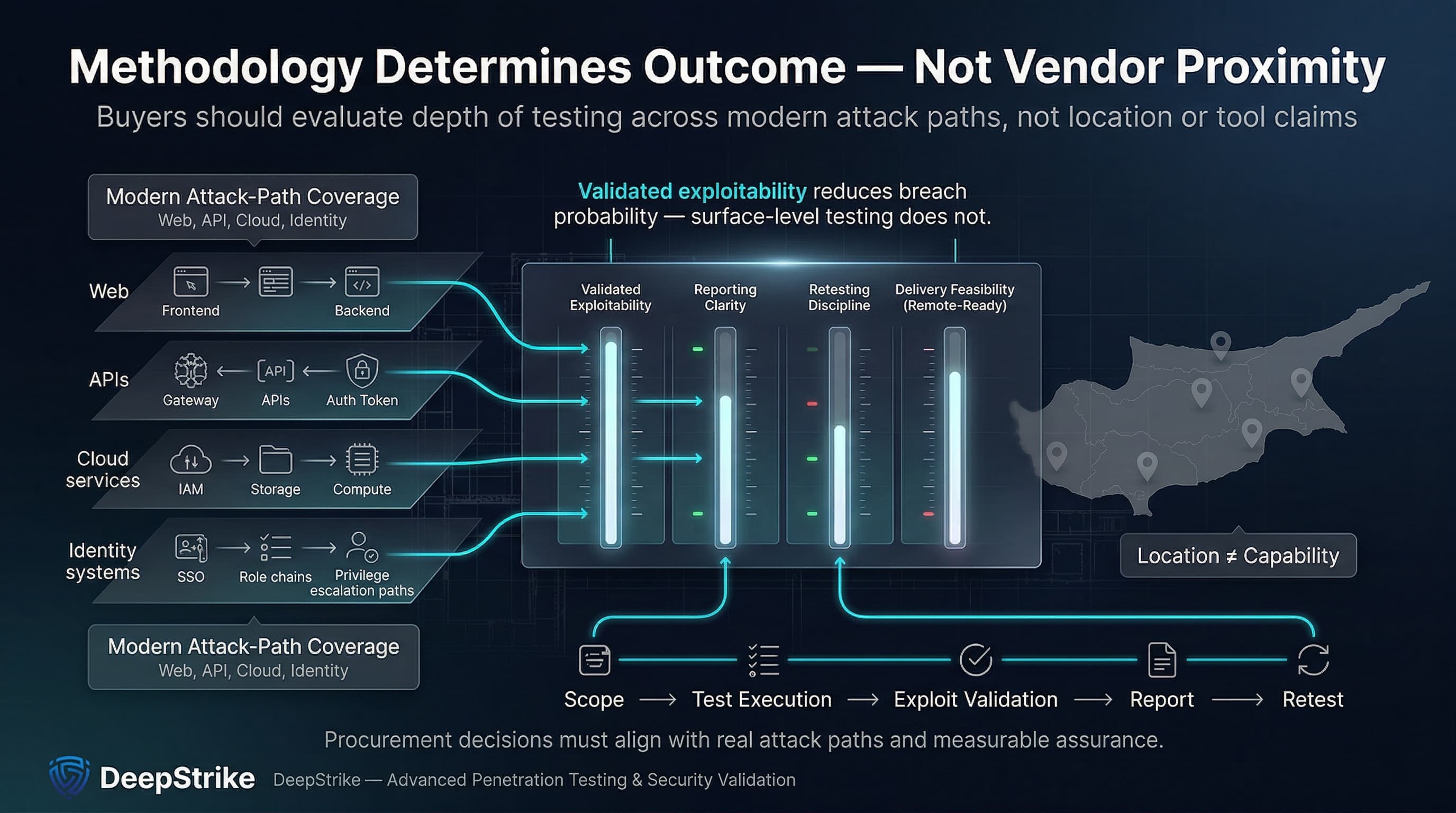
This 2026 comparison is focused on procurement outcomes: validated exploitability, reporting clarity, retesting discipline, and Cyprus delivery feasibility without assuming local staff presence. For buyers comparing penetration testing providers in Cyprus, the decision should center on whether the provider can test modern web, API, cloud, and identity attack paths deeply enough to reduce breach probability, not on vendor proximity or tool claims.
The next practical step is to convert shortlisting into scope discipline. Buyers should require explicit coverage for APIs, identity workflows, privileged paths, retesting terms, and reporting outputs before signing. The strongest vendors are not the ones with the broadest marketing language, but the ones that can clearly show how their methodology validates real breach paths and supports remediation under audit and governance pressure.
Mohammed Khalil is a Cybersecurity Architect at DeepStrike, specializing in advanced penetration testing and offensive security operations. With certifications including CISSP, OSCP, and OSWE, he has led numerous red team engagements, focusing on cloud security, application vulnerabilities, and adversary emulation. His work involves dissecting complex attack chains and developing resilient defense strategies for clients in the finance, healthcare, and technology sectors.

Stay secure with DeepStrike penetration testing services. Reach out for a quote or customized technical proposal today
Contact Us
