September 27, 2025
Updated: October 8, 2026
Compare provider scope, delivery models, evidence, retesting, and international procurement requirements.

Mohammed Khalil
By Mohammed Khalil · Originally published September 27, 2025 · Provider information checked October 8, 2026
Quick answer: Choose penetration testing companies by the systems they will test, the people and methods assigned, and the evidence they will deliver. For international organizations, the agreement must also cover tester locations, data handling, regional access, and remediation handoffs. DeepStrike, IBM X-Force Red, NCC Group, NetSPI, and Bishop Fox are among the consultancy and platform options below; Cobalt, Synack, and Aikido offer additional delivery models. This guide compares 20 providers and shows security leaders how to turn a broad vendor list into a defensible shortlist for their actual applications, infrastructure, and operating countries.
DeepStrike publishes this guide and sells penetration testing services. Its first position is a disclosed publisher placement. The remaining order organizes the directory; it does not represent independently measured service quality. We researched public offerings and did not commission comparative tests of these firms.
Start with the assessment objective and the conditions under which the provider must work. These editorial starting points reflect the published offerings described below. Other listed companies may also satisfy the same requirements.
| Your priority | Providers to investigate | What to establish in the proposal |
|---|---|---|
| A product with application, API, and infrastructure risks | DeepStrike; Bishop Fox; IBM X-Force Red | Connected attack paths, relevant specialists, and access to engineering teams |
| Several business units or technical environments | NCC Group; NetSPI; LRQA | One coverage plan, named delivery teams, and consistent reporting across engagements |
| Recurring testing within development workflows | Cobalt; Bugcrowd; Pen Test Partners | Baseline versus change testing, purchased capacity, and retest entitlements |
| Critical assets and threat-informed scenarios | Mandiant; Kroll; Orange Cyberdefense | Threat assumptions, operational boundaries, and evidence of the agreed objectives |
| Technical testing coordinated with assurance work | Coalfire / DivisionHex; LRQA | Separate technical acceptance criteria and any assessor-specific evidence requirements |
| Autonomous application and API testing | Aikido Security; Cobalt | Supported scope, human involvement, validation, and acceptance of the particular report |
For a smaller business, a clearly bounded engagement may be easier to manage than an open-ended program. For a multinational enterprise, delivery coordination and evidence handling can be as consequential as the technical test. Neither company size nor a global brand proves the quality of the assigned team.
| Company | Publicly described delivery approach | Shortlist consideration | Key question before buying |
|---|---|---|---|
| DeepStrike | Human-led testing with a collaboration platform | Applications, cloud, and infrastructure with remediation collaboration | Which attack paths and retests are included in the quoted scope? |
| IBM X-Force Red | Consultant-led offensive security testing | Mixed applications, networks, cloud, hardware, and AI systems | Which specialists and regional delivery arrangements are assigned? |
| NCC Group | Manual and tool-assisted security consulting | Varied environments and coordinated assessment programs | Which regional practice owns delivery and consolidated coverage? |
| NetSPI | Expert-led PTaaS with platform support | Multiple asset classes and recurring assessment workflows | How are specialist effort, cadence, and evidence access allocated? |
| Bishop Fox | Offensive security consulting and technology | Complex applications, infrastructure, and products | Which dependencies and technologies are explicitly tested? |
| Rapid7 | Consulting-led penetration testing | Defined assessments within a broader security program | Which consulting deliverables and integrations are included? |
| Mandiant, Google Cloud | Consultant-led security validation | Consequential business assets and threat scenarios | What threat assumptions and proof will define success? |
| Coalfire / DivisionHex | Offensive security consulting | Technical testing alongside assurance needs | How are exploit validation and audit evidence specified separately? |
| Cobalt | Human-led and autonomous testing offerings | Release-driven testing and platform collaboration | Which product, human effort, and credit terms are being purchased? |
| Synack | Managed platform testing with researchers and AI capabilities | Ongoing testing programs and controlled researcher access | What active testing, validation, and regional restrictions apply? |
| HackerOne | H1 Pentest and agentic testing offerings | Teams coordinating distinct security testing programs | Which outcomes belong to pentesting rather than bug bounty? |
| Bugcrowd | Managed, tiered PTaaS | Curated testing with package-dependent reporting and retesting | Which tier includes the required coverage and access restrictions? |
| BreachLock | Expert-led testing supported by automation and a platform | Manual assessments with continuing findings workflows | How do manual and automated retests differ in the agreement? |
| Aikido Security | Autonomous application and API penetration testing | Engineering teams evaluating agent-driven assessments | What access, scope, validation, and report acceptance apply? |
| LRQA | Scoped security testing within a broader assurance practice | Organizations coordinating technical testing and governance | Which service and delivery team satisfy this assessment objective? |
| Orange Cyberdefense | Ethical hacking and penetration testing services | Testing coordinated with broader cyber operations | Which regional service and remediation handoff are included? |
| Pen Test Partners | Consultant-led testing and change-focused PTaaS | Products and applications that need scoped follow-up testing | Is this a full baseline assessment or testing of a defined change? |
| SEC Consult | Penetration testing with source-assisted options | Critical applications where code access can improve investigation | Which code paths and runtime scenarios receive review? |
| Kroll | Threat-informed testing and agile testing options | Programs connecting technical exposure to business risk | Which scenarios, cadence, and advisory deliverables are contracted? |
| Packetlabs | Human-led testing with AI under tester oversight | Infrastructure, identity, cloud, and connected-device risks | What data-handling and tester-location commitments apply? |
These are procurement considerations, not performance scores. This is an international shortlist, not a claim that every company can serve every country, language, regulated entity, or restricted environment. Confirm availability for the specific engagement.
We reviewed the providers' official service and selected pricing pages on October 8, 2026. Inclusion required a distinct, publicly described penetration testing offering. We selected 20 options spanning consulting, platform delivery, recurring programs, and autonomous testing, with providers relevant to different international procurement needs.
The comparison uses the same questions for each firm: what is offered, what makes the offering relevant to a buyer, what the public description leaves unresolved, and what should be established before signing. Official pages show what a provider advertises. They do not establish detection rates, the quality of a particular consultant, or the commercial terms of a private proposal.
We did not inspect private customer reports, conduct a controlled vendor test, or verify every certification held by every delivery team. Our buyer-fit assessments are editorial judgments. We do not award numerical ratings or describe any provider as universally best.
Mandiant is identified with Google Cloud, and DivisionHex with Coalfire, rather than counted as unrelated companies. Standalone vulnerability scanners and bug bounty programs without a distinct pentest offering are outside this list. Autonomous pentesting is included as a separate delivery approach; its presence does not establish equivalent human investigation or auditor acceptance.
If your procurement requirement is specifically American, use the dedicated comparison of penetration testing companies serving US buyers. The present guide concentrates on selecting and coordinating providers across operating countries.
A penetration test is an authorized assessment of a defined environment. It should investigate and validate security weaknesses, explain their impact, and provide evidence your team can use to remediate them. A scan can contribute to that process, but a list of possible vulnerabilities is not a complete description of test coverage.
| Delivery model | Useful when | What the label does not establish |
|---|---|---|
| Consultant-led engagement | You need investigation of a bounded application, network, product, or attack scenario | The assigned skills, authenticated access, or amount of investigation |
| PTaaS | You want testing and remediation managed through a shared platform | Continuous human testing, unlimited scope, or uniform features across tiers |
| Recurring or change-focused testing | Releases and infrastructure changes create new assessment needs | A complete baseline assessment or coverage of unchanged components |
| Autonomous penetration testing | You need repeatable testing of a supported application or API scope | Human review, unrestricted business-logic investigation, or acceptance by your assessor |
| Threat-led assessment or red team | You need evidence about adversary objectives and defensive response | The same deliverables, permissions, or breadth as a conventional pentest |
Penetration testing as a service, or PTaaS, describes a delivery approach, not one standardized product. Ask when people investigate the environment, what automation does, how findings are validated, and what causes another test to begin. Our guide to manual and automated penetration testing explains the distinction in more detail.
A bug bounty program accepts researcher submissions under its rules. It can complement testing, but participation alone does not commit researchers to complete a scheduled assessment of every role or asset. Buy the service that answers your coverage question.
Public offering: DeepStrike's penetration testing services cover applications, cloud environments, and infrastructure through human-led testing supported by a findings platform. Its published process includes controlled exploitation, reporting, and technical support. The service describes reproduction evidence, root-cause information, and remediation guidance, giving buyers concrete deliverables to discuss during scoping.
Cross-border buying point: Put permitted tester locations, access methods, evidence storage, and the engineering handoff into the agreement. A remotely delivered engagement still needs clear ownership when regional teams work different hours.
Official sources: Pricing , Contact Us
Buyer fit: Teams that want application, cloud, or infrastructure findings connected to practical remediation work.
| Documented strengths | Limits and buying considerations |
|---|---|
| Human-led testing with technical evidence and remediation guidance is part of the published approach. | Judge the assigned team and a relevant sample report; publisher placement here is not independent proof of quality. |
| The Basic plan lists a one-shot test, collaboration features, and 12 months of remediation retesting. | No numeric price is published. Define eligible fixes and scope changes; recurring testing is a different plan. |
Public offering: IBM X-Force Red describes manual testing across applications, networks, hardware, personnel, cloud, and AI systems. Application options include web and mobile applications, APIs, thick clients, and code or binary analysis. That breadth is relevant when a product's risk crosses several technologies rather than stopping at its public website.
Cross-border buying point: Ask which consultants own each technical component and how they will share evidence across regional workstreams. A single supplier name does not establish one delivery team or permission to move assessment data between countries.
Official source: https://www.ibm.com/services/penetration-testing
Buyer fit: Organizations that need multiple specialist assessments coordinated around a complex environment.
| Documented strengths | Limits and buying considerations |
|---|---|
| The published catalog covers application, cloud, hardware, network, and AI testing. | Name each required specialty and dependency in the proposal; catalog breadth is not purchased coverage. |
| Application testing includes source- and binary-oriented options. | Confirm the access required, code-handling terms, investigation depth, and how results join the main report. |
Public offering: NCC Group describes manual and tool-assisted penetration testing across applications, infrastructure, cloud, and hardware. Its broader catalog also includes configuration, design, and recurring testing options. Those services can address different stages of a security program, provided the buyer distinguishes a review from an assessment that attempts to validate exploitation.
Cross-border buying point: Request a named delivery owner and a common coverage template for each business unit. Regional reports become difficult to compare when they use different scope descriptions or close findings under different rules.
Official source: https://www.nccgroup.com/penetration-testing-services/
Buyer fit: Organizations coordinating several environments, specialist requirements, or regional assessment workstreams.
| Documented strengths | Limits and buying considerations |
|---|---|
| Published testing spans common applications and infrastructure alongside specialist assets. | Confirm which regional practice and specialists will deliver each part of the engagement. |
| Adjacent review and recurring-testing options offer different ways to investigate security questions. | Require separate deliverables for design review, configuration review, and exploitation-based testing. |
Public offering: NetSPI describes expert-led penetration testing supported by its PTaaS platform. Its catalog covers applications, APIs, cloud, networks, and specialist technologies, with workflows for findings, reporting, and remediation testing. This is relevant when a central security team needs to manage several assessments without losing track of ownership and evidence.
Cross-border buying point: Ask whether regional teams can use appropriately separated workspaces, who can view sensitive findings, and how evidence can be exported when the engagement ends. Confirm those controls in the actual platform and agreement.
Official source: https://www.netspi.com/netspi-ptaas/
Buyer fit: Enterprises managing multiple asset classes, assessment teams, and remediation queues.
| Documented strengths | Limits and buying considerations |
|---|---|
| Expert delivery is combined with findings and remediation-management workflows. | Platform access does not specify how much specialist investigation your scope receives. |
| The catalog extends beyond standard web and network targets. | Identify specialist assets, assigned expertise, retest capacity, and the cadence purchased. |
Public offering: Bishop Fox offers offensive security assessments across applications, cloud, networks, hardware, and AI-related systems. Its penetration testing material describes technical and executive reporting, engagement communication, and review of findings. Buyers can use that breadth to investigate connected product risks, while distinguishing a consulting assessment from its other security offerings.
Cross-border buying point: Define who will participate in technical discussions and how urgent findings reach each responsible engineering team. For a distributed product, ask for one account of the attack path across components rather than isolated observations by geography.
Official source: https://bishopfox.com/services/penetration-testing-services
Buyer fit: Products or infrastructure where several technologies and trust boundaries need coordinated investigation.
| Documented strengths | Limits and buying considerations |
|---|---|
| Published assessment options span applications, infrastructure, and specialist product surfaces. | Source review, hardware, and other specialties need explicit inclusion and relevant assigned experience. |
| Reporting and engagement communication are described as part of delivery. | Agree on the evidence required to connect findings across components and on the remediation review format. |
Public offering: Rapid7's penetration testing services include internal and external networks, web applications, wireless environments, and IoT devices. Its consulting portfolio also includes other offensive security exercises. A buyer should specify the particular assessment and evidence required, rather than assuming every Rapid7 product or service is included in the purchase.
Cross-border buying point: Establish the handoff to the teams that own vulnerability management in each region. If findings must enter an existing system, demonstrate the agreed export or integration before treating it as an engagement dependency.
Official source: https://www.rapid7.com/services/penetration-testing/
Buyer fit: Organizations adding a bounded technical assessment to an existing security operations or vulnerability management program.
| Documented strengths | Limits and buying considerations |
|---|---|
| Published consulting scope covers several common network and application assessment needs. | Product licenses and consulting services are distinct; verify integrations and access separately. |
| The wider portfolio provides additional offensive security options. | Select the engagement by objective and deliverable, with retesting and remediation support written into the quote. |
Public offering: Mandiant's penetration testing service covers internal and external environments, applications, cloud, social engineering, embedded devices, and industrial systems. Published deliverables include an executive summary, reproduction documentation, risk analysis, and tactical and strategic recommendations. Its service description emphasizes tailoring the assessment to the customer's environment.
Cross-border buying point: Identify the critical business outcome and permitted proof before discussing individual techniques. For sensitive systems, regional authorization and operational limits should be agreed alongside the technical objective, including who can stop the exercise.
Official source: https://cloud.google.com/security/consulting/mandiant-penetration-testing
Buyer fit: Organizations that need to investigate plausible threats to critical assets or operations.
| Documented strengths | Limits and buying considerations |
|---|---|
| Published options cover both conventional IT and specialist environments. | Specialist services need their own scope and safety conditions; inclusion in a catalog is not blanket authorization. |
| Deliverables distinguish technical reproduction from executive risk and longer-term recommendations. | Set measurable evidence requirements for your scenario and clarify which recommendations will be retested. |
Public offering: Coalfire presents DivisionHex as its offensive security services offering, including penetration testing, red teaming, and related assessments. The portfolio covers application and cloud risks as well as other attack scenarios. Its position within a broader assurance business can be relevant to buyers managing technical assessment and audit work at the same time.
Cross-border buying point: Separate the technical statement of work from each region's evidence or procurement requirements. Ask which team owns technical findings, who produces any assurance mapping, and which stakeholder accepts the final deliverables.
Official source: https://coalfire.com/services/security/offensive-security-services-coalfire-divisionhex
Buyer fit: Organizations coordinating offensive testing with a larger assurance or governance program.
| Documented strengths | Limits and buying considerations |
|---|---|
| DivisionHex provides a defined offensive security offering within Coalfire. | A broader assurance relationship does not establish the depth of a particular application or infrastructure test. |
| The portfolio includes penetration testing and separate adversary-oriented exercises. | Define exploit evidence, reporting, retesting, and assessor expectations individually; a pentest is not a certification. |
Public offering: Cobalt offers human-led pentesting and a separate Autonomous Pentest product through its platform. Its service portfolio includes applications, APIs, cloud, and networks, with collaboration and findings workflows. The pricing page describes credit-based plans and a separately conditioned autonomous web application promotion.
Cross-border buying point: Ask which plan supports the tester-location and working-hour constraints you require. Then distinguish access to the platform from active testing time, report review, and remediation validation.
Official sources: https://www.cobalt.io/services; https://www.cobalt.io/platform/pricing
Buyer fit: Teams that want testing coordinated with development and remediation workflows, with a clearly selected delivery product.
| Documented strengths | Limits and buying considerations |
|---|---|
| Human-led and autonomous offerings can be evaluated as distinct purchases. | Do not apply the autonomous promotional price to a conventional human-led engagement. |
| Platform workflows support collaboration and management of findings. | Credit usage, retest windows, staffing requests, and start-time commitments vary with product and plan. |
Public offering: Synack describes platform-based penetration testing using managed security researchers alongside automation and AI capabilities. Its PTaaS material covers applications, APIs, and hosts, with ongoing testing, findings workflows, and patch verification. A buyer can evaluate the platform as a way to coordinate testing over time rather than treating every test as an isolated report.
Cross-border buying point: Establish who can access each asset and how location restrictions, access revocation, and sensitive evidence are managed. Ask which work is performed by researchers and which is performed by automated or agentic systems in the purchased service.
Official source: https://www.synack.com/products/penetration-testing-as-a-service/
Buyer fit: Security programs that need managed researcher access and recurring testing through a shared platform.
| Documented strengths | Limits and buying considerations |
|---|---|
| Platform delivery combines researcher coordination with testing and findings workflows. | Ongoing platform access does not itself establish continuous manual investigation of every asset. |
| Published capabilities include patch verification and changing-asset workflows. | Confirm validation responsibilities, supported targets, and the evidence returned for your specific assessment. |
Public offering: HackerOne offers H1 Pentest and H1 Agentic Pentest alongside its other security programs. Its pentesting material describes scoped assessments, reporting, remediation workflows, and integrations. The agentic offering introduces a distinct testing approach with human oversight; it should be assessed on its own supported scope and deliverables.
Cross-border buying point: Specify whether you are buying a scheduled pentest, agentic assessment, bug bounty program, or combination. For a mixed program, document which activity satisfies each regional or customer evidence requirement.
Official source: https://www.hackerone.com/product/pentest
Buyer fit: Organizations coordinating pentesting with other researcher-led or automated security programs.
| Documented strengths | Limits and buying considerations |
|---|---|
| A distinct pentest offering provides scoped testing and reporting beyond an open submission program. | Bug bounty participation does not substitute for a contracted coverage commitment. |
| Findings and remediation workflows can support development-team handoffs. | Establish which targets, human review, retesting, and integrations belong to the chosen product. |
Public offering: Bugcrowd describes managed PTaaS delivered through curated testing and platform workflows. Its published tiers differentiate reporting, coverage, retesting, and other service features. Buyers can compare the package against a defined application or infrastructure requirement instead of assuming one uniform PTaaS entitlement.
Cross-border buying point: Ask which tier supports required geolocation and testing-window restrictions, and how those requirements are enforced. Confirm the eligibility of assets and fixes for any included retesting period.
Official source: https://www.bugcrowd.com/products/pen-test-as-a-service/
Buyer fit: Teams that want managed platform delivery and can select a tier against explicit reporting and coverage requirements.
| Documented strengths | Limits and buying considerations |
|---|---|
| Published packages make several coverage and reporting differences visible. | Compare the actual tier, rather than crediting every advertised capability to every engagement. |
| The offering includes findings workflows and retesting options. | Confirm report updates, changed-asset rules, location constraints, and the number or window of included retests. |
Public offering: BreachLock describes in-house manual penetration testing supported by automation and a unified platform. Its service process includes scoping, live findings, remediation guidance, automated retesting, and an included manual retest. The distinction between automated and manual validation is particularly useful when procurement compares post-assessment support.
Cross-border buying point: Confirm the assigned team's permitted locations and how sensitive evidence is shared. Put response expectations and the manual retest booking process into the agreement, rather than inferring them from platform availability.
Official source: https://www.breachlock.com/penetration-testing-service/
Buyer fit: Organizations that want a defined manual assessment with platform support for reviewing findings and validating fixes.
| Documented strengths | Limits and buying considerations |
|---|---|
| The service explicitly combines manual testing, findings visibility, and remediation guidance. | Request the exact authenticated scope and relevant assigned expertise; automation does not define investigation depth. |
| The published offer distinguishes automated retests from a manual retest. | Confirm scheduling, eligible changes, residual-risk reporting, and the scope of manual validation. |
Public offering: Aikido offers autonomous penetration testing for applications and APIs, with reporting and fix-retesting workflows. Its published Typical Pentest is a time-boxed assessment of one application and its primary APIs. The stated default is white-box testing; black-box and gray-box options carry different pricing conditions.
Cross-border buying point: Establish what code, credentials, and test evidence the service processes and where that processing occurs. Before purchase, ask the stakeholder receiving the report whether this specific engagement and its validation model meet the requirement.
Official sources: https://www.aikido.dev/attack/aipentest; https://www.aikido.dev/pricing
Buyer fit: Engineering teams evaluating repeatable autonomous assessment of a supported application and API boundary.
| Documented strengths | Limits and buying considerations |
|---|---|
| A defined application/API assessment includes reporting and retesting workflows. | Do not infer coverage of networks, physical systems, or every business workflow from the application offering. |
| The pricing page identifies scope, default access model, and a retest window. | Confirm any expert review and report acceptance; autonomous delivery is not an implied human-led pentest or compliance guarantee. |
Public offering: LRQA describes penetration testing across applications, infrastructure, cloud, and related environments, combining manual investigation with tools. Its published process covers scoping, assessment, reporting, and remediation support. The wider cyber portfolio also includes PTaaS and adversary-oriented exercises, which are separate choices to establish during procurement.
Cross-border buying point: Ask which team will deliver the work and whether each local stakeholder needs a shared report or a separate evidence package. A broad assurance relationship should simplify coordination without obscuring the technical test objectives.
Official source: https://www.lrqa.com/en/penetration-testing/
Buyer fit: Organizations that need to coordinate technical assessment with governance, risk, or assurance workstreams.
| Documented strengths | Limits and buying considerations |
|---|---|
| The published process connects scoping, technical work, reporting, and remediation. | Require an explicit statement of authenticated coverage and what will remain untested. |
| Multiple testing and assurance offerings can address different program needs. | Verify the exact service, delivery entity, qualifications required by your procurement process, and retest terms. |
Public offering: Orange Cyberdefense describes penetration testing of applications, networks, and systems through ethical hacking. Its offering emphasizes identifying exploitable weaknesses, prioritizing findings, and providing remediation guidance. This can be relevant when a security team needs to connect an assessment to the people operating and improving the environment.
Cross-border buying point: Confirm regional service availability, delivery language, and who will coordinate with operations during the test. Ask for an escalation route that reaches the asset owner even when the testing team and operations team work different hours.
Official source: https://www.orangecyberdefense.com/global/offering/penetration-testing
Buyer fit: Organizations coordinating scoped ethical hacking with broader security operations and remediation responsibilities.
| Documented strengths | Limits and buying considerations |
|---|---|
| Published testing covers applications, networks, and systems with prioritized findings. | The global service page does not settle availability, language, or staffing for every location. |
| Remediation guidance is part of the described assessment outcome. | Define the operations handoff, retesting, and any separate threat-led exercise in the contract. |
Public offering: Pen Test Partners offers penetration testing across applications, infrastructure, cloud, and connected technologies. Its separate PTaaS service uses blocks of consultant time to assess defined changes. The provider recommends a full baseline assessment before relying on this change-focused approach, making the distinction particularly clear for release-driven teams.
Cross-border buying point: Decide whether regional releases share the same code and configuration. A change tested in one deployment should not automatically be recorded as coverage of every deployment or local integration.
Official sources: https://www.pentestpartners.com/service/penetration-testing/; https://www.pentestpartners.com/service/pen-testing-as-a-service-ptaas/
Buyer fit: Teams that need a conventional baseline assessment followed by bounded investigation of subsequent changes.
| Documented strengths | Limits and buying considerations |
|---|---|
| The service distinguishes a full assessment from change-focused consultant work. | A change test does not establish whole-application coverage or validate unrelated components. |
| PTaaS is described in half-day time blocks, making the unit of purchased effort visible. | Confirm minimum capacity, unused-time rules, larger-change treatment, and baseline prerequisites. |
Public offering: SEC Consult describes black-box, gray-box, and white-box penetration testing. Its GlassBox approach combines penetration testing with manual review of security-relevant source code. This gives application owners a distinct option when runtime testing alone may leave important implementation questions unanswered within the available time.
Cross-border buying point: Establish which repositories and branches can be accessed, whether code may be copied, and what happens to working copies after the engagement. Coordinate source permissions with the team that owns the runtime environment.
Official source: https://sec-consult.com/security-testing/penetration-testing/
Buyer fit: Organizations that can provide source access and want targeted code investigation alongside runtime testing.
| Documented strengths | Limits and buying considerations |
|---|---|
| GlassBox explicitly combines penetration testing with manual review of critical code. | Identify the components and code paths receiving attention; this is not a promise of exhaustive source review. |
| Several access models are described for different assessment conditions. | Define time limits, credentials, build access, report evidence, and the coverage consequences of withheld access. |
Public offering: Kroll describes penetration testing informed by threat intelligence and incident response experience. Its catalog includes applications, APIs, cloud, networks, mobile, and connected devices. It also offers agile testing aligned with development activity, while distinguishing penetration tests from broader red team exercises.
Cross-border buying point: Ask how the selected scenarios reflect your operating model and how findings reach regional engineering and risk owners. If the wider relationship includes incident response or advisory work, specify which activities actually belong to the testing contract.
Official source: https://www.kroll.com/en/services/cyber/threat-exposure-management/penetration-testing
Buyer fit: Organizations connecting technical assessment to business risk, or integrating testing into a development program.
| Documented strengths | Limits and buying considerations |
|---|---|
| Published methodology includes threat modeling, testing, and reporting with remediation guidance. | Threat-informed positioning should become named scenarios and evidence requirements in the scope. |
| Agile testing provides an option for development-aligned assessment. | Confirm cadence, release triggers, regional access, and retest capacity; related advisory services are separate. |
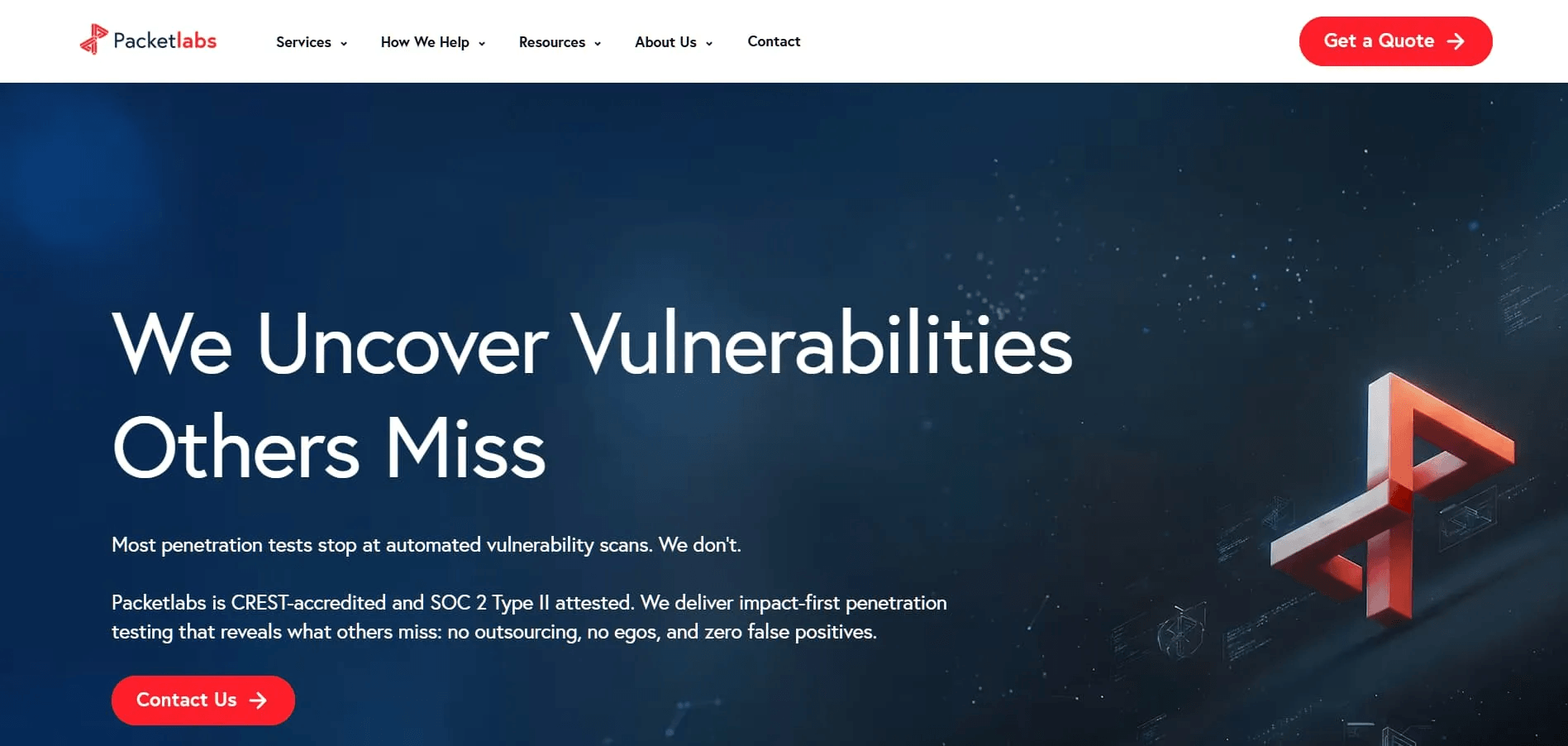
Public offering: Packetlabs describes testing of infrastructure, cloud, IoT, and attack surfaces, with a separate continuous testing option. Its current service page states that testing is human-led and AI is used under tester oversight. It also makes specific statements about client data and public AI services, giving buyers concrete terms to confirm in their statement of work.
Cross-border buying point: Identify the contracting entity, assigned tester locations, and approved processing systems. Carry any required restriction on AI processing, model training, or evidence access into the signed agreement rather than relying on a general marketing statement.
Official source: https://www.packetlabs.net/services-overview/penetration-testing-services/
Buyer fit: Organizations investigating infrastructure, identity, cloud, or connected-device attack paths with explicit data-handling expectations.
| Documented strengths | Limits and buying considerations |
|---|---|
| Published services investigate access paths across infrastructure, cloud, and connected systems. | Select the relevant services and trust boundaries rather than assuming one assessment covers the entire catalog. |
| The provider explicitly describes human oversight and client-data conditions for AI use. | Verify the actual contract, processing systems, exceptions, and evidence-retention arrangements. |
A useful statement of work connects each important security question to assets, access, and acceptable evidence. The following Scope-to-Proof matrix is DeepStrike's procurement framework, not a certification standard or a claim about work performed by the listed providers.
| Security question | Scope and access to provide | Evidence to request |
|---|---|---|
| Can one customer or partner access another's records? | At least two representative tenants, relevant roles, portal workflows, and API documentation | Sanitized evidence of authorization checks and any validated cross-tenant path |
| Can a regional administrator exceed the intended boundary? | Regional roles, identity configuration, federation relationships, and representative accounts | A record of tested privilege boundaries, preconditions, results, and limitations |
| Can an exposed workload reach sensitive cloud resources? | Approved cloud accounts, identity paths, workload context, and access restrictions | Validated paths or control observations tied to specific assets and permissions |
| Can a compromised internal account reach a critical system? | Approved internal access, network boundaries, identities, and safe test targets | Evidence of the agreed movement or segmentation scenarios without uncontrolled access |
| Can a device or client expose backend privileges? | Devices or builds, firmware where applicable, backend interfaces, and test credentials | A connected account of client, communication, API, and backend findings |
| Can an AI-enabled workflow access data or actions beyond its authority? | Approved model-facing workflows, retrieval sources, tool permissions, and test data | Evidence of authorization outcomes and downstream effects within the permitted scenario |
Use the OWASP Web Security Testing Guide to help organize application test cases. A reference to OWASP is useful context, but it does not replace a provider's statement of which tests, roles, and workflows were actually covered.
An API-only shortlist belongs in the dedicated guide to API penetration testing companies. Keep detailed endpoint and authorization requirements in that specialist scope instead of treating the words “API included” as sufficient coverage.
Likewise, use the dedicated comparison of cloud penetration testing companies when cloud identity, account boundaries, and deployment architecture dominate the engagement.
Consider a fictional B2B distributor with a customer portal, partner APIs, regional administrators, and single sign-on shared with an acquired subsidiary. Its objective is to assess whether a low-privilege account can cross customer or regional boundaries. This example illustrates proposal review; it is not a customer case study or a test result.
Proposal A describes a public web application test. Proposal B includes authenticated testing of representative roles and the connected API and identity boundaries. Neither proposal should be selected solely from the headline price or number of calendar days.
| Requirement | Proposal A | Proposal B |
|---|---|---|
| Portal access | Public pages and one standard user | Standard, partner, and regional administrator roles |
| Tenant boundaries | Not specified | Two isolated test tenants with synthetic records |
| Partner API | Listed as an integration without explicit testing | Named API workflows and authorization scenarios |
| Shared identity | Login functionality only | Agreed federation and role-boundary scenarios; third-party systems excluded unless authorized |
| Regional delivery | Tester location and working hours unstated | Permitted locations, access window, and regional escalation owners documented |
| Evidence handling | Standard report delivery | Agreed storage, redaction, access, retention, and deletion terms |
| Closure | Report and optional follow-up | Original-finding retest, residual-risk status, and separately priced new scope |
For this objective, Proposal B provides a stronger basis for selection because its coverage matches the business question. That is a judgment about the documented proposals, not evidence that one unnamed vendor is more skilled. Proposal A could still suit a deliberately narrow external-exposure test; it needs revision before it answers the distributor's stated question.
Before award, ask both suppliers to price the same minimum scope. Separate active testing effort from elapsed scheduling time and identify what is included in reporting and retesting. If B exceeds the budget, narrow lower-priority assets explicitly while retaining the customer and regional authorization boundaries that motivated the test.
A useful closeout would identify the tested roles and deployments, show reproducible findings using synthetic records, document untested dependencies, and distinguish corrected findings from unresolved risk. “No critical findings” would not, by itself, demonstrate that the agreed boundaries were assessed.
Ask for a sanitized sample before contracting. The report should allow an engineer to understand and fix a finding while giving a decision-maker an accurate account of coverage and remaining risk.
| Acceptance criterion | What a useful deliverable shows | What to clarify if it is missing |
|---|---|---|
| Scope traceability | Assets, versions or test dates, roles, access level, exclusions, and limitations | Whether the omitted component was untested, inaccessible, or merely undocumented |
| Reproducible evidence | Preconditions, affected component, safe reproduction detail, and sanitized proof | How engineering can validate the issue without exposing customer information |
| Risk explanation | Technical severity connected to plausible business impact and prerequisites | Whether the severity reflects your environment or only a generic score |
| Remediation guidance | Affected control, actionable fix direction, and compensating controls where appropriate | Who can answer implementation questions and review a proposed fix |
| Retest result | Date, tested fix, observed outcome, and remaining or newly introduced issues | Whether the provider checked the original path and relevant bypass conditions |
| Closure and ownership | Open, corrected, accepted-risk, and not-retested findings kept distinct | Who accepts residual risk and where the evidence will remain available |
A retest validates an agreed change under stated conditions. It does not certify that the whole environment is free of vulnerabilities. If the application changes materially, the provider may need new scope rather than treating the work as a retest of the original finding.
The location of a provider's headquarters does not determine where its testers work or where its platform processes data. Ask for the proposed delivery arrangement, then have the appropriate security, procurement, and legal stakeholders evaluate it against your requirements.
Confirm these points before granting access:
The NIST technical guide to security testing and assessment provides a planning reference for rules of engagement, assessment execution, and reporting. Translate that planning discipline into your own authorization and operational constraints.
If a customer, assessor, or sector-specific scheme requires particular provider qualifications or a particular type of exercise, obtain the exact requirement before choosing. Verify the relevant entity and scope of any claimed accreditation. An individual's certification, a company's accreditation, a security compliance report, and acceptance of your pentest report are different things.
For UK-specific procurement, the comparison of penetration testing companies in the UK provides a separate shortlist. This international guide does not substitute for a country-specific or scheme-specific approval check.
There is no defensible single price for the twenty companies in this guide. Most assessments require a scoped quote, and public prices may cover a narrow product or promotion. The examples below were checked on October 8, 2026; they are not a market average or comparable bids.
| Provider and product | Published price or commercial model | Scope and conditions to carry into the comparison |
|---|---|---|
| DeepStrike Basic | Scoped quote; no numeric price displayed | One-shot testing; the page lists 12 months of remediation retesting. Confirm covered assets, eligible fixes, and changes. |
| Cobalt Autonomous Pentest | Promotional US$3,500 per test | Web application product with Cobalt Core pentester direction. The test must begin and finish before December 31, 2026 to qualify. Credit deductions can depend on the contracted credit rate. |
| Aikido Typical Pentest | US$4,000 per assessment, excluding applicable taxes | Time-boxed assessment of one application and its primary APIs; white-box is the stated default. Black-box and gray-box cost extra. Retesting applies to initial findings for up to six months. |
| Pen Test Partners PTaaS | Consultant time purchased in half-day blocks; no numeric rate used here | Change-focused testing, with a full baseline assessment recommended first. Confirm capacity and the treatment of larger changes. |
Official pricing sources: Pricing; https://www.cobalt.io/platform/pricing; https://www.aikido.dev/pricing; https://www.pentestpartners.com/service/pen-testing-as-a-service-ptaas/
Compare the total cost of the required work: assessment, reporting, retesting, coordination, and any necessary travel or specialist effort. A price per application, a day rate, a credit allocation, and an annual subscription use different units. Do not convert them into a cheapest-to-most-expensive ranking without normalizing the scope.
Use this worksheet when requesting proposals:
| Ask every supplier for | Why it changes the comparison |
|---|---|
| Named applications, APIs, networks, deployments, and exclusions | Prevents a narrow quote being mistaken for broad coverage |
| Roles, tenant boundaries, authentication models, and source access | Reveals which security questions the assessment can actually investigate |
| Assigned specialties and active testing effort | Separates technical work from elapsed project duration |
| Human, automated, and agentic responsibilities | Shows who investigates, validates, and accepts each class of result |
| Evidence, report format, and technical handoff | Makes deliverables usable by the people receiving them |
| Retest scope, window, booking, and new-scope charges | Clarifies the cost and practical availability of fix validation |
| Regional staffing, data-processing, and incident contacts | Exposes procurement constraints before access is granted |
| Currency, taxes, travel, platform access, cancellation, and renewal | Supports a like-for-like total commercial comparison |
A smaller organization can often begin with one important application or externally exposed environment, clearly defined roles, a realistic remediation owner, and a retest commitment. Ask for a proposal that fits the team's ability to act on findings. Buying a larger scope than the team can remediate may delay the most useful improvements.
An enterprise may need a common coverage model across business units, centralized reporting, regional access rules, supplier security review, and a process for new acquisitions or releases. Ask how results stay comparable when different delivery teams work on different systems. A recurring contract should state both its capacity and its limits.
Request separate dates for scoping, access preparation, active testing, reporting, remediation, and retesting. The active assessment is only one part of the schedule. Regional approvals, test accounts, synthetic data, and engineering availability can affect the calendar, so confirm dependencies before committing to a customer or audit deadline.
Base the cadence on meaningful changes, exposure, risk, and applicable contractual or assessment requirements. A major identity change, new partner API, acquisition, or cloud migration may justify targeted testing before the next scheduled full assessment. Distinguish testing of a change from a fresh review of the complete environment.
Possibly, but confirm availability and conditions for each relevant entity, environment, and location. A global brand or remote delivery model is not sufficient evidence. Use a common scope and reporting standard, then document any regional staffing, access, language, or processing exceptions before award.
Build a shortlist around your environment, delivery constraints, and evidence requirements. Then compare providers against the same roles, attack paths, reporting standards, and retest conditions. For international work, make regional access and data handling part of the scope from the start.
If DeepStrike is on your shortlist, request a scoped proposal using the worksheet above, including the evidence your engineering and risk teams need to accept the engagement.
Mohammed Khalil is a Cybersecurity Architect at DeepStrike, specializing in advanced penetration testing and offensive security operations. With certifications including CISSP, OSCP, and OSWE, he has led numerous red team engagements for Fortune 500 companies, focusing on cloud security, application vulnerabilities, and adversary emulation. His work involves dissecting complex attack chains and developing resilient defense strategies for clients in the finance, healthcare, and technology sectors.
Provider service pages and the selected pricing pages are identified beside the relevant profiles and pricing comparison. Those pages were checked on October 8, 2026 and describe advertised offerings, not independently measured outcomes. Company screenshots illustrate provider identity and may show an earlier website design; they are not proof of current pricing, accreditation, or test quality.
OWASP's Web Security Testing Guide and NIST SP 800-115 inform the assessment-planning discussion. The Scope-to-Proof matrix, fictional proposal comparison, acceptance checklist, and procurement worksheet are DeepStrike's editorial frameworks. They should be adapted to the authorized environment and the requirements of the people who will use the findings.

Stay secure with DeepStrike penetration testing services. Reach out for a quote or customized technical proposal today
Contact Us
