November 24, 2026
Updated: November 24, 2026
What TikTok Shop's partner policy and API documentation mean for a penetration test: the app secret, shop isolation, webhooks, buyer data, and fix deadlines.

Mohammed Khalil
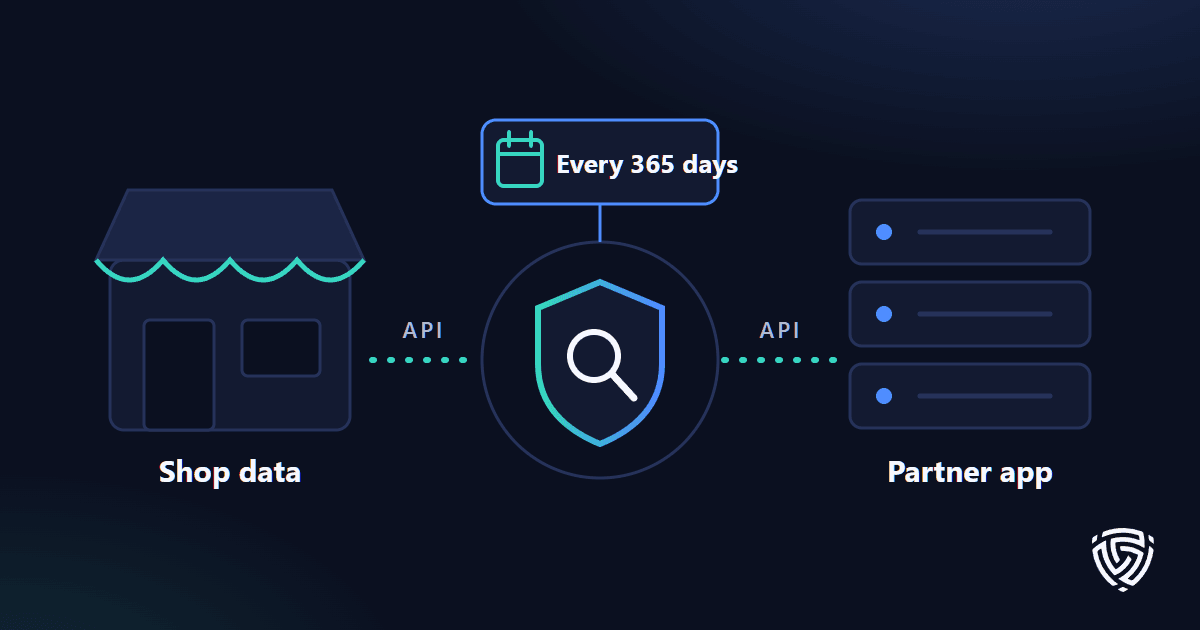
Three days. That is how long TikTok Shop's new partner policy gives a service provider to fix a critical vulnerability, and it allows 30 days after order delivery before buyer data taken from orders has to be gone. The same document, the TSP Security and Data Protection Policy, takes effect on December 20, 2026 and requires penetration tests at least every 365 days. It does not say what the test should cover. This guide to TikTok Shop penetration testing works that out from TikTok Shop's own pages: the policy clauses a test can verify, and the API mechanics (one app secret, shop identifiers, signed webhooks, masked buyer data) that decide where a partner app is most likely to fail.
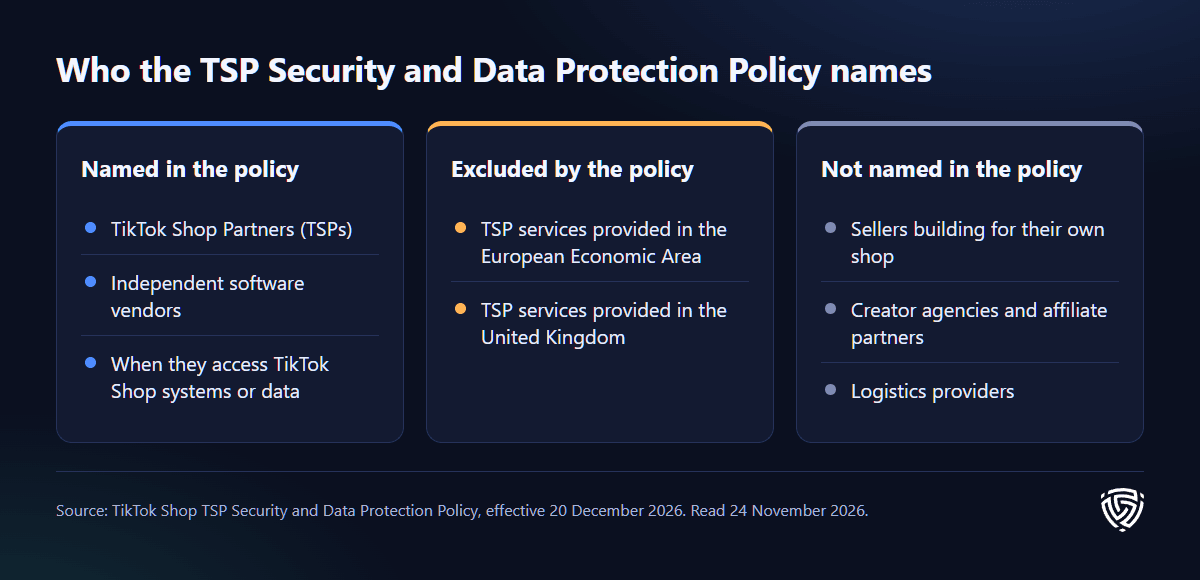
The TikTok Shop TSP Security and Data Protection Policy sits in the Terms and Policies section of Partner Center and is headed "Effective from: 20 December 2026." It sets requirements for "TikTok Shop Partners ('TSP' or 'Service Provider'), including independent software vendors, accessing TikTok Shop ('TTS') systems or data." It states that it forms part of the Partner Center Terms of Service and that it "does not apply to TSP services provided in the European Economic Area or United Kingdom."
Sellers and creators appear in the text as Authorizing Users, the people who grant a provider access. Creator agencies, affiliate partners, and logistics providers are not named. If your category is unclear, ask your partner manager in writing.
The testing rule is one item in clause 15.1:
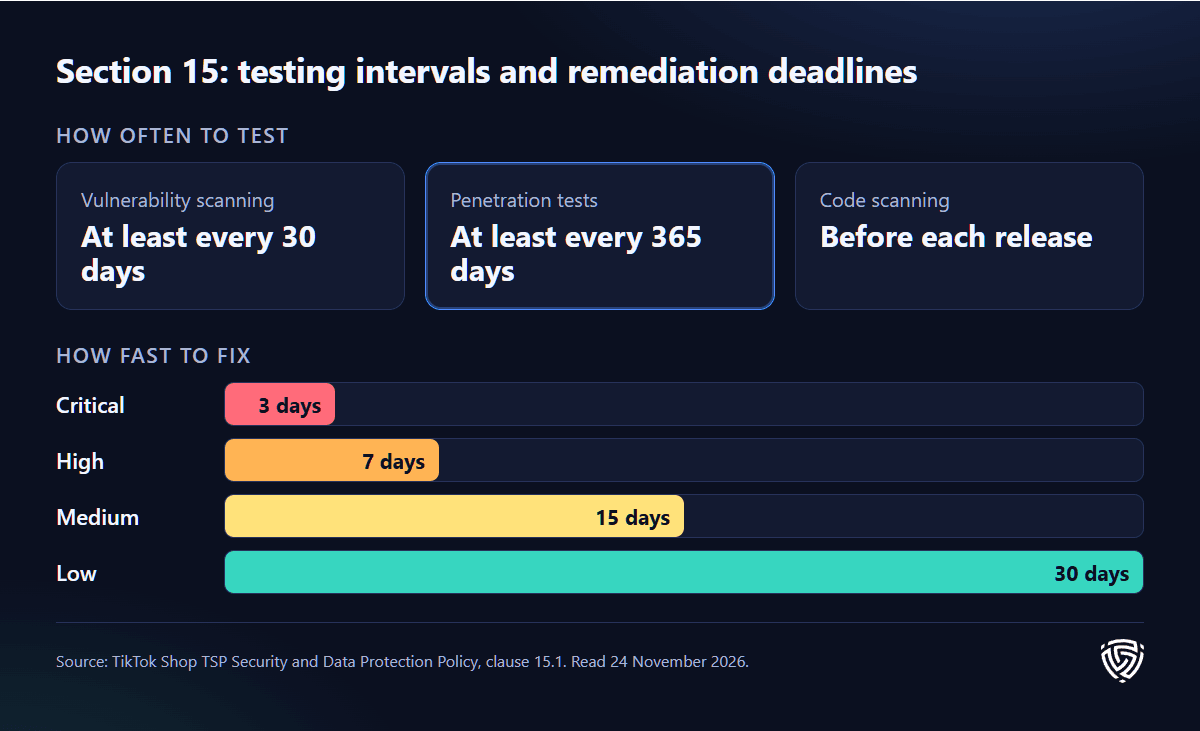
"Conduct vulnerability scanning at least every 30 days, penetration tests at least every 365 days, and scan code for vulnerabilities prior to each release."
Nothing else in the policy describes the test. It names no tester, method, scope, report format, or date for a first test, so an in-house test is not ruled out. The Developer Terms of Service still list "Penetration testing as appropriate" in Annex A, and the policy adds a fixed interval on top of that for the partners it names.
On November 24, 2026 the page still showed the placeholder "[insert verified channel]" in clauses 1.3, 3.5, and 16.1, where a reporting contact belongs. The wording may change. Save a dated copy and read the live page again on the effective date.
Clause 15.1 gives no scope, but the other sections describe controls a tester can check directly. Each row pairs policy text with an objective for an authorized test of your own systems.
| Clause | Policy text | Test objective | The control fails when |
|---|---|---|---|
| 4.6 | "Identify the originating Authorizing User and prevent unauthorized access or use across Users." | Cross-shop access on every endpoint, export, and report | One shop's user reads or changes another shop's data |
| 7.1 | "User accounts must be locked out after 10 or fewer unsuccessful login attempts." | Lockout on every login surface, including admin and API logins | An eleventh guess is accepted anywhere |
| 8.4 | "Require Multi-Factor Authentication (MFA) for all user accounts." | Seller, staff, and admin sign-in, plus recovery and single sign-on paths | Any path reaches Platform Data with a password alone |
| 8.4 | API keys "encrypted and accessible only to employees who require access" | Where the app secret and tokens are stored and who can read them | A secret is readable in configuration, build output, or a support tool |
| 12.1 | Encryption in transit enforced "on all applicable internal and external endpoints" | Protocol versions on public and internal services | Plaintext or outdated TLS between internal services |
| 13.2 | "must not hardcode sensitive credentials in their code" | Client bundles, mobile builds, repositories, container images | A credential ships in any artifact |
| 14.1 | Logs must "not contain Platform Personal Data"; alarms on "unexpected request rate and data retrieval volume" | Log content after test traffic, and whether bulk reads raised an alert | Buyer details appear in logs, or a mass export goes unnoticed |
| 18.2 | Deletion "covers all live instances, exports, caches, backups and subcontractor copies" | What remains after a shop disconnects | Orders are still retrievable after the deletion window |
| 19.2 | "respect per-Authorizing User throttling quotas" | Whether one tenant can exhaust shared call capacity | One shop's activity stalls synchronization for the others |
Other sections shape the scope more than the test cases. Section 9 requires network segmentation and intrusion detection, clause 10.1 a quarterly inventory of assets with access to Platform Personal Data, and section 17 a geographically separated backup site. That inventory is the natural starting list for a written penetration testing scope.
The policy names no methodology. NIST SP 800-115, the OWASP Web Security Testing Guide, and the OWASP API Security Top 10 are public options. State which one was used in the report.
The policy talks about "API keys." The Partner Center documentation shows what that means in practice.
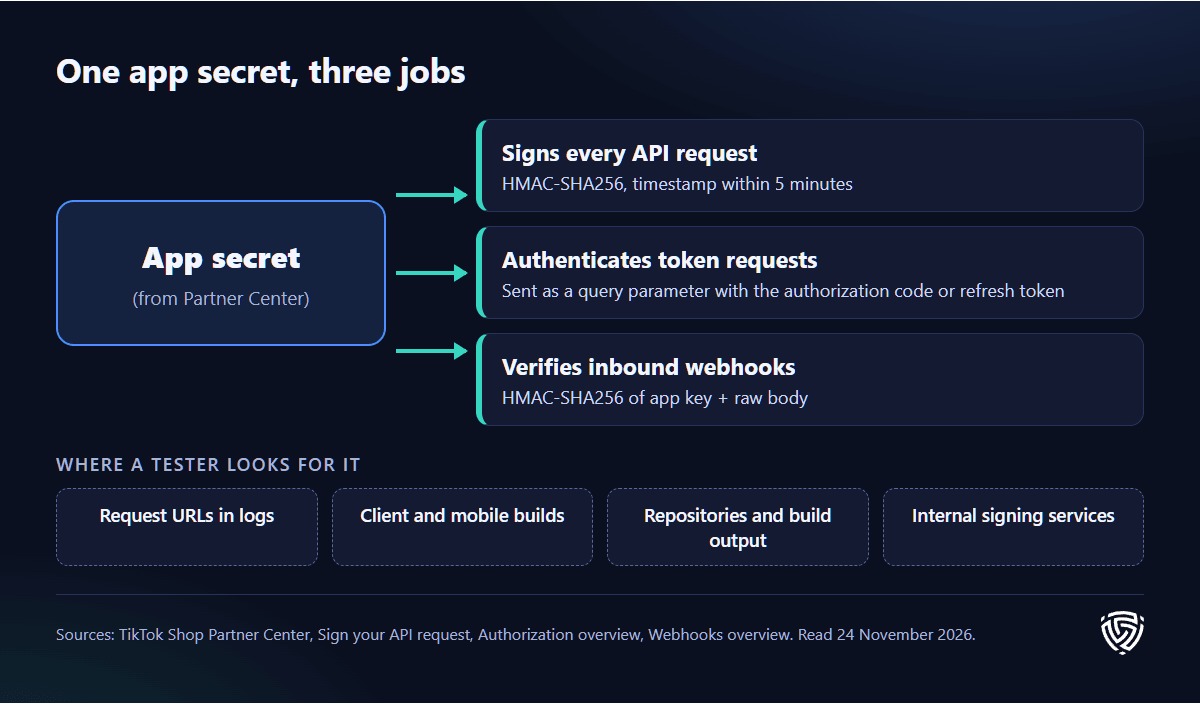
TikTok Shop's guide to signing API requests says: "TikTok Shop APIs use your app secret as the private key for authentication." Every call carries an HMAC-SHA256 signature computed with that secret over the request path, the sorted query parameters, and the body. The timestamp must be within five minutes of the time TikTok Shop receives the request.
The same secret does two more jobs. The authorization overview shows the token endpoints as GET requests that carry app_key, app_secret, and the authorization code or refresh token as query parameters. And the secret is the key for checking inbound webhooks.
| Item | Documented behavior | Partner Center page |
|---|---|---|
| App secret | Signs API requests, authenticates token requests, verifies webhooks | Sign your API request, Authorization overview, Webhooks overview |
| Request timestamp | Within 5 minutes of receipt | Sign your API request |
| Authorization code | Expires in 30 minutes, usable once | Authorization overview |
| Access token | Default validity 7 days, sent in the x-tts-access-token header | Authorization overview |
| Refresh token | Expires with the authorization duration the seller granted | Authorization overview |
| Webhook retries | Four retries: after 2 minutes, 30 minutes, 3 hours, and 12 hours | Webhook configuration guide |
Our reading of those pages: whoever holds the app secret and a stored token can act as your app toward every shop that authorized it. Clauses 8.4 and 13.2 then become specific test targets:
Clause 3.4 adds a housekeeping risk: TikTok Shop may delete access keys that make no successful call in 90 days.
A seller connects a shop by approving an authorization link. TikTok Shop then redirects the browser to the app's redirect URL with a code and a state value, and the backend exchanges the code for tokens.
The documentation lists state as recommended, not enforced, and says it "should be an unguessable, server-generated, single-use random string that you validate on callback." The flow returns the seller to the app's Redirect URL, so teams that need several destinations sometimes route callbacks by the state value. That turns a security token into routing data, which is where flaws appear. A test should show that:
Then the token store. TikTok Shop's guide to connecting shops notes that an access token "does not contain enough shop-identifying information by itself," so apps keep tokens beside shop identifiers. Testers look for tokens returned to the browser, readable through a connection identifier that belongs to another customer, or written to logs and job queues.
The guide to disconnecting shops says the current API reference "does not list a public endpoint for a developer to revoke a seller's authorization." Removing a shop in your product is therefore a local action, and the tokens stay valid at TikTok Shop until the seller cancels the authorization or it expires. Clause 18.2 requires you to stop access and use when authorization ends, so the test checks that tokens are gone from stores, caches, and pending jobs.
TikTok Shop separates data by shop on its side. Shop-level endpoints need a seller access token plus the shop_cipher value returned by Get Authorized Shops. Inside a partner app, separation is whatever the code does with those identifiers. The connecting guide tells developers to store the token response and the authorized shop data together under their own customer identifier.
This is clause 4.6 in practice, and the multi-tenant form of broken object level authorization, the first entry in the OWASP API Security Top 10. A thorough test swaps shop, order, package, and connection identifiers between two test tenants across:
Capacity has a tenant boundary too. The rate limits guide calls the App ID and Authorized Shop pair the "minimum shop-scoped isolation unit" and tells developers: "Do not let one shop's traffic consume another shop's queue." A tester checks whether one tenant can trigger enough calls to stall the others, which is also what clause 19.2 asks you to prevent.
API penetration testing covers the routes, and the seller-facing portal belongs in a web application penetration testing scope.
According to the webhooks overview, "TikTok Shop sends the webhook signature in the HTTP Authorization header." The value is an HMAC-SHA256 digest of the app key followed by the raw request body, keyed with the app secret. The page tells receivers to reject missing or mismatched signatures and to compare with a constant-time function.
Delivery is at least once, and the documentation says to store tts_notification_id for duplicate handling. The published formula contains no nonce, and the two webhook pages we read state no time window for accepting a delivery. Our inference: a captured request stays valid until the secret is rotated, so replay defense is the receiver's job.
Test objectives for the listener:
Source IP filtering is not a substitute. TikTok Shop's own notice on webhook addresses tells developers to treat signature verification as the primary authenticity check and IP allowlisting as defense in depth.
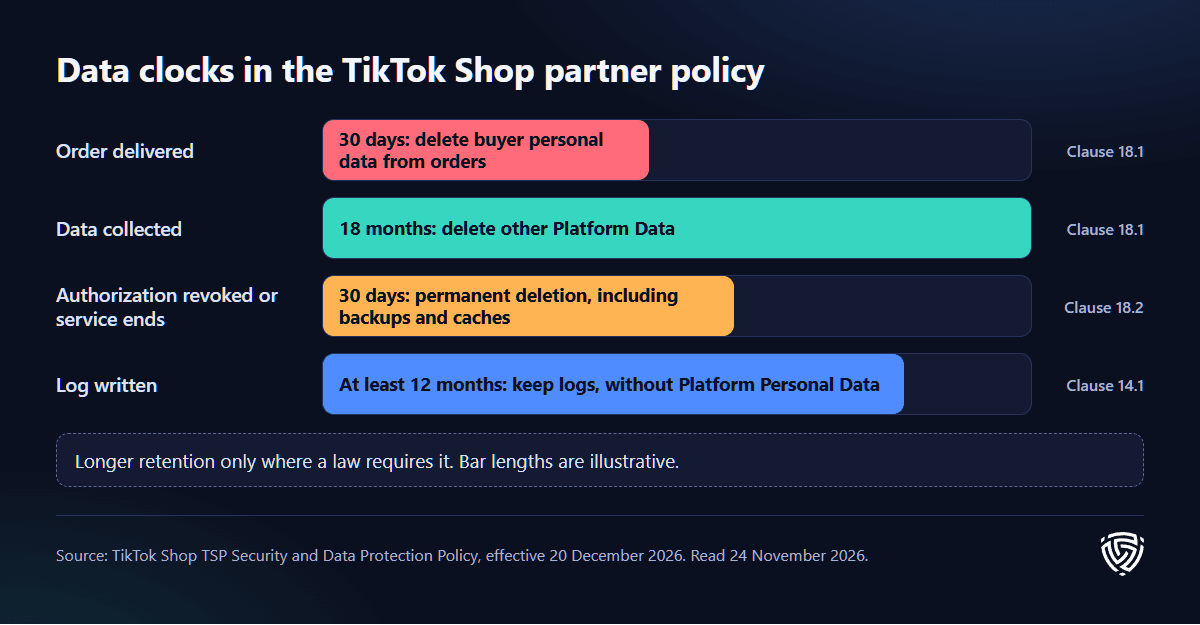
Clause 18.1 is the tightest data rule in the policy. Providers may keep "Platform Personal Data about Buyers contained in orders for no longer than 30 days after order delivery," and longer only where a law requires it. Other Platform Data is capped at 18 months from collection. When authorization is revoked or services end, clause 18.2 requires permanent deletion within 30 days, following a sanitization standard such as NIST SP 800-88.
TikTok Shop also limits what reaches a partner in the first place. A Partner Center notice on buyer personal information masking says that from October 12 the app category decides whether the order and package endpoints return the buyer's name, phone number, email address, and shipping address unmasked, and that "Other App Categories will receive masked data by default." A second notice, on US orders shipped through TikTok, instructs developers: "Do not display previously cached plaintext after TikTok Shop returns masked values."
A tester can show presence, not absence:
Backups need different evidence: retention job records and a restore test that shows deleted records do not come back.
Clause 15.1 sets the fix clock: "Remediate vulnerabilities within 3 days for critical, 7 for high, 15 for medium and 30 for low severity." The policy does not define the severity levels or say when the clock starts, so write both into your vulnerability management plan. Monthly scanning and release-time code scanning sit beside the annual test and do not replace it, as our comparison of vulnerability assessment and penetration testing explains. Some teams move to continuous penetration testing so findings arrive in batches small enough to fix in days.
Three documents carry the consequences. Section 20 of the policy lets TikTok Shop audit a provider, directly or through an independent accounting firm, and demand written certification of compliance. Clause 12.1 of the Partner Center Terms of Service allows suspension, removal of services, or account termination for a breach of TikTok policies. And the Violation Management Regulations for TikTok Shop Partners, which cover partners selling services through the Service Market, list an application with "security bugs that can cause data leakage and are not fixed in time" as a violation worth 120 points. At 120 points a partner is "No longer allowed to enter the Service Market."
The launch reviews are softer than the policy. The Data Security and Privacy Review guide asks for "penetration test reports if available" and at least annual access review evidence. The policy asks for an annual test and quarterly access reviews. Build to the policy.
Keep the test on your side of the line. The Partner Center Terms forbid circumventing security measures on TikTok systems, so point the test at your own application, with test shops from the Partner Center sandbox. A notice caps sandbox shops at 1,000 requests per hour. For what the finished document should contain, see our guide to the penetration testing report.
Much of the TikTok Shop policy matches the wording of Amazon's Data Protection Policy for Solution Providers. If you already run that program, most of your evidence carries over.
| Topic | TikTok Shop policy | Amazon Data Protection Policy |
|---|---|---|
| Penetration test | "at least every 365 days," no scope or method | "at least every 365 days using an industry-recognized methodology," with a listed scope |
| Vulnerability scanning | "at least every 30 days" | "at least every 30 days," plus change-triggered scans |
| Remediation | 3, 7, 15, and 30 days for critical, high, medium, and low | Critical "7 days from discovery," high-risk "30 days from discovery" |
| Buyer order data | "no longer than 30 days after order delivery" | "no longer than 30 days after order delivery" |
| Other data | "no longer than 18 months from collection" | No fixed cap, only as long as strictly necessary |
| Account lockout | "10 or fewer unsuccessful login attempts" | "no more than ten (10) consecutive unsuccessful login attempts" |
| Encryption at rest | "at least AES-128 or RSA with 2048-bit key size or higher" | At least AES-128 or RSA-2048 bit keys |
| Incident notice | "no later than 24 hours after becoming aware," channel still a placeholder | "within twenty four (24) hours of detecting," by email to a named address |
| Internal traffic | TLS 1.2+ on "all applicable internal and external endpoints" | Internal encryption "based on risk and data sensitivity" |
Four gaps stand out for a team that already meets Amazon's policy: faster fix deadlines that also cover medium and low findings, the 18-month cap, encryption on internal endpoints, and the duty in clause 4.6 to identify the originating Authorizing User. In the other direction, Amazon's text lists what a penetration test must cover (network, cloud, application layer, and other in-scope systems). Since TikTok Shop publishes no scope, that list is a reasonable template to borrow. Our article on Amazon SP-API penetration testing covers that side in detail.
The authorization overview lists it as recommended and describes it as an unguessable, server-generated, single-use random string that you validate on callback. Treat it as required in your own app, and never use it as a destination address.
The authorization overview gives a default access token validity of 7 days and says the refresh token expires with the authorization duration the seller granted.
You cannot do it from your side. The disconnecting guide says the current API reference lists no public endpoint for a developer to revoke a seller's authorization, and that a seller can revoke it in TikTok Shop. Delete your stored tokens and the shop's data under clause 18.2.
No. TikTok Shop's notice on webhook addresses calls signature verification the primary check and IP allowlisting an extra layer.
Since the masking change, unmasked buyer details depend on the app category and market. Categories outside the published list receive masked values by default. Do not try to rebuild them from older cached data.
Nothing in the policy says so. The review guide treats certifications as optional evidence that does not replace the questionnaire answers.
The policy describes no routine submission. It requires records, written certification on request, and evidence during an audit.
TikTok Shop's partner policy gives the penetration test a date and an interval and leaves the content to you. Its other clauses and the platform's own API documentation supply that content: guard the one app secret that signs requests, mints tokens, and verifies webhooks, prove that shops cannot reach each other's data, make the webhook listener reject forgeries and replays, and show that buyer data from orders is gone on time. Fix findings inside the 3, 7, 15, and 30-day clocks, keep dated evidence, and re-read the live policy on December 20, 2026, because the published text still has placeholders.
DeepStrike is a penetration testing company founded in 2016 and headquartered in Newark, Delaware, with a branch in Dubai. Our work covers web applications, APIs, mobile apps, and cloud environments, with continuous penetration testing available for products that ship frequently. Our site lists four deliverables: a report with fix recommendations, a shared Slack channel with the testers, an attestation letter, and a technical presentation.
We do not assess partners on TikTok Shop's behalf, and the outcome of any review or audit is TikTok Shop's decision alone. To start a scoping conversation, tell us how your app stores the app secret and tokens, how many shops and user roles it serves, where the webhook listener runs, and when your last test took place.
All sources were read on November 24, 2026. This article is not legal advice.
TikTok Shop Partner Center:
Other platform policy:
Standards:
Mohammed Khalil is a Cybersecurity Architect at DeepStrike, specializing in advanced penetration testing and offensive security operations. With certifications including CISSP, OSCP, and OSWE, he has led numerous red team engagements, focusing on cloud security, application vulnerabilities, and adversary emulation. His work involves dissecting complex attack chains and developing resilient defense strategies for clients in the finance, healthcare, and technology sectors.

Stay secure with DeepStrike penetration testing services. Reach out for a quote or customized technical proposal today
Contact Us
