July 20, 2026
Updated: October 1, 2026
A practical guide to penetration testing contracts, including authorization, scope, rules of engagement, data handling, liability, deliverables, retesting, red flags, and an annotated agreement framework.

Mohammed Khalil
A penetration testing contract is the agreement framework between a client and testing provider that establishes authority, services, scope references, safety boundaries, responsibilities, evidence handling, deliverables, commercial terms, and closure. It does not authorize testing of assets the client does not own or control, and it cannot replace a precise scope and Rules of Engagement. This guide is educational; qualified legal and procurement teams should review final language before signature.
A penetration testing contract is the signed agreement framework governing an authorized security test. It identifies the contracting parties, allocates responsibilities, connects the commercial terms to the approved work, and states which supporting documents control testing. Depending on the organization, that framework may be a standalone penetration testing services agreement or an MSA supplemented by a SOW, technical scope, ROE, authorization letter, and data terms.
“Contract” and “agreement” are often used interchangeably in business discussions. Their legal effect depends on the actual text, execution, governing law, and authority of the parties not the label alone. Legal counsel should determine the appropriate form.
Written permission must come from a person or entity with authority over the target. A client cannot grant rights it does not possess. Shared platforms, shared hosting, customer environments, acquired companies, managed infrastructure, SaaS dependencies, and cloud services may require separate owner consent or compliance with provider policy.
The contract should connect, rather than collapse, the supporting documents. NIST SP 800-115 describes assessment plans and ROE as pre-test controls that identify boundaries, permitted and prohibited activity, logistics, data handling, incident procedures, and approvals. NIST also calls its Appendix B ROE structure a starting point that organizations may need to supplement not a universal form. NIST SP 800-115
No responsible agreement should promise that every vulnerability will be found. A test is bounded by time, assets, access, information, methods, safety constraints, and system state. It can help identify exploitable weaknesses and support defined assurance objectives, but it cannot guarantee compliance, certification, audit approval, future security, or breach prevention.
Review the agreement across five connected layers:
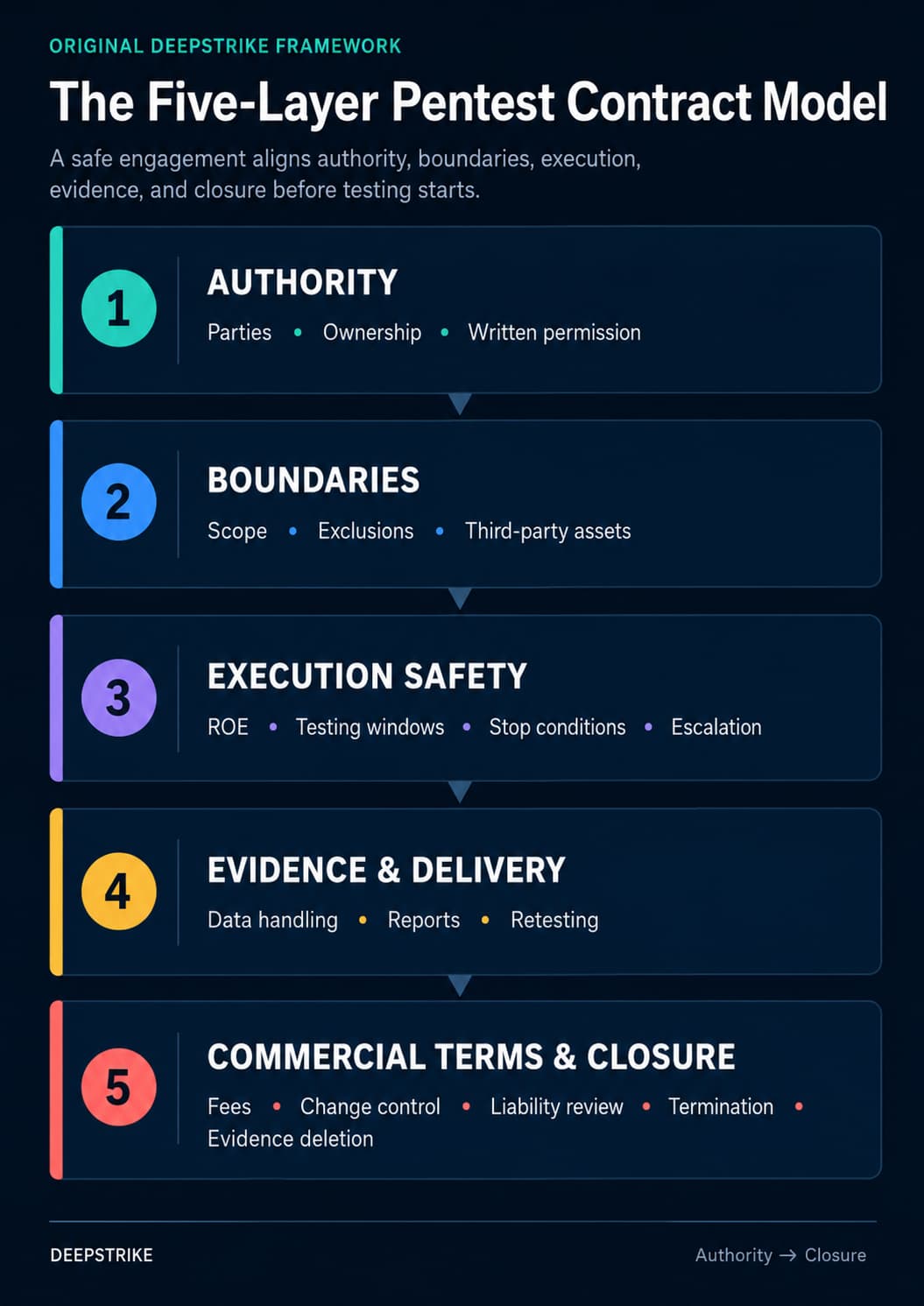
Figure 1. DeepStrike’s Five-Layer Pentest Contract Model connects authority, scope, safe execution, evidence, and commercial closure.
Source: Original DeepStrike framework informed by NIST SP 800-115 planning and Rules of Engagement concepts.
There is no single mandatory document architecture for every buyer, provider, jurisdiction, or assessment. The following model shows the usual function of each document and the gaps it should not be expected to fill.
| Document | Primary purpose | When it is used | What it should define | Typical owner or reviewer | What it should not replace |
|---|---|---|---|---|---|
| Request for Proposal | Solicit comparable provider responses | Before selection | Requirements, evaluation criteria, procurement instructions | Procurement, security, legal | Contract, authorization, or ROE |
| Proposal or quote | State the provider’s proposed approach and commercial assumptions | During evaluation | Proposed services, effort basis, assumptions, exclusions, fees | Provider sales/delivery; buyer security and finance | Executed agreement or exact scope |
| Master Services Agreement | Set reusable legal and commercial terms | Before or alongside one or more projects | General confidentiality, IP, warranties, liability, payment, disputes, term | Legal and procurement | Project-specific work plan or permission to test |
| Penetration Testing Services Agreement | Govern the testing relationship, sometimes as a standalone contract | Before testing | Authority framework, responsibilities, risk allocation, data, commercial terms, supporting documents | Legal, procurement, security, provider leadership | Exact asset schedule or detailed ROE unless expressly integrated |
| Statement of Work | Define the project-specific work plan | After selection, before kickoff | Objective, services, schedule, assumptions, responsibilities, deliverables, acceptance, retesting | Security, procurement, provider lead | MSA, technical scope, or authorization by default |
| Technical scope | Define testable boundaries | During scoping and before authorization | Asset identifiers, roles, environments, exclusions, dependencies | Security, engineering, asset owners, tester | Commercial terms or full operating rules |
| Rules of Engagement | Control how authorized testing is executed | Before active testing | Allowed and prohibited activities, windows, rate limits, contacts, stop and escalation rules | Security, SOC, engineering, provider lead, legal as needed | Asset-owner authority or commercial agreement |
| Authorization or permission-to-test letter | Evidence express approval for defined testing | Before any testing | Authorizing party, provider, assets, dates, approved activities, governing references, contacts | Asset owner or authorized representative; legal/security | Detailed scope, ROE, or third-party permission |
Document comparison — continued (2 of 2)
| Document | Primary purpose | When it is used | What it should define | Typical owner or reviewer | What it should not replace |
|---|---|---|---|---|---|
| NDA | Protect confidential information exchanged by the parties | Before sensitive disclosure | Confidential information, permitted use, recipients, exclusions, return/deletion, survival | Legal, privacy, procurement | Operational evidence controls or a DPA where required |
| DPA or BAA, where applicable | Address regulated or personal-data processing obligations | Before relevant data is processed | Roles, instructions, safeguards, subprocessors, incidents, deletion, required regulatory terms | Privacy, legal, compliance | NDA, authorization, or universal data terms |
| Service-Level Agreement | Define measurable service commitments | With the services agreement or SOW | Response, availability, escalation, or turnaround commitments that actually apply | Service owner, procurement, provider delivery | Testing scope, methodology, or acceptance criteria |
| Purchase order | Authorize purchasing and payment administration | After commercial approval | PO number, approved amount, billing details, purchasing references | Procurement and finance | Substantive testing terms unless expressly incorporated |
| Change order | Approve a controlled change | When scope, schedule, effort, or deliverables change | Changed assets or services, impact, price, dates, approvals | Buyer and provider authorized leads; procurement as needed | Informal chat or unilateral scope expansion |
| Final report | Communicate assessment results | After active testing | Scope performed, limitations, findings, evidence, severity, impact, remediation | Provider QA; security and engineering | Contract, authorization, or proof that all weaknesses were found |
| Retest or validation record | Record the status of specified original findings | After remediation | Original finding, validation date, method at a safe level, result, residual issues | Provider tester/QA; security and engineering | A new full penetration test or new-scope assurance |
For project-specific drafting, use DeepStrike’s guide to a penetration testing statement of work. At the procurement stage, a penetration testing RFP helps solicit and compare responses before a provider is contracted.
The signed stack should state which document controls if terms conflict. A generic “MSA always controls” rule may accidentally override a stricter project-specific data safeguard; an unqualified “SOW controls” rule may disturb negotiated legal protections. Review the conflict by subject legal terms, scope, ROE, data terms, and authorization and reconcile it before testing. Informal messages should not silently change signed boundaries.
The Center for Internet Security publishes provider-specific penetration testing terms that connect its terms to an accompanying SOW and state a precedence rule. That is a useful real-world example of document integration, not universal wording or a substitute for legal review. CIS Penetration Testing Services Terms and Conditions
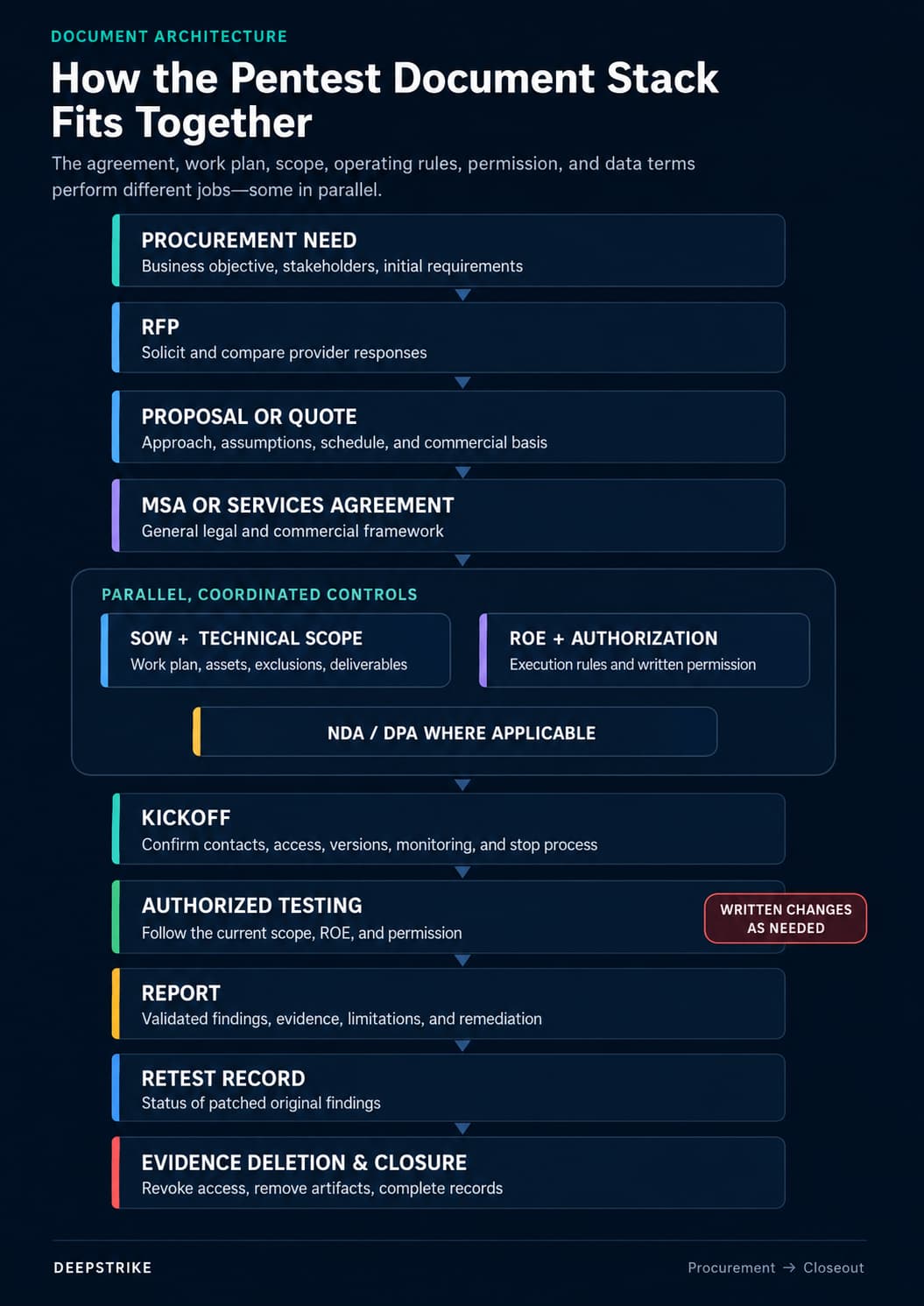
Figure 2. The penetration testing agreement stack from procurement through testing, reporting, retesting, and closure.
Source: Original DeepStrike synthesis based on NIST planning guidance and published penetration testing agreement structures.
Penetration testing is bounded and time-specific. Permission should match the provider, assets, dates, environments, and approved activity. NIST recommends that external assessors ensure proper authority is granted and maintain a signed assessment plan with documented updates. NIST SP 800-115, Sections 6–7
Testing can affect live services even when performed carefully. The agreement stack should turn risk decisions into practical controls: windows, rate limits, fragile-system exclusions, change freezes, monitoring coordination, incident contacts, and pause/resume authority. NIST’s ROE definition emphasizes pre-established constraints and authority for defined activities. NIST ROE glossary
The contract connects services to assumptions, dependencies, deliverables, acceptance, fees, schedule, and changes. It gives both parties a controlled way to address missing access, inaccurate inventories, new assets, delays, and additional work without improvising during the test.
Pentest evidence may contain credentials, tokens, source code, architecture, personal data, logs, screenshots, or exploitable details. The 2017 PCI SSC Penetration Testing Guidance information supplement recommends documenting evidence retention and destruction procedures before testing and reviewing third-party contract language for clarity. The supplement explicitly does not replace or supersede current PCI SSC standards. PCI SSC Penetration Testing Guidance v1.1
Complete these checks before turning a template into contract language:
Cloud rules can vary by provider and service. AWS currently permits testing of listed customer services without prior approval but prohibits testing AWS infrastructure or AWS services themselves and requires prior approval for certain activity such as command-and-control testing. Microsoft’s current Azure guidance says pre-approval is not required for authorized testing of customer-owned resources, but testers must follow Microsoft’s unified ROE; Microsoft does not authorize testing on a customer’s behalf. Verify the relevant provider’s official policy again at kickoff. AWS penetration testing policy Microsoft Azure penetration testing guidance
| Stakeholder | Pre-signature responsibility | Approval or evidence to provide |
|---|---|---|
| Security lead | Own objective, risk decisions, severity expectations, and escalation | Scope approval, security contacts, risk exceptions |
| Legal | Review authority, confidentiality, IP, liability, indemnity, insurance, law, disputes | Approved legal language and unresolved-risk disposition |
| Procurement/vendor management | Control sourcing, entity checks, PO, subcontractor and commercial workflow | Vendor record, executed agreement, purchasing approval |
| Privacy/compliance | Identify regulated data and assurance obligations | Data instructions, DPA/BAA decision, sharing and retention requirements |
| Engineering/application owner | Validate assets, roles, dependencies, stability, test data | Inventory, accounts, diagrams, blackout periods, restoration contact |
| Cloud/infrastructure owner | Confirm accounts, subscriptions, projects, tenants, hosting, third parties | Ownership evidence, provider-policy review, approved access |
| SOC/incident response | Distinguish test traffic and coordinate incidents | Monitoring plan, contacts, pause/resume process |
| Finance | Confirm budget, taxes, expenses, billing and change authority | Funding and invoice approval path |
| Provider lead | Validate feasibility, staffing, safety, evidence and delivery plan | Named lead, tester/subcontractor disclosures, signed acceptance of ROE |
Clause location varies. Some points belong in the services agreement, others in the SOW, scope schedule, ROE, authorization letter, or data appendix. The test is ready only when the signed set answers the operational questions without contradiction.
Identify the legal parties and representatives who can approve work, change scope, pause testing, and accept deliverables. Define key terms only when definitions reduce ambiguity.
State the business objective and expressly connect the services to the approved SOW, penetration testing scope, ROE, and authorization record. The asset schedule should use exact identifiers domains, IP ranges, application URLs, API base URLs, mobile builds, cloud account/subscription/project IDs, networks, identity domains, locations, roles, and environments plus explicit exclusions.
Require the client to represent that it owns, controls, or has obtained authority for each target. That representation should not be treated as proof when the asset inventory shows a third party. Record any provider or owner permission and relevant cloud policy. Define effective dates, testing windows, and document precedence.
Describe the methodology at a high level and attach the ROE that controls execution. The OWASP Web Security Testing Guide can inform web-testing coverage, while NIST SP 800-115 provides planning and ROE context; neither is legal authority or a substitute for exact scope and permission.
Define allowed and prohibited activity, production versus staging constraints, test accounts, access dependencies, approved origins, reasonable rate or concurrency limits, blackout periods, and fragile systems. Name the people who can trigger an emergency stop, how a pause is acknowledged, what evidence is preserved, and who authorizes resumption.
Set a secure critical-finding channel and notification threshold. Align SOC and operations communication so test activity is not mistaken for an unrelated incident or allowed to conceal one. If testers encounter an unlisted asset, suspected real compromise, or unsafe condition, require them to pause affected work and escalate. Scope changes should require written approval from named representatives and, where relevant, a change order.
Separate buyer responsibilities accurate inventory, authority, access, test accounts, documentation, test data, support coverage, and timely decisions from provider responsibilities authorized testing, ROE compliance, qualified staffing, evidence protection, communication, validation, QA, and delivery.
Name engagement leads and define expected tester roles without requiring a particular staffing model by default. Disclosed employees, contractors, and subcontractors can all contribute effectively; the agreement should address approval, screening appropriate to the risk, confidentiality, supervision, location or residency constraints, least-privilege access, substitution, and provider accountability.
Experience and certifications can support due diligence but do not guarantee quality. Ask how the assigned people fit the specific technology, architecture, and test type. Address conflicts of interest and agree a communication cadence, including status updates and urgent escalation.
Define the executive summary, technical findings, evidence standard, severity model, remediation guidance, limitations, and any requested control mapping. State whether the buyer receives a draft, how factual corrections and disputed or duplicate findings are handled, who performs QA, and what makes the final penetration testing report acceptable.
Critical issues should not wait for the final report. Define notification recipients, secure channels, minimum information, acknowledgement, and the relationship between an urgent notice and the later validated report.
Specify closeout, acceptance criteria, review periods, and any deemed-acceptance mechanism for legal review. Retesting should state eligibility, timing, rounds, prerequisites, output, changed-code treatment, and fees. A retest normally validates specified original findings in the agreed environment; it is not automatically a new full penetration test or assurance over unrelated changes.
Explain how the NDA, services agreement, and any DPA or BAA work together. No single NDA, DPA, or BAA structure fits every engagement.
Prefer test data and minimize collection. Define how credentials, tokens, logs, screenshots, source code, architecture, raw output, reports, and any inadvertently encountered sensitive data are transferred, stored, encrypted where appropriate, accessed, redacted, retained, returned, or securely deleted. Address storage location or residency when it matters, backups, legal holds, incident notification, and proof of deletion or attestation if required.
Distinguish ownership of client materials, reports, engagement-specific deliverables, and provider pre-existing tools, methods, templates, and know-how. Give the client the report-sharing rights it actually needs for named auditors, customers, regulators, insurers, counsel, acquirers, or other recipients subject to confidentiality and third-party rights. Prohibit public disclosure, case studies, logos, and marketing use unless expressly approved.
Connect fees and payment milestones to a penetration testing quote, assumptions, dependencies, expenses, and taxes where applicable. Define written change control and the consequences of client-caused delay, failed access, unstable environments, or materially inaccurate scope inputs.
Address term, termination, and suspension for unsafe, unlawful, or unauthorized conditions. State reasonable testing limitations: no promise to identify every vulnerability, guarantee compliance, secure the organization, or prevent a future incident.
Insurance, warranties, limitation of liability, indemnification, governing law, regulatory penalties, dispute resolution, and force majeure allocate material legal and financial risk. Stakeholders should ask whether the language reflects the actual assets, data, production exposure, prohibited conduct, subcontractors, and each party’s control. Do not copy these clauses from a generic sample. Qualified legal review is essential.
Closeout should cover final deliverables, outstanding invoices, test-account revocation, restoration or removal of artifacts, evidence return/deletion, unresolved findings, accepted risk, survival of confidentiality and data duties, and signed approval records.
| Clause or control | What it should answer | Buyer question | Provider question | Risk if missing | Usually located in | Required reviewer |
|---|---|---|---|---|---|---|
| Parties and authority | Who contracts, signs, changes, pauses, and accepts? | Does each signer have authority? | Whose written direction may we rely on? | Invalid approval or disputed instructions | MSA/services agreement; authorization | Legal, procurement, security |
| Asset-owner permission | Who owns or controls every target? | What proof or third-party consent exists? | Are any targets shared or externally owned? | Unauthorized testing | Scope; authorization letter | Legal, asset owner, security |
| Objective | What decision should the test support? | Is the expected outcome realistic? | Does the objective fit the scope and time? | Misaligned effort and unusable evidence | SOW | Security, GRC, provider lead |
| Exact scope and exclusions | Which assets, roles, environments, and activities apply? | Are identifiers exact and current? | Can testers act without guessing? | Overreach, gaps, delays | Scope schedule; SOW | Asset owners, security, provider lead |
| Third-party and cloud terms | Which external permissions and policies apply? | Have current policies and approvals been checked? | What is prohibited by the owner/provider? | Tenant or provider-policy breach | Scope; ROE; authorization | Cloud owner, legal, security |
| Testing window | When may work start, stop, and resume? | Do dates avoid fragile business periods? | Are time zones and support coverage clear? | Production disruption or stale permission | SOW; ROE; authorization | Engineering, SOC, security |
| Allowed/prohibited activity | Which high-level actions are permitted or banned? | Are risk tolerances explicit? | What requires separate approval? | Unsafe or incomplete testing | ROE | Security, engineering, legal as needed |
| Stop/pause procedure | Who can halt work and how? | Is a 24/7 contact available when needed? | What acknowledgement and resume authority apply? | Extended impact or confusion | ROE | SOC/IR, engineering, provider lead |
Clause review matrix — continued (2 of 3)
| Clause or control | What it should answer | Buyer question | Provider question | Risk if missing | Usually located in | Required reviewer |
|---|---|---|---|---|---|---|
| Critical escalation | What triggers immediate notice and to whom? | Can recipients act securely and quickly? | What evidence is sufficient before final QA? | Urgent risk waits for final report | ROE; SOW | Security, SOC/IR, provider QA |
| Incident coordination | How are test effects and real incidents handled? | Who leads and preserves evidence? | When must affected testing stop? | Test activity obscures or worsens an incident | ROE; incident appendix | SOC/IR, legal, provider lead |
| Client dependencies | What access, accounts, data, and support are required? | Can inputs be delivered on time? | What happens if inputs fail? | Delay, reduced coverage, fee dispute | SOW | Engineering, security, procurement |
| Personnel and subcontractors | Who accesses systems and under what controls? | Are third parties disclosed and approved? | What screening, supervision, and substitution rules apply? | Uncontrolled sensitive access | Services agreement; SOW; DPA | Procurement, legal, security and privacy |
| Deliverables | What exact outputs and evidence are included? | Will each audience receive usable content? | What format and depth are priced? | Generic or disputed output | SOW | Security, engineering, GRC, provider QA |
| Severity and disputes | How are ratings, duplicates, and disagreements handled? | Can business context adjust not erase technical evidence? | Who makes the final report judgment? | Inconsistent risk decisions | SOW; report criteria | Security, GRC, provider QA |
| Acceptance | What constitutes completion and rejection? | Are review periods and defects defined? | When is delivery accepted and billable? | Open-ended closure | SOW; services agreement | Procurement, security, legal |
Clause review matrix — continued (3 of 3)
| Clause or control | What it should answer | Buyer question | Provider question | Risk if missing | Usually located in | Required reviewer |
|---|---|---|---|---|---|---|
| Retesting | Which findings, window, rounds, inputs, and output apply? | Is validation broad enough for the objective? | When does changed scope require new work? | Assumed free work or false closure | SOW; change order | Security, engineering, provider lead |
| Evidence handling | How are sensitive artifacts minimized, secured, retained, and deleted? | Is collection proportionate? | Which systems, people, and backups hold evidence? | Credential, privacy, or report exposure | Data appendix; SOW; NDA/DPA | Privacy, security, legal |
| Report, IP, and sharing rights | Who owns what, and who may receive the report? | Can required stakeholders receive it? | Are pre-existing tools and third-party rights protected? | Blocked assurance use or IP dispute | Services agreement; SOW | Legal, procurement, GRC |
| Change control | Who approves changes and commercial impact? | Can chat messages alter scope? | What triggers re-estimation? | Scope creep or unilateral fees | Services agreement; SOW; change order | Procurement, security, provider lead |
| Liability/insurance/indemnity | How is material loss allocated and insured? | Does allocation reflect actual testing risk? | Are obligations controllable and insurable? | Unpriced or one-sided exposure | Services agreement | Qualified legal counsel, risk/insurance |
| Termination and closure | How do work, data, access, fees, and duties end? | What survives termination? | What evidence and artifacts must be returned or deleted? | Lingering access, data, or payment disputes | Services agreement; SOW | Legal, procurement, security/privacy |
The contract framework stays consistent, but its scope, safety, evidence, and authorization details should change with the assessment.
| Test type | Contract and scope emphasis | Safety and authorization difference |
|---|---|---|
| Web application | Exact domains, URLs, environments, roles, workflows, linked APIs, accounts, test data | Production transactions, uploads, notifications, payment paths, and third-party integrations need explicit controls |
| API | Base URLs, versions, endpoint inventory, methods, schemas, tenants, tokens, service roles | Rate/concurrency limits, destructive methods, asynchronous jobs, and downstream systems need boundaries |
| Mobile application | Exact iOS/Android builds, distribution method, devices, OS versions, backend APIs, accounts | Device ownership, rooted/jailbroken testing, third-party SDKs, local evidence, and production backends require decisions |
| Cloud | Account, subscription, project, tenant, region, service, IAM role, logging and management-plane boundaries | Asset-owner authority does not extend to provider infrastructure; current provider/service policy controls must be verified |
| External network | Owned public IP ranges, domains, hosts, hosting providers, scan origins, exposed services | Shared hosting, carrier ranges, fragile appliances, rate limits, and owner consent are central |
| Internal network and Active Directory | Subnets, sites, domains, trusts, domain controllers, identity tiers, endpoints, VPN/onsite access | Credential handling, lockout safety, business-critical systems, segmentation, and recovery contacts need detail |
| Wireless | SSIDs, access points, locations, radio boundaries, facilities, dates | Nearby networks, physical access, interference, guest networks, and property authorization must be resolved |
| Social engineering | Approved methods, target population, dates, pretexts at a high level, success criteria, data capture | HR/legal approval, excluded groups, consent model, emergency contacts, privacy, and stop rules are unusually important |
| Red team | Objectives, target groups, duration, assumed breach conditions, detection coordination, success/stop criteria | Broader paths require tighter governance, deconfliction, executive sponsorship, incident handling, and evidence limits |
| Continuous or recurring testing | Dynamic inventory, cadence, trigger events, per-test approvals, reporting periods, retest model | New assets and methods cannot inherit stale authorization automatically; change control and periodic revalidation matter |
This is an educational structure for assembling and reviewing the agreement stack. It is not a universal contract and is not ready to sign without qualified legal, procurement, security, privacy, and operational review.A free service agreement template can provide a basic client–provider framework, but penetration testing agreements still need engagement-specific authorization, scope, rules of engagement, data-handling, and liability terms.
| Section | Purpose | Information to insert | Operational question | Risk if vague | Legal review essential? |
|---|---|---|---|---|---|
| 1. Parties and effective date | Identify who is bound and when | [Client legal name], [Provider legal name], addresses, effective date | Who can issue binding instructions? | Wrong entity or ineffective approval | Yes |
| 2. Background and objective | Explain the business reason | [Assessment objective], relevant environment or change | What decision must the work inform? | Misaligned service | Usually |
| 3. Definitions | Make recurring terms precise | Defined “Services,” “Scope,” “ROE,” “Evidence,” “Critical Finding” | Do teams interpret key terms the same way? | Conflicting expectations | Yes |
| 4. Agreement documents and precedence | Connect the signed stack | MSA, SOW, scope, ROE, authorization, data schedule and order of precedence | Which document controls each conflict? | Unresolved contradictory instructions | Yes |
| 5. Authorization and asset ownership | Establish the permission basis | [Authorized representative], ownership/control representation, third-party approvals | Does the signer have authority for every target? | Unauthorized testing | Yes |
| 6. Services and SOW reference | Identify the purchased work | [SOW title/version/date], service type, milestones | What exactly is the provider engaged to do? | Scope and fee dispute | Yes |
| 7. Scope and exclusions | Bound targets and non-targets | [Authorized asset list], roles, environments, explicit exclusions | Can a tester identify a permitted target without guessing? | Overreach or missed assets | Legal/security review |
Annotated contract template — continued (2 of 4)
| Section | Purpose | Information to insert | Operational question | Risk if vague | Legal review essential? |
|---|---|---|---|---|---|
| 8. Rules of Engagement | Control execution | [ROE title/version], permitted/prohibited categories, contacts, safety rules | How may approved testing occur? | Unsafe execution | Legal review as risk warrants |
| 9. Testing window and stop conditions | Time-bound authority and control incidents | Dates, time zones, blackout periods, pause/resume contacts | When must testing stop, and who restarts it? | Stale authority or extended impact | Usually |
| 10. Client responsibilities | Make dependencies accountable | Accounts, access, documents, test data, support, approvals | What must be ready before testing? | Delay or reduced coverage | Procurement/security review |
| 11. Provider responsibilities | Set performance duties | ROE compliance, staffing, validation, QA, evidence protection, communications | What professional controls must the provider maintain? | Weak delivery accountability | Yes |
| 12. Personnel and subcontractors | Govern everyone with access | Named lead, roles, third parties, locations where relevant, substitution and supervision | Who can access systems or evidence? | Undisclosed or uncontrolled access | Yes |
| 13. Deliverables and acceptance | Define outputs and completion | Report sections, evidence, severity model, formats, review period, acceptance criteria | What must be delivered to close the project? | Generic report or endless review | Yes |
Annotated contract template — continued (3 of 4)
| Section | Purpose | Information to insert | Operational question | Risk if vague | Legal review essential? |
|---|---|---|---|---|---|
| 14. Critical-finding escalation | Avoid delayed urgent notice | Threshold, recipients, secure channel, timing, acknowledgement | How is an urgent finding communicated safely? | Material exposure continues unnoticed | Usually |
| 15. Retesting | Bound validation work | Eligible findings, rounds, window, prerequisites, output, changed-scope rule | Is this validation or a new test? | False closure or unpriced work | Procurement/legal review |
| 16. Confidentiality | Protect nonpublic information | Relationship to NDA, permitted recipients and use, compelled disclosure | Who may see or use sensitive information? | Disclosure or unusable sharing restrictions | Yes |
| 17. Data and evidence handling | Govern sensitive artifacts end to end | Data classes, minimization, transfer, storage, access, retention, deletion, legal hold, incident notice | Where does evidence exist from collection through deletion? | Credential, privacy, regulatory, or incident risk | Yes |
| 18. Intellectual property and report use | Allocate ownership and use rights | Client materials, deliverables, provider background IP, named sharing rights, marketing prohibition | Can the client use the report for its intended audience? | IP or assurance-sharing dispute | Yes |
| 19. Fees and change control | Connect payment to assumptions and controlled changes | Fees, schedule, expenses, taxes, dependencies, approvers, change-order process | Who can approve more work or cost? | Scope creep or payment dispute | Yes |
Annotated contract template — continued (4 of 4)
| Section | Purpose | Information to insert | Operational question | Risk if vague | Legal review essential? |
|---|---|---|---|---|---|
| 20. Warranties and testing limitations | State bounded commitments | Service commitments, assumptions, no complete-finding/compliance/breach guarantee | What outcome is promised and what is not? | Misleading reliance | Yes |
| 21. Insurance, liability, and indemnification | Allocate legal and financial exposure | Organization-specific negotiated positions and insurance evidence | Does allocation match the actual risk and control of each party? | Uninsurable or one-sided exposure | Always |
| 22. Termination and suspension | Define how work may end or pause | Cause, convenience if applicable, unsafe/unauthorized suspension, payment and data consequences | What happens immediately when work cannot continue? | Lingering access, unsafe work, disputed fees | Always |
| 23. Governing law and dispute resolution | Set the legal forum and process | Jurisdiction-specific negotiated terms | Where and how are disputes handled? | Procedural uncertainty | Always |
| 24. Signatures | Record assent and authority | Names, titles, dates, electronic-signature process, authorization records | Are all required approvals complete? | Unexecuted or unauthorized agreement | Always |
| 25. Supporting schedules and appendices | Keep operational details versioned and traceable | SOW, asset scope, ROE, authorization, data schedule, contacts, change forms | Is every referenced version attached and approved? | Missing or mismatched controls | Legal/security review |
Use short operational statements to direct drafting, then have counsel adapt them:
Do not use generic illustrative wording for indemnification, liability, insurance, governing law, regulatory penalties, or dispute resolution. Those provisions require qualified legal drafting for the specific transaction.
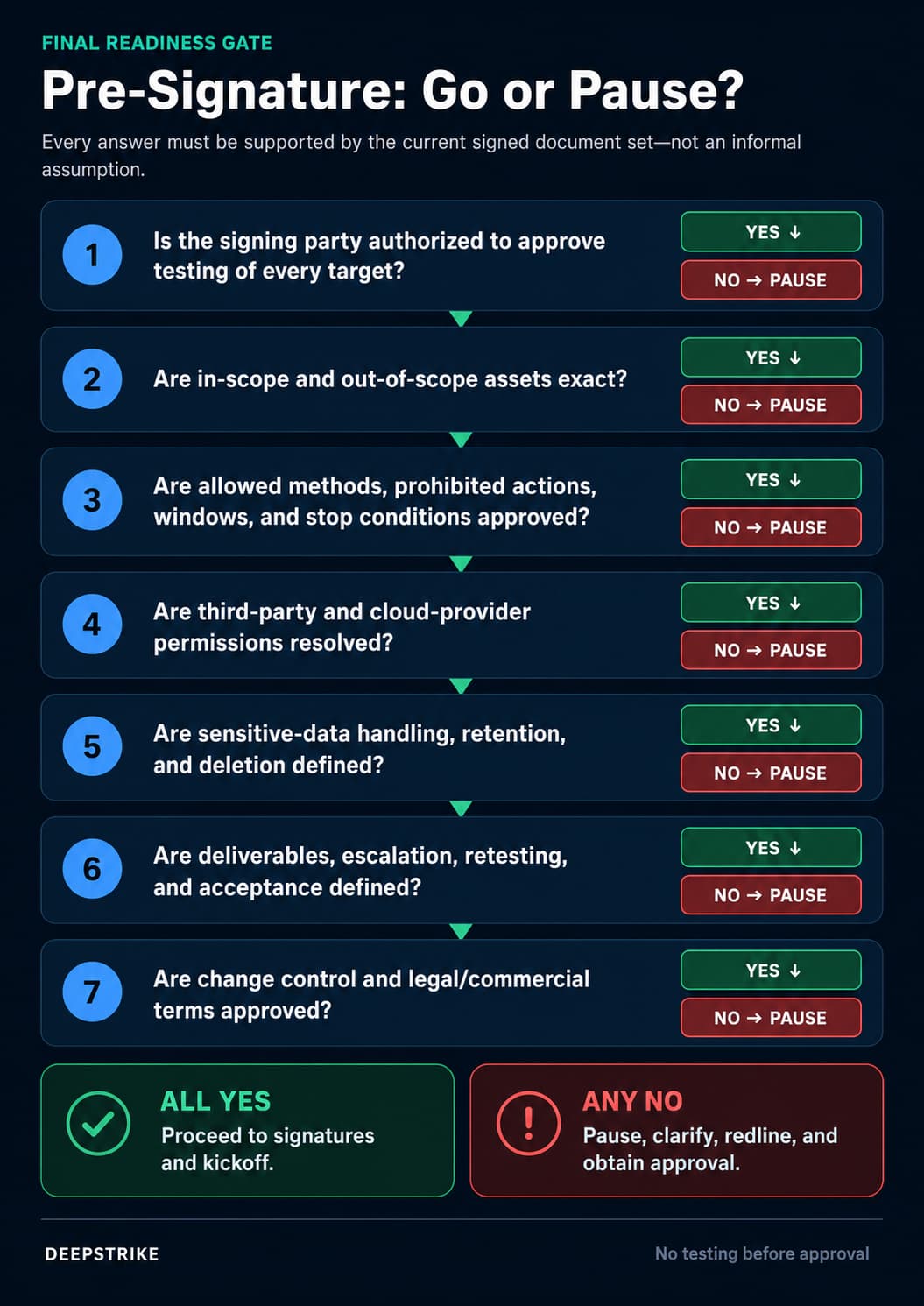
Figure 3. A pre-signature decision tree for determining whether a penetration testing agreement is operationally ready.
Source: Original DeepStrike decision framework.
Use this as a final go/pause review. A checked box means the point is evidenced in the signed document set not merely discussed.
If you are still evaluating the provider and assigned team, use DeepStrike’s guide to the best penetration testing companies before completing contract approval.
These signals call for clarification or redlining. Material authorization, safety, or data-handling gaps should pause approval until resolved.
| Red flag | Why it matters | Question to ask | Recommended action |
|---|---|---|---|
| “Test all systems” with no asset list | Neither party can identify the boundary | Which exact assets, owners, roles, and environments are authorized? | Pause and attach a versioned scope |
| No proof of ownership or third-party permission | Client permission may not extend to the target | Who owns each target, and where is their approval? | Exclude it until authority is evidenced |
| Scope exists only in informal messages | Instructions can conflict or disappear | Which signed document contains the controlling scope? | Incorporate and approve the final version |
| No prohibited-action list | Testers cannot infer risk tolerance safely | Which actions require separate approval or are forbidden? | Complete the ROE before testing |
| No emergency stop contact | Unsafe activity may continue | Who can pause, acknowledge, and authorize resumption at any hour needed? | Add primary/alternate contacts and test the channel |
| Undefined data retention | Sensitive evidence may persist indefinitely | What is stored, where, for how long, and how is it deleted? | Add lifecycle controls and legal-hold handling |
| Unclear subcontractor access | Unknown parties may reach systems or evidence | Who performs work, where relevant, and under what controls? | Require disclosure, approval, and accountability |
| No critical-finding escalation | Urgent issues may wait for the report | What threshold, channel, recipient, and acknowledgement apply? | Add a secure escalation procedure |
Penetration testing contract red flags — continued (2 of 2)
| Red flag | Why it matters | Question to ask | Recommended action |
|---|---|---|---|
| Deliverable is only “security report” | Quality and acceptance cannot be judged | What sections, evidence, severity, limitations, and format are included? | Define deliverables and acceptance criteria |
| Retesting is assumed but undefined | Scope, time, and fees will be disputed | Which findings, rounds, window, prerequisites, and output apply? | Write bounded retest terms |
| Provider can change scope or fees unilaterally | Buyer loses control of cost and authority | Who must approve a change and what evidence is required? | Require bilateral written change control |
| Contract guarantees compliance | A bounded test cannot prove overall compliance | Which exact service commitment replaces this guarantee? | Remove or correct the claim; legal review |
| Provider promises every vulnerability will be found | The promise ignores unavoidable test limitations | Where are scope, time, access, and technique limits acknowledged? | Replace with measurable delivery commitments |
| Buyer expects unrestricted cloud or third-party testing | Owner and provider boundaries still apply | Which current policies and permissions cover each service? | Narrow scope or obtain separate approval |
| Liability terms ignore the test’s real risk | Boilerplate may not fit production or sensitive data | Does allocation reflect assets, controls, conduct, and insurance? | Escalate to qualified legal and risk review |
| No rule for conflicting documents | Teams may follow different instructions | Which term controls by subject and version? | Reconcile conflicts before signature |
Authorized project personnel should be able to retrieve the current signed scope, ROE, authorization, contacts, and approved changes throughout the engagement. NIST recommends following the assessment plan or ROE unless specific permission to deviate is obtained, normally in writing, and making the documents understandable to assessors. NIST SP 800-115
Longer programs usually need a durable commercial framework plus current per-assessment controls. Define the term, cadence, covered service model, pricing assumptions, renewal, termination, and common data duties in the MSA or services agreement. Then use current SOWs, asset schedules, ROE, and authorization records for each assessment or controlled testing period.
Do not let an annual signature become stale permission for new assets, owners, methods, or materially changed environments. Set inventory update triggers, approval thresholds, retest rules, reporting periods, and change control. Keep detailed budgeting on the dedicated penetration testing cost guide rather than turning the contract into a pricing article.
It is the signed agreement framework that aligns legal authority, services, scope references, safe execution, responsibilities, evidence, deliverables, commercial terms, and closure for an authorized security test.
Not necessarily. An MSA or services agreement usually contains broader legal and commercial terms; the SOW defines project-specific work. A standalone agreement may combine some functions, but roles should remain clear.
Not automatically. It depends on the executed documents, wording, signers, and applicable law. Use express written authorization aligned to the exact scope and ROE from the appropriate asset owner or authorized representative. Obtain separate permission for third-party assets.
A person with actual authority to approve testing of the listed assets on behalf of the owner or authorized controller. Security, legal, and asset owners should confirm the signer. A client signer cannot authorize systems owned by another party without delegated authority.
At minimum: parties, authority, SOW/scope references, ownership, dates, ROE, responsibilities, staffing and subcontractors, deliverables, escalation, retesting, data handling, IP/report use, fees, change control, limitations, termination, closure, signatures, and legally reviewed risk-allocation terms.
The signed document set should contain or incorporate detailed execution rules. Higher-risk engagements benefit from a distinct, versioned ROE because it is easier for testers, operations, SOC, and incident responders to use during live work.
Identify the owner and service boundary, obtain permission where required, and verify the current official provider policy for the exact service. Exclude unresolved targets. A cloud customer’s authorization does not permit testing the provider’s infrastructure or other tenants.
It should at least be addressed. State whether it is included, which findings qualify, how many rounds, the time window, required remediation evidence, changed-scope treatment, output, and any fees.
The contract should say. Buyers typically need defined use and sharing rights, while providers may retain pre-existing methods, templates, and tools. Legal counsel should align ownership, licenses, confidentiality, and third-party rights with the intended recipients.
There is no universal duration. Retain only what has a defined security, quality, legal, regulatory, or assurance purpose; apply required legal holds; and securely delete or return evidence when the agreed period ends. Set the period before testing begins.
No. A test can support compliance readiness and provide evidence for defined requirements, but it cannot guarantee overall compliance, certification, audit approval, security, or breach prevention.
A common model is one MSA or services agreement with current SOWs, scopes, ROE, and authorization records for each assessment. The right architecture depends on the organization and legal review; authority and asset inventories must not become stale.
A signable pentest agreement is ready only when authority, boundaries, safe execution, evidence, delivery, commercial responsibility, and closure tell the same story. If any target, permission, stop condition, data path, deliverable, or change right remains ambiguous, pause and resolve it before testing.
If your organization is defining an authorized engagement, DeepStrike can discuss the technical scope, testing boundaries, reporting, and retesting requirements through its penetration testing services. Final contractual language should be reviewed by your legal and procurement teams before testing begins.
Mohammed Khalil is a Cybersecurity Architect at DeepStrike specializing in advanced penetration testing and offensive security. His certifications include CISSP, OSCP, and OSWE. His work focuses on application security, API security, cloud security, identity exposure, attack-path validation, and remediation-focused security testing.

Stay secure with DeepStrike penetration testing services. Reach out for a quote or customized technical proposal today
Contact Us
