November 2, 2026
Updated: November 2, 2026
Scope, safety rules and methods for testing EHRs, FHIR APIs, identity and medical device networks.

Mohammed Khalil
Healthcare penetration testing is an authorized simulation of real attacks against the systems that store or move patient data and support clinical care. It covers EHR and clinical applications, patient portals and mobile apps, FHIR and HL7 interfaces, identity systems, cloud and telehealth services, third-party connections and, under strict safety rules, connected medical devices. The goal is to prove which weaknesses could expose protected health information or disrupt care, then give each owner a specific fix and retest it. Done well, it also produces evidence that supports HIPAA risk analysis without putting patients at risk.
A penetration test goes beyond a vulnerability scan. Testers try to use weaknesses the way an attacker would, within an agreed scope, to show what could actually happen: a patient record read by the wrong person, a clinical system taken offline or a device network reached from the guest Wi-Fi.
In healthcare the same techniques apply, but the environment is different. Systems run around the clock, many devices are old and hard to patch, patient data flows through dozens of interfaces, and some assets are connected to patients. That changes what testers look at, how they test and what they are not allowed to touch.
If you are mainly asking whether the law requires a test, start with our HIPAA penetration testing requirements guide. This article focuses on how to test healthcare systems safely and usefully.
Five things make healthcare testing harder than a typical corporate engagement.
For current figures on breaches and attacks in the sector, see our healthcare cybersecurity statistics.
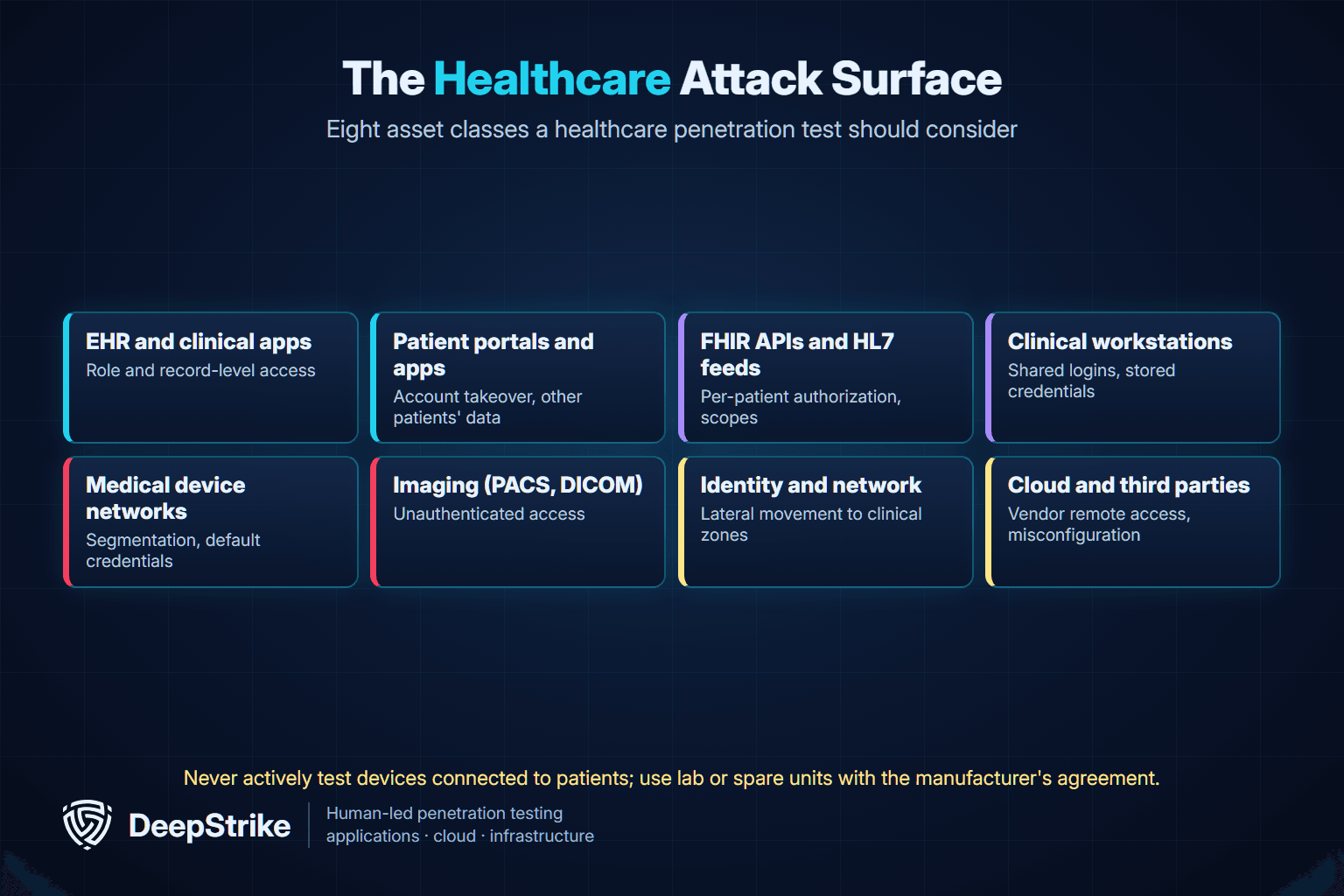
A healthcare test usually spans several asset classes. Use this table to agree scope and to decide where safety limits apply.
| Asset class | Examples | Main risks to test | How to test safely |
|---|---|---|---|
| EHR and clinical applications | EHR web and desktop clients, lab and pharmacy systems | Role and record-level authorization, session handling, injection | Use test tenants and synthetic patients |
| Patient portals and mobile apps | Scheduling, messaging, results, telehealth apps | Account takeover, viewing other patients' data, weak password reset | Staging or production with dedicated test accounts |
| FHIR APIs and interfaces | SMART on FHIR apps, partner APIs, HL7 v2 feeds, integration engines | Missing authorization per patient, excessive scopes, data leakage in search | Sandbox endpoints and synthetic records |
| Clinical workstations and thick clients | Nursing stations, imaging viewers, admin consoles | Stored credentials, local privilege escalation, shared logins | Lab images or non-clinical units |
| Medical devices and IoMT | Infusion pumps, monitors, imaging modalities, device gateways | Unpatched services, default credentials, unencrypted protocols | Spare or lab units with vendor involvement; never patient-connected devices |
| Imaging systems | PACS, DICOM nodes, viewers | Unauthenticated DICOM access, exposed archives | Off-hours windows, read-only checks |
| Identity and network | Active Directory, Entra ID, SSO, VPN, Wi-Fi, segmentation | Lateral movement from IT or guest networks to clinical zones | Agreed windows, no account lockouts |
| Cloud and third parties | Hosted EHR, telehealth platforms, vendor remote access | Misconfiguration, shared vendor accounts, over-broad remote access | Only with the provider's written permission |
FHIR is now the main way health data moves between apps, and HL7 is clear that FHIR does not secure itself. The specification's security page states that FHIR is not a security protocol and defers authentication and authorization to standards such as OAuth and the SMART App Launch framework, while offering the AuditEvent and Provenance resources for tracking access.
That means the security of a FHIR service depends on how each implementation applies those controls. A focused test checks:
_include and chained searches return records outside the caller's permissionOlder HL7 v2 interfaces and integration engines deserve attention too. In many environments they rely on network position rather than application-level authentication, so testers check who can reach them and what an attacker could send or read from that position. Our API penetration testing guide covers general API methods in more depth.
Medical device testing means two different things depending on who is asking.
Manufacturers test devices before and after they reach the market. In the United States, section 524B of the Federal Food, Drug, and Cosmetic Act applies to "cyber devices": devices that include sponsor-validated software, can connect to the internet and have characteristics that could be vulnerable to cybersecurity threats. Sponsors must submit a plan to monitor, identify and address postmarket vulnerabilities, including coordinated vulnerability disclosure; maintain processes that provide reasonable assurance the device and related systems are cybersecure, with regular and urgent updates and patches; and provide a software bill of materials (21 U.S.C. 360n-2). The section took effect 90 days after the law's December 29, 2022 enactment.
The FDA explains what it expects in premarket submissions in its final guidance Cybersecurity in Medical Devices: Quality Management System Considerations and Content of Premarket Submissions, issued in February 2026, which supersedes the June 2025 version. Industry groups such as the Medical Device Innovation Consortium have also published penetration testing best practices for manufacturers, covering scoping, execution, findings and documentation.
Hospitals and health systems do not usually test device firmware themselves. Their job is to understand how devices sit on the network and what an attacker could reach. A hospital-side test typically:
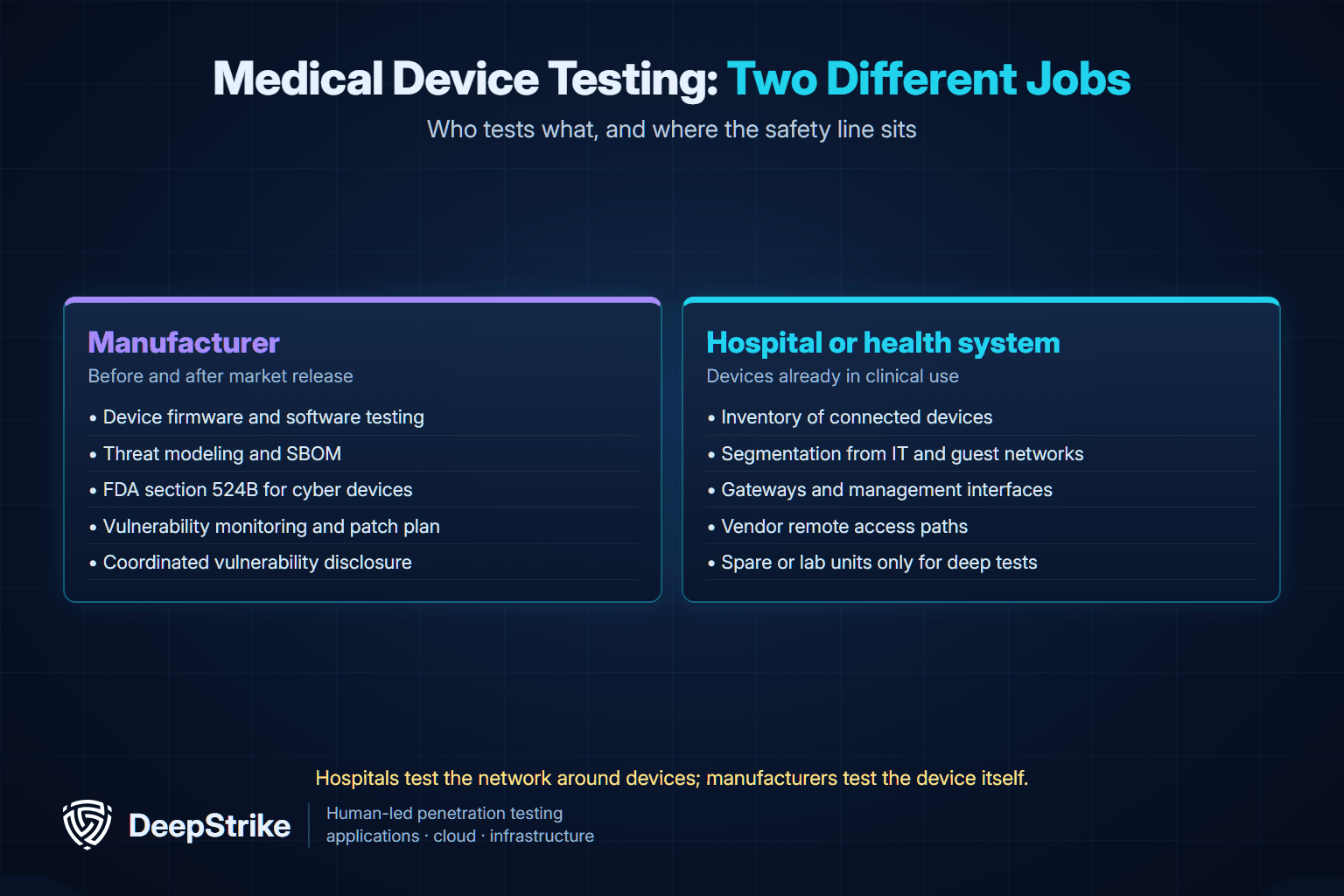
Hospital-side testers should never run active tests against a device connected to a patient. For background on device risk, see our IoMT vulnerability statistics.
A healthcare test plan should be agreed with clinical engineering, IT operations and the privacy office, not only the security team. At a minimum, the rules of engagement should cover:
Our penetration testing scope guide explains how to turn these rules into a statement of work.
Several rules and frameworks influence healthcare testing. They differ in who they apply to and whether they are mandatory.
| Framework | Who it applies to | What it says about testing |
|---|---|---|
| HIPAA Security Rule | Covered entities and business associates | Requires risk analysis and periodic technical evaluation; does not currently name penetration testing. An HHS proposal would add annual penetration testing but is not final. |
| HHS Healthcare and Public Health Cybersecurity Performance Goals | Healthcare organizations (voluntary) | The enhanced goal "Cybersecurity Testing" includes penetration testing and attack simulation |
| HITRUST CSF | Organizations seeking HITRUST certification | Uses penetration testing as evidence for technical controls |
| FDA section 524B | Manufacturers of cyber devices | Requires vulnerability monitoring plans, cybersecurity processes and an SBOM in premarket submissions |
The HHS goals are published on the HHS cybersecurity performance goals page, which describes them as a voluntary subset of practices. For HITRUST specifics, see HITRUST certification and penetration testing.
A typical engagement follows seven stages.
The specifics vary, but these patterns appear often in healthcare assessments:
Clinical workstation software is often a thick client, which brings its own risks. See thick client penetration testing for how those applications are tested.
The following example is illustrative and simplified; it does not describe a specific client.
A clinic's patient portal uses a FHIR API. A test patient signs in and opens their lab results, which the app loads by calling the API with that patient's ID. Using a second synthetic patient account, the tester changes the ID in the request. The API returns the other patient's results, because it checks that the token is valid but not that the token belongs to the requested patient.
A common baseline is to test critical systems at least once a year and after significant changes, such as a new EHR module, a new patient portal or app, a cloud migration, a merger, or new device networks. Base the schedule on your HIPAA risk analysis rather than a fixed calendar alone. Vulnerability scanning and configuration checks can run more often, while penetration tests validate whether the remaining weaknesses can actually be used.
A healthcare report has more readers than most: security, IT, clinical engineering, privacy, compliance and sometimes vendors. Make sure it includes:
Avoid reports that only list scanner output. The value of a penetration test is the validated attack path and the business context around it.
Ask any provider these questions before you sign:
It is an authorized simulation of attacks against healthcare systems such as EHRs, patient portals, FHIR APIs, identity systems, networks and, within strict safety limits, medical device networks. It shows which weaknesses could expose patient data or disrupt care and how to fix them.
Not explicitly today. The HIPAA Security Rule requires risk analysis and periodic technical evaluation, and penetration testing is a common way to provide that evidence. HHS has proposed requiring annual penetration testing, but as of November 2026 that rule is not final.
Hospitals should not actively test devices that are connected to patients. They can test the networks, gateways and management systems around devices, and test spare or lab units with the manufacturer's agreement. Deep firmware testing is usually the manufacturer's responsibility.
Under section 524B of the Federal Food, Drug, and Cosmetic Act, a cyber device is a medical device that includes sponsor-validated software, can connect to the internet and has characteristics that could be vulnerable to cybersecurity threats. Manufacturers of cyber devices must provide vulnerability monitoring plans, cybersecurity processes and a software bill of materials.
Use sandbox endpoints and synthetic patient records, create test accounts for each role, and check that every request is limited to the right patient and scope. Avoid bulk operations against production data unless they are explicitly approved.
Health records contain identity, insurance and medical details that are valuable for fraud, and hospitals are under strong pressure to restore systems quickly, which attackers try to exploit with ransomware. Complex networks, legacy devices and many third-party connections also give attackers more ways in.
Healthcare security depends on proving that controls hold up without putting patients or clinicians at risk. A well-scoped penetration test does both: it shows where patient data and clinical operations are exposed and gives each owner a fix to verify.
If you are planning a healthcare assessment, contact DeepStrike to discuss scope, safety rules and retesting, or review our penetration testing services.
Mohammed Khalil is a Cybersecurity Architect at DeepStrike, specializing in advanced penetration testing and offensive security operations. With certifications including CISSP, OSCP, and OSWE, he has led numerous red team engagements for Fortune 500 companies, focusing on cloud security, application vulnerabilities, and adversary emulation. His work involves dissecting complex attack chains and developing resilient defense strategies for clients in the finance, healthcare, and technology sectors.

Stay secure with DeepStrike penetration testing services. Reach out for a quote or customized technical proposal today
Contact Us
