November 24, 2026
Updated: November 24, 2026
What the UAE Open Finance Testing and Certification Framework requires from LFIs and TPPs before go-live: who tests, when, the evidence for Nebras, and related CBUAE rules.

Mohammed Khalil
In UAE Open Finance, the bank does not issue the access token. The API Hub does, and the UAE security profile says that token must expire within 10 minutes and be bound to the Third Party Provider's (TPP's) mutual TLS certificate. The same platform enforces the FAPI 2.0 profile on behalf of every Licensed Financial Institution (LFI). Yet the Testing and Certification Framework still makes LFIs and TPPs pass an independent penetration test before go-live. This guide to UAE Open Finance penetration testing works out, from the published documents, what the platform already enforces, what is left for each participant to test, which performance figures a stress test has to meet, and how the evidence reaches Nebras.
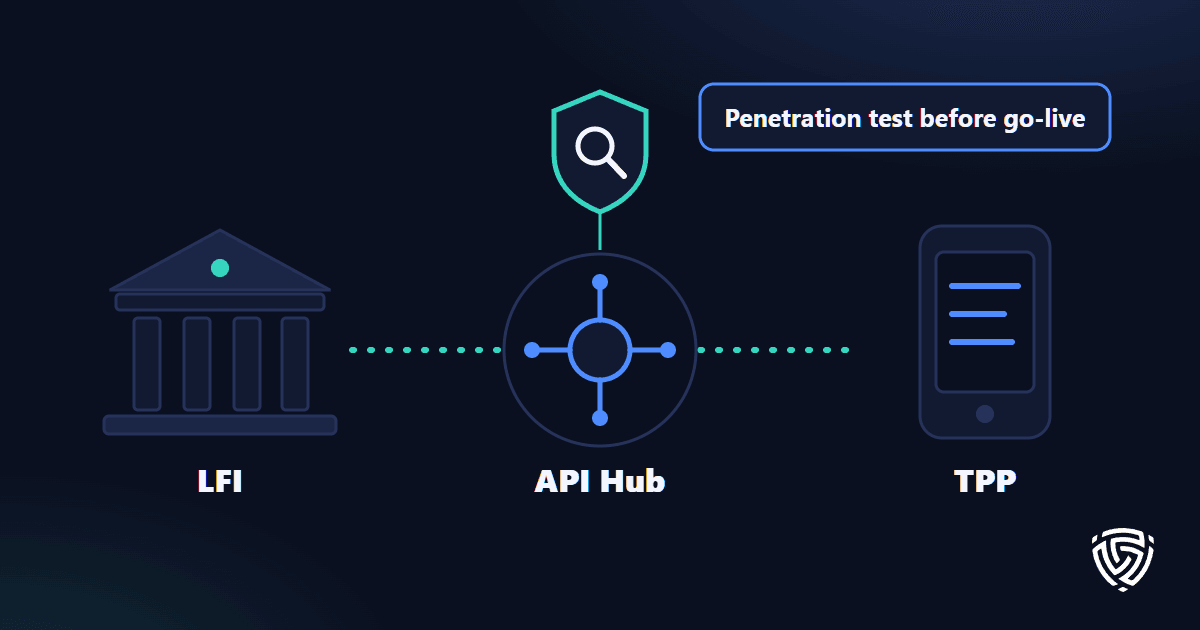
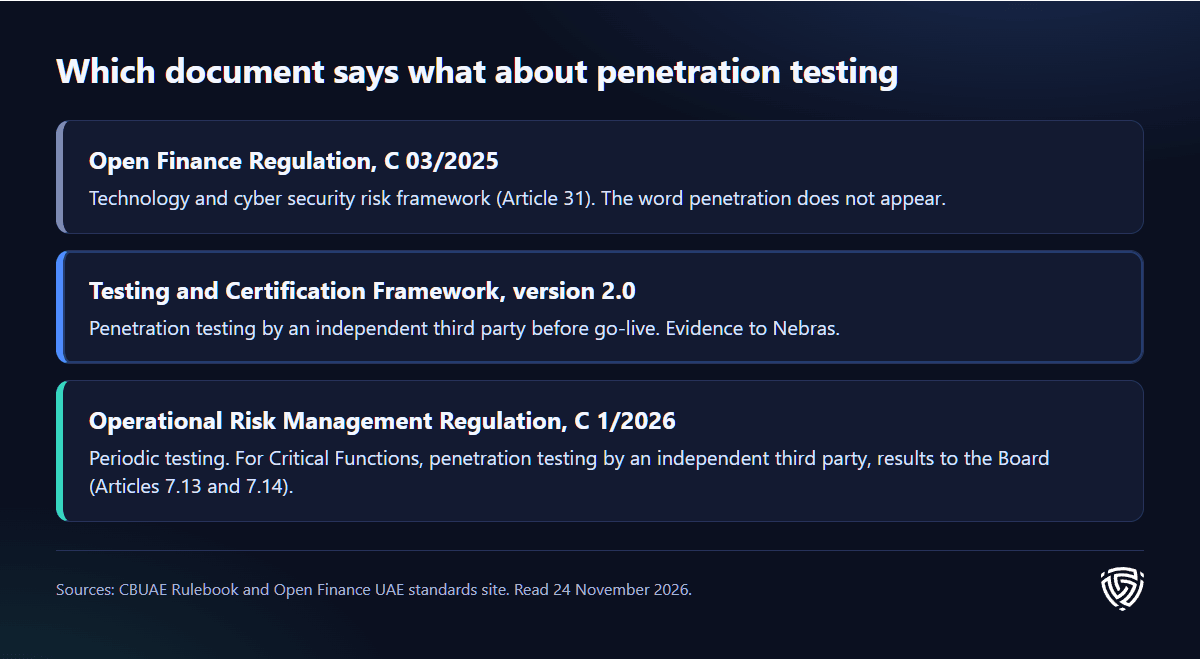
The requirement is in the Testing and Certification Framework, version 2.0, published August 11, 2025 and last updated May 12, 2026. The Central Bank of the UAE (CBUAE) Open Finance Regulation, Circular 03/2025, does not contain the word "penetration." Its Article 31(5) tells Open Finance Providers to "adhere to the security and other requirements set by the API Hub."
The framework says four things about the test:
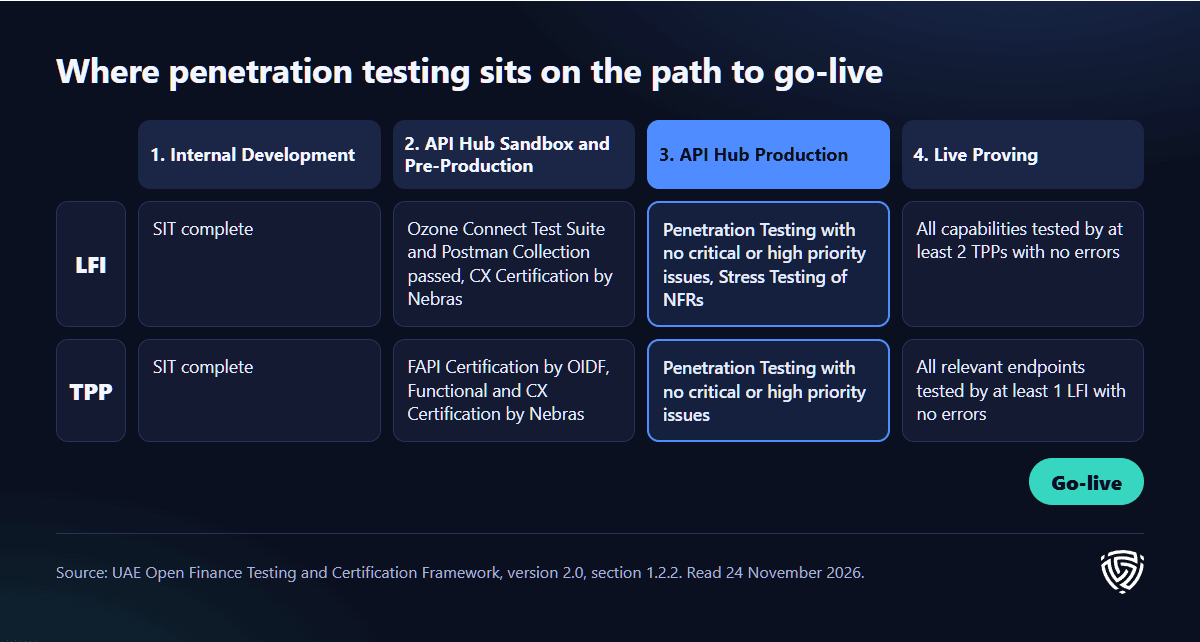
It does not define scope, method, report content, or how old a test may be. It also contradicts itself twice. The exit criteria table asks for "no critical or high priority issues" from both groups, and it wants LFI endpoints tested "by at least 2 TPPs" where section 2.4 says "at least one TPP."
More detail now exists, with a caveat. A community developer documentation site, published under the Nebras-Open-Finance organization on GitHub, describes itself as "Community-driven and open source. Not official." Its LFI page on security validation, which we read on November 24, 2026, goes further than the framework. We treat it as an indication of what reviewers may expect, not as the rule.
| Point | Framework v2.0 (official) | Developer documentation (not official) |
|---|---|---|
| Tester | Reputable, independent, accredited. No accreditation named | Independent third party, "for example a CREST-accredited testing organisation." No material conflict of interest, including with the vendor that built or hosts the implementation |
| Scope | Not defined | LFI: consent journey, consent management interface, every Ozone Connect endpoint. TPP: everything that relies on the Open Finance integration |
| Findings | LFI: critical, high, medium fixed. TPP: critical or high fixed | Critical and high fixed and retested. Medium and lower need a documented remediation plan |
| Age of test | Not stated | LFI: completed within the 3 months before submission |
| Environment | Pre-production must mirror production | Pre-production is acceptable if it matches production |
| Submission | "Evidence" to Nebras | Service Desk ticket, certification type "Penetration Test Results" |
| Repeat | New Standards version, material change, Nebras request | LFI: should repeat at least every 12 months. New test after a material change |
Where the two columns differ, the framework is the published rule. Ask Nebras in writing which line applies to you, above all on medium findings and accepted accreditations.
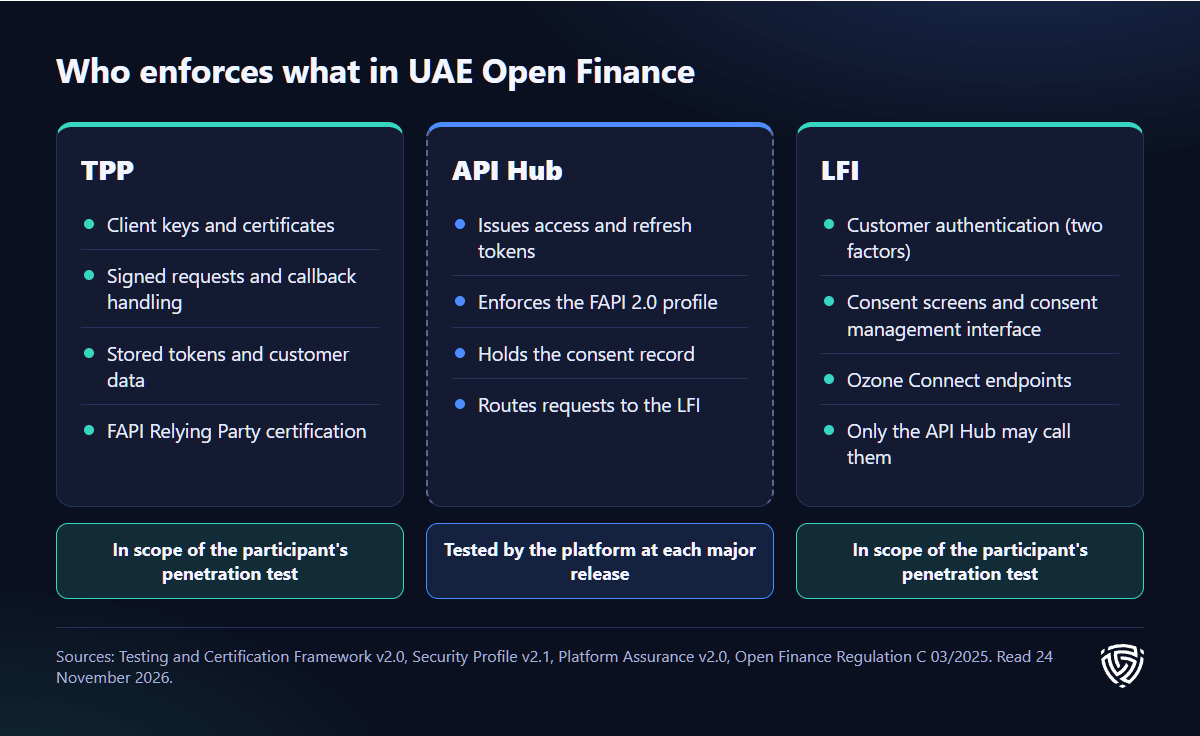
Scoping starts with the split of duties, because much of what a normal OAuth test covers is not yours to test here.
The framework states that "the OFP strictly enforces the UAE FAPI 2.0 security profile on behalf of LFIs," which is why LFIs need no FAPI certification of their own. The Security Profile for Standards v2.1 adds that the security layers between the platform and the LFI "are not part of the Ecosystem Security Profile." They are documented separately, and they are where an LFI's own exposure sits.
| Control | API Hub | LFI | TPP |
|---|---|---|---|
| Authorization server and tokens | Issues every access and refresh token | Does not issue tokens to TPPs | Stores tokens and the keys that make them usable |
| FAPI profile enforcement | Enforces pushed requests, signed request objects, certificate-bound tokens | No FAPI certification required | Implements the client side and holds an OpenID Foundation Relying Party certification |
| Customer authentication | Runs the OpenID Connect protocol | Authenticates the customer with at least two factors (Regulation Article 18) | Relies on the LFI for customer authentication |
| Consent record | Holds the record of consent state | Runs the consent screens and the consent management interface | Keeps its own consent state current |
| Customer data | Routes requests and responses | Returns the data from its Ozone Connect endpoints | Stores what it receives and is liable for unauthorized access (Article 21) |
| Network boundary | Calls the LFI over mutual TLS | Must make sure only the API Hub can reach those endpoints | Protects transport and signing keys |
The framework, the security profile, and Regulation Articles 18 and 21 support the certification, authentication, and liability rows. Token issuance, the consent record, and routing are described in the developer documentation's API Hub overview.
Two conclusions follow. First, retesting the platform's authorization server adds little: the Platform Assurance page says the API Hub "is subjected to regular penetration testing at each major release." Second, the platform's checks are not a reason to trust what arrives. The developer documentation notes that the API Hub enforces the OpenAPI schemas before proxying, "but your endpoints MUST NOT depend on that alone." Write that boundary into the penetration testing scope before any testing starts.
The UAE profile is a narrowed version of the FAPI 2.0 Security Profile. Where FAPI 2.0 offers choices, the UAE page picks one: private_key_jwt for client authentication, mutual TLS for token binding, PS256 for signatures, Rich Authorization Requests for consent detail, and signed request objects. Fewer options means a shorter and more specific test plan.
Each row below pairs a published requirement with a test objective for an authorized test of your own systems.
| Mechanism | What the UAE documents require | What the tester tries to show |
|---|---|---|
| Pushed, signed authorization requests (RFC 9126, RFC 9101) | "Shall support and require signed request objects." Request exp no more than 10 minutes after nbf. Only parameters inside the signed object count | TPP: user-controlled input cannot alter signed claims such as permissions, amounts, or redirect target. The signing service cannot be called by an unauthenticated internal path |
| Client authentication | "Shall authenticate the confidential client using private_key_jwt." PS256 only | TPP: the signing key cannot be read from code, build artifacts, logs, or a mobile app. Assertions are short-lived and never reused |
| Certificate-bound tokens (RFC 8705) | "Shall only issue sender-constrained access tokens using mTLS." Access token expiry "no longer than 10 minutes" | TPP: a stolen token is useless alone, so the target is token plus transport key. Show that no request-forgery or proxy path lets an attacker use both. Refresh tokens are issued without an expiry, so they need the same protection |
| PKCE and the callback (RFC 7636) | FAPI 2.0 requires PKCE with S256 and requires the client to check the iss value in the response | TPP: state is bound to the session, iss is checked, the code verifier stays server-side, and a used code is rejected |
| Redirect URIs | The server "shall reject any requests containing unregistered redirect URIs" | TPP: the registered callback host has no open redirect, no reflected input, and no takeover risk. Mobile apps use verified HTTPS links |
| Consent as authorization data | "Shall support OAuth 2.0 Rich Authorization Requests" | Both sides: one customer's consent identifier never returns or changes another customer's data |
| Tracing header | "Shall send the x-fapi-interaction-id request header" as a unique UUID | Both sides: log handling of this value does not allow injection, and logs carry no tokens or personal data |
The UAE profile fixes mutual TLS as the binding method, so DPoP is not part of it. Scope the mechanisms your Standards version lists and no others.
The row on consent identifiers deserves the most hours. It is the Open Finance form of broken object level authorization, the first item in the OWASP API Security Top 10. Passing the conformance suite says nothing about it, which is why API penetration testing remains a separate exercise from FAPI certification.
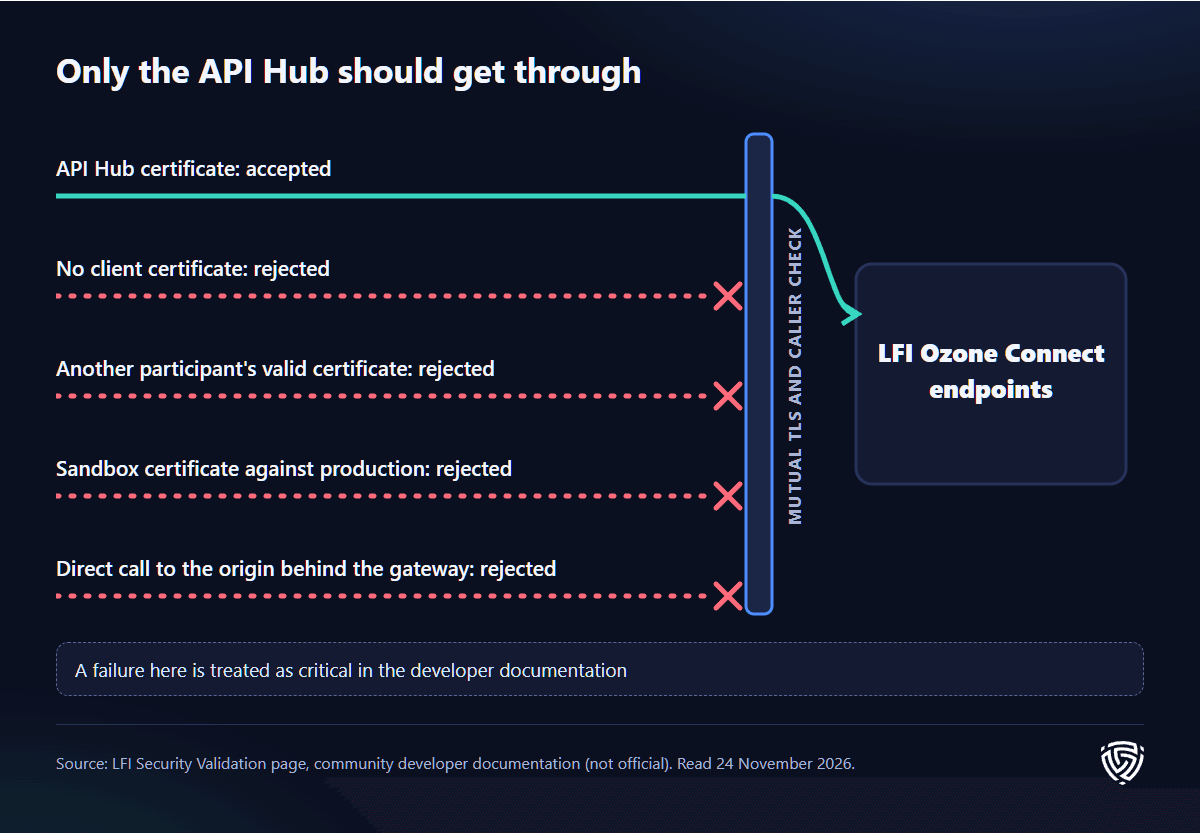
An LFI builds a set of endpoints, called Ozone Connect in the documentation, that only the API Hub should call. The developer documentation lists three ways to add application-level authentication on top of mutual TLS: an API key, a client credentials grant, or a signed JWT.
The sharpest point in the developer documentation is easy to miss in a design review. Mutual TLS proves that the caller holds a certificate from the Trust Framework. It does not prove the caller is the API Hub, because the same certificate authority "signs certificates for every participant: every TPP and every other LFI." An LFI that relies on mutual TLS alone, or on JWT validation keyed to the caller's own certificate, can be reached by any other participant.
A test of this boundary should show that:
The documentation asks for these negative cases "against each endpoint, not against one representative endpoint," and says Nebras treats a failure of mutual TLS enforcement or caller restriction as critical "whatever severity the tester assigns."
The customer-facing side needs the same attention. Strong customer authentication must not be skippable by jumping to the authorization step. A customer must only be able to select accounts they hold. Identifiers returned to the platform should be opaque. In the consent management interface, changing a consent identifier must never reveal or revoke another customer's consent, and a revoked consent must stop the next TPP call. Where these screens run in a browser, they belong in a web application penetration testing scope.
The developer documentation adds that when an LFI adopts the centralized authentication service operated by Nebras, the consent journey and the consent management interface leave the LFI's test scope. The endpoints that service calls stay in it.
A TPP has no platform in front of it. Its app, its backend, and its keys are the whole attack surface. The developer documentation says the test must cover "the full extent of the TPP's services that rely on the Open Finance implementation" and that testing a subset is not enough.
Three areas are specific to this scheme:
Customer apps bring ordinary mobile risks too: token storage on the device, link hijacking on the callback, and debug builds. Those belong to mobile application penetration testing.
The regulation gives this weight. Article 21 makes an Open Finance Provider liable to a user for loss caused by "unauthorized access to or loss of the User Data" it holds. In a payment dispute, "it is for the Service Initiation Provider to prove that the Transaction was correctly processed, with supporting evidence."
The framework pairs the penetration test with stress testing "to meet all NFRs in the Standards," and lets participants run it with internal tools. The figures are on the Availability, Performance and Usage Benchmarks page of Standards v2.1.
| Measure | Published benchmark | Detail |
|---|---|---|
| Availability | "Uptime of 99.5%" | Planned and unplanned downtime both count. Server errors count, client errors do not |
| Response time, service initiation | Average of 500 ms to last byte | Excludes batch and file payments |
| Response time, bank data | Average of 500 ms to last byte | Per response, or per page of up to 100 records |
| LFI leg of each call | 250 ms to last byte | From the API Hub v LFI Performance Service Levels page, version 1.0 |
| Payment execution | "3 seconds per payment" | Set by the Aani scheme rules |
Two lines matter for planning. Supplier failures are "attributed to the LFI," so a hosted core system or a vendor gateway is inside your number. And the framework says the volume of calls is "agreed individually between each LFI and Nebras," so there is no public transactions-per-second target to quote.
The framework's stages run from internal development to the sandbox or pre-production, then production, then Live Proving. Penetration testing is an exit criterion of the production stage, so plan for the report to be accepted before testing with a partner TPP starts.
For the report itself, the LFI documentation lists what reviewers look for: the tester's name and a statement of independence, test dates, environment and base URL, each in-scope area and endpoint, a pass or fail result for every boundary test, each finding with a severity and the rating method, and retest evidence for fixed findings. Our guide to the penetration testing report covers general structure.
Live Proving has its own security conditions. If an LFI tests itself in production as a TPP, the framework requires dedicated testing credentials that are revoked right after testing, separate teams for testing and for production operations, and isolation of the test activity.
Then the cycle repeats. The published Roadmap, version 3.0, lists a public go-live deadline of December 31, 2026 for Tier 2 banks on Standards v2.1, and March 31, 2027 to June 30, 2027 for the uplift to v2.2. Teams that ship between those dates often keep testers on a continuous penetration testing basis so each material change is covered.
The go-live test is not the whole duty. The framework says it "does not cover any operational or general cyber security requirements" tied to licensing.
For licensed institutions, the Operational Risk Management Regulation, Circular 1/2026, requires periodic testing that includes, for Critical Functions, "penetration testing by an independent third party. The results must be presented to the Board" (Article 7.14). Article 8.4 adds that the Board and senior management must be told about weaknesses found in testing. The regulation defines the institutions it binds as banks, insurers and reinsurers, and other financial institutions licensed under the Central Bank Law. If you hold only an Open Finance License, confirm with the CBUAE whether that includes you.
The Open Finance Regulation also requires professional indemnity insurance that covers data breaches and cyber security risks (Article 9).
No. The framework says the platform enforces the FAPI 2.0 profile on behalf of LFIs and holds the certification. The LFI's test covers what the LFI builds and runs: its consent journey, its consent management interface, and its Ozone Connect endpoints.
Not by itself. Every participant holds a certificate from the same authority. The LFI needs a control that identifies the API Hub, such as pinning to the Hub's certificate details, an application-level credential only the Hub holds, or a network restriction.
The framework allows pre-production certification if it mirrors production in architecture, network elements, software versions, and customer experience. The developer documentation says the same for the penetration test.
The sources conflict. Section 2.4 of the framework tells LFIs to fix medium findings. The exit criteria table and the developer documentation stop at critical and high. Plan to fix medium findings and ask Nebras for its position in writing.
The framework requires participants to "retest and renew their certification" for each new Standards version. It does not say that every renewal needs a full new penetration test. Assume the changed surface needs testing and confirm the extent with Nebras.
The licensed participant. The regulation says responsibility "cannot be transferred to the Technical Service Provider or any other third party." The developer documentation adds that the tester should have no conflict of interest with the vendor that built or hosts the implementation.
The framework only says evidence goes to Nebras and gives a support email address. The developer documentation describes a Service Desk ticket of type "Providing certification evidence" with the certification type "Penetration Test Results."
UAE Open Finance penetration testing is shaped by one design choice: a central platform issues the tokens and enforces the security profile. That moves the real test work to the edges. For an LFI, the edge is the Ozone Connect boundary, the consent journey, and the consent management interface. For a TPP, it is key custody, callback handling, consent-level authorization, and stored data. The framework sets the duty and the threshold, the Standards set the performance figures, and the community developer documentation suggests what a reviewer may check. Because that last source is not official and the framework contradicts itself in places, confirm the open points with Nebras before the test is scoped.
DeepStrike is a penetration testing company founded in 2016, headquartered in Newark, Delaware, with a branch in Dubai. We test web applications, APIs, mobile apps, and cloud environments, and we offer continuous penetration testing for teams that release often. The deliverables listed on our site are a penetration test report with fix recommendations, a shared Slack channel with the testers, an attestation letter, and a technical presentation of the results.
We are not a certifying body for UAE Open Finance. Certification, go-live, and licensing are decided by Nebras and the CBUAE. Nebras also decides which tester accreditations it accepts, so confirm accepted accreditations with Nebras before you appoint any firm, including DeepStrike. To request a scope, send your role, your applications, your Roadmap date, the Standards version you are implementing, and for LFIs the application-level authentication method you selected.
All sources were read on November 24, 2026. This article is not legal advice.
Official sources:
Standards referenced:
Community developer documentation:
Mohammed Khalil is a Cybersecurity Architect at DeepStrike, specializing in advanced penetration testing and offensive security operations. With certifications including CISSP, OSCP, and OSWE, he has led numerous red team engagements, focusing on cloud security, application vulnerabilities, and adversary emulation. His work involves dissecting complex attack chains and developing resilient defense strategies for clients in the finance, healthcare, and technology sectors.

Stay secure with DeepStrike penetration testing services. Reach out for a quote or customized technical proposal today
Contact Us
