August 15, 2026
Updated: August 24, 2026
A threat intelligence profile of Torzon Market for defenders: how darknet marketplaces are built, what their rise signals about the criminal economy, and why every one of them ends in an exit scam or a takedown.
Abdalla Mohamed
Torzon Market is a darknet marketplace, a Tor-based platform where illicit goods and cybercrime services are traded. This is a threat intelligence profile written for defenders, not a route into the market: it contains no address, no mirror, and no access instructions. What it does explain is what Torzon reportedly is, how marketplaces like it are built, what its rise says about the criminal economy your organization faces, and how these platforms almost always end, which is either an exit scam or a law enforcement takedown. Understanding the ecosystem is useful security knowledge; visiting it is not.
Updated: August 2026. Torzon-specific figures are self-reported by the market or drawn from monitoring and should be treated as unverified. Marketplace-lifecycle facts are sourced to blockchain-intelligence firms and law enforcement.
Torzon Market is a general-purpose darknet marketplace operating as a Tor onion service, reportedly launched around 2022. Like the markets before it, it functions as an intermediary: it does not sell goods itself but connects anonymous buyers and vendors, takes a cut of transactions, and provides the escrow, reputation, and dispute systems that let strangers trade illegal products with some expectation of delivery. Security researchers track it because its listings reportedly include cybercrime tooling, stolen data, and malicious services alongside the drug trade that dominates most markets.
Its relevance grew in 2025. After two of the largest Western markets left the scene within weeks of each other, displaced buyers and vendors migrated to whatever remained, and Torzon was one of the platforms that absorbed them. That growth is the reason it now appears in threat briefings, but it is worth stating plainly that a market's current size is a snapshot, not a guarantee of stability. For the wider pattern of these rises and falls, see our coverage of dark web marketplace takedowns. Others, like the Canadian-focused WeTheNorth, carved out regional niches instead.
Searches for Torzon overwhelmingly want a link, a URL, or an onion address. This profile deliberately provides none of them, and the reason is itself a piece of threat intelligence. A working marketplace address is an access route to a criminal platform, and publishing one from a security company's site would be both reckless and pointless: darknet addresses rotate constantly, most published mirrors are phishing clones designed to steal from newcomers, and the destinations trade in genuinely illegal material.
The more useful thing we can give you is an understanding of how these markets work and what they mean for defense. That knowledge does not expire next month and does not put anyone at risk. If you are trying to understand why marketplace links are so unreliable in the first place, our explainer on the Hidden Wiki covers the clone-and-phishing economy that surrounds every popular darknet name.
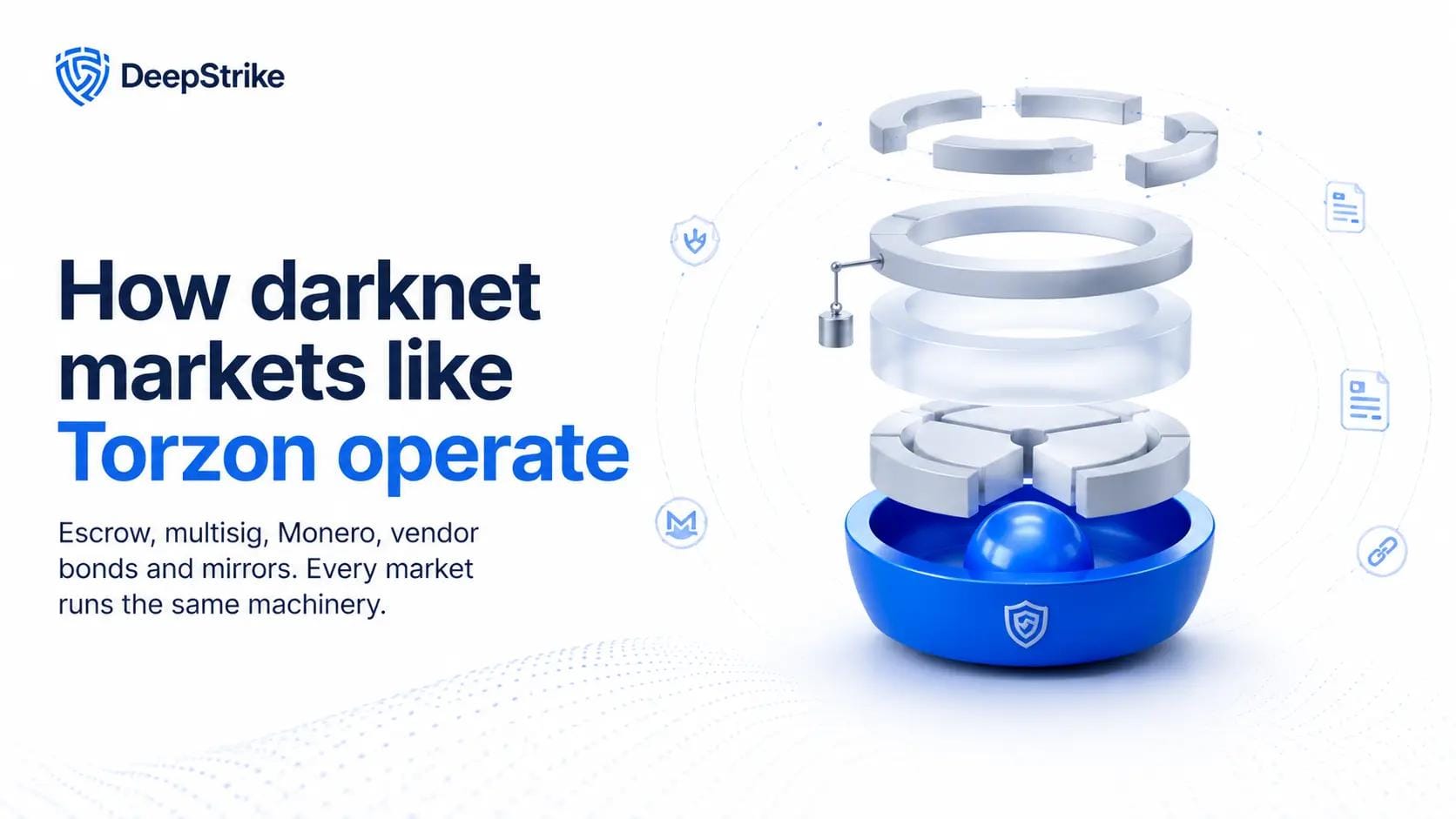
Strip away the specific brand and every modern darknet market shares the same machinery, refined over a decade to let anonymous strangers trade with a working level of trust. Understanding this structure is what lets an analyst reason about any market, including ones that do not exist yet. The core components are consistent.
Escrow is the foundation. The market holds a buyer's cryptocurrency until they confirm the goods arrived, which discourages simple non-delivery fraud. The weakness is obvious: escrow concentrates everyone's money in the operator's hands, and that pile is exactly what gets stolen in an exit scam. Some markets, reportedly including Torzon, offer 2-of-3 multisig escrow, where the buyer, vendor, and market each hold one key and no single party can move funds alone. Multisig genuinely reduces the escrow-drain risk, but it is not the guarantee some marketing claims: it is optional and more technical, so most transactions do not use it, and an operator still controls the interface, the default flow, and every non-multisig trade. It is a mitigation, not a cure for exit scams.
Markets settle in cryptocurrency, and the choice of coin is a direct response to law enforcement. Bitcoin was the original medium, but its public ledger is traceable, and blockchain-analysis firms have repeatedly used that traceability to map market revenue and identify users. In response, the ecosystem has shifted heavily toward Monero, whose protocol-level privacy hides amounts and participants. Many markets now treat Monero as the primary currency and accept Bitcoin only as a secondary, higher-risk option. This shift is one of the clearest examples of enforcement pressure shaping criminal behavior.
To keep scammers out, markets make vendors pay a bond, an upfront fee that is forfeited if the vendor cheats buyers or breaks the rules. On top of that sits a reputation system: feedback scores, dispute ratios, completed-sale counts, and PGP key validity all feed a vendor rating. PGP does double duty here, both proving a vendor controls their identity and encrypting the communication and delivery details that buyers send. When a deal goes wrong, the market's dispute resolution process arbitrates between buyer and vendor over the escrowed funds, which is what gives the reputation scores their teeth. These systems are why an established market can feel orderly despite trading entirely in illegal goods.
Because a single onion address can be seized or knocked offline, markets invest heavily in resilience. They run multiple mirrors and rotate addresses, they weather DDoS attacks that rivals often launch against each other, and some publish canary statements meant to signal whether they have been compromised. This constant defensive churn is also why the link ecosystem around any market is so chaotic and so full of impostors.
| Component | Purpose | Weakness it creates |
|---|---|---|
| Escrow | Assures delivery before release | Concentrates funds for an exit scam |
| Multisig | Splits control of funds | Optional, so most trades skip it |
| Monero | Hides transaction detail | Still relies on the market's honesty |
| Vendor bond | Deters low-effort scammers | Priced in, absorbed by serious actors |
| Mirrors | Resist takedown and DDoS | Enable phishing-clone confusion |
For a security team, a market like Torzon matters less as a place and more as an indicator. These platforms are a wholesale channel for the raw material of attacks against your organization: stolen credentials, exposed personal data, ready-made malware, and access sold by initial-access brokers who have already breached a company and are auctioning the entry. When a general-purpose market grows quickly, it means more liquidity and more supply in that criminal economy, which is a signal worth noting regardless of the specific brand on the storefront.
The defensive response is not to browse it. It is to assume your organization's exposed data may be traded on platforms like this and to monitor for it directly, so a leaked credential set surfaces as an alert rather than as an intrusion months later. Our overview of how anonymous the dark web really is explains why the anonymity these markets rely on protects the sellers, not your data once it is listed.
Every darknet market so far has met one of a small number of fates, and none of them is a happy retirement for its users. This is the single most important thing to understand about Torzon or any market claiming dominance: the question is not whether it ends, but how. The table below maps the common outcomes to documented cases.
| Fate | What happens | Documented example |
|---|---|---|
| Exit scam | Operators drain escrow and vanish, no seizure notice | Abacus Market, July 2025, estimated hundreds of millions in lifetime sales |
| Law enforcement seizure | Coordinated arrests and infrastructure takedown | Archetyp Market, June 2025, Europol-led across six countries |
| Sting continuation | Police secretly run the seized market to gather intelligence | Hansa, 2017, run by Dutch police for weeks |
| Vendor sweep | The market survives but its users are arrested | Operation SpecTor, 2023, 288 arrests worldwide |
History reinforces the pattern. In 2017, Operation Bayonet took down AlphaBay and, in the same stroke, quietly ran its rival Hansa to harvest the details of users fleeing the first raid. In 2022, the seizure of Hydra exposed roughly $5.2 billion in lifetime cryptocurrency flows to investigators. In 2019, Wall Street Market's operators tried to flee with around $11 million of escrowed funds. Whether by their own greed or by a coordinated raid, markets end, and their users, buyers and vendors alike, are the ones left exposed.
Torzon is only the latest name in a lineage that stretches back more than a decade, and seeing that lineage is the antidote to treating any single market as significant in itself. The modern darknet market began with Silk Road, seized by the FBI in 2013, whose founder is serving a double life sentence. Its fall did not end the trade; it scattered users to successors. AlphaBay grew into the largest market of its era before Operation Bayonet destroyed it in 2017. Hydra dominated the Russian-speaking underground until a German-led seizure in 2022 exposed billions in transactions. Each takedown was hailed as a milestone, and each was followed by new markets absorbing the displaced demand.
That is the whack-a-mole dynamic defenders need to internalize. Enforcement can remove a specific platform, arrest specific operators, and seize specific servers, but it does not remove the demand, the vendors, or the cryptocurrency rails underneath. As long as those persist, a new market rises to fill the gap, which is exactly the role Torzon stepped into after 2025. This is also why chasing individual market links is a losing game: the names change faster than any list can track, while the underlying threat to your data stays constant.
Torzon's moment is a direct product of a turbulent 2025, and the sequence is well documented by blockchain-intelligence firms. In June 2025, a Europol-led operation across six countries dismantled Archetyp Market, the longest-running darknet drug market, which had operated for more than five years and served over 600,000 registered users; investigators arrested its administrator in Barcelona and seized millions in assets. Weeks later, in early July, Abacus Market, the largest Western marketplace at the time, went dark and disappeared with user funds in what TRM Labs assessed as a likely exit scam.
Two major markets gone within weeks left a vacuum, and users scattered to the survivors, Torzon among them. But the same analysts caution that this reshuffling may be short-lived, because operators are increasingly moving trade to peer-to-peer channels on Telegram and Signal, away from large centralized markets entirely. For defenders, the lesson is that market dominance in this space is temporary by nature. A platform that looks unstoppable in one quarter is a seizure banner or an exit scam away from vanishing in the next, and its displaced users simply move on to the next name. Our look at dark web daily activity puts this churn in the context of the wider underground.
Analysts study markets like Torzon without ever endorsing or accessing them for personal use, and it is worth knowing how, because it also explains why the numbers you see should be treated with caution. Two methods do most of the work. Crawlers and scrapers collect listing data, vendor aliases, PGP keys, and prices at scale, while blockchain-analysis firms such as Chainalysis and TRM Labs trace cryptocurrency flows to estimate revenue and, where possible, identify operators.
Both methods have real limits. Scraping is constantly disrupted by captchas, mandatory logins, DDoS-related downtime, and slow Tor connections, which leaves gaps in the data. More importantly, the headline figures a market advertises about itself, such as tens of thousands of listings or vendors, are marketing rather than audited fact, and markets have every incentive to inflate them to look busy and trustworthy. When you see a precise-sounding count for Torzon or any market, treat it as a claim, not a measurement. Reliable intelligence comes from independent analysis and on-chain evidence, not from a market's own storefront banner.
For nearly every organization, the correct level of engagement with Torzon is zero direct contact and a clear understanding of the risk it represents. Nobody on your team needs to visit a darknet market to defend against it. What matters is the data and access that markets like this trade, and that concern is addressed from your own side of the fence.
The broader inventory of active markets, and where Torzon sits among them, is covered in our roundup of top dark web marketplaces.
Torzon Market is a Tor-based darknet marketplace, reportedly launched around 2022, where illicit goods and cybercrime services are traded anonymously. It acts as an intermediary, providing escrow, vendor reputation, and dispute systems rather than selling anything itself. Security teams track it as an indicator of criminal supply, not as a place to visit.
No. It is a criminal marketplace, and like every darknet market it carries a high risk of ending in an exit scam or a law enforcement takedown, both of which leave users exposed. "Legitimate" does not apply to a platform trading illegal goods, and its escrow and reputation systems reduce, but never remove, the risk of being scammed.
Darknet market availability changes constantly, and any specific status can be outdated within days. What is certain is the pattern: markets rotate addresses, suffer downtime, and eventually vanish through seizure or exit scam. This profile deliberately does not track or publish live status, because doing so would function as an access route.
They connect anonymous buyers and vendors on Tor, hold payment in cryptocurrency escrow until delivery is confirmed, and enforce trust through vendor bonds and reputation scores. Most now favor Monero for privacy over traceable Bitcoin. The operator takes a commission and controls the funds, which is also what makes exit scams possible.
An exit scam is when a market's operators suddenly shut down and disappear with the cryptocurrency held in escrow, keeping both buyers' payments and vendors' balances. There is no seizure notice and no recourse, just vanished infrastructure and missing funds. It is one of the two most common ways darknet markets end.
Because it would be an access route to a criminal platform, most published addresses are phishing clones built to rob newcomers, and the destinations trade in illegal material. A link also expires quickly as addresses rotate. Understanding how these markets operate is far more useful, and far safer, than any address.
Through coordinated law enforcement operations that seize servers, arrest administrators and vendors, and trace cryptocurrency flows on the blockchain. Recent examples include the Europol-led takedown of Archetyp Market in 2025 and Operation SpecTor in 2023. Sometimes police secretly run a seized market for a period to gather intelligence before announcing it.
Like most modern darknet markets, it reportedly settles primarily in Monero and accepts Bitcoin as a secondary option. The preference for Monero is a direct response to law enforcement: Bitcoin's public ledger is traceable by blockchain-analysis firms, while Monero hides amounts and participants, making transactions far harder to follow on-chain.
It is a signal that stolen credentials, data, and network access are being traded at scale, some of which may relate to your organization. The response is to monitor for your own exposure and to close the entry points that initial-access brokers sell, not to engage with the market itself. Treat it as a threat indicator, not a destination.
Torzon Market is best understood as the current occupant of a role that never stays filled for long. It has the same architecture as every market before it, escrow and multisig, vendor bonds and reputation, Monero and mirrors, and it faces the same two endings, an exit scam or a takedown, that claimed Archetyp and Abacus within weeks of each other in 2025. For defenders the takeaway is not a link but a posture: assume the criminal economy these markets serve has your data in its inventory, monitor for it, and close the access it depends on. If you want to know whether your organization's exposure is already for sale and how an attacker would get in, DeepStrike's security testing answers both without anyone going near a marketplace.

Stay secure with DeepStrike penetration testing services. Reach out for a quote or customized technical proposal today
Contact Us
