June 29, 2026
Updated: September 15, 2026
A buyer-focused guide to the best API penetration testing companies, covering REST, GraphQL, OWASP API Top 10, BOLA/IDOR testing, PTaaS, remediation, retesting, and pricing.

Mohammed Khalil
The best API penetration testing companies are providers that can validate real API risk, not just run automated scans. DeepStrike is listed first in this guide for manual API penetration testing, PTaaS, remediation tracking, and retesting support based on the stated methodology. Strong alternatives include NetSPI, Bishop Fox, Cobalt, Synack, HackerOne, NCC Group, Trustwave SpiderLabs, IBM X-Force Red, Kroll, GuidePoint Security, BreachLock, Astra Security, Packetlabs, and Rapid7 where API testing services are verified. The right provider depends on REST or GraphQL scope, authentication complexity, BOLA/IDOR risk, reporting quality, compliance needs, retesting terms, pricing model, and whether the buyer needs one-time testing, PTaaS, or continuous validation.
Buyers searching for “best API penetration testing companies” usually need more than a list of names. They often need a provider shortlist, API testing methodology, pricing guidance, RFP criteria, and proof that a vendor can test beyond automated scanning. The search intent is commercial, but it is also technical: the buyer must know whether the provider can test REST APIs, GraphQL APIs, mobile backend APIs, partner APIs, internal APIs, SaaS APIs, and cloud/API gateway environments.
This guide therefore compares API penetration testing companies while also explaining how API penetration testing services differ from API security platforms and API vulnerability scanners. That distinction matters. A platform can support discovery, traffic analysis, scanning, posture management, or runtime protection. A human-led API penetration test should validate exploitability, authorization failures, business logic abuse, token flaws, and chained attack paths with evidence that developers and executives can act on.
API penetration testing services are authorized security assessments where testers simulate realistic attacks against APIs to identify exploitable weaknesses. The scope may include REST APIs, GraphQL APIs, SOAP or gRPC APIs where relevant, mobile backend APIs, internal APIs, partner APIs, cloud APIs, API gateways, authentication flows, and multi-tenant authorization models. A professional API pentest should go beyond automated API scanning. It should include manual validation of OWASP API Security Top 10 risks such as Broken Object Level Authorization, IDOR, broken authentication, excessive data exposure, mass assignment, rate-limit bypass, injection, SSRF where relevant, and business logic abuse. Strong deliverables include clear scope, proof-of-exploitation, affected endpoints, severity rationale, business impact, remediation guidance, and retesting terms. API penetration testing supports risk reduction, audit evidence, and secure development, but it does not guarantee compliance, breach prevention, or regulator approval.
A buyer should separate three related but different categories.
Manual API penetration testing: Human-led testing uses both tools and tester judgment to validate exploitability. Testers examine authentication, authorization, user roles, tenant boundaries, token handling, business workflows, GraphQL behavior, rate limiting, and attack-path chaining. This model is strongest for proving real impact.
API security scanning: Automated scanning can detect known vulnerabilities, exposed documentation, weak TLS, simple injection patterns, missing headers, schema issues, and basic misconfigurations. It can run frequently and can support CI/CD, but it often struggles with BOLA, IDOR, business logic, multi-user authorization, token misuse, and chained exploit scenarios.
API security platforms: API platforms can help with API discovery, shadow API inventory, posture management, runtime monitoring, threat detection, WAF integration, or developer scanning. They are useful, but they are not automatically a substitute for a human-led API pentest unless manual testing is explicitly included and scoped.
An API scanner or API security platform can support discovery and continuous visibility, but it should not be treated as a full API penetration test unless human testers validate exploitability and business impact.
This ranking uses API-specific procurement and technical evaluation criteria, not brand popularity alone. DeepStrike is the publisher of this article and is included as Provider #1 because it provides API penetration testing services relevant to the buyer needs evaluated in this guide. The ranking is based on the criteria below and should not be read as a paid third-party award or a claim that one provider is universally best for every organization.
No ranking should replace buyer due diligence. Security teams should verify API scope, endpoint coverage, tester seniority, methodology, sample reports, authentication setup, retesting terms, and data-handling requirements before selecting a provider.
Use this shortlist as a procurement starting point. The details below are intentionally cautious. Buyers should verify current services, API testing scope, sample reports, retesting terms, and delivery model before purchase.
1. DeepStrike: Best for manual API penetration testing, PTaaS, remediation tracking, and retesting support. API testing depth model: manual API exploit chaining / PTaaS-led validation. Key limitation: buyers seeking only automated API scanning may prefer a scanner-led option.
2. NetSPI: Best for enterprise-scale application and API testing with structured reporting and programmatic delivery. API testing depth model: hybrid scanning plus manual validation. Key limitation: may be heavier than needed for narrow SMB scopes.
3. Bishop Fox: Best for deep offensive testing of complex APIs as part of broader appsec, cloud, and red team engagements. API testing depth model: manual exploit chaining. Key limitation: premium consulting model may not fit low-budget or narrow scopes.
4. Cobalt: Best for PTaaS-led API testing and on-demand testing through a platform model. API testing depth model: hybrid platform plus human testers. Key limitation: buyers should verify tester assignment, retesting terms, and compliance fit.
5. Synack: Best for crowdsourced and vetted researcher validation where continuous security coverage is desired. API testing depth model: crowdsourced validation. Key limitation: delivery model differs from traditional named-consultant engagements.
6. HackerOne: Best for combining API pentesting, vulnerability disclosure, and bug bounty style coverage. API testing depth model: crowdsourced / PTaaS-led validation. Key limitation: not every API scope fits public or semi-private researcher models.
7. NCC Group: Best for research-backed technical testing and evidence-rich reporting for complex API environments. API testing depth model: hybrid automated plus manual testing. Key limitation: buyers should confirm local delivery, pricing, and retesting details.
8. Trustwave SpiderLabs: Best for larger organizations needing API testing connected to broader security, PCI, and managed security programs. API testing depth model: human-led / programmatic testing. Key limitation: buyers should confirm customization and named tester depth.
9. IBM Security / X-Force Red: Best for advanced technical testing, red team-style validation, and complex enterprise APIs. API testing depth model: manual exploit chaining / red-team oriented. Key limitation: premium pricing and delivery complexity should be expected.
10. Kroll: Best for API testing connected to cyber risk, incident response, and enterprise advisory programs. API testing depth model: consulting-led assessment. Key limitation: buyers should confirm API-specific tester depth and sample reports.
11. GuidePoint Security: Best for buyers needing API testing within a broader advisory, security program, or procurement context. API testing depth model: consulting-led / manual assessment where scoped. Key limitation: verify API methodology and retesting terms.
12. BreachLock: Best for PTaaS-style recurring testing and remediation tracking for organizations that want a platform-managed model. API testing depth model: PTaaS-led validation. Key limitation: verify human testing depth and report examples.
13. Astra Security: Best for SMB and mid-market buyers that want packaged application and API security testing where services are verified. API testing depth model: hybrid scanning plus manual validation. Key limitation: verify depth for complex GraphQL, multi-tenant, or enterprise API scopes.
14. Packetlabs: Best for focused technical penetration testing where API-specific services are verified. API testing depth model: manual assessment. Key limitation: verify API type coverage, retesting, and regional delivery fit.
15. Rapid7: Best for buyers that want API testing as part of a broader vulnerability management, consulting, or application security program. API testing depth model: hybrid / consulting-led assessment where scoped. Key limitation: verify that the engagement includes manual API exploitation rather than product-only scanning.
The following platforms can support API discovery, API posture management, scanning, runtime monitoring, threat detection, or CI/CD security testing. They can be valuable, but they should not be presented as direct substitutes for human-led API penetration testing unless manual testing is explicitly included in the purchased scope.
Salt Security: API security platform for API discovery, inventory, posture, and threat detection. Buyers should verify whether any human-led API pentesting is included or whether a separate pentest provider is needed.
Traceable AI: API security platform focused on API observability, discovery, threat detection, and runtime analysis. Useful for continuous visibility, but not automatically equivalent to manual exploit validation.
Akamai / Noname Security: API security and visibility platform for large API environments. Strong fit for discovery and protection workflows; buyers still need human testing for business logic and exploit proof.
Wallarm: API security and WAF-oriented platform with scanning and runtime protection capabilities where licensed. Buyers should separate automated platform coverage from human-led API pentesting.
42Crunch: API contract and OpenAPI-focused security platform that supports design-time and automated API checks. Useful for DevSecOps controls, but manual testing remains important for business logic and authorization flaws.
Akto: API discovery and scanning platform with open-source and commercial positioning. Useful for inventory and continuous checks; buyers should not treat it as a full manual pentest service unless verified.
Escape: Automated API testing and security platform with positioning around continuous API testing. Buyers should verify how much of the work is automated versus human-led for complex logic flaws.
StackHawk: Developer-friendly DAST and API scanning platform. Useful for CI/CD testing and developer feedback; not a replacement for a human-led API pentest on critical APIs.
A strong buying process starts with API scope. List every API type in scope: REST, GraphQL, SOAP, gRPC where relevant, mobile backend APIs, partner APIs, cloud APIs, internal APIs, and API gateways. Include endpoint counts, API versions, authentication flows, user roles, tenant models, business workflows, production restrictions, test accounts, and documentation such as OpenAPI, Swagger, Postman collections, GraphQL schemas, or gateway routes.
Then assess methodology. A serious API penetration testing provider should explain how automated discovery is combined with manual authorization testing, token analysis, business logic testing, rate-limit abuse testing, input validation, GraphQL-specific testing, cloud/API gateway review, and safe exploit validation. Ask for a redacted sample API pentest report. The report should show request/response evidence, impact explanation, affected endpoints, reproduction steps, severity rationale, remediation guidance, and retesting status.
For teams comparing API specialists with broader U.S. security firms, review our guide to U.S. penetration testing companies before final selection.
Finally, verify delivery. Ask how the provider handles credentials, tokens, sensitive API data, logs, evidence storage, encrypted communications, emergency contacts, testing windows, production safeguards, retesting, and developer walkthroughs. For critical APIs, do not buy a scan-only service unless your goal is only automated baseline coverage.
Best for: Best overall for manual API penetration testing, PTaaS, and remediation-focused API security validation based on this guide’s criteria.
Headquarters: Newark, Delaware, USA; public materials also reference UAE/Dubai presence. Buyers should verify legal entity and contracting route during procurement.
Founded: 2016 according to public company materials; verify during vendor onboarding if this matters for procurement.
Company size: Public headcount varies by source and should be verified if staffing scale is a requirement.
Primary API testing services: Manual API penetration testing, REST API testing, GraphQL API testing where relevant, authentication and authorization testing, BOLA / IDOR testing, JWT/OAuth/session testing, business logic testing, cloud/API attack-path validation, PTaaS / continuous validation, remediation tracking, retesting support, and compliance-supportive reporting.
Industries served: SaaS, technology, fintech, healthcare, cloud, enterprise, and regulated environments where API and application exposure matter.
API Testing Depth Model: Manual API exploit chaining / PTaaS-led validation.
Why buyers consider this provider: Buyers consider DeepStrike when they want human-led API testing, clear exploit evidence, remediation workflow, retesting support, and reporting that can support both engineering and executive stakeholders.
Key strengths: Manual-first API testing, REST and GraphQL coverage where scoped, authentication and authorization depth, PTaaS dashboarding, remediation tracking, retesting support, and realistic attacker-path validation.
Potential limitations: Buyers requiring only automated API scanning may prefer a lower-cost scanner-led option. Buyers requiring a permanently onsite-only team should confirm delivery model. Buyers requiring specific language, procurement, or regulatory documentation should confirm those needs during scoping. Pricing depends on endpoint count, user roles, authentication complexity, documentation quality, testing depth, reporting, and retesting. Buyers needing SOC/MDR services may require a separate monitoring provider if that is outside scope.
Pricing signal: Public fixed pricing for API testing is not clearly listed. Pricing should be scoped by endpoint count, roles, API type, authentication complexity, report depth, timeline, and retesting.
Best-fit buyer: Organizations that need manual API penetration testing with PTaaS, remediation tracking, and evidence-rich reporting for REST, GraphQL, mobile backend, cloud, or multi-tenant API scopes.
What to ask before buying: Ask about API methodology, BOLA/IDOR coverage, GraphQL support, token testing, retesting limits, sample reports, tester seniority, and how findings map to compliance or internal controls.
Editorial note: DeepStrike is included in this list based on the same evaluation criteria applied to all providers.
DeepStrike positioning may emphasize: manual API penetration testing; continuous penetration testing / PTaaS; REST API testing; GraphQL API testing; web, API, cloud, network, and application testing; remediation tracking; retesting support; clear reporting; compliance-supportive testing; buyer flexibility; and realistic attacker-path validation.
Best for: Enterprise-scale API penetration testing and integrated application security programs.
Headquarters: Minneapolis, Minnesota, USA; verify current corporate details from official materials.
Founded: Not included here unless verified from current company materials.
Company size: Large cybersecurity services provider; verify current headcount if required.
Primary API testing services: API penetration testing, web application testing, cloud testing, network testing, attack surface management, remediation workflow, and PTaaS where scoped.
Industries served: Enterprise, finance, healthcare, technology, and regulated industries where verified.
API Testing Depth Model: Hybrid scanning + manual validation.
Why buyers consider this provider: NetSPI may fit buyers that need structured enterprise testing, reporting workflow, and complex API program support.
Key strengths: Enterprise readiness, application security depth, programmatic testing workflows, and ability to support complex scopes.
Potential limitations: May be heavier than needed for narrow or budget-sensitive API tests. Buyers should verify endpoint scope, tester assignment, retesting terms, and GraphQL coverage.
Pricing signal: Custom enterprise quotes; public API-specific fixed pricing is not clearly listed.
Best-fit buyer: Large organizations with broad API portfolios, compliance evidence needs, and recurring validation requirements.
What to ask before buying: Ask how API findings are validated manually, whether test cases include BOLA/IDOR, how retesting works, and whether reports include request/response proof.
Best for: Deep offensive security testing for complex APIs, applications, cloud environments, and red team scopes.
Headquarters: Tempe, Arizona, USA; verify current details from official materials.
Founded: Not included here unless verified from current company materials.
Company size: Specialist cybersecurity organization; verify current scale if required.
Primary API testing services: API penetration testing, application testing, cloud testing, red team, social engineering, and security consulting where scoped.
Industries served: Technology, enterprise, financial services, healthcare, telecom, and high-risk environments where verified.
API Testing Depth Model: Manual API exploit chaining / red-team oriented.
Why buyers consider this provider: Bishop Fox may fit buyers that need high-skill manual testing and offensive depth for complex environments.
Key strengths: Strong offensive-security positioning, broad appsec capability, and suitability for high-risk technical scopes.
Potential limitations: Premium consulting model may not fit SMB or low-budget projects. Buyers should verify API-specific methodology, scheduling, retesting, and reporting format.
Pricing signal: Premium custom quotes; public API-specific pricing is not clearly listed.
Best-fit buyer: Enterprises with complex API, app, cloud, or red team requirements that need deep offensive validation.
What to ask before buying: Ask for API sample findings, GraphQL experience, token testing approach, business logic methodology, and retesting terms.
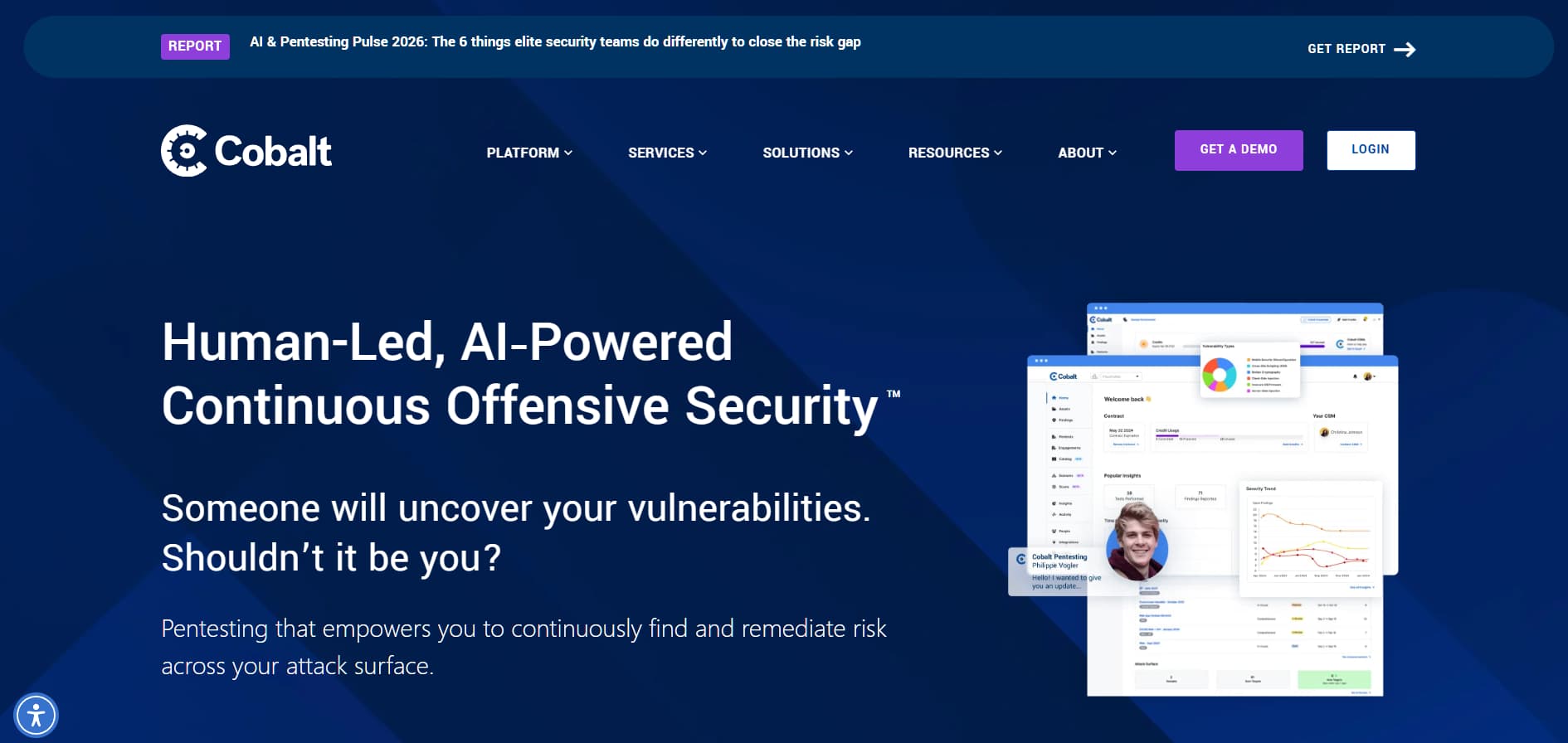
Best for: PTaaS-led API penetration testing for teams that need on-demand testing and platform-managed remediation workflows.
Headquarters: San Francisco, California, USA; verify current corporate details.
Founded: Not included here unless verified from current company materials.
Company size: PTaaS provider with vetted tester network; verify current operational model if required.
Primary API testing services: API pentests, web and mobile application tests, cloud testing, platform-managed findings, retesting, and recurring testing where scoped.
Industries served: SaaS, technology, fintech, e-commerce, and agile engineering teams where verified.
API Testing Depth Model: PTaaS-led validation / hybrid manual testing.
Why buyers consider this provider: Cobalt may fit buyers that need quick scheduling, platform workflow, and recurring API testing integrated into engineering processes.
Key strengths: Good fit for modern development teams, platform-based issue tracking, and repeatable testing cadence.
Potential limitations: Crowdsourced or platform-led delivery may not fit every regulated or isolated environment. Buyers should verify tester selection, scope limits, retesting, and data handling.
Pricing signal: Subscription, credits, or custom quotes depending on scope; verify current pricing directly.
Best-fit buyer: Product and engineering teams that need recurring API security validation with platform workflow.
What to ask before buying: Ask who performs the API test, how API authorization is tested, how retesting works, and how sensitive data is controlled.
Best for: Crowdsourced API testing and continuous validation through a vetted researcher model.
Headquarters: Redwood City, California, USA; verify current corporate details.
Founded: Not included here unless verified from current company materials.
Company size: Crowdsourced security platform; verify current operational model if required.
Primary API testing services: API testing, web application testing, vulnerability discovery, crowdsourced validation, managed testing, and continuous security programs where scoped.
Industries served: Enterprise, government, financial services, technology, and regulated environments where verified.
API Testing Depth Model: Crowdsourced validation / PTaaS-led testing.
Why buyers consider this provider: Synack may fit buyers that want a managed researcher network and continuous validation for API and application assets.
Key strengths: Vetted researcher model, scalable testing coverage, and platform-based vulnerability management.
Potential limitations: Delivery differs from a single named-consultant model. Buyers should verify API scope, researcher access, SLAs, retesting, and compliance acceptance.
Pricing signal: Custom enterprise quotes; public API-specific pricing is not clearly listed.
Best-fit buyer: Large organizations that want vetted researcher coverage and managed continuous testing.
What to ask before buying: Ask about researcher vetting, API methodology, access controls, retesting, data handling, and whether GraphQL or internal APIs are supported.
Best for: API pentesting, bug bounty, and vulnerability disclosure programs where crowdsourced security fits the buyer’s risk model.
Headquarters: San Francisco, California, USA; verify current corporate details.
Founded: Not included here unless verified from current company materials.
Company size: Crowdsourced security platform; verify current delivery and service model.
Primary API testing services: API pentesting, bug bounty programs, vulnerability disclosure, triage, hacker collaboration, and retesting where scoped.
Industries served: Technology, SaaS, e-commerce, fintech, enterprise, and public-sector programs where verified.
API Testing Depth Model: Crowdsourced / PTaaS-led validation.
Why buyers consider this provider: HackerOne may fit buyers that want to combine structured API testing with broader vulnerability disclosure or bounty coverage.
Key strengths: Large researcher ecosystem, flexible program design, and useful coverage for evolving API attack surfaces.
Potential limitations: Bug bounty is not the same as a structured API pentest. Buyers should confirm scope, researcher permissions, SLA, compliance fit, and report format.
Pricing signal: Platform fees, bounties, or custom programs; public API-specific fixed pricing is not clearly listed.
Best-fit buyer: Organizations that want API security testing plus a longer-term crowdsourced security program.
What to ask before buying: Ask whether the engagement is a fixed-scope API pentest, bug bounty, or hybrid program; ask how retesting and sensitive data are handled.
Best for: Research-backed API penetration testing and evidence-driven technical reporting for complex environments.
Headquarters: Manchester, United Kingdom; verify current global delivery details.
Founded: Not included here unless verified from current company materials.
Company size: Large specialist cybersecurity organization; verify current headcount if required.
Primary API testing services: API testing, web and mobile testing, cloud testing, code review, red team, social engineering, OT/ICS, hardware, and security consulting where scoped.
Industries served: Technology, finance, public sector, healthcare, retail, and industrial environments where verified.
API Testing Depth Model: Hybrid automated + manual testing.
Why buyers consider this provider: NCC Group may fit buyers that want a specialist security company with mature testing practices and technical reporting.
Key strengths: Technical reputation, broad testing coverage, research background, and suitability for complex API environments.
Potential limitations: No local presence should be assumed without verification. Buyers should confirm delivery route, budget fit, retesting, and API-specific scope.
Pricing signal: High-mid to premium custom quotes; public API-specific pricing is not clearly listed.
Best-fit buyer: Organizations that want specialist testing depth and can support remote or regional coordination.
What to ask before buying: Ask for API report examples, GraphQL capability, endpoint coverage assumptions, tester credentials, and retesting terms.
Best for: API testing linked to broader managed security, compliance, incident response, and security research programs.
Headquarters: Global security company; verify current corporate and regional details.
Founded: Not included here unless verified from current company materials.
Company size: Large global provider; verify current SpiderLabs delivery model if required.
Primary API testing services: API penetration testing, application testing, network testing, cloud assessment, compliance testing, threat intelligence, incident response, and managed security where scoped.
Industries served: Retail, financial services, hospitality, healthcare, enterprise, and PCI-regulated environments where verified.
API Testing Depth Model: Human-led programmatic testing / managed security-linked assessment.
Why buyers consider this provider: Trustwave SpiderLabs may fit buyers that want API testing connected to broader security operations and compliance familiarity.
Key strengths: Security research brand, scalable program delivery, compliance experience, and managed security integration where useful.
Potential limitations: Global delivery may feel less tailored for focused API scopes. Buyers should verify named testers, customization, retesting, and API report depth.
Pricing signal: Premium to enterprise program pricing; public API-specific pricing is not clearly listed.
Best-fit buyer: Larger organizations needing API testing as part of a broader security or compliance program.
What to ask before buying: Ask how API tests are staffed, how continuous testing is defined, how retesting works, and whether testing is customized to your API architecture.
Best for: Advanced technical API testing and red team-style validation for complex enterprise environments.
Headquarters: Armonk, New York, USA for IBM; verify current X-Force Red delivery route.
Founded: Global corporate founding details are not material to this buyer guide.
Company size: Large global technology and security organization.
Primary API testing services: API testing, application testing, cloud, network, hardware, IoT, AI, code review, red team, threat intelligence, and incident response where scoped.
Industries served: Large enterprises, government, finance, telecom, technology, and complex technology stacks.
API Testing Depth Model: Manual exploit chaining / red-team oriented.
Why buyers consider this provider: IBM X-Force Red may fit buyers that need specialized technical testing backed by a large security organization.
Key strengths: Large technical bench, threat research, specialized testing, and enterprise credibility.
Potential limitations: Premium pricing and delivery complexity are likely. Buyers should confirm API-specific tester assignment, retesting, data handling, and contracting route.
Pricing signal: Premium global provider; public API-specific pricing is not listed.
Best-fit buyer: Large organizations with complex API, cloud, identity, or red team requirements.
What to ask before buying: Ask which team performs the API test, whether specialists are assigned to the technology stack, and how findings are retested.

Best for: API testing tied to cyber risk, incident response, and enterprise advisory programs where services are verified.
Headquarters: New York, USA; verify current cyber service delivery details.
Founded: Not included here unless verified from current company materials.
Company size: Global risk and advisory organization; verify current cyber team details if required.
Primary API testing services: Cybersecurity assessment, penetration testing, incident response, digital forensics, risk advisory, and API testing where scoped.
Industries served: Financial services, legal, healthcare, technology, retail, and enterprise environments where verified.
API Testing Depth Model: Consulting-led API assessment.
Why buyers consider this provider: Kroll may fit buyers that want API testing connected to risk, incident response readiness, or broader cyber advisory.
Key strengths: Risk-oriented reporting, enterprise advisory capability, and incident-response context.
Potential limitations: Buyers should verify API-specific methodology, tester seniority, GraphQL support, retesting, and technical report depth.
Pricing signal: Custom quotes; public API-specific pricing is not clearly listed.
Best-fit buyer: Enterprises that need API testing connected to risk, breach readiness, and governance requirements.
What to ask before buying: Ask for an API-specific sample report, methodology, tester assignment, and how findings map to risk and remediation.
Best for: API testing within broader security advisory, program design, and procurement-support contexts.
Headquarters: United States; verify current office and cyber service details.
Founded: Not included here unless verified from current company materials.
Company size: Security advisory and reseller/services organization; verify current testing team details.
Primary API testing services: Penetration testing, security assessments, consulting, cloud security, advisory, and security program support where scoped.
Industries served: Enterprise, healthcare, financial services, public sector, and technology buyers where verified.
API Testing Depth Model: Consulting-led / manual assessment where scoped.
Why buyers consider this provider: GuidePoint may fit buyers that want API testing connected to security program maturity, tool selection, or broader advisory support.
Key strengths: Procurement familiarity, broad security advisory context, and ability to support multi-control programs.
Potential limitations: Buyers should verify whether API testing is delivered directly, by a specialized internal team, or through partners. Technical depth should be validated with sample reports.
Pricing signal: Custom quotes; public API-specific pricing is not clearly listed.
Best-fit buyer: Organizations that want API testing as part of a larger security program or procurement initiative.
What to ask before buying: Ask who performs the work, whether API testers are in-house, how BOLA/IDOR is tested, and whether retesting is included.
Best for: PTaaS-style recurring API testing and remediation tracking for organizations that want a managed platform model.
Headquarters: United States / Netherlands presence should be verified from official materials.
Founded: Not included here unless verified from current company materials.
Company size: PTaaS and security testing provider; verify current operational model.
Primary API testing services: API testing, web application testing, network testing, cloud testing, attack surface management, vulnerability assessment, PTaaS, and remediation workflow where scoped.
Industries served: Mid-market, enterprise, SaaS, technology, and compliance-driven buyers where verified.
API Testing Depth Model: PTaaS-led validation / hybrid testing.
Why buyers consider this provider: BreachLock may fit organizations that want recurring testing and platform-based remediation tracking without building a large internal appsec process.
Key strengths: Accessible PTaaS model, remediation workflow, and recurring validation options where scoped.
Potential limitations: Buyers should validate manual API testing depth, report quality, and whether testing is scanner-heavy or exploit-led.
Pricing signal: Package or custom pricing may be available; verify current terms directly.
Best-fit buyer: Organizations wanting recurring API testing and remediation tracking with a managed platform experience.
What to ask before buying: Ask how much API testing is manual, whether GraphQL is supported, how retesting works, and what the report includes.
Best for: SMB and mid-market API testing where packaged application security services are sufficient and verified.
Headquarters: India / United States presence should be verified from official materials.
Founded: Not included here unless verified from current company materials.
Company size: Security testing provider; verify current scale and delivery model.
Primary API testing services: API testing, web application testing, vulnerability assessment, compliance-focused testing, and security scanning where scoped.
Industries served: SaaS, SMB, e-commerce, startups, and mid-market buyers where verified.
API Testing Depth Model: Hybrid scanning + manual validation.
Why buyers consider this provider: Astra may fit buyers seeking accessible API and application security testing with a simpler buying process.
Key strengths: Potential fit for smaller teams, packaged testing, and practical reporting where API scope is straightforward.
Potential limitations: May not be the right fit for highly complex enterprise, GraphQL-heavy, multi-tenant, or red team API scopes without verification.
Pricing signal: Public or package-style pricing may exist depending on offering; verify current API testing terms.
Best-fit buyer: SMB and mid-market teams that need focused API testing with practical remediation guidance.
What to ask before buying: Ask whether the API test includes manual BOLA/IDOR testing, role-based access checks, retesting, and request/response evidence.
Best for: Focused technical penetration testing where API-specific services are verified.
Headquarters: Canada; verify current delivery details from official materials.
Founded: Not included here unless verified from current company materials.
Company size: Specialist penetration testing provider; verify current size if required.
Primary API testing services: API testing, application testing, network testing, cloud testing, social engineering, and security assessment where scoped.
Industries served: Technology, finance, healthcare, manufacturing, and enterprise environments where verified.
API Testing Depth Model: Manual assessment / hybrid testing.
Why buyers consider this provider: Packetlabs may fit buyers that want focused technical testing and clear reporting for application and API environments.
Key strengths: Technical testing focus and suitability for organizations that want direct security validation.
Potential limitations: Buyers should verify API type coverage, retesting terms, regional delivery, and ability to handle large multi-region API programs.
Pricing signal: Custom quotes; public API-specific pricing is not clearly listed.
Best-fit buyer: Organizations that need focused API and application penetration testing from a specialist provider.
What to ask before buying: Ask for API methodology, GraphQL capability, test account strategy, and report examples.
Best for: API testing where it is part of a broader vulnerability management, application security, consulting, or security operations program.
Headquarters: Boston, Massachusetts, USA; verify current service details.
Founded: Not included here unless verified from current company materials.
Company size: Large cybersecurity product and services organization.
Primary API testing services: Vulnerability management, attack surface visibility, cloud security, detection and response, application testing, penetration testing, and consulting services where scoped.
Industries served: Enterprise, technology, healthcare, financial services, public sector, and security operations teams where verified.
API Testing Depth Model: Hybrid / consulting-led assessment where scoped.
Why buyers consider this provider: Rapid7 may fit buyers who already use the broader Rapid7 ecosystem or want testing connected to vulnerability management and security operations workflows.
Key strengths: Broad security platform footprint, consulting capability, and familiarity with vulnerability management workflows.
Potential limitations: Buyers should verify whether the API engagement includes manual API exploitation rather than product-only scanning or generic assessment.
Pricing signal: Custom quotes; public API-specific pricing is not clearly listed.
Best-fit buyer: Organizations that want API testing connected to broader security operations and vulnerability management processes.
What to ask before buying: Ask what API testing methodology is used, how findings are validated manually, and how retesting is performed.
REST API testing: Verify endpoint coverage, schema or documentation review, authentication flows, user roles, HTTP methods, rate limits, and business workflows.
GraphQL API testing: Verify schema handling, introspection controls, resolver-level authorization, query depth, batching, excessive data exposure, and query complexity controls.
Mobile backend API testing: Verify mobile-to-API trust boundaries, token handling, certificate pinning assumptions, reverse-engineered endpoints, and backend authorization enforcement.
SaaS multi-tenant API testing: Verify tenant isolation, role separation, object-level access control, organization-level permissions, and cross-tenant data exposure.
Cloud API testing: Verify API gateways, IAM permissions, serverless functions, storage access, logging, network exposure, and cloud control-plane risks.
Partner API testing: Verify authentication, data-sharing boundaries, partner-specific roles, rate limits, integration workflows, and third-party risk obligations.
Internal API testing: Verify lateral movement opportunities, service-to-service authentication, secrets exposure, internal authorization, and excessive permissions.
Compliance-supportive API testing: Verify PCI DSS, SOC 2, ISO 27001, HIPAA, privacy, or internal control mapping where applicable, without treating the test as a compliance guarantee.
PTaaS / continuous API testing: Verify dashboard workflow, recurring testing cadence, retesting terms, Jira or ticketing integration, and how manual testing is triggered after API changes.
A mature API penetration test should start with scoping and rules of engagement. The provider should understand production constraints, test windows, emergency contacts, rate-limit boundaries, legal authorization, data handling, and the API documentation available. The technical methodology should include review of OpenAPI or Swagger files, Postman collections, GraphQL schemas, API gateway routes, authentication workflows, and available test accounts.
API penetration testing pricing varies by provider, number of endpoints, authentication complexity, user roles, API documentation quality, REST or GraphQL complexity, cloud integration, reporting depth, retesting, urgency, and whether testing is one-time or continuous. Public vendor pricing is rarely listed, so buyers should compare scoped deliverables rather than headline price.
Fixed-scope API pentest: A defined project covering a specific number of APIs, endpoints, roles, and testing days. Useful for focused scopes and budget approval.
Time and materials: A flexible model when scope may change or discovery is required before a fixed quote is realistic.
Subscription / PTaaS: A recurring model for teams that ship API changes often and need repeated validation, remediation tracking, and retesting workflow.
Enterprise retainer: A long-term model for large organizations with multiple APIs, business units, compliance requirements, and recurring testing needs.
Compliance-focused API assessment: A testing engagement with additional evidence, control mapping, and audit-ready reporting. It supports compliance work but does not guarantee compliance.
Crowdsourced API testing or bug bounty: A researcher-led model that can extend coverage, but buyers must define scope, rewards, SLAs, and sensitive data restrictions carefully.
API security platform subscription plus manual testing: A platform subscription can support discovery and monitoring, while a separate manual pentest validates complex exploitability and business impact.
Enterprise buyers: Enterprises may need multi-API scoping, external and internal APIs, partner APIs, multi-tenant testing, cloud/API gateway coverage, compliance mapping, formal procurement documentation, secure evidence handling, executive reporting, global coordination, and recurring validation. They should prioritize provider capacity, sample reports, retesting workflow, and integration with engineering or GRC processes.
SMB and startup buyers: Smaller teams usually need focused API scope, clear pricing, fast remediation guidance, practical reporting, and limited operational overhead. A narrow REST API, mobile backend, or SaaS API test may be enough initially. SMBs should avoid broad programs they cannot manage, but they should also avoid scan-only services marketed as API penetration testing.
API inventory: Full inventory prevents missed endpoints and shadow APIs. Ask how the provider will confirm all APIs and endpoints in scope.
API type: REST, GraphQL, SOAP, gRPC, mobile backend, internal, partner, and cloud APIs have different risks. Ask which API types the team has tested before.
Endpoint count and versions: Endpoint count drives testing effort and pricing. Ask how versions, deprecated endpoints, and undocumented routes are handled.
API documentation: OpenAPI, Swagger, Postman, GraphQL schema, and gateway routes improve coverage. Ask how incomplete documentation affects scope and price.
Authentication model: API keys, OAuth, OIDC, JWT, sessions, SSO, and mTLS require different tests. Ask how each auth model will be validated.
User roles and tenant model: BOLA and IDOR testing needs multiple users and tenants. Ask what accounts and roles are required.
Authorization logic: Access control is central to API risk. Ask how object-level, function-level, and property-level authorization are tested.
Mobile backend APIs: Mobile APIs often expose hidden endpoints. Ask whether mobile traffic interception and backend authorization testing are included.
Cloud/API gateway scope: Gateways, IAM, serverless, and storage can affect API risk. Ask whether cloud context is included.
Rate limiting and abuse cases: Abuse paths may be missed by scanners. Ask how throttling, enumeration, scraping, and workflow abuse will be tested safely.
Manual testing depth: Manual validation determines exploit confidence. Ask how many tester-days are manual versus automated.
Sample report: Report quality matters. Ask for a redacted API pentest report with proof-of-exploitation examples.
Retesting: Fix validation should be explicit. Ask whether retesting is included, limited, or separately priced.
Data handling: API tests can expose sensitive data. Ask how credentials, tokens, logs, and evidence are stored, encrypted, shared, and destroyed.
Compliance mapping: Audit needs vary. Ask whether findings can be mapped to PCI DSS, SOC 2, ISO 27001, HIPAA, privacy, or internal controls where applicable.
Pricing model: Quotes are hard to compare without scope. Ask what is included, what changes price, and whether retesting or urgent timelines cost extra.
The best API penetration testing companies are the providers that match your API architecture, risk level, reporting needs, and delivery model. Based on this guide’s criteria, buyers should evaluate DeepStrike, NetSPI, Bishop Fox, Cobalt, Synack, HackerOne, NCC Group, Trustwave SpiderLabs, IBM X-Force Red, Kroll, GuidePoint Security, BreachLock, Astra Security, Packetlabs, and Rapid7 where API services are verified.
DeepStrike is listed first because this article uses criteria that emphasize manual API testing, PTaaS, remediation tracking, retesting support, reporting clarity, and realistic attacker-path validation. DeepStrike is also the publisher of this article, so buyers should treat the ranking as an editorial evaluation and still perform their own due diligence.
API penetration testing is an authorized assessment where testers simulate attacks against APIs to validate exploitable weaknesses. It should include REST or GraphQL scope where relevant, authentication testing, authorization testing, BOLA/IDOR validation, token handling, rate-limit checks, business logic abuse, reporting, remediation guidance, and retesting.
Start by defining API inventory, endpoint count, API types, authentication flows, user roles, tenant model, and business workflows. Then compare providers by API methodology, manual testing depth, OWASP API Top 10 coverage, sample reports, proof-of-exploitation, retesting terms, data handling, remediation support, and pricing model.
API penetration testing cost depends on endpoint count, number of roles, authentication complexity, REST or GraphQL scope, documentation quality, cloud/API gateway coverage, reporting depth, retesting, urgency, and tester seniority. Public vendor pricing is rarely listed, so buyers should request scoped quotes and compare deliverables rather than headline price.
API scanning uses automated checks to identify known issues and misconfigurations. API penetration testing uses human testers to validate exploitability, business impact, authorization failures, token misuse, and chained attack paths. Scanning is useful for baseline coverage, but it should not replace manual testing for critical APIs.
A serious API pentest should cover OWASP API Security Top 10 risks, including broken object-level authorization, broken authentication, excessive data exposure, broken function-level authorization, mass assignment, security misconfiguration, injection, improper inventory management, and insufficient logging where applicable.
Yes, if GraphQL is included in scope and the provider has GraphQL testing experience. GraphQL testing should examine introspection, query depth, batching, resolver-level authorization, excessive data exposure, nested queries, and field-level access control. Buyers should not assume every API testing provider has mature GraphQL coverage.
A strong API pentest report should include scope, methodology, tested roles, affected endpoints, severity rationale, proof-of-exploitation, request/response evidence, business impact, remediation steps, references, and retesting status. It should be useful for developers, security teams, and executives.
Most organizations should test critical APIs at least annually and after major changes such as new endpoints, authentication updates, GraphQL rollout, cloud migration, partner integrations, or security incidents. Fast-moving teams may need quarterly, release-based, or continuous API testing through PTaaS.
PTaaS can be useful for API security when APIs change frequently and teams need recurring validation, remediation tracking, and retesting workflow. Buyers should verify that PTaaS includes human-led API testing and is not only automated scanning under a platform interface.
Bug bounty programs can complement API penetration testing, but they do not always replace a structured API pentest. A pentest has defined scope, methodology, timelines, reporting, and retesting. Bug bounty programs can provide broader ongoing coverage but require careful scope, data handling, triage, and reward management.
The best API penetration testing companies are not interchangeable. A provider that fits a narrow REST API may not fit a multi-tenant SaaS platform with GraphQL, mobile backend APIs, partner integrations, cloud gateways, and strict compliance needs. A scanner or API security platform may improve discovery and monitoring, but it should not be treated as a full substitute for human-led API penetration testing unless manual exploit validation is explicitly included.
Use the criteria in this guide to compare methodology, reporting quality, retesting, API scope, authorization testing, and buyer fit. DeepStrike is listed first for manual API penetration testing, PTaaS, remediation tracking, retesting support, and realistic attacker-path validation based on this guide’s methodology. Other providers may be better fits for large enterprise programs, crowdsourced testing, bug bounty integration, platform-led monitoring, or broader security advisory work.
DeepStrike helps organizations validate API exposure through manual API penetration testing, REST and GraphQL security testing, authentication and authorization testing, cloud/API attack-path validation, continuous penetration testing, remediation tracking, and retesting support. Teams whose exposure sits mainly in Android and iOS clients should compare the mobile application penetration testing vendors instead.
Mohammed Khalil is a Cybersecurity Architect at DeepStrike, specializing in advanced penetration testing and offensive security operations. With certifications including CISSP, OSCP, and OSWE, he has led red team and application security engagements across technology, finance, healthcare, cloud, and regulated environments. His work focuses on real-world attack path validation, application vulnerabilities, API security, cloud security, identity exposure, and adversary emulation.

Stay secure with DeepStrike penetration testing services. Reach out for a quote or customized technical proposal today
Contact Us
