July 14, 2026
Updated: July 28, 2026
ALPHV/BlackCat was a ransomware-as-a-service ecosystem in which core operators maintained the service and affiliates conducted varied intrusions. This guide explains the entity model, verified timeline, major incidents, current status, ATT&CK techniques, detection priorities, defensive controls, and safe validation.

Mohammed Khalil
Updated 14 July 2026 • Research cutoff 14 July 2026
Ransomware brands change names, infrastructure, affiliates, and methods. This article reflects evidence verified through 14 July 2026. Criminal leak-site posts are treated as claims unless supported by independent evidence, and ALPHV operators, affiliates, and BlackCat malware are not treated as one actor. For active indicators, consult current government advisories. This is defensive information, not legal, ransom-payment, or incident-response advice.
ALPHV/BlackCat was a ransomware-as-a-service ecosystem first observed publicly in November 2021. ALPHV usually names the criminal operation, while BlackCat or Noberus may refer to its ransomware malware. Independent affiliates obtained access and conducted intrusions, so tactics varied by incident. U.S. authorities disrupted infrastructure in December 2023; researchers later assessed an apparent March 2024 exit scam. As of 14 July 2026, reviewed public evidence did not establish that the original ALPHV service had resumed.
DeepStrike's Red Teaming Services emulate ALPHV-style affiliate intrusions end to end, showing whether your identity and recovery controls actually hold.
“ALPHV/BlackCat” compresses several related entities into one convenient label. The U.S. Department of Justice’s disruption announcement described a ransomware-as-a-service, or RaaS, organization in which developers maintained the malware and infrastructure and affiliates conducted attacks. MITRE ATT&CK separately catalogs BlackCat as malware, assigns it software ID S1068, and lists ALPHV and Noberus as associated software names.
That distinction matters. A BlackCat payload on a system is technical evidence about malware use. It does not by itself identify who acquired access, stole data, negotiated, or selected the target. An affiliate might have used its own social-engineering method, bought access from a broker, or relied on an exposed remote service. Core ALPHV operators could provide infrastructure without conducting every stage of that affiliate’s intrusion.
Noberus is a research name associated with the BlackCat malware family. It is not proof of a separate criminal organization. Similarly, “BlackCat group” is common public shorthand, but accurate attribution should state whether the evidence concerns the RaaS operation, an affiliate, malware behavior, or a leak-site claim.
Researchers and authorities have associated ALPHV with the earlier DarkSide and BlackMatter ecosystems. The Canadian Centre for Cyber Security cited reporting about shared users, code, or operating practices, while Australia’s ACSC profile also described reported lineage. These links support a successor or overlap assessment; they do not establish that every operator or affiliate was the same person across all three brands.
| Term | Usually Refers To | Relationship | Evidence Caveat |
|---|---|---|---|
| ALPHV | RaaS operation or brand | Operators, infrastructure, and affiliate program associated with BlackCat | Some sources also use it as a malware alias |
| BlackCat | Ransomware malware; sometimes the overall operation | Payload offered through the ALPHV ecosystem | Malware presence does not identify the full intrusion team |
| Noberus | Research alias for BlackCat malware | Associated software name in MITRE ATT&CK | Not a universally used group name |
| Core operators | Developers or administrators of malware, services, brand, or negotiation infrastructure | Enabled affiliates and maintained the RaaS | Public reporting rarely establishes every individual role |
| Affiliates | Independent or semi-independent intrusion actors | Obtained access and deployed the service in many incidents | Tactics varied; one affiliate is not the universal ALPHV playbook |
| Initial-access brokers | Actors selling or transferring compromised access | Could supply access to an affiliate | Not automatically ALPHV members or affiliates |
| Data-leak infrastructure | Sites or systems used for disclosure pressure | Supported extortion claims and publication | A listing is not independent proof of compromise, data authenticity, or payment |
| DarkSide / BlackMatter | Earlier ransomware ecosystems linked in public assessments | Reported overlap in personnel, code, or practices | Public evidence does not prove complete continuity of membership |
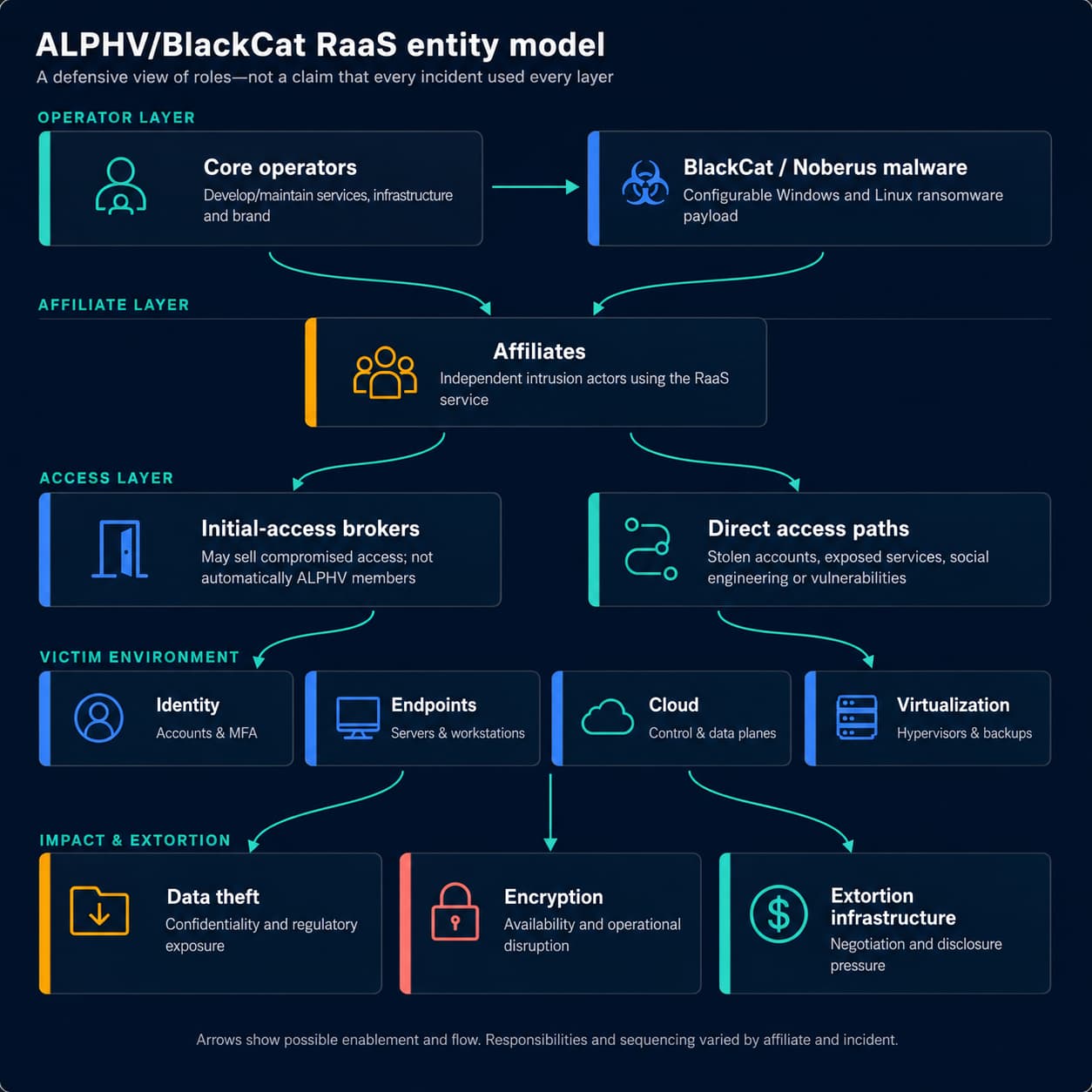
Figure 1. A simplified defensive model of the ALPHV/BlackCat ransomware-as-a-service ecosystem. Roles varied between incidents.
Source note: DeepStrike synthesis based on dated government advisories and original threat research listed in the source ledger.
RaaS separated enablement from intrusion work. Operators maintained the ransomware, supporting infrastructure, brand, and services. Affiliates brought or obtained access, moved through victim environments, stole data, and deployed the payload in return for a negotiated revenue share. A December 2025 DOJ plea announcement documents one agreement in which administrators received 20% and affiliates 80%. That court-supported example should not be presented as a universal split across all affiliates or periods.
Affiliates could use their own tools, social-engineering approaches, access suppliers, and targeting logic. Microsoft’s early analysis, “The many lives of BlackCat ransomware”, showed why incident paths differed even when the final malware family was the same. The FBI, CISA, and HHS later documented affiliate-specific identity tactics in their updated ALPHV advisory.
For defenders, the consequence is simple: an IOC list or one “BlackCat attack chain” is too narrow. Detection must cover access, identity, privilege, remote administration, data movement, recovery interference, and encryption behaviors. The brand can also disappear while affiliates continue in other ecosystems, or malware artifacts remain detectable after the service is no longer operating. DeepStrike’s ransomware-group landscape provides broader ecosystem context without replacing this entity-specific analysis.
| Date | Event | Evidence Level | Primary Source | Why It Matters |
|---|---|---|---|---|
| Mid-November 2021 | BlackCat malware first observed publicly | Documented | MITRE ATT&CK | Establishes emergence of the malware, not every operator identity |
| 14 April 2022 | Australia’s ACSC publishes an ALPHV/BlackCat ransomware profile | Confirmed | ACSC | Early official documentation of access paths, sectors, and extortion |
| 13 June 2022 | Microsoft publishes multi-affiliate analysis | Attributed | Microsoft | Shows that different affiliates produced different intrusion patterns |
| 16 November 2023 | U.S. agencies issue advisory on Scattered Spider, a threat actor known to deploy BlackCat | Attributed | FBI/CISA | Separates an affiliate actor’s identity-focused tactics from malware capability |
| 19 December 2023 | DOJ announces disruption, site seizures, and decryption support | Confirmed | DOJ | Disrupted infrastructure without proving permanent elimination |
| 21 February 2024 | Change Healthcare detects the attack later identified in sworn testimony as ALPHV/BlackCat | Confirmed | U.S. Senate testimony | Demonstrates material post-disruption activity and an identity-control failure |
| 27 February 2024 | Joint ALPHV advisory updated with post-disruption observations | Confirmed | FBI/CISA/HHS | Records leak-site activity and affiliate tactics after December 2023 |
| 5 March 2024 | A disputed seizure notice and affiliate complaints support an apparent exit-scam assessment | Assessed / disputed | Reuters | The UK denied responsibility; the actor’s own notice was not reliable evidence |
| 9 August 2024 | Unit 42 assesses that the operator finalized an exit scam in March 2024 | Assessed | Unit 42 | Supports shutdown assessment while leaving rebrand questions open |
| 6 May 2025 | Mandiant describes ALPHV RaaS as shut down and tracks former affiliate UNC3944 with RansomHub | Attributed | Mandiant | Former-affiliate activity is not proof that ALPHV itself resumed |
| 9 July 2026 | DOJ announces sentencing tied to historical BlackCat collaboration and 2023 attacks | Confirmed | DOJ | Shows continuing accountability, not current operation |
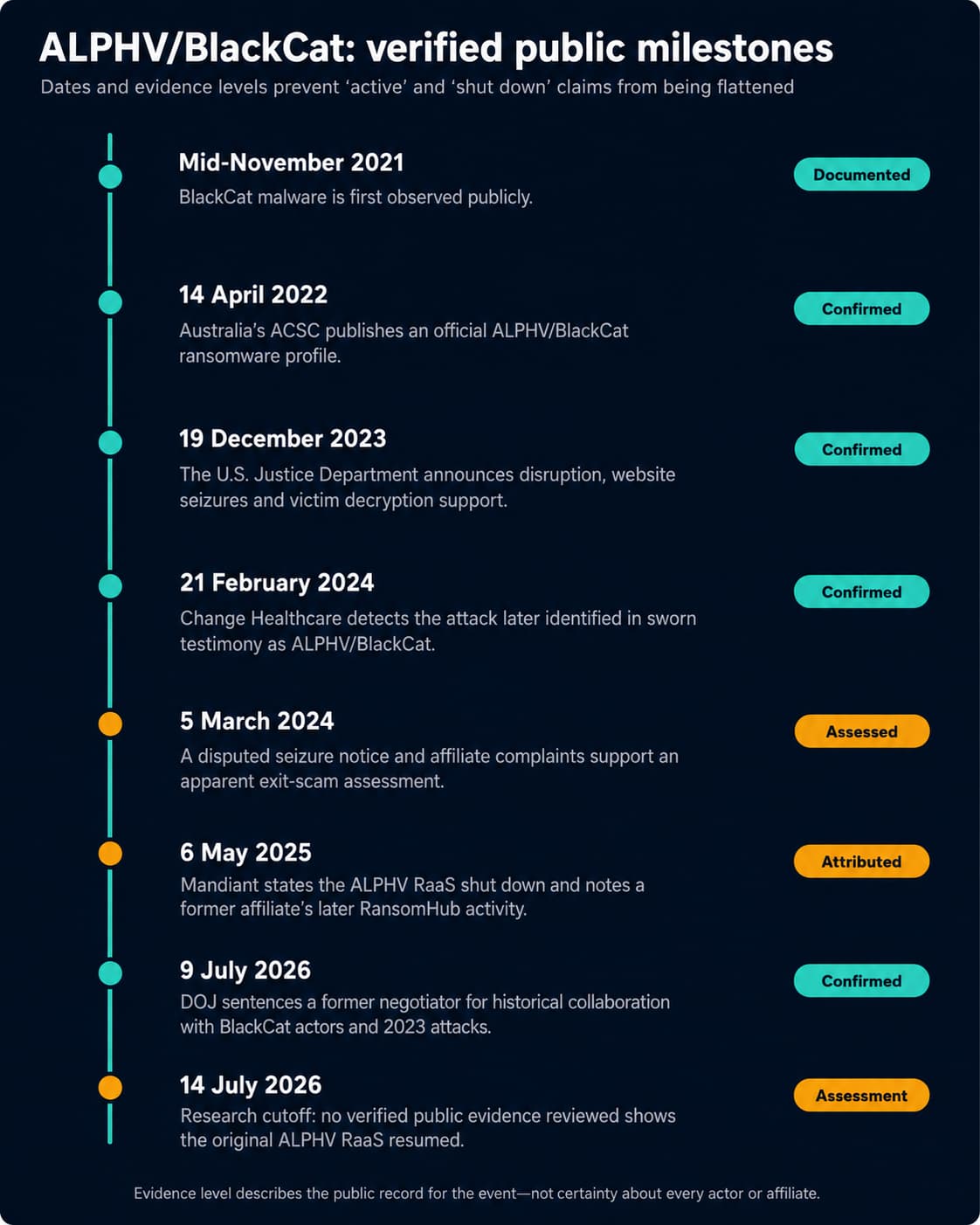
Figure 2. Key verified milestones in the public history of ALPHV/BlackCat through the stated research cutoff date.
Source note: MITRE ATT&CK; ACSC; Microsoft; FBI/CISA; U.S. Department of Justice; U.S. Senate Finance Committee; Unit 42; and Mandiant, with direct links in the timeline and source ledger.
Official sources describe broad, opportunity-driven exposure rather than one centrally directed sector strategy. The December 2023 DOJ announcement named victims across government, emergency services, defense-related organizations, critical manufacturing, healthcare, and education. Australian and Canadian authorities also documented activity across multiple regions and sectors.
The February 2024 joint advisory reported nearly 70 organizations posted to the actor’s leak site since mid-December 2023, with healthcare most frequently listed in that narrow period. This measures alleged leak-site victims observed by the FBI not independently confirmed breaches, affected individuals, payments, or successful encryption events. Public datasets therefore should not be merged into a “top industries” ranking.
The following ALPHV Exposure Chain is a defensive synthesis. It combines patterns documented across government advisories, technical analysis, and specific incidents. It is not a universal sequence and not a deployment guide: an incident may skip, combine, or reorder stages.
| Stage | Defensive Interpretation | Evidence to Seek |
|---|---|---|
| 1. Access opportunity | Exposed service, vulnerable system, supplier connection, or targetable user creates a path | Attack-surface inventory, vulnerability records, third-party access register |
| 2. Identity compromise | An account, authentication flow, or help-desk process is abused | IdP, MFA, help-desk, VPN, and remote-access logs |
| 3. Privilege expansion | Access grows toward administrative or control-plane authority | Role changes, new tokens, elevation events, privileged session records |
| 4. Environment discovery | The actor maps accounts, systems, shares, and business dependencies | Endpoint, directory, cloud, and network discovery telemetry |
| 5. Lateral access | Activity reaches additional systems or administrative planes | East-west flows, remote-service use, host-to-host authentication |
| 6. Control impairment | Monitoring, security services, or recovery protections are weakened | EDR tamper alerts, policy changes, log gaps, security-service state |
| 7. Data collection | Sensitive or operationally valuable data is accessed or staged | File, database, SaaS, and cloud audit records |
| 8. Exfiltration preparation | Data is consolidated or transferred for extortion | Proxy, DNS, egress, cloud-storage, and DLP events |
| 9. Ransomware impact | Encryption or destructive changes affect availability | Rapid multi-host file changes, service stops, hypervisor and backup events |
| 10. Recovery and assurance | The organization contains, restores, investigates, and validates remediation | Evidence chain, restore results, containment log, retest findings |
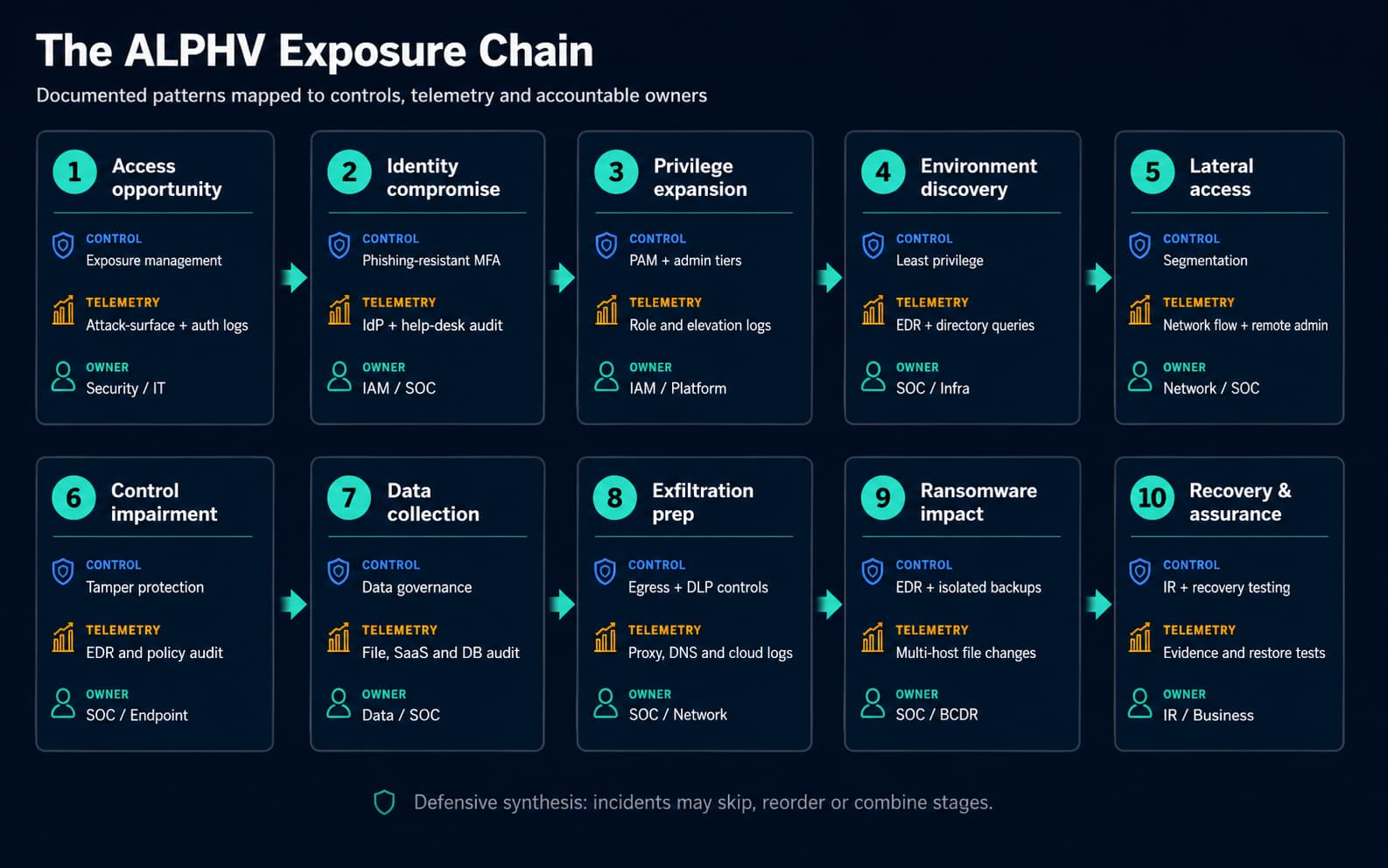
Figure 3. The ALPHV Exposure Chain maps documented ransomware behaviors to defensive controls and validation evidence.
Source note: Original DeepStrike framework informed by verified incident reporting and MITRE ATT&CK mappings. Incidents may skip, reorder, or combine stages.
The access evidence is varied because affiliates were varied. Treat each source’s scope as part of the finding.
| Access Pattern | Evidence and Scope | Frequency Statement | Defensive Control |
|---|---|---|---|
| Valid accounts and remote access | DOJ cited compromised credentials; the joint ALPHV advisory documented account compromise; Microsoft observed compromised credentials and remote desktop in affiliate cases | Recurring across multiple sources, not universal | Phishing-resistant MFA, conditional access, device trust, session-risk controls, rapid credential revocation |
| Help-desk and user social engineering | The Scattered Spider advisory and Microsoft’s Octo Tempest analysis document identity-focused behavior by a known BlackCat-deploying actor | Affiliate-specific; do not generalize to all ALPHV incidents | Verified callback or strong identity proofing, restricted resets, supervisor approval, help-desk audit alerts |
| Exposed services and vulnerabilities | ACSC’s 2022 profile cited remote services, known vulnerabilities, and misconfiguration | Documented historical pattern; public sources do not establish a universal rate | Internet exposure inventory, prioritized remediation, hardened gateways, restricted management interfaces |
| Third-party access | Caesars’ SEC filing confirmed social engineering of an outsourced IT support vendor; its filing did not name ALPHV | Incident-specific; ALPHV linkage remains attributed in public reporting | Supplier identity standards, scoped accounts, just-in-time access, session monitoring, rapid offboarding |
| Brokered or transferred access | Microsoft documented affiliate relationships involving access brokers and pre-existing access | Ecosystem pattern; frequency not quantified | Detect dormant-account reuse, require ownership and expiry for external access, monitor access-source changes |
| Missing MFA on critical remote access | Change Healthcare’s CEO testified that stolen credentials were used on a Citrix portal without MFA | Confirmed in one major incident, not a universal ALPHV condition | Enforce phishing-resistant MFA on every external and privileged path; continuously test for bypasses and exceptions |
Identity controls require more than “MFA enabled.” Defenders should know which applications are exempt, whether legacy protocols bypass policy, how service accounts authenticate, who can reset factors, and whether device or network context constrains a valid session. The joint advisory specifically recommends phishing-resistant approaches such as FIDO/WebAuthn or public-key infrastructure where feasible.
Ransomware impact becomes easier when a compromised identity can discover high-value systems and cross trust boundaries. MITRE’s BlackCat entry documents malware capabilities for account, group, file, network-share, and remote-system discovery. Those capabilities do not prove that every affiliate used them in every incident; they show what defenders should be able to observe when the malware or comparable tooling is present.
Administrative tiers reduce blast radius when workstation, server, cloud, directory, and backup privileges are not shared through the same accounts or management hosts. Privileged-access management should capture who requested access, what role was granted, which device and session used it, and when it expired. Segmentation needs similar evidence: policy definitions alone do not prove that identity systems, hypervisors, backups, and security-management planes are isolated in practice.
SOC investigations should correlate endpoint discoveries with identity and network context. A directory query may be normal for an administrator; the same query from a new device, immediately after a factor reset and followed by remote authentication across several servers, has different meaning. This context-driven approach is more durable than matching one tool name.
ALPHV incidents could create two separate harms: loss of availability through encryption and loss of confidentiality through data theft. The DOJ described multiple extortion, and the February 2024 advisory noted that some affiliates extorted organizations without deploying ransomware. A restore can return systems to service, but it cannot retrieve copied data or erase notification, contractual, legal, and reputational exposure.
Criminal leak-site statements are pressure tactics, not neutral incident records. A post does not prove that the named organization was breached, that files are genuine or complete, that the actor caused an outage, or that a payment occurred. The same caution applies to claimed data deletion. Even where an organization confirms payment, defenders cannot independently verify that every copy was destroyed or that access was fully removed.
Response decisions may require incident responders, executive leadership, legal counsel, insurers, privacy teams, regulators, and law enforcement. This article does not recommend whether to pay or explain how to negotiate. Those questions are jurisdiction- and incident-specific and require qualified advice.
The table intentionally mixes two evidence scopes and labels them. Malware capability rows come from MITRE’s BlackCat software entry. Affiliate behavior rows come from the February 2024 joint advisory. It is not a complete matrix.
| Tactic | Technique | ATT&CK ID | Public Evidence | Defensive Relevance | Confidence |
|---|---|---|---|---|---|
| Reconnaissance | Phishing for Information | T1598 | Joint advisory; affiliate behavior | Monitor identity-verification abuse and targeted information requests | High for cited affiliates; not universal |
| Resource Development | Compromise Accounts | T1586 | Joint advisory; affiliate behavior | Alert on account takeover signals before endpoint impact | High for advisory scope |
| Credential Access | Credentials from Password Stores | T1555 | Joint advisory; affiliate behavior | Protect credential stores; correlate access with new sessions | High for advisory scope |
| Credential Access | Steal or Forge Kerberos Tickets | T1558 | Joint advisory; affiliate behavior | Monitor ticket anomalies and privileged authentication | High for advisory scope |
| Credential Access / Collection | Adversary-in-the-Middle | T1557 | Joint advisory; affiliate behavior | Prefer phishing-resistant MFA; detect unusual session properties | High for advisory scope |
| Privilege Escalation / Defense Evasion | Bypass User Account Control | T1548.002 | MITRE S1068; malware capability | Detect unexpected elevation and constrain local admin rights | High for documented malware capability |
| Discovery | Account Discovery: Domain Account | T1087.002 | MITRE S1068; malware capability | Baseline directory queries and investigate unusual enumeration | High for documented malware capability |
| Discovery | File and Directory Discovery | T1083 | MITRE S1068; malware capability | Correlate broad enumeration with access to sensitive stores | High for documented malware capability |
| Discovery | Network Share Discovery | T1135 | MITRE S1068; malware capability | Watch new-host share enumeration and access | High for documented malware capability |
| Lateral Movement | Lateral Tool Transfer | T1570 | MITRE S1068; malware capability | Detect unexpected host-to-host transfers and remote administration | High for documented malware capability |
| Defense Evasion | Clear Windows Event Logs | T1070.001 | MITRE S1068; malware capability | Alert on audit-log clearing and telemetry gaps; protect logs off-host | High for documented malware capability |
| Impact | Service Stop | T1489 | MITRE S1068; malware capability | Alert when security, application, or virtualization services stop unexpectedly | High for documented malware capability |
| Impact | Inhibit System Recovery | T1490 | MITRE S1068; malware capability | Isolate recovery administration and alert on restore-policy changes | High for documented malware capability |
| Impact | Data Encrypted for Impact | T1486 | MITRE S1068; malware capability | Detect rapid distributed file changes and preserve isolated recovery paths | High for documented malware capability |
This selection is deliberately short. It illustrates how official confirmation, technical attribution, and criminal claims can differ.
| Organization or Incident | Date | What Was Publicly Reported | Verification Status | Best Source | Important Caveat |
|---|---|---|---|---|---|
| 5 February 2023 | Reddit confirmed a targeted phishing incident, employee credential compromise, and access to internal data | Incident confirmed; ALPHV attribution unverified | Reddit statement | A later actor claim does not make ALPHV attribution official | |
| Caesars Entertainment | September 2023 | Caesars confirmed social engineering against an outsourced IT support vendor and theft of loyalty-program data | Incident confirmed; ALPHV/affiliate linkage attributed, not company-confirmed | SEC Form 8-K | Filing did not name ALPHV or confirm public payment claims |
| MGM Resorts | September 2023 | MGM confirmed operational disruption and theft of some customer data | Incident confirmed; BlackCat deployment attributed in public threat reporting | SEC Form 8-K | MGM’s filing did not attribute the intrusion to ALPHV; core-operator involvement is not established |
| Change Healthcare | 21 February 2024 | UnitedHealth’s CEO identified ALPHV/BlackCat in sworn testimony and described stolen credentials on a remote portal without MFA | Incident and attribution confirmed by victim testimony | Senate testimony and UnitedHealth update | Testimony concerned this incident; it does not establish one universal ALPHV access method |
On 19 December 2023, the U.S. Department of Justice announced that the FBI had gained visibility into ALPHV’s network, seized several websites, and developed a decryption tool offered to more than 500 affected organizations. The action involved international partners. Australia later documented its participation in its 2023–2024 Annual Cyber Threat Report. DeepStrike’s separate LockBit ransomware profile offers related context on why disruption of infrastructure and elimination of every related actor are not the same claim.
The action affected infrastructure and victim access to decryption support. It did not establish the identity or custody of every operator and affiliate, nor did it guarantee permanent shutdown. The updated joint advisory documented activity after the disruption, and Change Healthcare was attacked in February 2024.
In early March 2024, an ALPHV-associated site displayed a seizure notice. The UK National Crime Agency denied responsibility, and researchers assessed that the operator staged the notice amid an exit scam and affiliate dispute. The actor-controlled notice therefore cannot be treated as an official law-enforcement statement. Later prosecutions, guilty pleas, and the July 2026 sentencing are confirmed legal actions tied to historical conduct; they do not prove that the RaaS continued operating.
Latest verifiable date: 14 July 2026. The answer is more precise than “yes” or “no.”
Behavioral detection should connect identity, endpoint, network, cloud, data, and recovery evidence. Static indicators from current FBI/CISA/HHS guidance can support triage, but indicators age and can be changed or shared.
| Detection Category | Relevant Telemetry | Responsible Team | Detection Objective | Context / False-Positive Consideration |
|---|---|---|---|---|
| Identity anomalies | IdP, MFA, SSO, VPN, risk, and device logs | IAM / SOC | Detect impossible or unusual sessions, factor changes, and new device use | Travel, device replacement, and service accounts need baselines |
| Help-desk abuse | Ticketing, call recording where lawful, reset approvals, admin audit | Help desk / IAM / SOC | Find high-risk resets, bypasses, and repeated targeting | Legitimate urgent recovery must still follow strong proofing |
| Remote-access anomalies | Gateway, VPN, VDI, Citrix, RDP broker, firewall | Network / SOC | Identify new source, unusual time, unmanaged device, or broad access | Administrators and suppliers may work irregular hours; require ownership context |
| Privileged misuse | PAM, directory, cloud IAM, endpoint elevation | IAM / Platform / SOC | Detect unexpected role grants, token use, or admin sessions | Approved change windows should be linked to tickets |
| Discovery and lateral access | EDR, directory audit, network flow, remote-service logs | SOC / Infrastructure | Correlate enumeration with host-to-host authentication and tool transfer | Asset-management and deployment tools can look similar at scale |
| Security-control tampering | EDR health, policy audit, event-log pipeline, service state | SOC / Endpoint | Detect disabled tools, cleared logs, or telemetry gaps | Maintenance must be pre-authorized and observable out of band |
| Data staging and outbound transfer | File audit, database, SaaS, DLP, proxy, DNS, cloud egress | Data / Network / SOC | Find unusual archive creation, sensitive access, or high-volume transfer | Backups and business exports need known destinations and schedules |
| Recovery interference | Backup controller, vault, hypervisor, identity, configuration audit | BCDR / Platform / SOC | Detect deletion attempts, changed retention, disabled jobs, or new admins | Routine lifecycle operations require dual control and change records |
| Rapid multi-host impact | EDR, file servers, storage, application monitoring | SOC / IT operations | Detect synchronized file changes, service stops, and availability loss | Approved migrations and bulk jobs should be allowlisted narrowly, not globally |
No single control prevents every ransomware attack. Priorities should be validated against the organization’s actual identity, access, data, and recovery architecture.
| Priority | Control | Exposure Addressed | Evidence to Validate | Owner |
|---|---|---|---|---|
| 0 | Phishing-resistant MFA for external and privileged access | Stolen passwords, session phishing, weak factors | Enforcement report, exception inventory, test of all access paths | IAM |
| 0 | Strong help-desk identity proofing | Social-engineered resets and factor changes | Reset workflow, approval log, sampled call/ticket audit | Service desk / IAM |
| 0 | Remote-access hardening | Exposed or over-permissive gateways | Internet inventory, supported versions, device trust, source restrictions | Network / IT |
| 0 | Privileged-access management and administrative tiers | Privilege expansion and control-plane compromise | Role inventory, just-in-time grants, session records, separate admin devices | IAM / Platform |
| 0 | EDR, centralized logging, and tamper alerts | Control impairment and late detection | Coverage by critical asset, off-host retention, simulated alert receipt | SOC / Endpoint |
| 0 | Isolated backups and recovery tests | Encryption, deletion, prolonged outage | Immutable/offline copy evidence, privileged separation, timed restore test | BCDR / Business owners |
| 1 | Patch and exposure management | Vulnerable internet-facing systems | Asset-to-owner mapping, remediation SLA evidence, exception expiry | Security / IT |
| 1 | Network and management-plane segmentation | Lateral movement and blast radius | Tested path matrix, denied-flow evidence, controlled failover test | Network / Platform |
| 1 | Service-account governance | Persistent or broad non-human access | Named owner, least privilege, rotation, interactive-login restriction | IAM / Application teams |
| 1 | Data governance, DLP, and egress controls | Collection and exfiltration | Sensitive-data map, outbound destination baseline, alert validation | Data / Network / SOC |
| 1 | Third-party access governance | Supplier compromise and inherited trust | Contracted controls, scoped identity, expiry, session and offboarding evidence | Procurement / IAM |
| 1 | Ransomware exercises and remediation validation | Coordination failure and untested assumptions | Exercise record, decision log, owners, retest closure | IR / Executive / Risk |
Activate the approved incident-response plan, preserve evidence, and isolate affected systems through authorized procedures that account for safety-critical services. Protect identity infrastructure early by restricting compromised accounts, reviewing privileged sessions and factor resets, and preserving authentication, endpoint, network, and cloud logs.
Engage qualified incident-response, legal, privacy, insurance, executive, regulatory, and law-enforcement stakeholders as the facts and jurisdiction require. Validate backups before restoration, confirm that identity and management planes are trustworthy, and avoid public attribution based only on a ransom note, filename, or leak-site claim. After containment, retest the access path and the controls expected to prevent or detect it.
Authorized testing can validate whether internet-facing services expose unintended paths, whether web and API weaknesses cross identity boundaries, whether cloud and IAM roles permit excessive privilege, and whether segmentation separates user, server, management, backup, and security planes. Readers defining the scope can start with what penetration testing is, the difference between a vulnerability assessment and penetration test, and the distinct perspectives of internal and external testing. A controlled exercise can also test whether identity, endpoint, and network detections produce actionable evidence under realistic but safe conditions; the red-team and blue-team roles should be explicit. Remediation testing confirms that a control changed in practice, not only on paper.
Every engagement requires written authorization, approved scope, asset-owner permission, rules of engagement, test-data controls, stop conditions, emergency contacts, and production safeguards. A documented penetration testing methodology should make those controls reviewable. Testing must not reproduce uncontrolled ransomware impact or place real sensitive data at risk.
Penetration testing does not guarantee ransomware prevention, prove full compliance, replace incident response, replace backup and recovery testing, replace continuous monitoring, or reproduce every criminal technique. It provides evidence about the scoped systems and scenarios at the time of the test. DeepStrike’s verified penetration testing services can support authorized attack-path, access-control, segmentation, and remediation validation within agreed rules of engagement.
| Misconception | More Accurate Explanation |
|---|---|
| ALPHV and every affiliate were the same actor | ALPHV operators maintained a service; affiliates and access suppliers could be independent and use different methods |
| BlackCat malware explains the whole intrusion | A payload identifies malware use, not who obtained access, stole data, or made every decision |
| Every leak-site listing proved a breach | Actor posts are claims until supported by victim disclosure, technical evidence, a filing, or an authority |
| The December 2023 disruption permanently ended all related activity | Authorities affected infrastructure; activity followed, and affiliates could migrate even after the RaaS shut down |
| Backups eliminated extortion risk | Backups support availability; they do not reverse data theft or disclosure consequences |
| One IOC list detects every affiliate | Indicators change, and affiliates use different access and tooling; behavioral detection is essential |
| Payment guaranteed deletion or recovery | Criminal promises cannot provide reliable assurance of deletion, access removal, or functional recovery |
| All BlackCat incidents followed one fixed chain | Incidents could skip, reorder, or combine stages depending on the affiliate and environment |
| Penetration testing guarantees prevention | Testing provides scoped evidence at a point in time; it cannot eliminate every future path or replace other controls |
| Former-affiliate activity proves ALPHV returned | A former affiliate operating under RansomHub or another brand is not proof that the original ALPHV service resumed |
ALPHV/BlackCat was a ransomware-as-a-service ecosystem first observed publicly in November 2021. ALPHV usually refers to the operation, while BlackCat or Noberus may refer to its ransomware malware. Core operators maintained the service and independent affiliates conducted intrusions, which is why access methods and tooling varied.
They are related labels, but not perfectly interchangeable. ALPHV commonly names the RaaS operation or brand; BlackCat commonly names the malware and is also used as shorthand for the operation. Accurate reporting should specify whether the evidence concerns operators, an affiliate, malware, infrastructure, or an incident claim.
Noberus is a research alias associated with the BlackCat malware family. MITRE ATT&CK lists Noberus and ALPHV as associated names for BlackCat S1068. The label does not establish a separate criminal group, and researchers may use the term differently.
There was no universal spread method. Public sources documented compromised credentials, remote-access paths, social engineering, exposed or vulnerable services, third-party access, and brokered access in different cases. Defenders should prioritize identity security, remote-access controls, segmentation, and behavioral monitoring rather than assume one fixed vector.
Government sources documented incidents or claims across healthcare, government, emergency services, education, manufacturing, and defense-related organizations in multiple regions. Some figures count leak-site listings rather than confirmed breaches, and affiliate opportunity may explain part of the sector pattern.
Government and research sources assessed links involving personnel, code, or operating practices and often described ALPHV as a successor ecosystem. Public evidence does not prove that every DarkSide or BlackMatter member joined ALPHV or that the three brands had identical membership.
Change Healthcare was identified as ALPHV/BlackCat in sworn testimony after its February 2024 attack. MGM Resorts and Caesars confirmed major 2023 incidents, but their SEC filings did not name ALPHV; those links remain attributed in public threat reporting. Reddit confirmed a 2023 breach without officially confirming ALPHV attribution.
The DOJ announced an international disruption on 19 December 2023, including website seizures and victim decryption support. Activity continued afterward, including the Change Healthcare attack. Researchers later assessed that the operator conducted an apparent exit scam in March 2024, so disruption and shutdown are distinct events.
As of 14 July 2026, reviewed public evidence did not verify that the original ALPHV RaaS resumed after March 2024. Researchers described the service as shut down, while former affiliates operated in other ecosystems. Affiliate migration or historical malware artifacts do not alone prove an ALPHV return.
Correlate unusual logins or factor resets with privilege changes, discovery, remote administration, security-control tampering, data staging, outbound transfer, backup changes, and rapid multi-host impact. Use current official indicators as supporting evidence, not the sole detection strategy.
Prioritize phishing-resistant MFA, hardened remote access, strong help-desk proofing, separated privileged identities, tested segmentation, tamper-resistant telemetry, isolated backups, monitored data movement, and scoped third-party access. Assign control owners, exercise response and recovery, and retest remediation.
No. Authorized testing can identify exposed paths, excessive privilege, segmentation failures, application or cloud weaknesses, and missing detection evidence. It cannot guarantee prevention, prove complete compliance, replace monitoring or incident response, or cover every future affiliate method. Written authorization and safety controls are mandatory.
ALPHV/BlackCat is most useful to defenders as a lesson in entity clarity and control evidence. A shared ransomware payload did not create one universal intrusion method, a leak-site post did not prove an incident, and a former affiliate’s later activity did not prove the original service returned. The durable response is to validate identity, exposed services, privilege boundaries, segmentation, telemetry, data controls, and recovery as one connected system.
Organizations that need independent evidence can use carefully scoped, authorized penetration testing or red-team exercises to validate those assumptions. DeepStrike can support testing across its verified service areas when written authorization, rules of engagement, safety controls, and asset-owner approval are in place.
Mohammed Khalil is a Cybersecurity Architect at DeepStrike and holds CISSP, OSCP, and OSWE certifications. His work focuses on application and cloud security, penetration testing, control validation, and communicating technical risk to security and executive stakeholders.

Stay secure with DeepStrike penetration testing services. Reach out for a quote or customized technical proposal today
Contact Us
