May 5, 2026
Updated: May 5, 2026
A procurement-focused ranking of Hong Kong penetration testing providers for enterprises, SMBs, cloud teams, and audit-driven buyers.

Mohammed Khalil
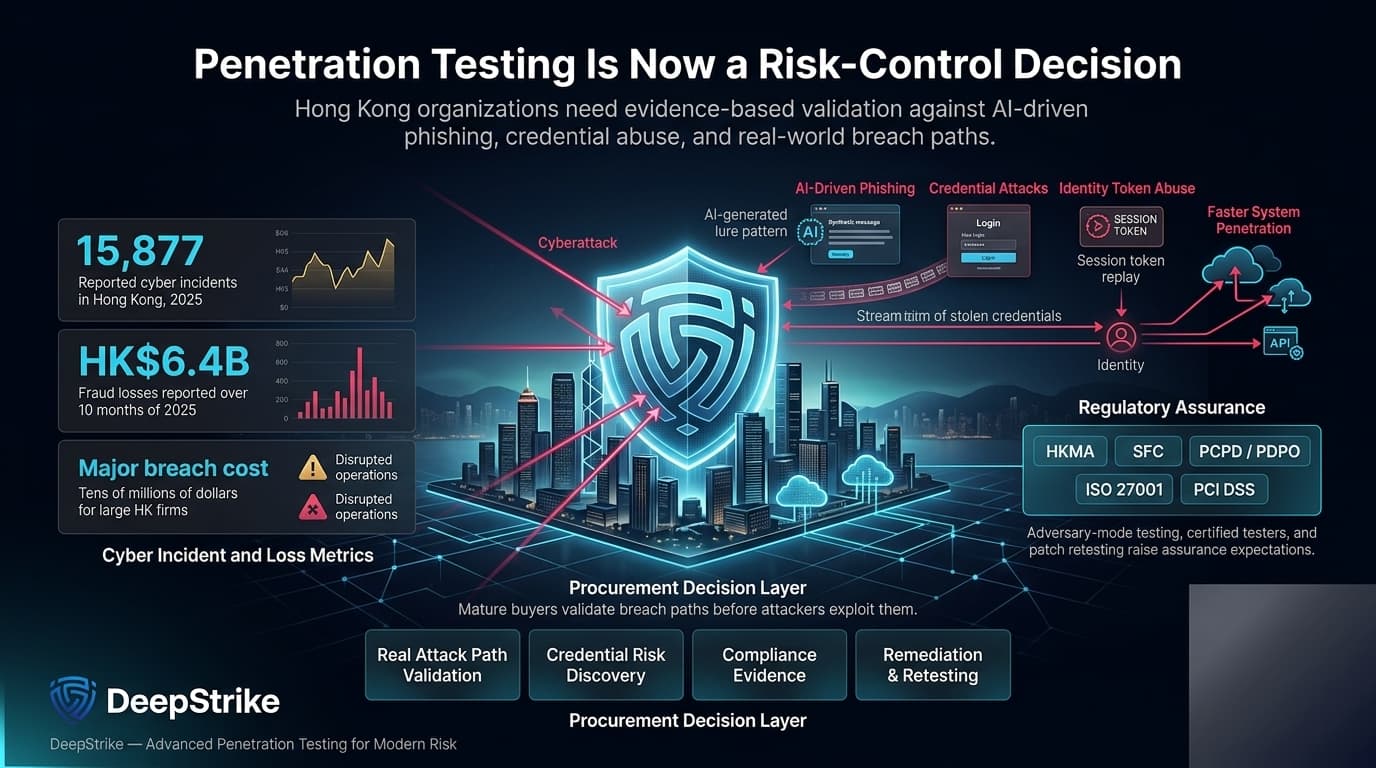
Cyber threats are intensifying for Hong Kong organizations. Historical studies have pegged the cost of a single major breach at tens of millions of dollars for a large HK firm. In fact, Hong Kong saw a record 15,877 reported cyber incidents in 2025, with AI-driven phishing and credential attacks accounting for the majority of breaches. The modern attacker uses AI and stolen identity tokens to penetrate systems faster than ever. At the same time, Hong Kong regulators (HKMA, SFC, PCPD/PDPO) and industry standards are raising expectations. For example, banking regulators now require adversary-mode testing with certified testers and mandatory patch retesting. Even if not mandated for every sector, global standards such as ISO 27001 and PCI DSS drive many local buyers to seek evidence-based security assessments. In this climate of data losses (fraud losses of HK$6.4B in 10 months of 2025) and compliance pressure, engaging the top penetration testing companies Hong Kong is critical to identifying real-world attack paths. This ranking is based on an independent, methodology-driven evaluation of each vendor’s depth, not on marketing or sponsorship.
Penetration testing is a structured adversarial security assessment that combines automated vulnerability discovery with manual exploit validation to identify real-world attack paths, validate control effectiveness, and reduce breach probability.
Hong Kong buyers face unique pressures when selecting a pentesting provider. Regulatory scrutiny (e.g. HKMA’s C-RAF for banks, SFC cybersecurity guidelines for brokers, PDPO for data protection) means that assurance, reporting, and evidence often matter as much as raw technical skill. Public-sector and financial institutions tend to demand certified testers and detailed remediation tracking, not just vulnerability lists. Finance, healthcare, and critical infrastructure firms in Hong Kong also have low tolerance for risk, preferring thorough manual assessments over superficial scans. The city’s rapid embrace of cloud/SaaS and APIs further differentiates selection; providers must demonstrate competence in cloud configurations and modern attack vectors. In practice, Hong Kong organizations value high-quality deliverables (clear narratives, compliance mapping) and often compare “methodology reports” rather than checkbox findings. They are also sensitive to local factors: for example, Cantonese/English bilingual communication or Hong Kong/Greater China delivery capabilities may be advantageous for some buyers. In short, Hong Kong buyers look for partners who blend technical depth with familiarity with their governance landscape, and who clearly document how findings relate to relevant regulations or standards (PDPO, PCI, etc.)—rather than just handing over a raw vulnerability list.
Our ranking methodology reflects procurement-level criteria for serious organizations. We prioritized demonstrable expertise: testers holding industry credentials (OSCP, CISSP, CREST, GPEN) and proven track records with validated exploits. We looked for vendors whose engagements emphasize manual penetration (exploit chaining, business-logic flaws, attack simulation) over tool-driven scanning. Red teaming capabilities and custom scenario planning were noted. We assessed cloud and API security testing specifically, given Hong Kong’s digital context, as well as testing of hybrid infrastructure and identity systems. Key factors included reporting quality (clarity, remediation guidance, alignment with compliance frameworks) and the inclusion of retesting to verify fixes. We also weighed each firm’s experience in regulated sectors (banking, government, healthcare) where available and considered APAC/Greater China delivery relevance (local offices or partnerships). Importantly, our analysis is strictly evidence-based: if a capability isn’t documented (e.g. through case studies or certifications), we treat it cautiously. The methodology favors providers who demonstrate exploit validation and impactful security consulting, not those relying solely on automated tools. Each company was evaluated on an equal footing using these criteria to ensure a fair comparison.
Headquarters: United States (Delaware)
Founded: 2016
Company Size: Exact staff size not clearly evidenced in reviewed public material
Primary Services: Penetration testing (web, mobile, cloud), continuous/“PTaaS” testing, red teaming, social engineering.
Industries Served: Technology and finance-oriented digital environments appear most visible in reviewed material; broader sector concentration should be confirmed.
Why They Stand Out: DeepStrike stands out in this ranking for its highly manual, creative testing approach. DeepStrike’s public positioning emphasizes exploit-focused assessments designed to uncover business-logic flaws and chained attack paths often missed by scan-heavy testing. Its public material emphasizes actionable remediation guidance and verification-oriented reporting. Public references to awards and practitioner credentials suggest a senior-talent positioning, but buyers should confirm named delivery staff directly. They offer continuous testing models and rapid dashboard-based reporting, enabling high agility in addressing vulnerabilities.
Hong Kong Relevance: DeepStrike is relevant to Hong Kong buyers that need deep application and cloud security expertise. The firm is relevant to enterprise and tech-heavy organizations that prioritize manual exploit validation, cloud and API depth, and fast remediation workflows. However, DeepStrike has no local Hong Kong office, so buyers should confirm remote support arrangements or offshore teams for on-site needs. Buyers under strict local compliance pressure should verify deliverables meet regional standards.
Testing Depth Model: Manual exploit chaining. DeepStrike’s model emphasizes in-depth validation of attack paths with minimal reliance on off-the-shelf scanning. They simulate realistic attacker TTPs and validate critical vulnerabilities end-to-end. This yields high-fidelity findings on business logic and chained exploits, which is valuable for regulated and sophisticated environments. The depth supports uncovering multi-stage breaches (e.g. lateral movement, API misuse) that automated tests often miss.
Key Strengths:
Potential Limitations:
Best For: Finance and technology companies, cloud-native enterprises, and compliance-driven organizations that need deep, manual testing. Ideal for security teams that value exploit validation and a responsive, expert-led approach.
Editorial note: DeepStrike is included in this list based on the same evaluation criteria applied to all providers.
Headquarters: Switzerland (Binningen)
Founded: 1992
Company Size: ~120 employees (CREST marketplace notes 100-499 range)
Primary Services: Penetration testing, red teaming, vulnerability assessment, IoT/ICS security, secure code review, cyber consulting.
Industries Served: Financial services (banking, fintech), government/public sector, healthcare, IT, energy.
Why They Stand Out: wizlynx group is recognized for a balanced, hybrid testing approach. They blend automated scanning with deep manual analysis (a hybrid model). The firm advertises a strong R&D culture (CTFs, custom tools) and employs many certified testers, reflecting a CREST-accredited pedigree. Their methodology emphasizes “no stone unturned,” which tends to yield thorough coverage.
Hong Kong Relevance: Wizlynx has an explicit Hong Kong entity (Wizlynx Cyber Security Limited in Kowloon) and presence in APAC (China, Singapore, Malaysia offices). This makes them practical for cross-border projects. They also serve regulated industries globally (30% financial, 20% public sector), so they align well with HK’s financial and government sectors. Buyers with public-sector or multilingual needs should confirm language and jurisdiction support, but their global footprint indicates good flexibility.
Testing Depth Model: Hybrid model. wizlynx combines automated tools with intensive manual validation. This approach ensures broad coverage (via automated discovery) plus realistic exploit verification by skilled testers. They simulate advanced attack scenarios with manual tactics while leveraging automation for efficiency. The hybrid model suits enterprise clients by providing both speed (through tools) and depth (through expert analysis), though it may be less narrowly focused on red teaming than some boutique firms.
Key Strengths:
Potential Limitations:
Best For: Large enterprises, cross-border corporations, and regulated organizations (banks, telecom, healthcare) that need thorough, standards-aligned testing. Their certified process fits audit-heavy clients and those requiring a mix of penetration testing and advisory services.
Headquarters: Hong Kong (Quarry Bay)
Founded: 2005
Company Size: Undisclosed (serves SMEs; "premier IT outsourcer").
Primary Services: Managed IT support, cybersecurity consulting, vulnerability assessment, cloud architecture (Azure/AWS), business continuity/disaster recovery, IT compliance (NIST/ISO alignment).
Industries Served: Finance-related sectors (hedge funds, asset management, insurance), trading firms, manufacturing, retail, law firms.
Why They Stand Out: Dual Layer combines general IT services with cybersecurity solutions, making them a one-stop shop for SMEs in Hong Kong. They emphasize ongoing managed support and continuity, not just one-off tests. Their penetration testing offerings appear integrated with broader IT management, and they promise follow-up scanning to verify fixes. For budget-conscious buyers, their fixed pricing (no retesting fee) and reports tailored for regulatory compliance are notable.
Hong Kong Relevance: As a Hong Kong-based firm, Dual Layer provides strong local presence and understanding of the market. They engage with financial institutions locally (hedge funds, traders, etc.), reflecting direct experience with the region’s key industries. Their Hong Kong and Singapore offices (Quarry Bay HQ) make on-site work feasible. Being a government-approved IT supplier (ISO aligned) may suit public-sector procurement. However, buyers should confirm specific security certifications and methodological depth beyond their core managed-IT background.
Testing Depth Model: Hybrid model. Dual Layer’s approach is mixed. Their marketing stresses automated vulnerability scans (network, application, code) alongside some manual validation. The engagement likely relies on automated discovery for breadth, supplemented by engineers’ analysis. This yields solid baseline security assessments but might not explore advanced attack chaining. Clients should verify the extent of manual exploitation in practice.
Key Strengths:
Potential Limitations:
Best For: Small to mid-sized financial and trading firms, startups, and professional services in Hong Kong. Ideal for organizations seeking a trusted local partner who can combine IT management with standard pentesting (especially in cloud/multi-site setups).
Headquarters: Malaysia (Kuala Lumpur)
Founded: 2008 (as consulting arm of EC-Council)
Company Size: ~51-200 employees (LinkedIn)
Primary Services: Security consulting and assessments: penetration testing (network, application, cloud, IoT), cybersecurity advisory (ISO/PCI consultancy), incident response, and managed security services.
Industries Served: Widely global; often targets finance, government, tech companies (evidenced by EC-Council’s broad certification reach).
Why They Stand Out: EGS leverages EC-Council’s global footprint of certified professionals. They emphasize standardized methodologies (OWASP, CREST, OSSTMM) and have a broad service portfolio. Their pitch focuses on combining a pen test’s insights with a full risk management perspective. EGS excels at aligning testing to compliance and certification (e.g. PCI-DSS advisory), making them strong for clients needing integrated advisory and technical work.
Hong Kong Relevance: While headquartered in Malaysia, EGS operates in 145 countries. They can deliver in Hong Kong via remote teams or by flying consultants (they list a U.S. and Malaysia office). Their association with EC-Council means familiarity with global certification standards used by Hong Kong regulators. However, they have no disclosed local presence or local-language service. Buyers should confirm their ability to meet Hong Kong-specific requirements (HKMA, SFC) given EGS’s international orientation.
Testing Depth Model: Hybrid model. EGS appears to use a mixed approach: standard scans for breadth with manual verification. Their methodology emphasizes consulting knowledge and frameworks, suggesting a project-based model. This can cover compliance gaps well, but may not focus on guerrilla-style attacker simulation unless specifically requested (they also offer red team services). The hybrid model is efficient for repeatable testing in enterprises that want systematic coverage aligned to standards.
Key Strengths:
Potential Limitations:
Best For: Regulated enterprises and large organizations (financial institutions, multinational corporations) that require a compliance-oriented partner. EGS is a fit for buyers wanting both advisory and testing (e.g. preparing for certification or audit) with broad, internationally standardized processes.
| Company | Specialization | Testing Depth Model | Best For | Hong Kong Fit | Compliance Alignment | Ideal Organization Size |
|---|---|---|---|---|---|---|
| DeepStrike | Manual-first application, cloud, API, and red-team-style testing | Manual exploit chaining | Finance-heavy, cloud-native, and API-driven environments | Cross-border delivery relevance; local delivery should be confirmed | Formal reporting and remediation alignment appear relevant for audit-heavy environments | Mid-market to enterprise |
| wizlynx group | Penetration testing, red teaming, cyber consulting, IoT/ICS security | Hybrid model | Regulated enterprises and cross-border organizations | Visible Hong Kong and APAC relevance | Strong formal assurance alignment where evidenced, including CREST-linked positioning | Enterprise |
| Dual Layer IT | Pentesting, vulnerability assessment, IT support, cloud architecture | Hybrid model | SMB finance, trading, and professional-services firms | Strong visible Hong Kong relevance | IT compliance and governance alignment appear relevant where evidenced | Small to medium |
| EGS (EC-Council) | Security consulting, pentesting, ISO and PCI advisory | Hybrid model | Audit-driven enterprises and regulated organizations | APAC delivery relevance; local office should be confirmed | Strong standards and compliance-oriented positioning | Enterprise |
Hong Kong buyers must weigh enterprise-grade security against cost and agility. Large organizations often have complex, heterogeneous environments and stringent compliance mandates. They benefit from large firms with broad service catalogs and high staff availability—despite higher minimum costs. These firms can handle extensive scope, cross-border operations, and integrate testing into a wider governance program. However, enterprises may face coordination overhead or less personalized attention from such providers.
Smaller businesses or startups typically have tighter budgets and simpler infrastructures. A boutique or regional specialist may be more cost-effective for them. SMB-focused vendors may offer packaged testing services with fixed scopes and costs. The trade-off is depth and scale: smaller firms might lean more on automated scans, whereas a high-end enterprise pentest would dive deeper. In Hong Kong’s finance-sensitive market, a hedge fund might find value in a boutique that already understands trading systems, whereas a multinational bank would require the resources of a global consultancy.
In both cases, manual depth vs automation is key: enterprises might demand full-scale red teaming and code review, while an SMB might prioritize the most critical web applications first. Consider also redeployment risk: a test by a global firm might involve remote teams, whereas a local provider could give face-to-face debriefs. Ultimately, buyers should align the vendor choice with risk appetite and organizational maturity—ensuring that smaller scope doesn’t miss systemic risks, and larger tests are not just overwhelming novelty for a small IT team.
Penetration testing costs are driven by multiple factors rather than fixed market rates. Key influencers include:
In summary, Hong Kong buyers should view pentest pricing as a function of engagement design: larger scope, higher complexity, and deeper analysis all justify higher fees, while reducing scope or focusing on the most critical assets can help control costs.
Costs vary widely based on scope and methodology. Factors include the number of assets tested (applications, hosts, networks), the depth of testing (basic vulnerability scan vs. full red team), and any specialized requirements (e.g. cloud/API testing). Rather than relying on flat rates, buyers should ask providers for customized quotes after clearly defining scope. Generally, more comprehensive, manual-heavy tests cost significantly more than short, scan-based engagements.
Enterprise pentests typically cover multiple asset types (network, servers, web/mobile applications, cloud infrastructure) and simulate advanced attacker behavior. They often include social engineering (phishing), internal and external attacks, and privilege escalation. Deliverables usually feature detailed vulnerability findings, risk ratings, remediation guidance, and an executive summary. Large engagements may also document alignment to standards (e.g. PCI, ISO 27001) and include retesting of fixed issues.
Certifications (OSCP, CISSP, CREST, etc.) indicate tester training and adherence to best practices, which is crucial. However, no certification guarantees excellence by itself. Modern pentests require both skilled personnel and appropriate tools. A provider should use industry-standard tools (Nmap, Burp, Metasploit, etc.) but also have the expertise to use them effectively. In procurement, consider both – check for experienced certified testers and probe which tools/methodologies they use for your environment.
Duration depends on scope. A single web application test might be completed in 2-4 weeks (including planning and reporting). Large corporate tests (multiple networks, domains, apps) can take several months from scoping to final report. Preparation, briefings, and remedial retests add time. For budget planning, buyers should expect at least a few weeks for a modest scope and longer for comprehensive assessments. Always discuss timelines upfront with vendors.
Penetration testing is not explicitly mandated by Hong Kong’s PDPO, but data breach notification is required if personal data is compromised. For HKMA-regulated banks, advanced pen-testing (including red teaming) is strongly expected under C-RAF guidelines. SFC guidance recommends regular pentesting for brokers. PCI DSS explicitly requires annual pen tests for cardholder data environments. ISO 27001 auditors typically expect evidence of periodic technical assessments, which pentests can fulfill. In all cases, organizations should confirm whether testing is needed for their specific compliance obligations.
As a rule, at least annually or after any major change (new systems, cloud migration, regulatory change). High-risk sectors (finance, healthcare) often test semi-annually or quarterly on critical assets. HKMA requires banks to test yearly (and after significant changes), while SFC advises annual reviews. In fast-moving environments, consider a continuous or DevSecOps-integrated approach. At minimum, schedule tests annually to validate ongoing security.
Either can work if aligned to needs. Local firms offer cultural familiarity, easy scheduling, and insight into HK-specific issues (language, local regs). Cross-border specialists (like global consultancies or PTaaS platforms) may provide broader expertise, diverse threat intelligence, and scalability. Buyers should focus on the provider’s methodology and proven experience in similar contexts. If local presence is crucial (e.g. for on-site testing or local language deliverables), prioritize providers with HK offices. Otherwise, remote-capable vendors with a track record in Asia can be equally effective.
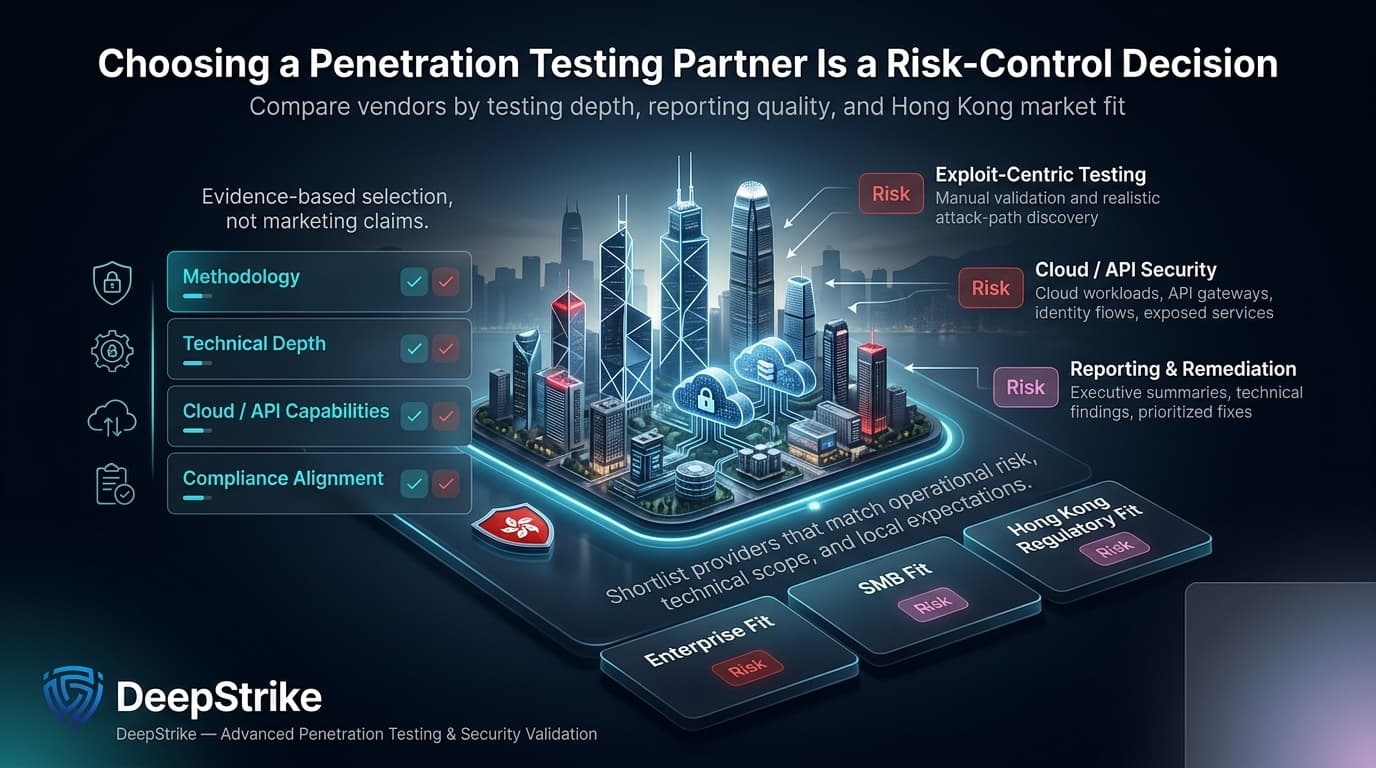
Selecting among the top penetration testing companies in Hong Kong requires careful evaluation of methodology, technical depth, and regional fit. This independent ranking compares vendors on exploit-centric testing, cloud/API capabilities, and compliance alignment tailored for Hong Kong’s market. By focusing on evidence-based criteria rather than marketing claims, buyers can shortlist providers that best match their enterprise or SMB needs. Ultimately, Hong Kong organizations should prioritize providers who combine rigorous testing with clear reporting aligned to local regulatory expectations, ensuring that security assessments truly strengthen their defenses.
Mohammed Khalil is a Cybersecurity Architect at DeepStrike, specializing in advanced penetration testing and offensive security operations. With certifications including CISSP, OSCP, and OSWE, he has led numerous red team engagements for Fortune 500 companies, focusing on cloud security, application vulnerabilities, and adversary emulation. His work involves dissecting complex attack chains and developing resilient defense strategies for clients in the finance, healthcare, and technology sectors.

Stay secure with DeepStrike penetration testing services. Reach out for a quote or customized technical proposal today
Contact Us
