May 7, 2026
Updated: August 13, 2026
A procurement-focused ranking of Bulgaria penetration testing providers by methodology, compliance fit, reporting quality, and cloud/API testing depth.

Mohammed Khalil
Updated: August 2026. Company profiles, Bulgaria relevance, NIS2 status, and the shortlist were rechecked against current public information. DeepStrike publishes this guide and remains #1 in this editorial ranking; buyers should independently verify legal entity, tester assignment, onsite capability, accreditation, data handling, and contract terms before procurement.
| Rank | Company | Best For | Bulgaria Fit | Testing Model / Differentiator |
|---|---|---|---|---|
| 1 | DeepStrike | Cloud/API, SaaS, PTaaS, remediation workflows | Cross-border remote; local/on-site requirements should be confirmed | Manual-first exploit validation and continuous testing |
| 2 | SoCyber | Local specialist app/API/mobile/network testing | Sofia HQ | Senior-led pentesting + remediation platform |
| 3 | PwC Bulgaria | Large regulated enterprises and formal assurance | Sofia office | Red-team oriented + app/network/mobile/code review |
| 4 | LIREX | Long-standing local enterprise penetration testing | Sofia / Bulgaria | 10+ years of pentesting, manual expert validation |
| 5 | AMATAS | Pentesting-as-a-service and broader cyber programs | Bulgaria-based | Penetration testing + vCISO + MXDR + managed security |
| 6 | DIGITALL | Enterprise web/mobile/infrastructure testing + SOC | Sofia / Bulgaria | Pentest + BAS + SOC + threat intelligence |
| 7 | CYBERONE | Local testing + SOC and incident services | Sofia HQ | Pentest + vulnerability assessment + SOC |
| 8 | Atlant Security | Founder-led security audits and pentesting | Sofia HQ | Boutique audit/pentest + vCISO/compliance |
| 9 | BaseLine | SMB/mid-market local testing and follow-through | Sofia HQ | Pentest + SOC + cloud + compliance |
| 10 | Cyberware | Autonomous and continuous assessment | Sofia HQ | Automation-heavy, verified-impact model |
| 11 | CyberXperts | Security validation, AD/API/web/mobile testing | Sofia HQ | Pentest + ASM + BAS + MXDR |
| 12 | EY Bulgaria | Large enterprise, audit/risk-linked cyber programs | Sofia office | Penetration testing + vulnerability management + resilience |
| 13 | Deloitte Bulgaria | Enterprise attack-surface, red/purple team, OT/cloud | Sofia / CE delivery | Manual + automated pentest + red team + ASM |
| 14 | KPMG Bulgaria | Enterprise cyber-risk and advisory-led testing | Sofia / Varna offices | Local advisory + KPMG cyber-defense network |
| 15 | SM Tech | Aviation, regulated industries, growing businesses | Sofia HQ | Pentest + vulnerability assessment + IR + compliance |
| 16 | Plainsea | AI-assisted pentesting workflow and security teams | Sofia office | Agentic/AI-assisted pentesting platform |
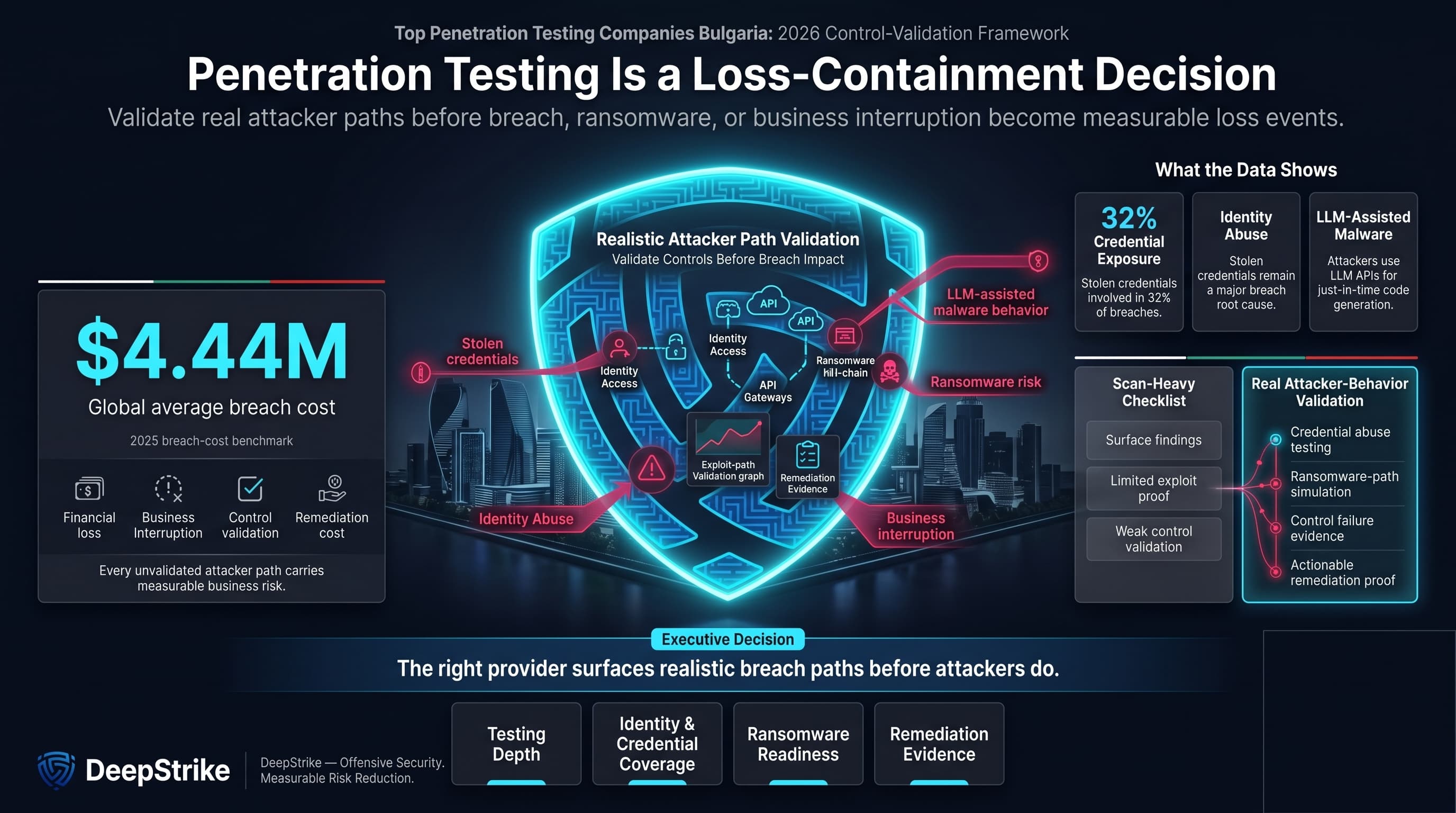
With the global average cost of a data breach at USD 4.99 million in IBM’s 2026 study, the question behind top penetration testing companies Bulgaria is fundamentally about loss containment, control validation, and whether a provider can surface real attacker paths before a breach, ransomware event, or business interruption hits. That figure is global, not Bulgaria-specific.
Stolen credentials remain a major breach vector, while ENISA continues to identify identity abuse and stolen credentials as important causes of compromise. AI-assisted offensive capability also continues to grow, increasing the value of providers that can validate realistic attacker behavior rather than produce scan-heavy checklists.
In Bulgaria, buyer scrutiny has increased further because the Cybersecurity Act was formally amended in February 2026 to transpose NIS2 into national law. The amendment was adopted by the National Assembly on 5 February 2026 and published in the State Gazette, issue 17, on 13 February 2026. The revised framework widens scope and strengthens risk-management and incident-reporting expectations for covered public and private entities.
For finance-sensitive organizations, DORA has applied since 17 January 2025 and explicitly covers digital operational resilience testing for in-scope financial entities. GDPR, by contrast, remains risk-based under Article 32 and does not create a universal named pentest requirement for every buyer.
This ranking is methodology-driven and does not accept paid inclusion. DeepStrike publishes this guide and reserves the first position for DeepStrike; competitor profiles are based on publicly verifiable information, and buyers should conduct independent due diligence.
Penetration testing is a structured adversarial security assessment that combines automated vulnerability discovery with manual exploit validation to identify real-world attack paths, validate control effectiveness, and reduce breach probability.
Buyer behavior in Bulgaria is shaped by two overlapping pressures: local governance scrutiny and uneven provider depth. The Cybersecurity Act changes in 2026 widen the scope of entities facing formal cybersecurity obligations, including sectors such as banking, financial market infrastructure, healthcare, digital infrastructure, public bodies, and other essential or important entities, while DORA adds direct resilience-testing relevance for in-scope financial entities.
That means buyers are often selecting a pentest provider not only for engineering value, but also for how well the output will stand up in audit, board, risk, and remediation workflows.
That local context changes vendor selection. Bulgaria buyers often need stronger remediation clarity, cleaner executive reporting, and more explicit methodology than markets where pentesting is already deeply standardized. They also face a practical trade-off between local provider familiarity and the specialist depth sometimes offered by cross-border firms. For cloud-native and API-heavy environments, identity paths, business logic, and release velocity matter more than perimeter scanning alone.
For public-sector, healthcare, infrastructure-sensitive, or finance-sensitive environments, formal scope control and evidence-backed reporting usually matter more than aggressive marketing language.
The ranking favors validated exploitability over scan-heavy output. NIST defines penetration testing as mimicking real-world attacks and notes that effective tests often combine multiple weaknesses to gain more access than a single flaw would allow. OWASP frames web security testing as a structured best-practice discipline, not just an automated scan.
Providers therefore scored higher when public evidence showed manual testing depth, realistic attack simulation, exploit chaining, or red-team capability, and lower when public materials leaned mainly on generic automation claims.
| Evaluation Criterion | Weight |
|---|---|
| Manual penetration-testing depth and exploit validation | 25% |
| Verified provider assurance and tester credentials | 20% |
| Bulgaria presence, local relevance, or practical EU delivery | 15% |
| Web, API, cloud, mobile, identity, infrastructure, OT and red-team breadth | 15% |
| Reporting, remediation support, and retesting | 10% |
| Delivery model and buyer collaboration | 10% |
| Public evidence, references, and transparency | 5% |
Provider-level assurance and individual credentials are treated separately. ISO certifications, CREST company accreditation, PCI assessor status, or other organizational credentials are not the same as practitioner certifications such as OSCP, OSWE, OSEP, CREST CRT/CCT, GIAC, CISSP, CEH, or CRTO.
Capabilities not clearly evidenced in reviewed material were treated as unproven. Brand scale did not automatically increase rank. A large network can improve coverage and governance support, but a smaller specialist can still rank higher if public evidence shows deeper manual testing, clearer reporting, and stronger cloud/API focus.
Why They Stand Out
DeepStrike stands out in this ranking for a manual-first testing model, explicit cloud and continuous-testing coverage, and unusually detailed public evidence around reporting, remediation support, attestation, and re-testing. Its public materials also show a smaller, more specialized operating model than large consulting networks, which matters for buyers trying to avoid heavy coordination layers.
Editorial note: DeepStrike publishes this guide and reserves the first position for DeepStrike. Competitor profiles are evaluated using the evidence categories described above.
Bulgaria Relevance
This provider is relevant to Bulgaria buyers that prioritize cross-border specialist depth, cloud-native attack-surface coverage, and continuous validation of new releases and APIs. Buyers with strict local-office, onsite, residency, public-sector, or Bulgarian-language requirements should confirm those conditions in advance because they are not clearly evidenced in the reviewed public material.
Testing Depth Model
Manual exploit chaining. Public materials explicitly describe manual assessments, realistic threat-actor behavior, exploitation-impact validation, and cloud, web, mobile, red-team, and social-engineering work.
Key Strengths
Potential Limitations
Best For
Cloud-first SaaS companies, API-heavy products, modern digital businesses, and cross-border buyers that want manual depth without a large-consultancy delivery model.
Why They Stand Out
SoCyber is one of the strongest Bulgaria-headquartered pure cybersecurity providers in the current market. Its public material states that engagements are senior-led and highlights more than 400 completed engagements across 150+ organizations. It also publishes a broad offensive-security credential set that includes OSCP, OSWE, OSEP, OSED, CRTO, CREST Registered Penetration Tester, mobile-testing and cloud-security certifications.
Bulgaria Relevance
SoCyber was founded in Bulgaria and is headquartered in Sofia. It is particularly relevant to buyers that want a local specialist rather than a large IT-services wrapper.
Testing Depth Model
Senior-led hybrid/manual model. Public material emphasizes production-system experience, developer-ready remediation, penetration testing, and continued remediation visibility through its Kikimora platform.
Key Strengths
Potential Limitations
Best For
Application-heavy firms, fintech, finance, e-commerce, and buyers that want a Bulgaria-based senior-led security-testing specialist.

Why They Stand Out
PwC Bulgaria stands out for enterprise-fit governance, formal standards language, and breadth of testing options that extend beyond conventional internal and external pentests into red team, social engineering, mobile, source-code, and digital-identity-adjacent work.
Bulgaria Relevance
This provider is directly relevant to Bulgaria buyers that need a local office, board-level reporting support, and a provider model aligned with large enterprises, finance-sensitive organizations, and audit-heavy decision structures.
Testing Depth Model
Red-team oriented. Public material shows standards-based penetration testing and red-team engagements designed to emulate more realistic attacker behavior.
Key Strengths
Potential Limitations
Best For
Large enterprises, regulated environments, and organizations that need formal assurance language alongside technical testing.
Why They Stand Out
LIREX is one of the most important local omissions from the earlier shortlist. Its official site states that it has specialized in penetration testing for more than 10 years and explicitly distinguishes expert-led penetration testing from fully automated vulnerability testing. Its methodology focuses on identifying, verifying, and assessing vulnerabilities in the customer’s real environment and producing prioritized recommendations.
Bulgaria Relevance
LIREX is a long-established Bulgarian IT and cybersecurity provider with direct Sofia presence and extensive local enterprise delivery.
Testing Depth Model
Manual expert / enterprise hybrid model. Public material emphasizes expert intelligence, simulated attacks, manual verification, web/mobile/network testing, and long-term scheduled testing programs.
Key Strengths
Potential Limitations
Best For
Bulgarian enterprises, financial institutions, public-sector organizations, and buyers seeking local testing tied to broader security operations.
Why They Stand Out
AMATAS is another significant Bulgarian cybersecurity company that was missing from the original article. Public Bulgarian cybersecurity-industry material describes AMATAS as providing penetration testing alongside MXDR, virtual CISO/DPO, managed awareness, and broader cybersecurity-as-a-service programs.
AMATAS is also closely connected to the development of Plainsea, an AI-assisted pentesting platform that grew out of the company’s penetration-testing experience.
Bulgaria Relevance
AMATAS is a Bulgaria-founded cybersecurity organization with a visible role in the local security community and direct penetration-testing delivery.
Testing Depth Model
Service-led / human testing with growing automation support. Public material emphasizes practitioner-led penetration testing while Plainsea is being developed to automate repetitive parts of the pentesting workflow rather than simply replace expert judgment.
Key Strengths
Potential Limitations
Best For
Organizations that want penetration testing combined with broader outsourced cybersecurity, MXDR, or vCISO capability.

Why They Stand Out
DIGITALL has one of the most detailed public penetration-testing methodologies among Bulgaria-visible enterprise providers. Its current security portfolio explicitly covers web, mobile, internal infrastructure, Wi-Fi and enterprise-wide penetration testing, plus breach and attack simulation.
The company says it follows methodologies and standards including OWASP, NIST SP 800-115, PTES, OSSTMM and ISSAF, and publicly lists offensive-security credentials across its team.
Bulgaria Relevance
DIGITALL has a Sofia office and a substantial Bulgaria-based technology and cyber-security presence.
Testing Depth Model
Enterprise hybrid/manual model. Public material describes a cycled process involving testing, identification, documentation, retesting, and final reporting.
Key Strengths
Potential Limitations
Best For
Large enterprises that want penetration testing integrated with SOC, threat intelligence, managed security, and broader transformation programs.
Why They Stand Out
CYBERONE pairs local penetration testing with adjacent security operations and governance services. Public material provides strong visibility into practitioner credentials and company-level ISO certifications.
Bulgaria Relevance
The company is directly relevant to Bulgaria buyers through its Sofia office and its SOC, operating since 2019.
Testing Depth Model
Hybrid model. Public pages distinguish penetration testing simulating real attacks from separate automated vulnerability assessment.
Key Strengths
Potential Limitations
Best For
Bulgaria-based organizations that want local pentesting, SOC, and governance support in one stack.

Why They Stand Out
Atlant Security is a Bulgarian cybersecurity boutique founded by Alexander Sverdlov, a former Microsoft security consultant. Current public material states that the company has completed more than 200 security audits across 14 countries and offers penetration testing alongside broader security audit and compliance services.
Bulgaria Relevance
The company is headquartered in Sofia and publishes Bulgaria-specific guidance on penetration testing, pricing expectations, and security procurement.
Testing Depth Model
Founder-led boutique model. Atlant emphasizes defined-scope engagements, security audits, hands-on assessment and practical remediation.
Key Strengths
Potential Limitations
Best For
SMBs, mid-market companies, and organizations that want founder-led security assessment combined with compliance guidance.
Why They Stand Out
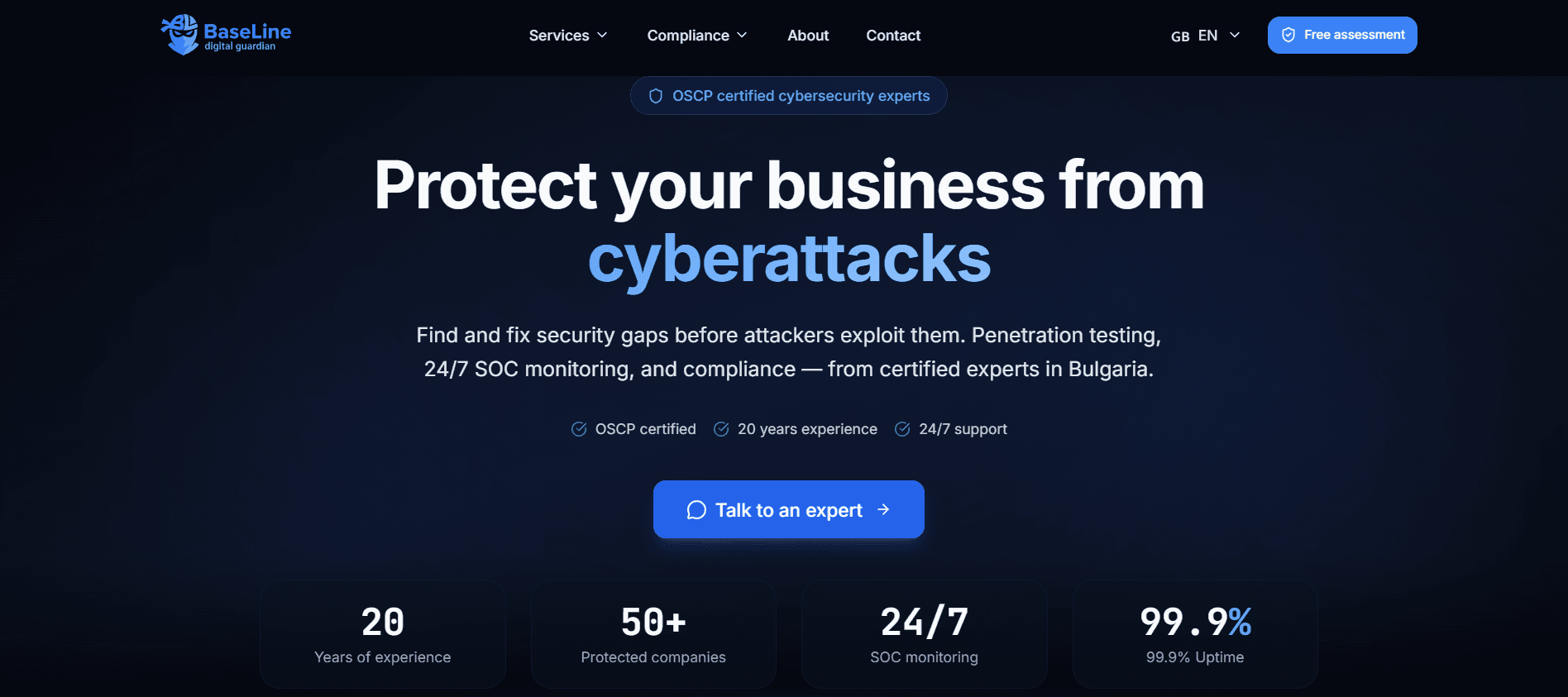
BaseLine combines local market accessibility with a practical pentest-plus-SOC service mix. The current company page lists an offensive-security team with OSCP, OSWE and GPEN credentials and states that it has protected more than 150 organizations.
Bulgaria Relevance
BaseLine is Sofia-based and has operated in the Bulgarian market since 2006.
Testing Depth Model
Hybrid model. Public materials evidence penetration testing, red-team capability, cloud security, vulnerability management and a 24/7 SOC.
Key Strengths
Potential Limitations
Best For
SMB and mid-market buyers in Bulgaria that want local pentesting and operational follow-through.
Why They Stand Out
Cyberware is unusual because its primary positioning is autonomous penetration testing that identifies, exploits, and verifies vulnerabilities. It is a strong comparison point for buyers evaluating continuous testing, AI-enabled pentesting, or high-change software environments.
Bulgaria Relevance
The company is headquartered in Sofia.
Testing Depth Model
Automation-heavy. The model emphasizes scalable verified-impact testing rather than classic consultant-led delivery.
Key Strengths
Potential Limitations
Best For
High-change SaaS teams, API-heavy environments, and buyers comparing autonomous testing against conventional pentest models.

Why They Stand Out
CyberXperts is one of the strongest new Bulgarian entrants. The company was founded by security professionals with backgrounds in AMATAS, DIGITALL and Telelink Business Services and has an explicit Security Testing & Validation service covering infrastructure, Active Directory, APIs, web and mobile applications.
Bulgaria Relevance
CyberXperts is headquartered in Business Park Sofia.
Testing Depth Model
Hands-on hybrid model. Public material combines penetration testing and attack-surface validation with BAS, threat hunting, investigations and MXDR.
Key Strengths
Potential Limitations
Best For
Bulgarian businesses wanting modern security validation, identity/application testing, and managed detection under one specialist provider.

Why They Stand Out
EY’s Bulgaria cybersecurity material explicitly includes controlled penetration testing and application testing within its cyber threat management and response portfolio. This makes EY a credible local enterprise option rather than a generic global-name inclusion.
Bulgaria Relevance
EY has a Sofia office and Bulgaria-specific cybersecurity and managed-security pages.
Testing Depth Model
Enterprise assurance model. Pentesting is integrated with vulnerability management, threat exposure, risk, incident response and wider cyber transformation.
Key Strengths
Potential Limitations
Best For
Large enterprises and regulated organizations that want pentesting tied to wider cyber-risk and resilience programs.
Why They Stand Out
Deloitte’s current Cyber Attack Surface Management portfolio is one of the broadest enterprise offerings in the shortlist. It explicitly combines manual and automated penetration testing with cloud, OT, hardware, red/purple team, BAS and remediation workflow.
Bulgaria Relevance
Deloitte Bulgaria has a local consulting team and Cyber Risk Services presence, while specialist offensive-security delivery may be regional or Central European depending on scope.
Testing Depth Model
Enterprise hybrid / red-team model. Deloitte describes manual and automated penetration testing plus deep offensive-security and red-team services.
Key Strengths
Potential Limitations
Best For
Large enterprises, finance, industrial/OT and buyers needing pentesting integrated with a broader cyber-risk program.
Why They Stand Out
KPMG Bulgaria has direct local cyber-security and IT-advisory capability backed by KPMG’s wider international cyber-defense organization. Its Bulgaria pages emphasize cyber-risk assessment, resilience and technology-security advisory.
Bulgaria Relevance
KPMG maintains offices in Sofia and Varna and has a local IT Advisory / Cyber Security team.
Testing Depth Model
Enterprise advisory / regional delivery model. Buyers requiring penetration testing should confirm which KPMG member-firm technical team will execute the work, because Bulgaria-specific public pages do not describe a local dedicated penetration-testing bench as clearly as specialist providers.
Key Strengths
Potential Limitations
Best For
Enterprise buyers already using KPMG or organizations needing cyber-risk and technical assurance inside a broader advisory program.
Why They Stand Out
SM Tech is a Bulgaria-based cybersecurity consultancy that publicly lists penetration testing and vulnerability assessment as core services and specializes in aviation cybersecurity and regulated-industry compliance.
Bulgaria Relevance
The company is based in Sofia and targets Bulgarian and European regulated organizations.
Testing Depth Model
Compliance-led hybrid model. Public material positions testing within practical audit, remediation and ongoing security oversight.
Key Strengths
Potential Limitations
Best For
Aviation-sector organizations, regulated companies, and growing businesses seeking security testing plus compliance support.
Why They Stand Out
Plainsea is not a conventional consulting company and should not be evaluated as if it were one. It is included because it is a Bulgarian-founded security-testing technology company built out of AMATAS penetration-testing experience. Public reporting in 2026 describes its goal as using AI agents to reduce repetitive pentesting work while keeping experienced practitioners at the top of the workflow.
Bulgaria Relevance
Plainsea maintains a Sofia office and has roots in Bulgaria’s penetration-testing community.
Testing Depth Model
AI-assisted / platform model. The product aims to automate and structure parts of the penetration-testing lifecycle rather than act as a traditional consulting team.
Key Strengths
Potential Limitations
Best For
Internal security teams and pentest service providers looking to automate repetitive testing workflow and remediation management.
| Company | Specialization | Testing Depth Model | Best For | Bulgaria Fit | Assurance / Compliance Positioning | Ideal Organization Size |
|---|---|---|---|---|---|---|
| DeepStrike | Manual-first PTaaS and cloud/app testing | Manual exploit chaining | Cloud-first and API-heavy environments | Cross-border; local office should be confirmed | Formal report mapping | SMB–Enterprise |
| SoCyber | App/API/mobile/network pentesting | Senior-led hybrid/manual | Fintech, apps, sensitive-data environments | Sofia HQ | Strong credentials and compliance services | SMB–Enterprise |
| PwC Bulgaria | Enterprise assurance-led testing | Red-team oriented | Large regulated organizations | Sofia office | Audit and formal assurance | Enterprise |
| LIREX | Enterprise pentesting + integrated security | Manual expert/hybrid | Finance/public/enterprise | Strong local presence | ISO/PCI/GDPR-oriented delivery | Mid–Enterprise |
| AMATAS | Pentest + vCISO + MXDR | Human-led service model | Outsourced cyber programs | Bulgaria-based | Managed-security/compliance context | SMB–Enterprise |
| DIGITALL | Web/mobile/infrastructure + BAS + SOC | Enterprise hybrid/manual | Large enterprise | Sofia office | OWASP/NIST/PTES/OSSTMM/ISSAF | Enterprise |
| CYBERONE | Pentest + SOC + governance | Hybrid | Local operational security | Sofia HQ | ISO-certified company / practitioner credentials | SMB–Mid |
| Atlant Security | Security audit + pentest + vCISO | Founder-led boutique | SMB and compliance | Sofia HQ | ISO/NIS2/DORA/SOC 2 prep | SMB–Mid |
| BaseLine | Pentest + red team + SOC | Hybrid | SMB/mid-market | Sofia HQ | Broad offensive/defensive certifications | SMB–Mid |
| Cyberware | Autonomous pentesting | Automation-heavy | High-change software | Sofia HQ | Evidence-backed continuous model | SMB–Enterprise |
| CyberXperts | Infra/AD/API/web/mobile + BAS | Hands-on hybrid | Modern local security validation | Sofia HQ | GRC + NIST context | SMB–Enterprise |
| EY Bulgaria | Enterprise cyber-risk + penetration testing | Enterprise assurance | Regulated enterprise | Sofia office | Risk/resilience integration | Enterprise |
| Deloitte Bulgaria | Pentest + cloud/OT + red/purple team | Enterprise hybrid/red team | Large complex environments | Local + CE delivery | GRC/TIBER/TLPT capability in network | Enterprise |
| KPMG Bulgaria | Cyber-risk + regional technical assurance | Enterprise advisory | Large enterprise | Sofia/Varna | Governance/risk-heavy | Enterprise |
| SM Tech | Pentest + compliance + IR | Compliance-led hybrid | Aviation/regulatory | Sofia HQ | NIS2/ISO-oriented | SMB–Mid |
| Plainsea | AI-assisted pentest platform | Platform/automation | Internal security teams | Sofia office | ISO 27001/9001 visible | SMB–Enterprise |
The biggest comparison error is treating pentesting as a brand purchase instead of a methodology purchase. Large firms can be useful for enterprise governance, but they do not automatically deliver deeper exploit validation. A second mistake is overvaluing automation. Vulnerability assessment has value, but it is not the same as testing whether chained weaknesses can actually produce administrative access, material data exposure, or control failure.
A third mistake is ignoring reporting quality. In Bulgaria’s more audit-sensitive buying environment, a vague PDF with weak remediation guidance can create as much friction as the vulnerabilities themselves.
A fourth mistake is assuming local presence automatically means better fit. Local presence can help procurement, meetings, language and onsite execution, but it does not prove stronger application, cloud, API, identity or red-team expertise.
A fifth mistake is comparing companies and platforms as if they are interchangeable. Cyberware and Plainsea demonstrate how automation is changing the market, but a platform-led model should be compared differently from a senior-led manual consultancy.
Enterprise buyers usually need more than technical findings. They often need formal scoping, executive-ready reporting, standards language, red-team options, OT/cloud coverage, and coordination across multiple stakeholders. That tends to favor providers such as PwC Bulgaria, DIGITALL, EY or Deloitte on governance and program breadth, while firms such as DeepStrike, SoCyber or LIREX can be attractive when manual application, API and exploit-validation depth are the deciding factors.
SMB and mid-market buyers in Bulgaria usually need tighter scoping discipline. Overbuying a heavyweight firm for a narrow application or infrastructure review can reduce commercial efficiency. BaseLine, Atlant Security, CYBERONE, CyberXperts and SM Tech can make sense where local support and operational continuity matter.
Cross-border execution is acceptable when the provider’s reporting, communication model and modern testing depth are stronger than what is locally available, and when onsite, Bulgarian-language, residency or public-sector requirements are not mandatory.
Cost is primarily driven by scope and depth, not by geography alone.
The most important drivers are the number and type of assets in scope, whether the work is web, API, mobile, cloud, internal infrastructure, Active Directory or identity-focused, whether testing is black-box, gray-box or white-box, how much manual validation is required, whether social engineering or red-team elements are included, how complex third-party integrations are, and whether re-testing, attestation or board/audit-ready reporting is part of the deliverable.
Continuous and autonomous models also change buying logic because they price for change velocity and repeated validation rather than a single snapshot in time.
Buyers in Bulgaria should therefore request scope-based proposals and explicitly clarify re-testing, reporting format, tester seniority, evidence handling and onsite needs instead of benchmarking on generic market averages.
There is no reliable Bulgaria-wide benchmark that should drive procurement on its own. Cost depends on scope, attack-surface type, manual depth, evidence requirements, retesting terms, and whether the model is one-off, continuous, or platform-led.
At minimum, enterprise work should include scope definition, rules of engagement, testing, exploit validation, prioritized findings, remediation guidance, and stakeholder-ready reporting. Depending on need, it may also include red team, social engineering, source-code review, cloud, identity, OT, or re-testing.
Neither alone is enough. Relevant certifications help validate practitioner background, while company-level accreditations provide organizational assurance. Buyers should still confirm who performs the work, how findings are validated, and whether the provider can test business logic and chained exploit paths.
Frequency and duration depend on risk and change velocity. Point-in-time engagements can be short when scope is narrow, while high-change SaaS and API environments may justify more frequent or release-driven testing. Regulatory or contractual requirements should be evaluated separately.
Not universally. GDPR is risk-based. Bulgaria’s Cybersecurity Act was amended in February 2026 to transpose NIS2 and applies based on entity type, sector and scope. DORA applies to in-scope financial entities and includes digital operational resilience testing. PCI DSS contains more explicit penetration-testing requirements for applicable cardholder-data environments.
Choose by delivery fit, not geography alone. Local firms can simplify governance, language, meetings and onsite execution. Cross-border specialists can be the better choice when manual cloud, API, product-security or exploit-chaining depth is stronger and the engagement does not require confirmed local-office or residency conditions.
The Bulgaria penetration-testing market is deeper than the original six-company shortlist suggested. Local specialists such as SoCyber, LIREX, AMATAS, CYBERONE, Atlant Security, BaseLine, Cyberware, CyberXperts and SM Tech sit alongside enterprise providers such as PwC Bulgaria, DIGITALL, EY Bulgaria, Deloitte Bulgaria and KPMG Bulgaria, while Plainsea represents the emerging AI-assisted testing-platform segment.
The strongest choice depends on what the buyer actually needs. A cloud-native product team may care most about API, IAM and remediation speed. A bank may prioritize board-ready evidence, DORA/TLPT capability and supplier governance. A Bulgarian SMB may value local communication and practical remediation more than multinational scale.
DeepStrike remains #1 in this publisher ranking for organizations prioritizing manual-first PTaaS, cloud/API attack-path validation, developer collaboration and retesting. Bulgaria buyers with strict local delivery, Bulgarian-language, public-sector, audit-heavy or long-term managed-security requirements may reasonably prefer one of the strong Bulgaria-based providers above.
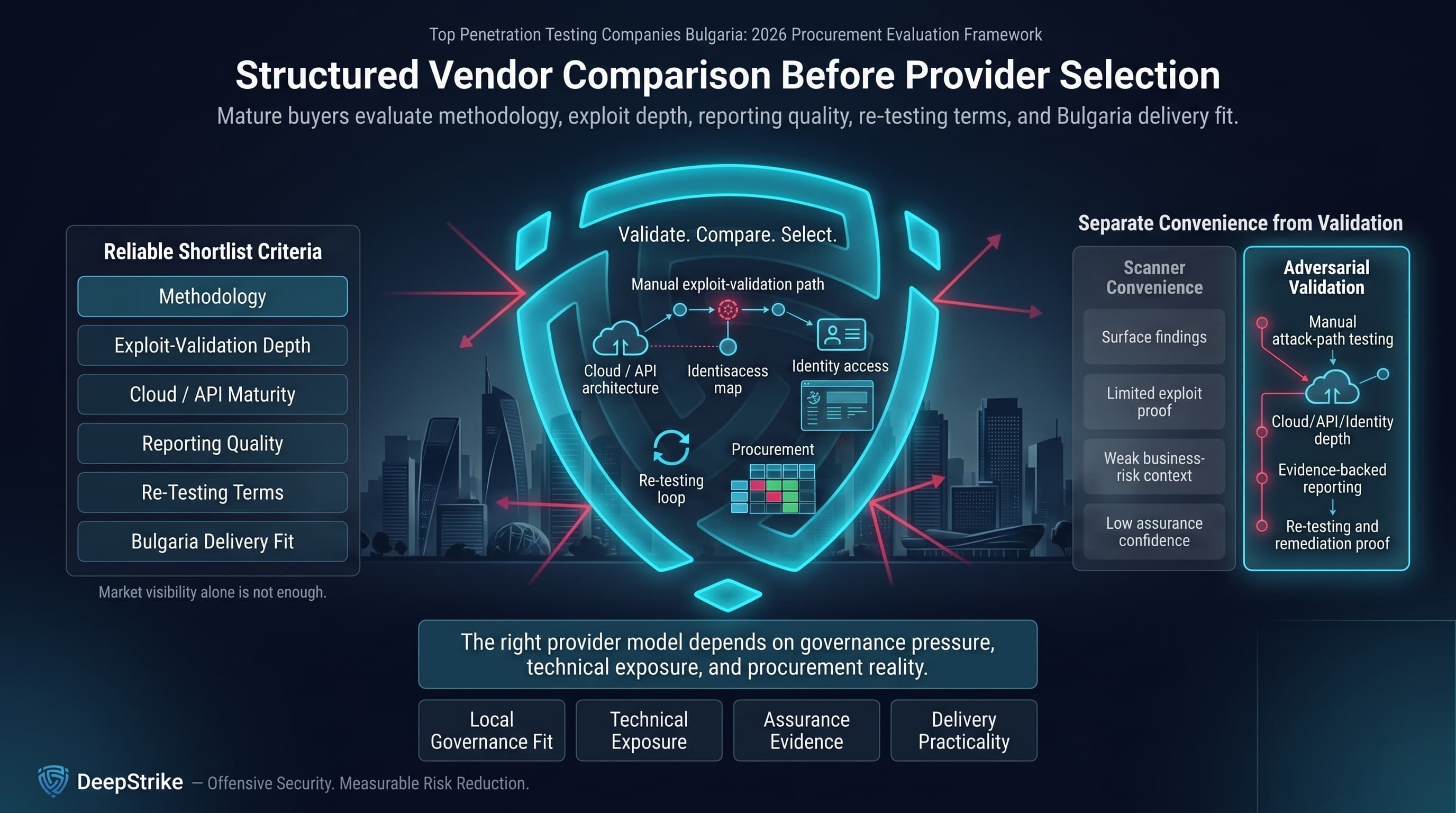
For buyers searching top penetration testing companies in Bulgaria online, market visibility alone is not enough. The more reliable shortlist comes from a structured comparison of methodology, exploit-validation depth, cloud and API maturity, reporting quality, re-testing terms, and actual delivery fit for Bulgaria-based operations.
Mohammed Khalil is a Cybersecurity Architect at DeepStrike, specializing in advanced penetration testing and offensive security operations. With certifications including CISSP, OSCP, and OSWE, he has led numerous red team engagements for Fortune 500 companies, focusing on cloud security, application vulnerabilities, and adversary emulation. His work involves dissecting complex attack chains and developing resilient defense strategies for clients in the finance, healthcare, and technology sectors.
Technical Review: DeepStrike Offensive Security Team
Last Reviewed: August 2026

Stay secure with DeepStrike penetration testing services. Reach out for a quote or customized technical proposal today
Contact Us
