November 30, 2025
Updated: February 23, 2026
A comprehensive guide to Australia’s leading cybersecurity firms, technologies, and market trends.

Mohammed Khalil

Australian organizations enter 2026 facing a materially different threat landscape than even a year ago. Data breach costs continue to rise, with global averages now exceeding USD $4.5–$5 million per incident and materially higher impact in regulated sectors such as finance, healthcare, and critical infrastructure. When factoring ransomware recovery costs, legal exposure, class actions, regulatory penalties, customer churn, and operational downtime, total incident impact frequently exceeds initial response estimates by 2–3x. According to recent cybersecurity statistics and breach trend analysis, AI enabled phishing, automated exploit chaining, deepfake enabled social engineering, and credential stuffing at scale are accelerating attack velocity across cloud first and hybrid environments.
In Australia, the ASD’s ACSC continues to report sustained growth in ransomware campaigns, supply chain compromise, insider driven data leakage, and business email compromise. At the same time, regulatory enforcement is intensifying. APRA CPS 234 scrutiny, SOCI Act obligations for critical infrastructure entities, ASD Essential Eight uplift expectations, PCI DSS 4.0 technical testing mandates, and ISO 27001:2022 surveillance audits increasingly require demonstrable evidence of control validation not policy intent alone. Boards are asking for measurable risk reduction, scenario based assurance, and documented remediation outcomes.
Penetration testing in Australia in 2026 is no longer a checkbox activity conducted once per year to satisfy audit requirements. It is a core assurance mechanism used to validate identity controls, cloud configurations, API exposure, third party integrations, privilege escalation pathways, and lateral movement risk. It is also increasingly tied to cyber insurance underwriting and board level risk quantification exercises.
This independent, research based ranking evaluates leading cybersecurity and penetration testing providers operating in Australia based on technical depth, certifications OSCP, CISSP, CREST, IRAP, breadth of services, compliance alignment, reporting transparency, maturity of methodology, and enterprise versus SME suitability. The goal is to support procurement clarity for CIOs, CISOs, and IT managers comparing vendors not to amplify marketing narratives or vendor positioning claims.
Several structural shifts justify a 2026 reassessment of top cybersecurity companies in Australia:
AI Assisted Offense and Defense: Adversaries now leverage generative AI to automate reconnaissance, draft tailored phishing lures, analyze exposed code repositories, and test credential combinations at scale. Automated exploit chaining enables attackers to move faster from initial foothold to privilege escalation. In parallel, providers are incorporating AI assisted testing workflows to improve coverage and reduce noise. However, human led exploitation, contextual analysis, and business logic abuse remain critical. AI augments capability; it does not replace senior offensive expertise.
Rise of Continuous Validation Models: The adoption of PTaaS and rolling engagement models has accelerated across SaaS providers, fintech, and enterprise DevOps environments. Annual pentests are increasingly supplemented by continuous penetration testing services, especially where infrastructure changes weekly through CI/CD pipelines. Security leaders are prioritizing reduced exposure windows rather than static compliance milestones.
Cloud and API Misconfiguration Growth: Misconfigured IAM roles, exposed storage buckets, insecure OAuth flows, token replay weaknesses, cross account trust misalignment, and container orchestration misconfigurations are rising. Multi cloud architectures increase complexity and create fragmented responsibility models. As organizations adopt serverless functions and microservices, attack surfaces expand beyond traditional perimeter testing.
Regulatory Enforcement Tightening: CPS 234 reviews, SOCI critical infrastructure audits, PCI DSS 4.0 testing obligations, ISO 27001:2022 technical validation expectations, and evolving privacy enforcement increase pressure for formalized red team and penetration testing programs. Evidence of internal and external testing is frequently requested during regulator reviews.
Insurance Driven Assurance: Cyber insurance underwriters increasingly request recent penetration testing reports, remediation confirmation, and proof of follow up validation. Insurers are examining exploit severity trends and time to remediation metrics before binding policies.
Formalized Security Budget Allocation: Boards are allocating structured budgets for red team Australia engagements, cloud penetration testing Australia programs, and PCI DSS pentest Australia validation exercises. Penetration testing spend is increasingly modeled as risk reduction investment rather than discretionary IT expense.
These changes materially increase the importance of selecting the right partner for penetration testing Australia engagements and broader cybersecurity validation programs.
Companies were evaluated based on a structured, multi dimensional framework designed to reflect real world procurement considerations:
Companies were assessed holistically across multiple dimensions rather than a single numeric score, reflecting real world buyer decision processes. Ranking order preserves structural integrity from the prior edition while layering updated 2026 intelligence and market evolution.

Headquarters: USA Delaware & UAE Dubai
Founded: 2016
Company Size: ~50–250 employees
Primary Services: Web, mobile, API and cloud penetration testing, red teaming, PTaaS, vulnerability assessments, adversary emulation, compliance validation.
Industries Served: Global enterprises, fintech, SaaS platforms, startups, and critical infrastructure sectors.
DeepStrike remains positioned as Best Overall for Australian organizations seeking advanced manual testing depth, strong cloud expertise, and continuous validation capability.
Why They Stand Out: DeepStrike is a specialist offensive security firm focused on high fidelity, human driven penetration testing services. Their model emphasizes manual exploitation, realistic adversary simulation, exploit chain mapping, and developer aligned reporting. Rather than relying primarily on automated scanners, DeepStrike testers validate business logic flaws, privilege escalation paths, authentication bypasses, and chained misconfigurations that frequently evade surface level assessments.
Their methodology integrates directly with DevOps workflows and supports rapid engagement initiation. Engagement models are aligned with modern penetration testing methodology standards and structured reporting suitable for both technical teams and board level stakeholders.
2026 Focus: In 2026, DeepStrike expanded adversary emulation depth in cloud IAM privilege escalation, API abuse patterns, OAuth/token trust boundary failures, and containerized workloads. Continuous penetration testing services were enhanced to provide rolling validation in CI/CD environments, reducing exposure windows between releases. Reporting now integrates exploit chain visualization, quantified business impact analysis, and prioritized remediation pathways tailored for regulated sectors.
Key Strengths:
Potential Limitations:
Best For: Cloud native enterprises, fintechs, SaaS providers, and DevSecOps driven teams requiring high impact manual testing, red team Australia simulations, and continuous validation aligned with evolving compliance expectations.
Headquarters: Melbourne, VIC
Founded: 2019
Company Size: 1,400+ employees
Best for Enterprise.
Why They Stand Out: CyberCX is Australia’s largest pure play cybersecurity provider. They deliver end to end services including penetration testing Australia, red teaming, managed SOC/MDR, incident response, GRC advisory, OT security, and risk consulting. Their extensive government footprint and IRAP aligned expertise provide depth for critical infrastructure and federal/state entities.
CyberCX’s breadth enables integrated testing aligned with compliance programs and long term transformation initiatives.
2026 Focus: CyberCX strengthened sovereign security capabilities, expanded red team simulation aligned to ASD Essential Eight and SOCI expectations, and integrated enhanced threat intelligence feeds into offensive testing scenarios. Increased scenario based testing for state sponsored threat modeling reflects evolving geopolitical risk exposure.
Best For: Large enterprises and government agencies requiring integrated cybersecurity programs, sovereign delivery capability, and alignment with Australian regulatory frameworks.
Headquarters: VIC, Australia
Founded: 2012
Best for Compliance Focused Organizations.
Why They Stand Out: CREST accredited testing combined with strong governance advisory capability. Alignment with IRAP, ISO 27001, PCI DSS pentest Australia obligations, and structured risk consulting makes Tesserent particularly relevant for regulated sectors.
Integration with Thales’ global security research capabilities adds intelligence context to formalized testing programs.
2026 Focus: Greater emphasis on PCI DSS 4.0 technical validation requirements, increased focus on formalized red team Australia exercises for financial institutions, and expanded advisory services linking penetration test findings directly into risk registers and board reporting.
Best For: Banking, defense, energy, and government linked organizations requiring certified validation and structured compliance alignment.
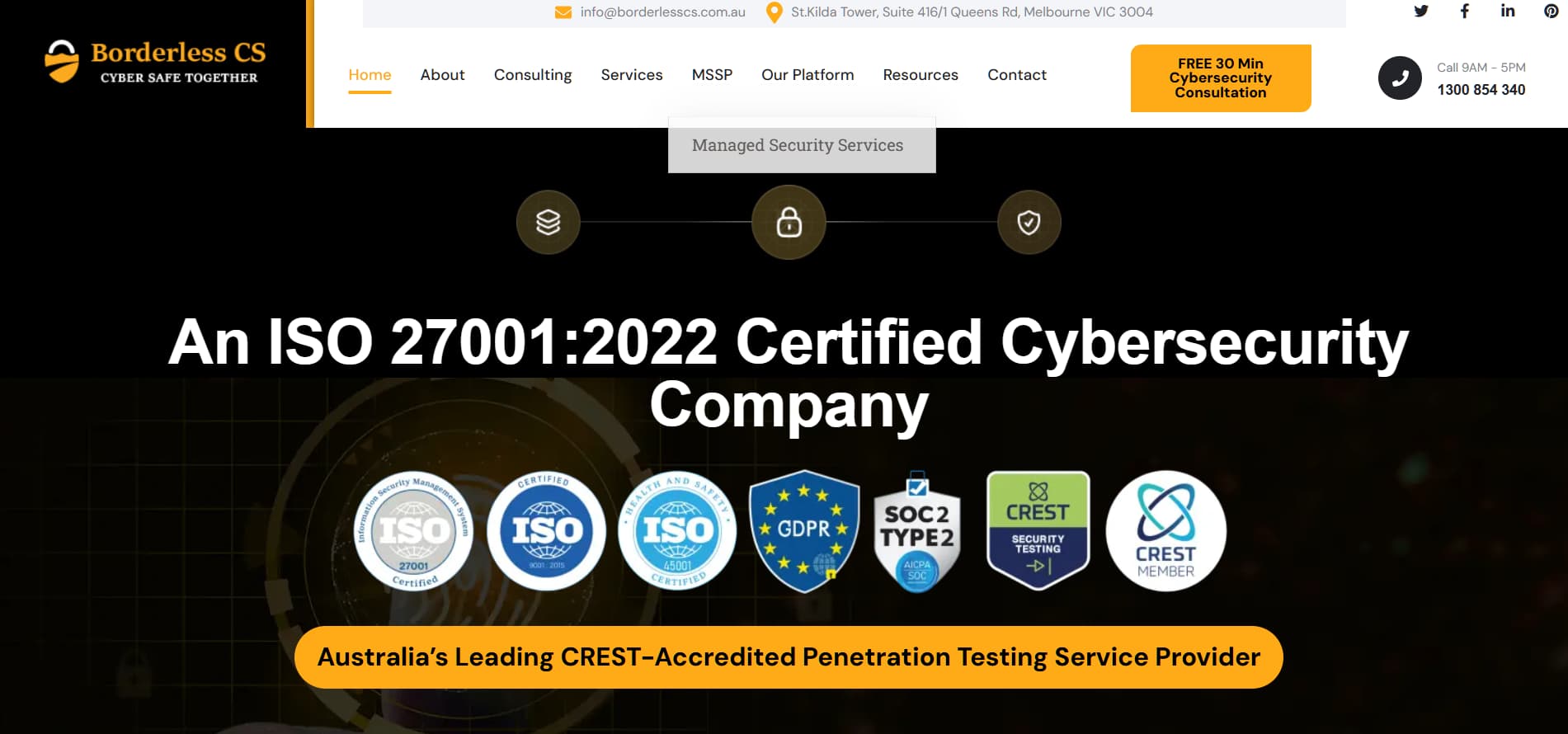
Headquarters: Melbourne
Founded: 2023
Company Size: Boutique
Best for SMBs.
Why They Stand Out: Strong local focus, ISO 27001:2022 alignment, CREST ANZ accreditation, and emphasis on manual validation rather than tool only scanning. Their approach integrates MITRE ATT&CK informed adversary simulation and practical remediation guidance.
Borderless CS combines penetration testing with managed detection and response for mid market Australian organizations seeking consolidated support.
2026 Focus: Expansion of SMB focused cloud penetration testing Australia packages, Essential Eight uplift validation engagements, and cost optimized VAPT bundles structured for mid market budgets. Increased focus on identity centric attack paths reflects rising credential abuse risk.
Best For: Mid market Australian organizations seeking cost effective but technically rigorous testing with strong local engagement.
| Company | Specialization | Best For | Region | Compliance | Ideal Size |
|---|---|---|---|---|---|
| DeepStrike | Manual offensive testing, PTaaS, cloud/API depth | Cloud native & fintech | Global / AU clients | PCI DSS, ISO 27001, SOC 2 | Mid–Enterprise |
| CyberCX | Full spectrum cyber services | Enterprise & Government | Australia | IRAP, ASD E8, SOCI | Large Enterprise |
| Tesserent | Compliance driven testing & advisory | Regulated sectors | Australia | CREST, ISO 27001, PCI DSS | Enterprise |
| Borderless CS | Boutique VAPT & SOC | SMB & Mid Market | Australia | ISO 27001, Essential Eight | SMB–Mid |
Penetration testing cost structures in Australia have adjusted in 2026 due to talent shortages, higher certification requirements, and expanded compliance overhead.
SMB Tier:$4,000–$18,000 for focused web application or internal network tests with limited scope.
Mid Market:$18,000–$60,000 for multi scope engagements web + API + cloud + internal network.
Enterprise:$60,000–$180,000+ depending on scope, application complexity, and reporting depth.
Red Team / Adversary Simulation:$80,000–$250,000+ for multi week campaigns simulating advanced threat actors.
Subscription PTaaS Australia models typically range from $5,000–$20,000 per month depending on scope, cadence, and reporting requirements. Continuous validation models are increasingly adopted by SaaS and fintech organizations with rapid release cycles.
Retesting policies vary. Boutique firms often include verification retests within engagement pricing. Larger consultancies may scope retesting separately. Buyers should confirm:
At minimum, one annual penetration testing Australia engagement is recommended, supplemented by additional testing following major releases or infrastructure changes.
When comparing penetration testing Australia providers, decision makers should evaluate beyond brand recognition or price positioning.
Organizations frequently misjudge value by selecting the lowest bid without assessing exploit depth, scenario realism, or reporting quality. In high risk environments, superficial assessments create false assurance.
Security assurance should be treated as an ongoing validation process rather than a static compliance artifact.
Ready to Strengthen Your Defenses? The threats of 2026 demand more than just awareness; they require readiness. If you're looking to validate your security posture, identify hidden risks, or build a resilient defense strategy, DeepStrike is here to help. Our team of practitioners provides clear, actionable guidance to protect your business. Explore our Penetration Testing Services to see how we can uncover vulnerabilities before attackers do. Drop us a line, we’re always ready to dive in.
AI accelerates reconnaissance, vulnerability discovery, and phishing generation. However, meaningful adversary simulation still requires manual exploit validation, contextual analysis, and business logic testing.
Continuous validation supplements but does not fully replace annual baseline assessments required by many compliance frameworks. Many organizations now combine annual comprehensive testing with quarterly or rolling validation.
Increasingly yes. Many insurers request recent penetration testing reports, evidence of remediation, and proof of follow up validation before issuing or renewing cyber policies.
OSCP, CISSP, CREST accreditation, IRAP related credentials, and strong cloud security expertise remain highly valued in Australia, particularly for regulated sectors.
Mohammed Khalil is a Cybersecurity Architect at DeepStrike, specializing in advanced penetration testing and offensive security operations. With certifications including CISSP, OSCP, and OSWE, he has led numerous red team engagements for Fortune 500 companies, focusing on cloud security, application vulnerabilities, identity based attack chains, and adversary emulation. His work involves dissecting complex exploit paths, validating real world breach scenarios, and developing resilient defense strategies for clients in the finance, healthcare, technology, and critical infrastructure sectors.

Stay secure with DeepStrike penetration testing services. Reach out for a quote or customized technical proposal today
Contact Us
