August 24, 2026
Updated: August 24, 2026
The automated shop that turns one malware infection into a searchable product other criminals buy for a few dollars.
Abdalla Mohamed
Russian Market is one of the dark web's most active and enduring marketplaces for stolen credentials: an automated marketplace that sells "stealer logs," credit card data, and remote access harvested from malware-infected computers, often within hours of the theft. It is not a place to visit; it is a threat to understand, because the passwords, session cookies, and corporate logins traded there are the raw material for account takeover, fraud, and ransomware. This guide explains what Russian Market is, what it sells, how the underground pipeline behind it works, whether it is "legit," and, most importantly, how to defend against it.
Updated: August 2026. Reflects the post-Lumma-takedown stealer landscape (Acreed's rise) and current credential-theft statistics. This is a defensive explainer for security teams and individuals; it contains no marketplace addresses or access instructions.
Here is the whole thing in one table; the rest of the guide expands each row.
| Question | Short answer |
|---|---|
| What is it? | An automated dark web marketplace specializing in stolen credentials and infostealer logs |
| Since when? | Emerged in early 2020; became a leading credential marketplace by the mid-2020s |
| What does it sell? | Stealer logs, CVV/card data, account and server logins; it historically sold RDP access, but that dedicated offering was discontinued in January 2024 |
| Where does the data come from? | Infostealer malware (RedLine, Lumma, Vidar, Acreed, and others) on infected devices |
| Why does it matter? | Those credentials fuel account takeover, business email compromise, fraud, and ransomware |
| Is it legal to use? | No. Buying or possessing stolen data is a crime in the US and most countries |
The one line to remember: Russian Market turns a single malware infection into a searchable product other criminals can buy for a few dollars.
Russian Market is a data-focused dark web marketplace. Unlike the sprawling markets that sell drugs and physical goods, it deals almost entirely in digital theft: login credentials, financial data, and remote access to compromised systems. Despite the name it operates largely in English and serves a global buyer base, and security vendors including Rapid7 and Searchlight Cyber track it as a leading credential marketplace worth monitoring.
It sits inside the broader ecosystem we map in our top dark web marketplaces roundup, and like other hidden services it is reached over anonymity networks such as Tor, explained in our dark web vs darknet vs Tor guide. What makes Russian Market notable is not novelty but scale and freshness: it lists millions of logs, and stolen credentials can appear for sale within hours of a machine being infected.
Russian Market did not start as a stealer-log giant. Its rise tracks the takedowns of its rivals, each of which sent buyers and sellers looking for a new home.
| Date | Event | Effect on Russian Market |
|---|---|---|
| Early 2020 | Russian Market emerges, initially offering RDP access and static credentials | Establishes itself as a data shop |
| 2022 | Hydra seized by German and US authorities | Market fragmentation; buyers scatter |
| Apr 2023 | Genesis Market seized (Operation Cookie Monster) | Growth accelerates, fills the gap |
| Jan 2024 | Dedicated RDP-access offering discontinued | Market focus shifts further toward credentials and infostealer logs |
| 2024 to 2025 | Infostealer-log brokerage becomes central to the marketplace | Strengthens its position as a leading credential shop |
| May 2025 | Lumma Stealer infrastructure disrupted (2,300+ domains) | Supply reshuffles; Acreed rises to feed logs |
| 2026 | Remains a leading active credential marketplace | Outlasts newer rivals |
The Genesis Market takedown, an FBI-led operation that also triggered US Treasury sanctions, was the turning point. We cover that and other operations in dark web marketplace takedowns. Russian Market absorbed the demand Genesis left behind and never looked back.
The inventory is organized around a few product categories, all of them stolen.
| Category | What it is | Who buys it |
|---|---|---|
| Stealer logs | Raw output from infostealer malware: passwords, cookies, tokens, profiles | Fraudsters, initial access brokers |
| CVVs | Card-not-present data (number, expiry, CVV) for online fraud | Carders |
| Dumps | Magnetic-stripe/track data for cloning physical cards | Carders |
| RDP access (historical) | Credentials to log into hacked Windows machines and servers; Russian Market's dedicated RDP offering was discontinued in January 2024 | Ransomware crews, access brokers |
| Account logins | Email, social, streaming, VPN, banking, hosting/cPanel | Account-takeover operators |
| Checkers and tools | Software to validate stolen credentials in bulk | Everyone above |
The core product, and the reason Russian Market matters more than a plain carding shop, is the stealer log.
A "log" (sellers also call it a "bot") is the complete harvest from one infected device. A single log is small, roughly 0.05 to 0.3 megabytes, yet it can contain dozens to thousands of credentials because it scrapes everything the browser and system hold.
| Data in a log | Why attackers want it |
|---|---|
| Saved browser passwords | Direct account access across many sites |
| Session cookies and tokens | Resume a logged-in session, often bypassing MFA |
| Autofill data (names, addresses, cards) | Identity theft and fraud |
| Saved payment cards | Card fraud |
| Cryptocurrency wallet data | Direct theft of funds |
| System profile (OS, IP, hostname, software) | Targeting and impersonation |
| Browser history, sometimes clipboard | Reconnaissance and lateral targeting |
The critical item on that list is the session cookie, and it deserves its own section because it is the reason so many "MFA-protected" accounts still fall.
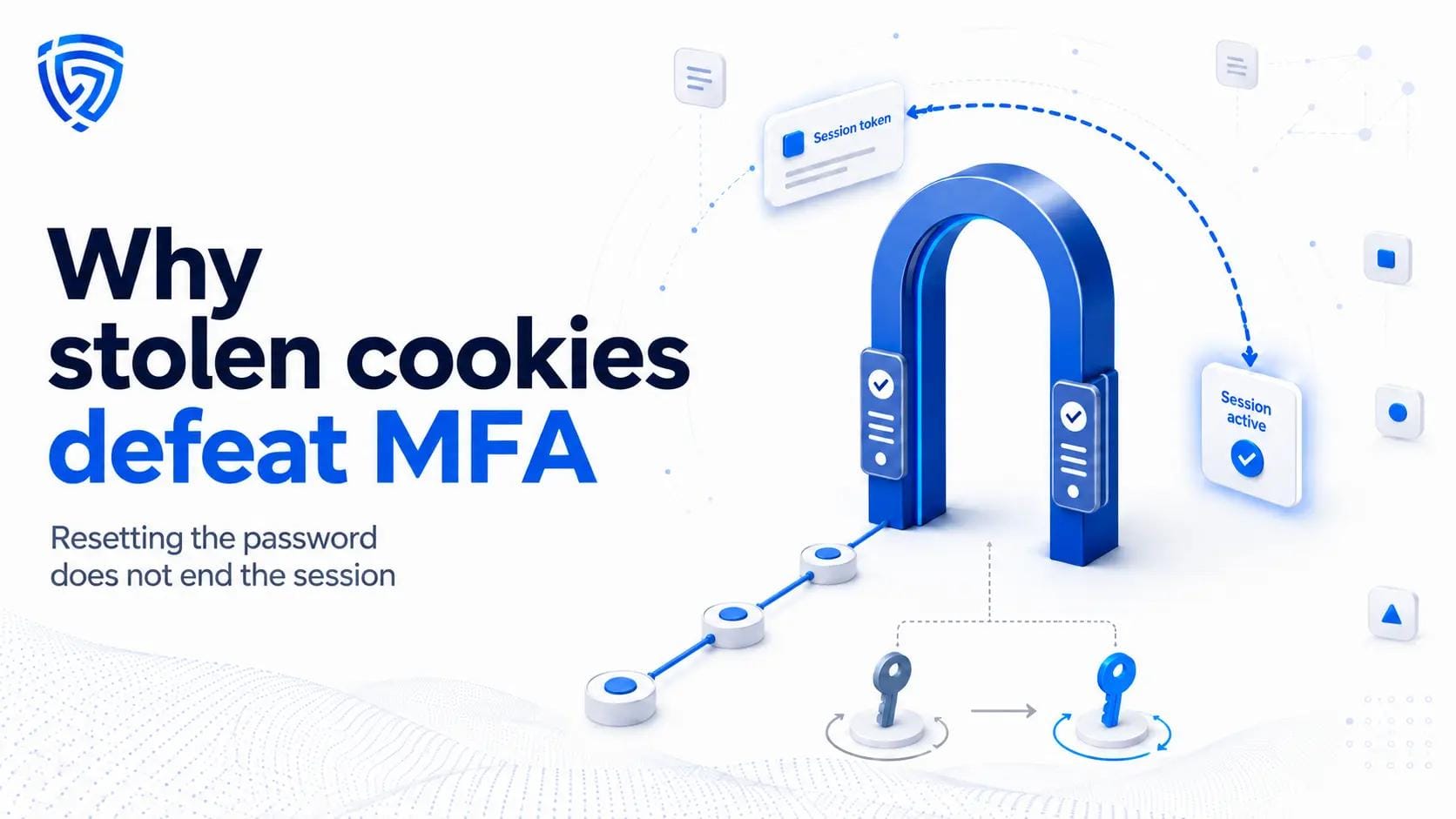
Multi-factor authentication verifies you at login. Once you pass, the site issues a session token (a cookie) that says "this browser is already authenticated," so you are not challenged on every click. Infostealers steal those live cookies. An attacker who imports your session cookie can pick up your authenticated session without ever seeing your password or your second factor, according to research from Huntress and Microsoft.
The dangerous corollary for incident response: rotating a password does not kill a stolen session. If the token is still valid, the attacker stays in. Containment requires revoking active sessions and tokens, not just resetting credentials, a point we return to in the defense section.
Russian Market is the storefront at the end of a supply chain. Understanding the chain is how you break it. The malware side is covered in depth in our infostealer malware and credential theft analysis; here is the pipeline in five stages.
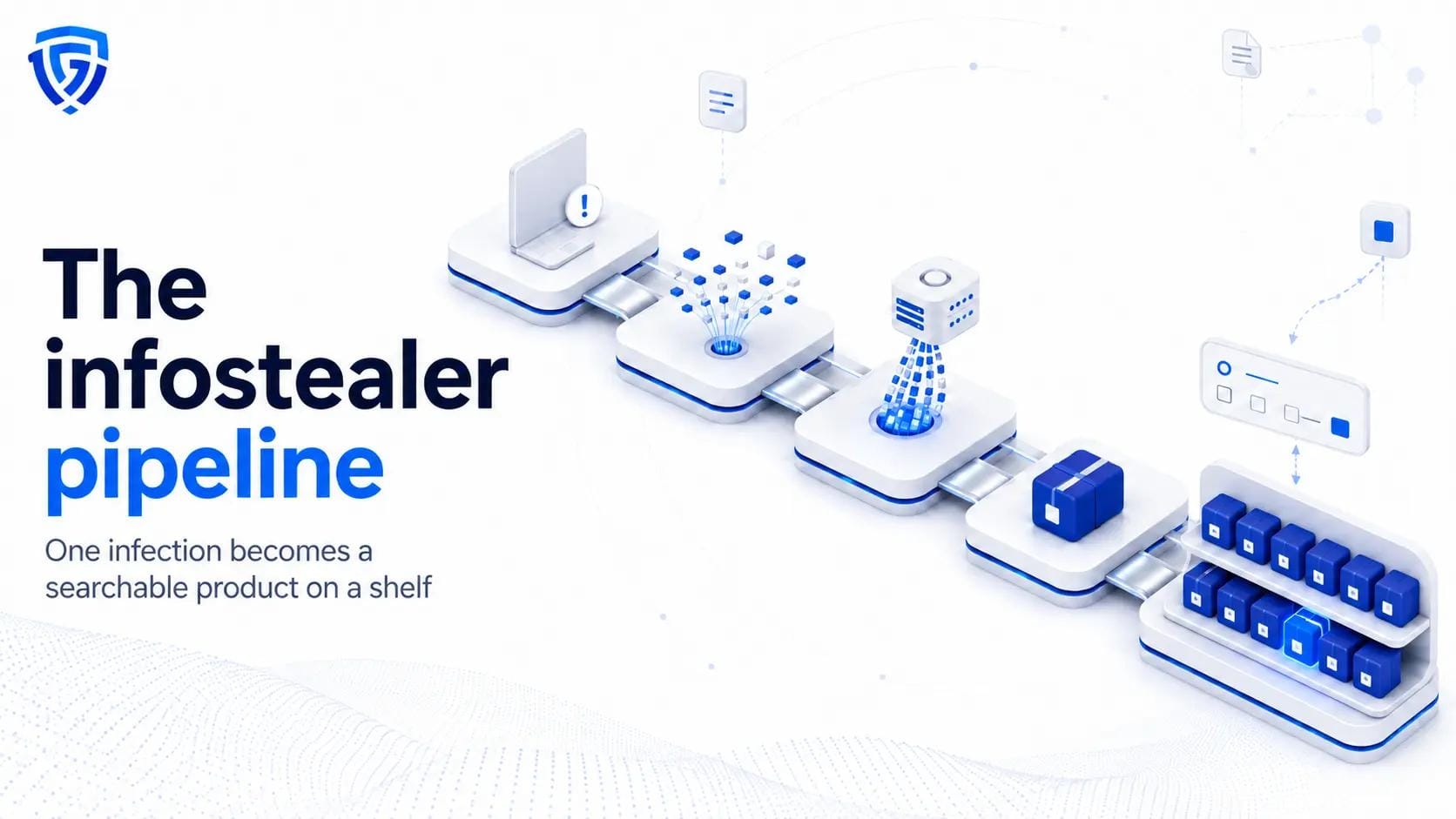
That domain-search capability is what turns a random infection into a targeted breach: an attacker hunting a specific company can filter millions of logs for one that contains a login to that company's VPN or email.
Russian Market does not write malware; it resells the output of independent stealer operations. The lineup shifts as law enforcement disrupts one family and another takes its place.
| Stealer family | Status by 2026 | Note |
|---|---|---|
| RedLine | Disrupted, still circulating | Long-time volume leader |
| Lumma (LummaC2) | Infrastructure disrupted May 2025 | 2,300+ domains seized |
| Vidar | Active | Established commodity stealer |
| Raccoon | Active, resurgent | Malware-as-a-service |
| StealC | Active | Popular successor strain |
| Acreed | Major post-Lumma strain | Rose sharply after the Lumma disruption and remained among the leading stealers in 2025 to 2026 |
| META | Active | RedLine-adjacent |
The takedowns matter but rarely end the problem: when Lumma was disrupted, Acreed rose sharply and became one of the leading post-Lumma stealer strains. The market outlives any single malware brand.
People often conflate Russian Market with Genesis Market, the shop the FBI seized in 2023. They sold different products, and the distinction is instructive.
| Dimension | Russian Market | Genesis Market (seized 2023) |
|---|---|---|
| Core product | Static stealer logs from third-party malware | "Bots": credentials plus live browser fingerprints |
| Impersonation | Buyer uses raw credentials and cookies | A browser plugin replayed the victim's full fingerprint |
| Anti-fraud evasion | Manual, via stolen cookies | Automated, designed to defeat device fingerprinting |
| Sourcing | Many independent stealer vendors | Its own curated bot supply |
| Status | Active | Seized (Operation Cookie Monster) |
Genesis was the more sophisticated tool, selling a way to become the victim's browser and slip past anti-fraud checks, as ReliaQuest documented. Russian Market is simpler, cheaper, and higher-volume: it sells the raw logs and lets the buyer do the work. That simplicity is exactly why it scaled.
The buyers are not one group. A cheap log is a flexible weapon, and different criminals use it differently.
| Buyer | What they do with a log |
|---|---|
| Account-takeover operators | Drain accounts, resell access, commit fraud |
| Carders | Cash out CVV and card data |
| Business email compromise crews | Hijack a mailbox to redirect invoices and payments |
| Initial access brokers | Verify a corporate login, then resell it upmarket |
| Ransomware affiliates | Use that access to breach, encrypt, and extort |
This is why a $2 log is a bargain for the criminal economy: it can be the first domino in a seven-figure ransomware incident. The buyer rarely needs to hack anything; the credentials already work.
Russian Market's model is high volume and low price. In Rapid7's H1 2025 analysis, bots were typically listed around $10, while historical listings ranged roughly from $1 to $100 depending on geography, session quality, and credential validity. For a fuller picture of underground pricing, see our dark web data pricing breakdown.
| Item | Typical price (indicative) |
|---|---|
| Typical bot / stealer log | Around $10 in Rapid7's H1 2025 dataset |
| Historical bot listings | Roughly $1 to $100 depending on quality and geography |
| CVV / card record | Often low single-digit to low double-digit prices, depending on validity and market conditions |
| Corporate or network access | Can command far more than a standard log; pricing varies widely by target and access level |
Two structural features make it work. Sellers list under pseudonymous aliases governed by a reputation system, and the market advertises escrow with refunds for "dead" (invalid) logs. Treat both as trust theater among criminals rather than consumer protection; they exist to keep the fraud economy liquid, not to protect anyone.
This is one of the most-searched questions about the market, and the honest answer is not a buyer's verdict, it is a warning. "Legit" here usually means "does it actually deliver stolen data," and even on those terms the answer is unreliable and beside the point:
If your goal is to find out whether your data is exposed, that is a defensive question with a legal answer, covered next, not a reason to go near the market.
You cannot take the market down, but you can make its product worthless against you. The strategy is to break the pipeline and to assume some credentials will leak anyway.
| Control | What it stops |
|---|---|
| Phishing-resistant MFA (FIDO2/passkeys) | Password-only theft; CISA and NIST recommend it as the standard |
| Session and token revocation on compromise | Stolen-cookie reuse that survives a password reset |
| Short session lifetimes + conditional access | The window a stolen token stays valid |
| EDR tuned to credential-theft behavior | The infostealer before it exfiltrates |
| Browser hardening (disable/encrypt saved passwords) | The primary data a stealer harvests |
| Application allow-listing / blocking cracked software | The most common infection vector |
| Dark-web and stealer-log monitoring for your domains | Blind spots: alerts when your creds appear for sale |
| Identity threat detection and response (ITDR) | Anomalous logins from leaked credentials |
The non-negotiable pairing is phishing-resistant MFA plus session revocation. MFA alone is not enough once cookies are in play, and password resets alone do not evict an attacker holding a live token.
Most logs come from ordinary personal machines, so individual hygiene directly starves the market.
You do not need to touch the market to find out. Use legitimate channels:
Russian Market changes the shape of the threat you are defending against. The attacker no longer has to breach your perimeter; they can buy a working login to it for pocket change, which is why credential exposure now shows up in the large majority of breaches, as our dark web statistics roundup documents. A single infected contractor laptop can put your VPN, email, or cloud console on sale the same day.
That reality is why testing has to assume the attacker already has credentials. DeepStrike's penetration testing is manual-first and adversary-realistic: our team probes what a criminal armed with a leaked login could actually reach inside your environment, validates whether your MFA and session controls hold up against cookie theft, and hands you the exact fixes before someone buys their way in. For US-based teams, see our US penetration testing services.
Russian Market is an automated dark web marketplace that sells stolen credentials, infostealer logs, and credit card data harvested from malware-infected devices. It historically sold dedicated RDP access, but that offering was discontinued in January 2024. It emerged in early 2020 and became one of the leading credential marketplaces by the mid-2020s, with data often listed for sale within hours of theft.
It sells stealer logs (bundles of passwords, cookies, and tokens from infected machines), CVV and card dumps, RDP access to hacked servers, and account logins for email, VPN, banking, and hosting. The core product is the stealer log, which can contain dozens to thousands of credentials each.
It is a criminal marketplace, so "legit" does not apply. Buying or possessing stolen data is illegal, dark web markets frequently exit-scam or get seized, and market mirrors are full of phishing and malware. Researchers use licensed monitoring feeds, never direct purchases.
A stealer log is the complete data haul from one device infected by infostealer malware: saved browser passwords, session cookies, autofill data, saved cards, crypto wallet details, and a system profile. Small in size but dense with credentials, it is the main product traded on Russian Market.
Genesis Market, seized in 2023, sold "bots" that included live browser fingerprints and a plugin to impersonate the victim and defeat anti-fraud checks. Russian Market sells static logs from third-party stealer malware and lets buyers use the raw credentials. It is simpler, cheaper, and higher-volume.
Yes. Infostealers steal live session cookies, which represent an already-authenticated session. Importing that cookie lets an attacker resume your session without your password or second factor. Rotating the password does not help; you must revoke active sessions and tokens to evict them.
Buying or using stolen credentials for unauthorized access or fraud is illegal. Laws governing possession vary by jurisdiction and circumstances, and interacting with criminal marketplaces can also expose users to malware, scams, and law-enforcement attention. Checking your own exposure should be done through legitimate monitoring services, not the market.
Yes. Despite the takedowns of rivals like Genesis, Hydra, and the Lumma stealer infrastructure, Russian Market remained one of the most active credential marketplaces in 2026, continually resupplied by newer stealer families such as Acreed after older ones were disrupted.

Stay secure with DeepStrike penetration testing services. Reach out for a quote or customized technical proposal today
Contact Us
