July 14, 2026
Updated: July 28, 2026
Cl0p can refer to a ransomware family, an extortion operation, or a campaign. This evidence-led guide verifies major campaigns and CVEs and gives defenders a practical exposure, detection, and response framework.

Mohammed Khalil
Last verified: 14 July 2026. Threat intelligence changes as vendors, investigators, and affected organizations release new evidence. This guide uses cited government advisories, vendor notices, CVE records, and original threat research. A name on a criminal leak site is treated as an actor claim not automatic confirmation of compromise, data theft, impact, or attribution.
| What is Cl0p ransomware? | Group, malware, and campaign |
|---|---|
| History and evolution | Major campaigns |
| Why MFT platforms matter | Associated vulnerabilities |
| Campaign lifecycle | MITRE ATT&CK behavior |
| Exposure assessment | Detection priorities |
| Incident response | Frequently asked questions |
Cl0p ransomware, also written Clop, is a Windows ransomware family associated with a financially motivated extortion operation using the same name. The operation has used encryption, data theft, and publication pressure; several later campaigns focused on stealing data from exposed enterprise software without widespread encryption.
| Field | Verified summary |
|---|---|
| Preferred name | Cl0p, using a zero. Source: FBI/CISA AA23-158A. |
| Common variant | Clop. MITRE names the malware “Clop,” while government and industry sources use both forms. Source: MITRE ATT&CK S0611. |
| Entity type | A criminal extortion brand/operation and a related ransomware malware family; the boundaries between vendor-tracked clusters are not exact. Sources: FBI/CISA, Google Threat Intelligence. |
| First documented activity | The ransomware family was first observed in February 2019. Sources: MITRE S0611, FBI/CISA. |
| Commonly reported motivations | Financial gain through encryption, data theft, extortion, and publication pressure. Source: FBI/CISA. |
| Typical campaign pattern | Historically, phishing and post-compromise ransomware activity; in several later campaigns, rapid exploitation of internet-facing enterprise software followed by data theft and extortion. Sources: FBI/CISA, NCC Group. |
| Encryption use | Verified for the Clop malware family and some incidents, but not present in every campaign. Sources: MITRE S0611, FBI/CISA. |
| Data-theft use | Central to the Accellion, GoAnywhere, MOVEit, Cleo, and Oracle E-Business Suite activity examined here. Sources: cited campaign research below. |
| Frequently associated technology | Internet-facing file-transfer and enterprise application platforms that can hold concentrated business data. This is a pattern, not a claim that all such products are unsafe. |
| Known aliases | “Clop” is a spelling variant. TA505, FIN11, UNC2546, UNC2582, and other vendor labels may describe related activity or narrower clusters; they are not treated here as exact synonyms. Sources: MITRE G0092, Mandiant Accellion research. |
| Current status | Cl0p-branded leak-site claims were observed in January 2026. That shows continued use of the brand, not automatic validation of listed incidents or a stable organizational boundary. Source: ZeroFox, 28 January 2026. |
| Attribution confidence | High for the broad operation and malware relationship; campaign-level confidence varies from Confirmed to Probable and is stated separately. |
| Last verified | 14 July 2026. |
Linked sources: FBI/CISA AA23-158A; MITRE ATT&CK S0611; Google Threat Intelligence; NCC Group; MITRE G0092; Mandiant Accellion research; ZeroFox, 28 January 2026
Verification note: URLs and current-status statements in this table were reviewed on 14 July 2026. “Current status” refers to observed brand activity, not an independently confirmed count of victims.
DeepStrike's Red Teaming Services attack your exposed file-transfer platforms the way Cl0p does, finding the data-theft paths a patch alone won't close.
“Cl0p ransomware group” is convenient shorthand, but it can blur four distinct subjects: an extortion brand, one or more operator clusters, the Clop ransomware executable, and a specific campaign. The distinction matters because a Cl0p-associated incident may involve data theft without deploying the encryption payload.
Cl0p uses a zero; Clop is a common spelling and MITRE’s name for the malware entry. This guide uses Cl0p for the operation and follows a source’s formal spelling when referring to a named entry or quotation.
Vendor labels such as TA505, FIN11, UNC2546, and UNC2582 may describe related activity or narrower evidence clusters. They are not treated as exact synonyms because a label may refer to a tool user, access cluster, extortion team, or wider activity set.
| Term | What it refers to | What it does not automatically prove |
|---|---|---|
| Cl0p operation or brand | The criminal extortion identity, infrastructure, communications, and associated activity discussed by investigators | That every operator, affiliate, or vendor cluster is the same person or team |
| Clop ransomware malware | The Windows ransomware family catalogued by MITRE as S0611 | That the malware was deployed in every Cl0p-branded campaign |
| Cl0p campaign | A bounded intrusion or mass-exploitation event tied to a product, time window, behavior, and attribution source | That all other Cl0p behaviors or techniques occurred in that incident |
| Vendor-tracked cluster | A research label such as FIN11, UNC2546, UNC2582, or another evidence-defined activity set | Exact equivalence to the Cl0p brand or to another vendor’s cluster |
| Leak-site claim | A public assertion made through criminal infrastructure | Confirmed compromise, data theft, impact, victim scope, or independent attribution |
| Data-extortion incident | Theft or claimed theft of data followed by pressure to pay or prevent publication | File encryption or broad operational disruption |
Linked sources: MITRE as S0611
Response decisions should be anchored to the affected product, exposure window, telemetry, and evidence source not to the actor label alone. Payload-only detection can miss data-theft campaigns, while a leak-site claim alone does not establish a confirmed breach.
MITRE and FBI/CISA date the Clop ransomware family’s first observation to February 2019 and describe it as a CryptoMix variant. Early documented activity included phishing-led access, post-compromise tooling associated with TA505, encryption, and later data theft with publication pressure.
The late-2020 Accellion File Transfer Appliance campaign marked a different model: exploit an internet-facing data-transfer platform, steal files, and apply Cl0p-branded extortion pressure. Mandiant kept exploitation and extortion clusters separate because the evidence did not justify treating every role as one actor.
NCC Group later documented TA505 exploitation of SolarWinds Serv-U in 2021 incidents that led to Clop ransomware activity. The contrast matters: some file-transfer intrusions progressed to broader post-compromise activity and encryption, while later campaigns could focus on data already stored in the platform.
Law-enforcement agencies announced arrests of suspected Cl0p-linked operators in 2021. Later campaigns show that the action did not eliminate use of the brand or operating model, and it does not prove that every operator was identified.
The 2023 GoAnywhere MFT and MOVEit Transfer campaigns made data-theft-focused mass exploitation especially visible. FBI/CISA reported that Cl0p campaigns since 2021 had generally favored exfiltration over encryption, allowing attackers to extort organizations without the lateral movement typical of conventional enterprise ransomware.
Mass exploitation continued in 2024 reporting on Cleo products. In 2025, Cl0p-branded extortion accompanied Oracle E-Business Suite exploitation; Google Threat Intelligence observed overlaps with suspected FIN11 activity but withheld formal group attribution, so this guide labels the campaign Probable rather than Confirmed.
Cl0p-branded leak-site activity was reported again in January 2026. The defensible conclusion is that the brand remained in use not that every listing was confirmed or that one unchanged team controlled all activity.
For broader comparison across active and historically significant operators, see DeepStrike’s ransomware groups overview.
| Operational shift | Why it matters to defenders |
|---|---|
| Encryption-led ransomware incidents | Endpoint impact, recovery controls, and enterprise-wide post-compromise evidence can be central. |
| Theft plus leak-site pressure | Confidentiality assessment and notification work remain necessary even when recovery is straightforward. |
| Mass exploitation of data-rich platforms | Product logs, exposure history, and file-access evidence may matter more than lateral-movement or encryption alerts. |
| Cl0p-branded activity with uncertain cluster boundaries | Attribution should be confidence-labeled and kept separate from the technical compromise assessment. |
| Campaign / product | Exploitation period | Public disclosure | CVE | Observed objective | Encryption observed? | Attribution confidence | Primary source |
|---|---|---|---|---|---|---|---|
| Accellion FTA | Mid-Dec 2020–Jan 2021 | 22–24 Feb 2021 | CVE-2021-27101, -27102, -27103, -27104 | File theft and Cl0p-branded extortion | No ransomware deployment reported in this campaign | High confidence: Cl0p-branded extortion; exact UNC/FIN11 boundary uncertain | Mandiant; CISA AA21-055A |
| SolarWinds Serv-U | 2021 incidents; exact start not published by NCC Group | Vendor advisory 9 Jul 2021; research 8 Nov 2021 | CVE-2021-35211 | Initial access followed by post-compromise activity in Clop cases | Clop ransomware observed in associated cases; not universal | High confidence: incident-response evidence linked TA505 exploitation to Clop cases | NCC Group; CISA |
| Fortra GoAnywhere MFT | Late Jan 2023 | Advisory available 1 Feb; CVE published 6 Feb 2023 | CVE-2023-0669 | Unauthorized accounts, file access, data theft, and extortion | No encryption identified in the campaign described by FBI/CISA | High confidence: government advisory and vendor investigation | FBI/CISA AA23-158A; Fortra |
| Progress MOVEit Transfer | Began 27 May 2023 | Vendor notice 31 May; CVE 2 Jun 2023 | CVE-2023-34362 | Data theft and extortion through exposed MOVEit systems | No widespread encryption reported in this campaign | Confirmed: official FBI/CISA attribution | FBI/CISA AA23-158A; Progress |
| Cleo Harmony, VLTrader, LexiCom | Mass exploitation observed from 3 Dec 2024 | Vendor/research updates 10–14 Dec 2024 | CVE-2024-50623, CVE-2024-55956 | Platform access, data theft, and extortion | Encryption not consistently reported | High confidence: actor claim plus original-research overlap; exact operator boundary uncertain | Cleo 50623; Cleo 55956; Huntress |
| Oracle E-Business Suite | Suspicious activity from 10 Jul; likely zero-day exploitation from 9 Aug 2025 | Oracle patch 4 Oct; GTIG research 9 Oct 2025 | CVE-2025-61882 | Data theft and Cl0p-branded extortion | No encryption reported in the reviewed research | Probable: Cl0p brand and overlaps present; GTIG did not formally attribute a tracked group | Google Threat Intelligence; Oracle |
Source note: dates separate the earliest supported exploitation from public disclosure. “No encryption reported” means the cited campaign evidence did not establish encryption; it is not proof that encryption was impossible. Sources retrieved 14 July 2026.
Across these campaigns, the recurring target was a data position rather than a single industry: internet-facing enterprise software with privileged access to concentrated information. One compromised platform can create direct and downstream exposure without a long internal intrusion.
Several campaigns began before a CVE was public. Exposure review therefore needs version and deployment history, external reachability, retained logs, accounts, integrations, and evidence of file access or movement not only today’s patch status.
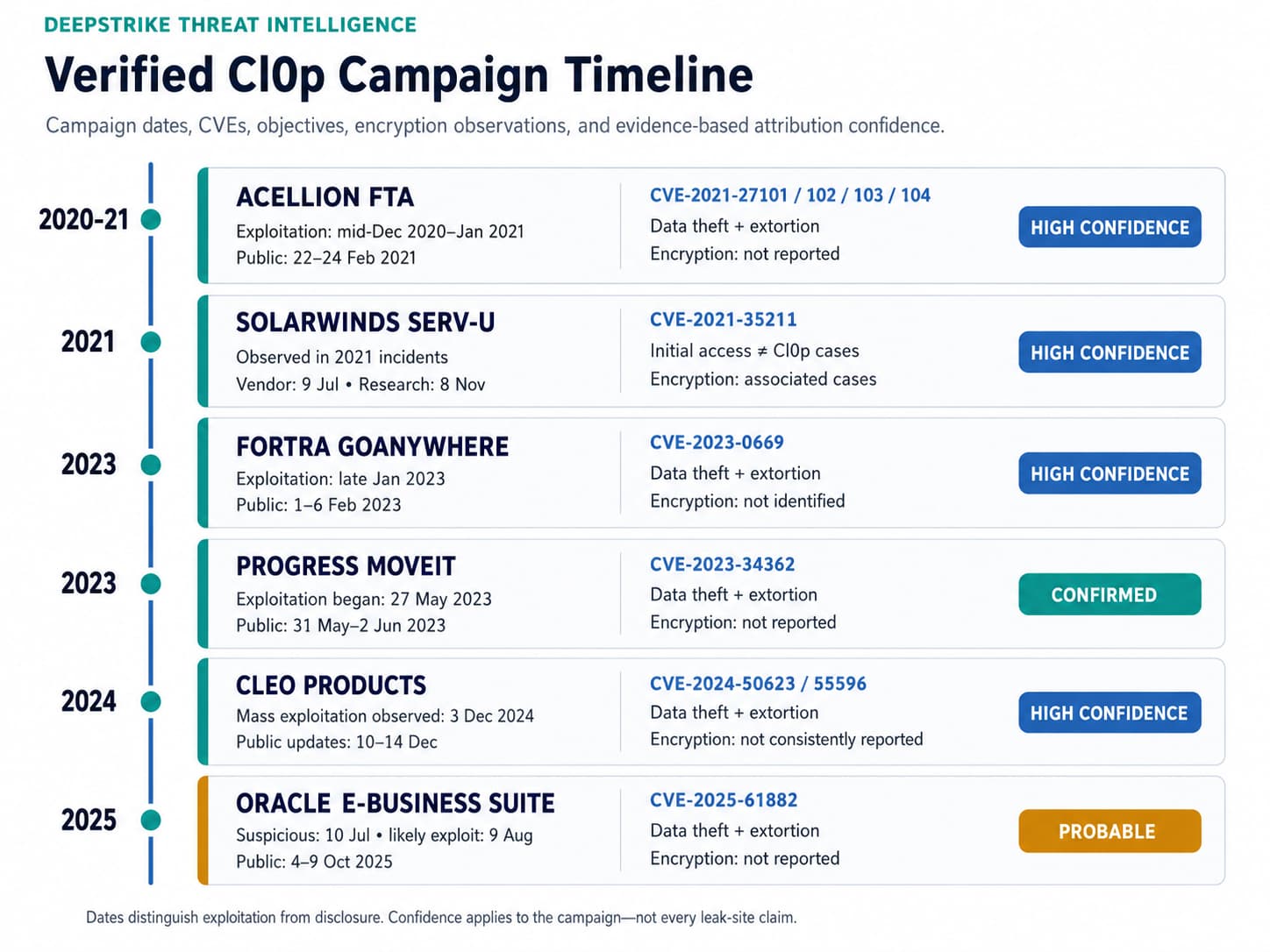
Figure 1. Verified timeline of major Cl0p campaigns and associated product vulnerabilities.
Source note: FBI/CISA AA23-158A; CISA AA21-055A; Progress, Fortra, Cleo, and Oracle vendor advisories; Mandiant/Google Threat Intelligence, NCC Group, Huntress, and Rapid7 original research. The confidence labels are this article’s evidence-based synthesis. Retrieved 14 July 2026.
Managed File Transfer (MFT) products move large or sensitive files with scheduling, access controls, workflow automation, and audit records. Their relevance to Cl0p does not mean that every MFT product is unsafe.
The risk comes from concentration and connectivity. One internet-facing system may serve several business units and connect to identity services, databases, cloud storage, or automation accounts, giving an intruder access to valuable data without broad lateral movement.
Ownership is often fragmented across infrastructure, application, business, and third-party teams. That can delay basic incident answers: which version ran, when it was exposed, what data was present, which integrations had access, and who must be notified.
Patching closes a known weakness but does not erase prior access. When exploitation may predate remediation, preserve evidence, restrict access as appropriate, review accounts and data movement, assess connected systems, and follow current product-specific guidance.
| CVE | Product | Disclosure date | CISA Known Exploited? | Cl0p association | Confidence | Required defensive action | Official source |
|---|---|---|---|---|---|---|---|
| CVE-2021-27101 | Accellion FTA | 16 Feb 2021 | Yes | Accellion theft/extortion campaign | High | Follow current vendor migration/retirement guidance; if historically exposed, preserve evidence and investigate the campaign window | NVD / KEV status |
| CVE-2021-27102 | Accellion FTA | 16 Feb 2021 | Yes | Same campaign | High | Same as above; verify historical version and exposure independently | NVD / KEV status |
| CVE-2021-27103 | Accellion FTA | 16 Feb 2021 | Yes | Same campaign | High | Same as above; do not treat absence of a public IOC as clearance | NVD / KEV status |
| CVE-2021-27104 | Accellion FTA | 16 Feb 2021 | Yes | Same campaign | High | Same as above; include downstream data owners in review | NVD / KEV status |
| CVE-2021-35211 | SolarWinds Serv-U MFT / Secure FTP | Vendor notice 9 Jul; NVD 14 Jul 2021 | Yes | TA505 exploitation in incidents leading to Clop cases | High | Apply current SolarWinds guidance; investigate any relevant historical exposure and post-access activity | CISA alert; NVD |
| CVE-2023-0669 | Fortra GoAnywhere MFT | 6 Feb 2023 | Yes | GoAnywhere data-theft/extortion campaign | High | Upgrade per current Fortra guidance; review unauthorized accounts and file access during the exposure window | Fortra investigation; NVD |
| CVE-2023-34362 | Progress MOVEit Transfer | Vendor notice 31 May; NVD 2 Jun 2023 | Yes | Officially attributed MOVEit campaign | Confirmed | Follow the current Progress advisory; if exposed in the campaign window, activate incident response and assess data access | Progress advisory; NVD |
| CVE-2024-50623 | Cleo Harmony, VLTrader, LexiCom | NVD 27 Oct; vendor update 10 Dec 2024 | Yes | Part of the Cleo mass-exploitation context | High | Upgrade to the vendor-specified fixed release and follow later Cleo guidance; review activity from the historical window | Cleo advisory; NVD |
| CVE-2024-55956 | Cleo Harmony, VLTrader, LexiCom | 13 Dec 2024 | Yes | Successive Cleo exploitation and extortion activity | High | Upgrade to the current fixed release and investigate exposure; do not rely on the earlier fix alone | Cleo advisory; NVD |
| CVE-2025-61882 | Oracle E-Business Suite 12.2.3–12.2.14 | Oracle 4 Oct; NVD 5 Oct 2025 | Yes | Cl0p-branded Oracle campaign; formal group attribution withheld by GTIG | Probable | Apply Oracle’s emergency update and prerequisites; preserve evidence and investigate any pre-patch exposure | Oracle alert; NVD |
Source note: “Disclosure date” uses the first authoritative public date available in the cited records and distinguishes vendor notice from NVD publication where necessary. All ten CVEs were rechecked against NVD and CISA Known Exploited Vulnerabilities status on 14 July 2026. A KEV entry establishes known exploitation, not Cl0p attribution; the association column relies on the separate campaign sources.
The following lifecycle is a defensive synthesis of the campaigns above. It is not an exploit sequence, and no single incident should be assumed to contain every stage.
The defensive implication is simple: teams should not wait for an encryption alert. Product logs, reverse-proxy records, identity activity, administrative changes, file-access history, and unusual outbound movement can be more important in data-theft-focused activity.
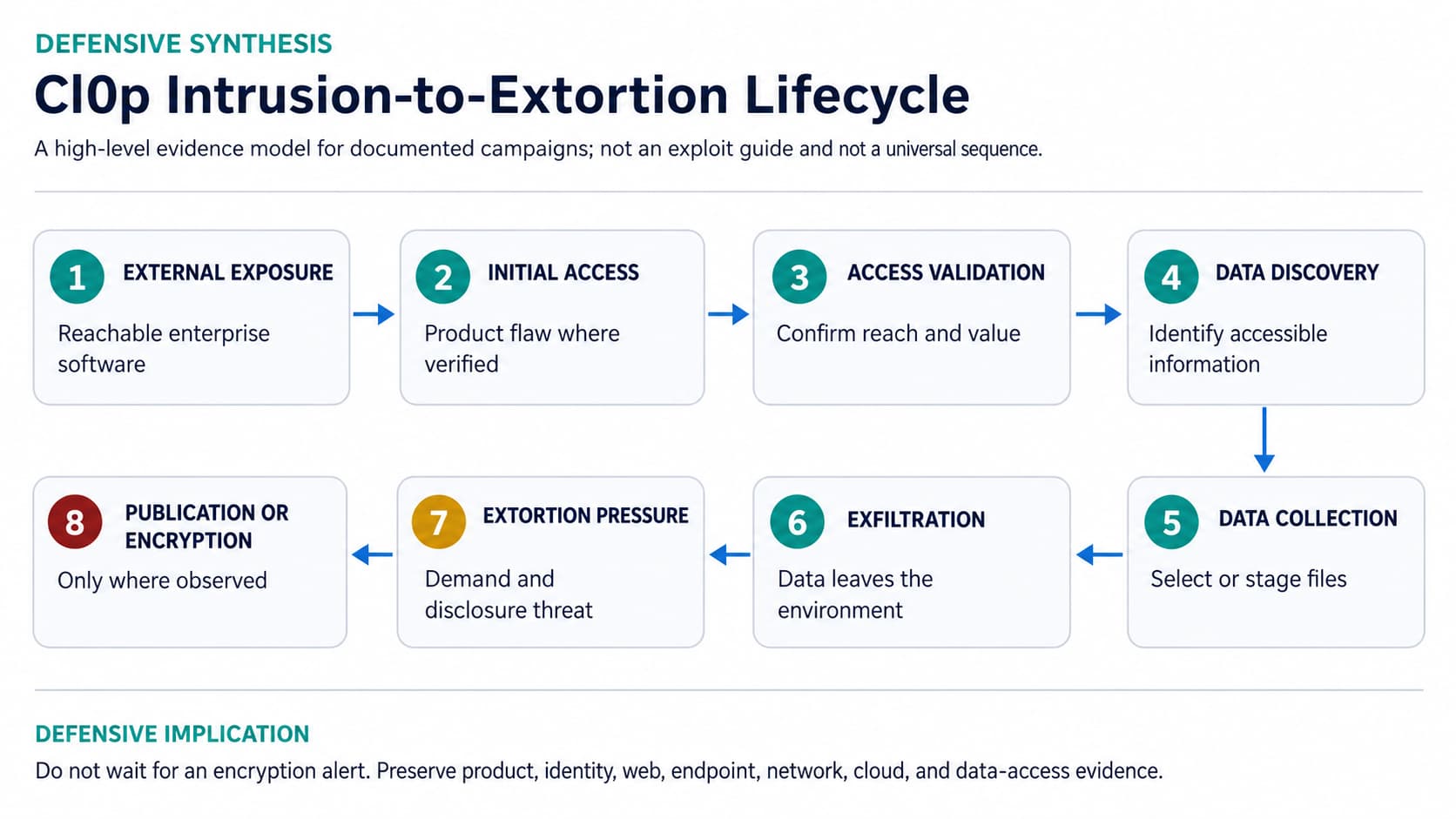
Figure 2. High-level Cl0p intrusion-to-extortion lifecycle based on publicly documented campaigns.
Source note: Original synthesis of the cited Accellion, Serv-U, GoAnywhere, MOVEit, Cleo, and Oracle E-Business Suite campaigns. It does not imply that every incident follows the same sequence.
| Observed behavior | ATT&CK tactic | Technique | Defensive evidence | Source and confidence |
|---|---|---|---|---|
| Exploitation of an internet-facing enterprise application | Initial Access | T1190 — Exploit Public-Facing Application | Application, web, WAF, reverse-proxy, and network records aligned to the exposure window | FBI/CISA AA23-158A; high for GoAnywhere/MOVEit |
| Web shell on compromised file-transfer systems | Persistence | T1505.003 — Web Shell | New or modified web-accessible files, application integrity changes, process lineage, and web requests | FBI/CISA AA23-158A; high for Accellion/MOVEit |
| PowerShell execution in historically documented activity | Execution | T1059.001 — PowerShell | Script-block logging, process telemetry, command-line records, and child-process anomalies | FBI/CISA AA23-158A; high for cited historical activity, not universal |
| Discovery of remote systems | Discovery | T1018 — Remote System Discovery | Endpoint process telemetry, network connection records, and administrative discovery activity | FBI/CISA AA23-158A; high for cited historical activity |
| Transfer of tools or files into a compromised environment | Command and Control | T1105 — Ingress Tool Transfer | Proxy, DNS, network, EDR, and file-creation telemetry | FBI/CISA AA23-158A; high for cited historical activity |
| Data exfiltration through an established channel | Exfiltration | T1041 — Exfiltration Over C2 Channel | Outbound volume, destination, timing, process-to-network correlation, and data-loss controls | FBI/CISA AA23-158A; high for the advisory’s mapped behavior |
| File encryption by the Clop payload | Impact | T1486 — Data Encrypted for Impact | Rapid file modification, extension changes, ransom-note artifacts, process activity, and recovery-control alerts | MITRE S0611; high for malware behavior, not every campaign |
| Inhibition of recovery in malware-led incidents | Impact | T1490 — Inhibit System Recovery | Backup-control changes, shadow-copy or recovery-setting events, and privileged process activity | MITRE S0611; high for catalogued malware behavior, not every campaign |
Mapping note: ATT&CK techniques are evidence labels, not a checklist to apply to every Cl0p incident. The campaign and malware scopes are stated separately to avoid importing ransomware-payload behaviors into data-theft-only cases.
Exposure is driven more reliably by technical and data conditions than by a broad industry label. Organizations should increase the priority of review when one or more of these factors applies:
None of these factors proves compromise. They indicate where evidence collection and incident-response capacity should be prioritized.
The impact of a Cl0p-associated incident depends on what the affected platform could reach and what the evidence shows not on the actor name alone.
Confidentiality impact may include personal information, customer records, contracts, financial files, intellectual property, credentials, or operational data. Even without encryption, data theft can trigger regulatory, contractual, legal, notification, and communications work.
Operational impact may include containment downtime, emergency upgrades, application rebuilding, credential rotation, forensic collection, and validation. Encryption can add wider recovery requirements, while a vendor-hosted compromise can expose organizations that never operated the product themselves.
Actor claims must remain separate from confirmed impact. Leak-site listings can guide triage, but incident evidence and official disclosures should establish systems affected, data accessed, and business consequences.
For broader quantitative context not proof of any Cl0p-specific claim see DeepStrike’s ransomware statistics.
Start with an evidence question, not an IOC search: Was an affected product reachable during the relevant exploitation window, and what could an intruder have accessed?
| Assessment priority | Key question | Primary owner | Completion evidence | Important limitation |
|---|---|---|---|---|
| Product and version | Did we run the affected product and version? | Asset owner / IT operations | Inventory record, version evidence, configuration backup | Current state may hide historical exposure |
| External exposure | Was it reachable during the campaign window? | Network / attack-surface owner | DNS, firewall, load-balancer, cloud, and scanning history | A current closed port does not prove past isolation |
| Remediation | When did effective mitigation occur? | Application owner / vulnerability management | Change ticket, package/version proof, vendor-matched validation | Patch time is not compromise-clearance time |
| Compromise evidence | What occurred before and after remediation? | Incident response / SOC | Preserved logs, timeline, forensic notes, detections | Public IOCs are incomplete and can become stale |
| Data scope | What information and integrations were accessible? | Data owner / privacy / application team | Data-flow map, repository list, access records | Stored-file lists may not prove actual access |
| Downstream exposure | Whose data or service depended on the platform? | Third-party risk / legal / procurement | Vendor map, contracts, recipient list, notification log | “We do not run it” does not eliminate vendor exposure |
Defensive source note: This framework applies the evidence-preservation and incident-management principles in the CISA StopRansomware Guide and NIST SP 800-61 Rev. 3 to the product-specific advisories cited above.
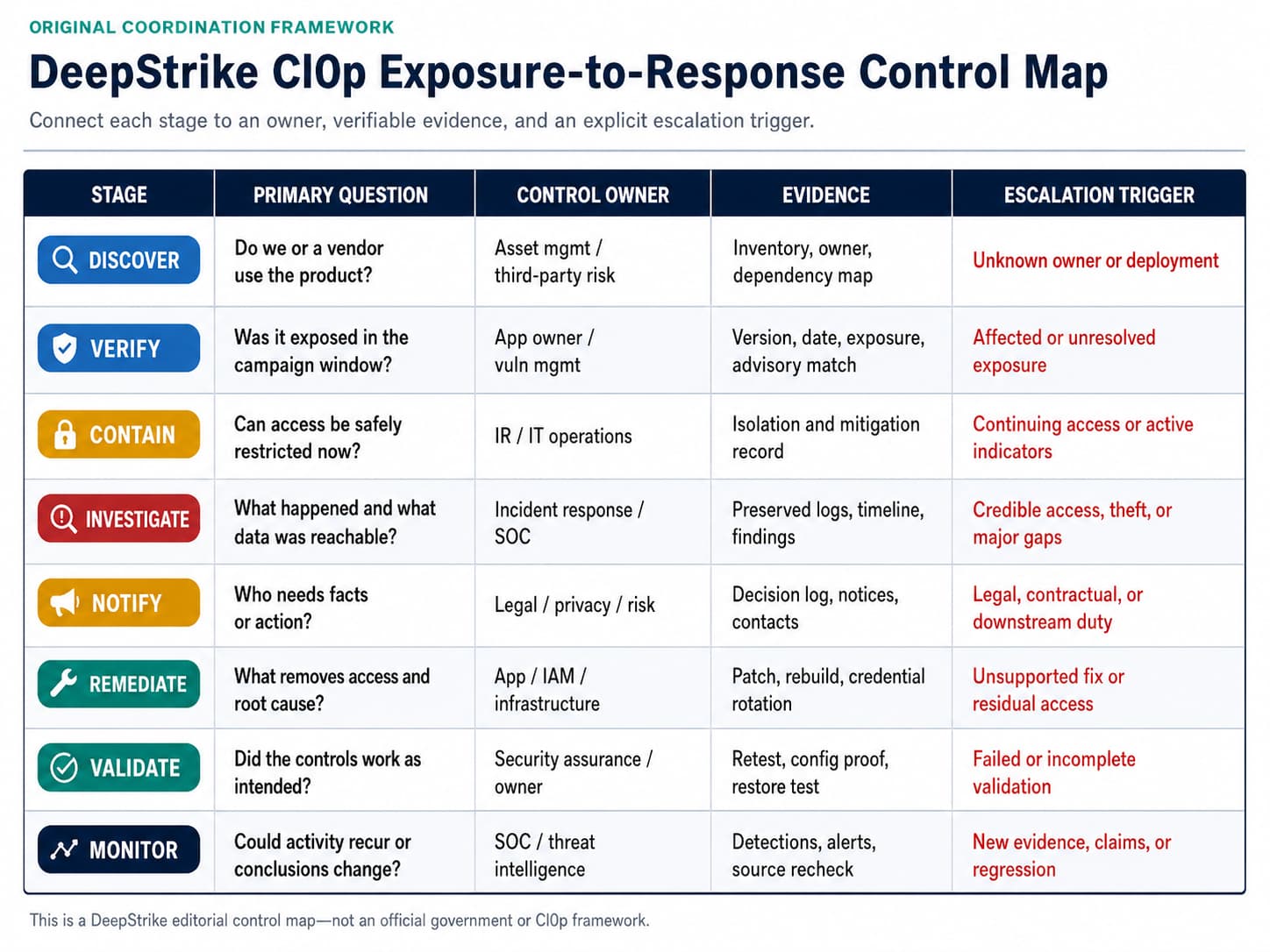
Figure 3. DeepStrike Cl0p exposure-to-response control map for coordinating security, IT, incident response, and risk teams.
Source note: Original DeepStrike editorial framework based on the cited vendor advisories, FBI/CISA guidance, CISA StopRansomware guidance, and NIST SP 800-61 Rev. 3. It is not an official Cl0p or government framework.
Detection should be product-aware and time-bounded. Preserve raw evidence before cleanup, and record the queries, time zones, coverage, and retention gaps used in the review.
| Detection priority | Evidence to review | Responsible owner | Important limitation |
|---|---|---|---|
| Product and application activity | Product audit logs, scheduled jobs, configuration history, application errors, file-transfer records | Application / MFT owner | Logging fields and retention differ by version |
| Authentication and sessions | Successful and failed logins, source addresses, MFA events, session creation, service-account use | Identity / SOC | Compromised sessions may not generate a failed-login signal |
| Administrative changes | New accounts, role changes, API keys, certificates, tokens, connectors, and settings | Application owner / IAM | A legitimate admin account can be misused |
| File and data access | Unusual reads, downloads, exports, archive creation, access outside normal workflows | Data owner / SOC | Application logs may record a transfer without proving file contents |
| Web and proxy activity | Requests, response codes, upload/download patterns, user agents, source and destination context | Network / application security | NAT, proxies, and missing headers can reduce attribution value |
| Endpoint telemetry | Process creation, file changes, web-process children, new services, persistence, encryption behavior | Endpoint / IR | Appliance or managed-service deployments may lack EDR |
| Network and cloud telemetry | Outbound volume, unusual destinations, flow records, egress controls, cloud audit activity | Network / cloud security | Encrypted traffic and normal bulk transfer can obscure content |
| Historical-window changes | Activity around earliest exploitation, disclosure, patching, and containment dates | IR lead / threat intelligence | Short retention can make a definitive conclusion impossible |
| Official advisory indicators | Current vendor or government IOCs, signatures, file hashes, paths, or addresses | Threat detection / SOC | IOCs age quickly; no match does not prove no compromise |
Retrieve product-specific indicators from the current official advisory and record the date. Static IOC lists age quickly, and a non-match does not prove that no compromise occurred.
| Priority | Action | Control owner | Why it matters | Verification evidence |
|---|---|---|---|---|
| 1 | Maintain current and historical inventory of internet-facing file-transfer and enterprise applications | Asset management / IT | Unknown assets cannot be patched, monitored, or investigated reliably | Owner, version, exposure, support status, and last-seen evidence |
| 2 | Monitor vendor advisories and CISA KEV; run an emergency change path for exploited flaws | Vulnerability management / change authority | Mass exploitation can begin before or near disclosure | Advisory subscription, triage record, approved emergency change, SLA evidence |
| 3 | Restrict administrative and user access to the minimum necessary networks and identities | Network / IAM / application owner | Reduces reachable attack surface and privilege | Firewall policy, private access path, MFA, role review, tested access |
| 4 | Retain application, identity, proxy, endpoint, network, and cloud logs for investigation needs | SOC / platform owners | Short retention can erase the exposure window | Retention policy, sample retrieval, time synchronization, coverage map |
| 5 | Minimize stored and staged data; define deletion and archive rules | Data owners / privacy | Less concentrated data reduces potential confidentiality impact | Retention configuration, sampling, exception register |
| 6 | Segment file-transfer systems and constrain service-account permissions and egress | Architecture / network / IAM | Limits access to connected systems and unneeded destinations | Segmentation test, entitlement review, egress logs |
| 7 | Maintain credential, token, key, and certificate rotation procedures | IAM / application owner | Compromise can outlive a software patch through retained access | Rotation runbook, dependency map, completed test |
| 8 | Map third-party file exchanges, subprocessors, and notification contacts | Procurement / third-party risk / legal | Data owners may be outside the platform operator | Contract register, data-flow map, current contacts |
| 9 | Exercise incident response and communications for data theft without encryption | IR / legal / privacy / communications | An extortion incident may not trigger ransomware-encryption alerts | Tabletop record, decisions, action owners, corrected gaps |
| 10 | Validate backups and recovery for systems where encryption or rebuilding remains possible | IT resilience / application owner | Recovery controls still matter even when recent campaigns emphasize theft | Restore test, immutable-copy evidence, recovery time results |
| 11 | Conduct authorized exposure and control testing within written scope | Security assurance / asset owner | Testing can find reachable assets, weak boundaries, and incomplete remediation | Scope, rules of engagement, findings, retest evidence |
| 12 | Re-test remediation and monitor for regression | Vulnerability management / security assurance | A change ticket alone does not prove the weakness or exposure was removed | Version proof, configuration check, safe retest, monitoring result |
Each hardening action needs an owner, verification evidence, and an escalation path for systems that cannot be remediated or whose historical exposure remains unresolved.
Qualified responders should adapt incident handling to the organization’s environment, evidence, legal obligations, and current product guidance.
| Phase | Action | Evidence or decision record | Key caution |
|---|---|---|---|
| Activate | Open the incident-response process and assign technical, legal, privacy, communications, and executive owners as appropriate | Incident record, severity decision, contact roster | Do not keep credible compromise in a patch-only workflow |
| Preserve | Protect volatile and short-retention evidence, including memory where relevant, application logs, security logs, cloud audit data, and network records | Acquisition log, hashes, time-zone record, chain of custody | Premature rebuilding can destroy evidence |
| Scope | Confirm product, version, deployment, exposure dates, accounts, integrations, and data repositories | Asset and exposure timeline | Current inventory may not reflect the exploited state |
| Contain | Isolate or restrict the affected service when operationally safe and follow current vendor mitigations | Containment decision, firewall/change evidence | Balance evidence preservation, business impact, and continuing risk |
| Investigate | Review access, administrative actions, suspicious files, sessions, processes, data movement, and connected systems | Investigation timeline, query set, findings with confidence | Do not rely only on public IOCs |
| Secure identities | Review and rotate affected credentials, tokens, keys, certificates, and service accounts when justified | Rotation register, owner approval, dependency validation | Rotating too narrowly can leave connected access intact |
| Determine data impact | Identify data accessible, evidence of access or transfer, owners, subjects, and recipients | Data-impact matrix, confidence statement, unresolved gaps | Actor claims are leads, not proof |
| Assess downstream risk | Notify and collect evidence from vendors, customers, subprocessors, or partners as contracts and law require | Dependency map, notices, evidence requests | Direct and downstream incidents may have different facts |
| Coordinate | Engage counsel, privacy, insurer, regulators, law enforcement, communications, and executives as appropriate | Decision log and approved communications | Do not contact the threat actor outside an approved legal and IR process |
| Eradicate and recover | Apply supported remediation, rebuild when necessary, remove unauthorized access, restore safely, and monitor | Remediation plan, validation, recovery test | Patch completion alone does not close the incident |
| Learn | Record decisions, retained evidence, control failures, notification outcomes, and corrective actions | Final report, lessons learned, tracked actions | Close only with named owners and deadlines |
CISA emphasizes preserving volatile and short-retention evidence, while NIST SP 800-61 Rev. 3 integrates detection, response, recovery, and continuous improvement. Those principles apply whether the incident involves encryption, data theft, or both.
Cl0p-associated file-transfer campaigns show that an organization can be affected without operating the vulnerable product. A service provider may hold its data on a shared platform.
Direct exposure means the organization owned or administered the system. Downstream exposure means its data, people, customers, or services depended on another organization’s deployment; both require evidence-led review.
Use this concise third-party checklist:
Contracts should define notification, cooperation, evidence access, subprocessors, data return or deletion, and contact paths before an incident. Qualified counsel should interpret obligations during an active case.
Authorized testing can support prevention and remediation when conducted under written authorization, approved scope, rules of engagement, asset-owner permission, and safety limits.
Testing can help an organization:
Testing cannot prove that no earlier compromise or data theft occurred, replace forensic incident response, or guarantee prevention or compliance. It also does not replace patching, asset management, logging, monitoring, backups, identity controls, or third-party governance. DeepStrike’s guide to vulnerability assessment versus penetration testing explains the assessment boundary. For authorized assessment and remediation validation, see DeepStrike’s penetration testing services.
Because several Cl0p campaigns produced no encryption alert at all, a Red Team vs Blue Team exercise is often the clearest way to check whether defenders can spot quiet data movement. Testing can help an organization: Discover internet-facing file-transfer systems and related web applications or APIs.
Cl0p ransomware, also written Clop, is a Windows ransomware family associated with a financially motivated extortion operation using the same name. The operation has used encryption, data theft, and publication pressure. Several prominent later campaigns focused on exploiting internet-facing file-transfer or enterprise software to steal data and extort organizations without widespread encryption, so defenders must separate the malware from the operator and the specific campaign.
Both spellings appear in authoritative reporting. “Cl0p” commonly refers to the operation or brand, while MITRE uses “Clop” for the malware entry. In context, the name can refer to the ransomware family, the extortion operation, or a specific campaign; vendor cluster labels are not exact synonyms.
No. The Clop payload can encrypt files, but several major campaigns emphasized data exfiltration and extortion. Each incident should be assessed using its product, exposure window, telemetry, and campaign-specific evidence rather than assuming a conventional encryption sequence.
FBI and CISA attributed the 2023 exploitation of Progress MOVEit Transfer CVE-2023-34362 to Cl0p actors. The campaign focused on stealing data from exposed systems for extortion; that attribution does not prove that the encryption payload ran at every affected organization.
Well-supported associations include Accellion FTA flaws, SolarWinds Serv-U CVE-2021-35211, Fortra GoAnywhere CVE-2023-0669, MOVEit CVE-2023-34362, Cleo CVE-2024-50623 and CVE-2024-55956, and Oracle E-Business Suite CVE-2025-61882. Confidence differs by campaign.
Cl0p-branded leak-site claims were observed in January 2026. That supports the narrow conclusion that the brand remained in use, not that every listing was confirmed or that one unchanged organization controlled all activity. Recheck current status before publication or incident decisions.
Identify current and historical deployments, verify versions and internet exposure during the campaign window, preserve evidence, and review accounts, configuration changes, file access, sessions, and outbound data movement. Escalate unresolved high-risk exposure to incident response; a missing IOC match is not clearance.
Treat them as actor claims. A listing can inform triage, but it does not independently prove compromise, data theft, authenticity, scope, impact, or attribution. Confirmed facts should come from incident evidence, official disclosures, regulatory filings, court records, or other reliable primary sources.
No security test guarantees prevention. Authorized penetration testing can identify exposed assets, weak boundaries, attack paths, segmentation gaps, and incomplete remediation within scope, but it cannot prove that no past compromise occurred or replace incident response, patching, logging, backups, and governance.
Preserve product audit and transfer logs, web and reverse-proxy records, authentication and administrative events, endpoint telemetry where available, network flow and egress data, cloud and identity audit logs, WAF alerts, and change history. Record time zones, retention limits, and evidence gaps before rebuilding.
Cl0p ransomware is best understood as a malware family, an extortion brand or operation, and a set of campaigns that require separate technical and attribution analysis. A Cl0p-associated incident may involve encryption, data-theft extortion, or both.
The durable priorities are accurate asset and version history, current vendor guidance, emergency remediation, sufficient logging, evidence-led incident response, third-party data mapping, credential review, and validated fixes. Neither a leak-site claim nor a missing IOC can replace that work.
Authorized testing can validate exposure, access boundaries, segmentation, and remediation within a defined scope. It does not replace incident response or prove that data was not stolen.
Mohammed Khalil, CISSP, OSCP, OSWE is a Cybersecurity Architect at DeepStrike specializing in penetration testing, offensive security, application security, cloud security, attack-path validation, and security assurance across regulated and business-critical environments.

Stay secure with DeepStrike penetration testing services. Reach out for a quote or customized technical proposal today
Contact Us
