August 2, 2026
Updated: October 11, 2026
A methodology-first ranking of the largest confirmed crypto hacks, disputed cases, recovery outcomes, attack paths, and current statistics.

Mohammed Khalil

The biggest publicly confirmed crypto hack is the February 2025 Bybit theft, in which about $1.5 billion in virtual assets was stolen. A retrospectively alleged 2020 theft from LuBian may have involved 127,426 bitcoin worth roughly $3.5 billion at the time, but the event was not contemporaneously confirmed and later U.S. court filings complicate ownership and custody. This ranking therefore separates confirmed incidents from disputed cases, values assets in U.S. dollars at the incident date, and distinguishes gross stolen value from realized outflow, frozen funds, reimbursement, recovery, and net unresolved loss.
The FBI attributed Bybit’s approximately $1.5 billion theft on February 21, 2025, to North Korean TraderTraitor activity. It remains the largest publicly confirmed, contemporaneously disclosed crypto hack in the evidence reviewed for this article.
For deeper context on the actor ecosystem behind several large service thefts, see DeepStrike’s analysis of North Korean crypto theft campaigns.
Arkham Intelligence later described an alleged December 2020 theft of 127,426 BTC from LuBian, worth about $3.5 billion then. Because neither side publicly confirmed the event at the time and later DOJ filings concern related bitcoin as alleged criminal proceeds, LuBian belongs in a separate retrospective tier.
The yearly totals depend on the dataset. Chainalysis estimated more than $3.4 billion stolen during 2025, including personal-wallet compromises.
TRM Labs reported $2.87 billion across nearly 150 hacks and exploits under a different methodology. For H1 2026, TRM recorded 207 hacks and $972 million in losses. More incidents did not mean more value stolen: Drift Protocol and KelpDAO alone accounted for most of the half-year loss.
That concentration also changed the headline attack surface: smart-contract exploits remained numerous, but signing and off-chain infrastructure failures drove the largest losses.
An incident qualifies when credible evidence supports unauthorized acquisition, creation, or transfer of digital assets through compromised systems, credentials, keys, signing workflows, code, or protocol logic. Scams, rug pulls, insolvency, lost keys, market collapses, ransomware payments, and ordinary fraud without a verified cyber compromise are excluded.
The confirmed ranking has a reproducible floor: approximately $190 million in gross value at the incident date. It covers every reviewed, sufficiently evidenced event meeting that floor. Smaller but historically important events remain in the timeline or recovery discussion. Cases with nominal token mints that could not be realized near the quoted market value, unresolved cyber classification, or conflicting first-party and third-party values are documented outside the ranking.
The ranking uses the best-supported U.S.-dollar value at the incident date, not the assets’ present value. “Hack,” “exploit,” “theft,” and “heist” are convenient labels, but the table identifies the actual failure layer wherever evidence permits.
DeepStrike’s editorial Loss Normalization Framework separates six states:
This is an editorial normalization method, not a universal accounting standard. Reimbursement and recapitalization can protect users while leaving the stolen assets unrecovered.
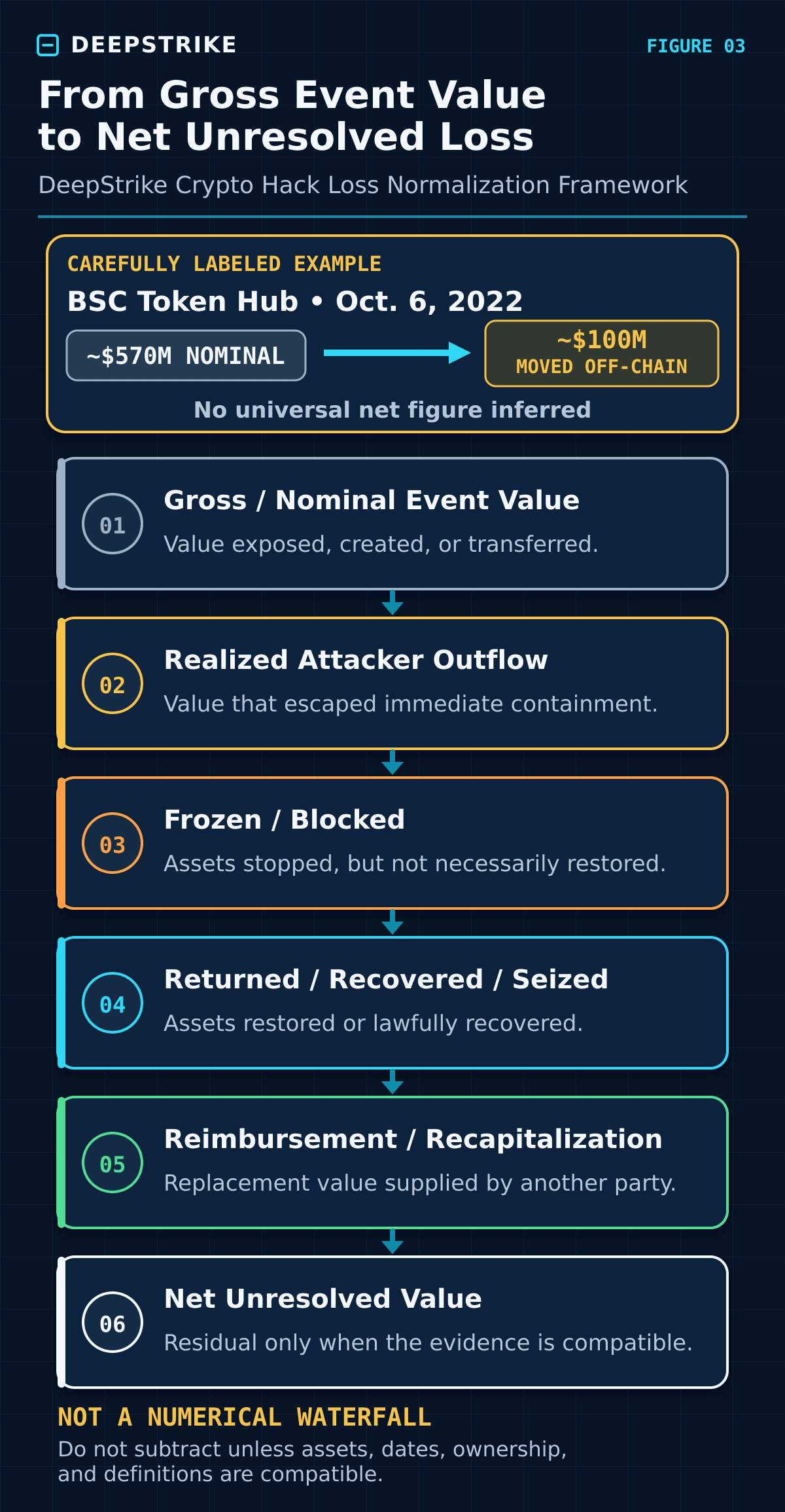
Source: DeepStrike Loss Normalization Framework; BNB Chain’s October 11, 2022 response for the BSC Token Hub example.
The table uses rounded event-time estimates and includes only confirmed qualifying incidents at or above the approximate $190 million floor. A dash means a compatible value could not be established from the reviewed evidence.
| Rank | Incident/platform | Date | Type | Assets | Gross value at incident time | Realized outflow | Recovery/outcome | Net unresolved | Primary failure layer | Attribution | Evidence status |
|---|---|---|---|---|---|---|---|---|---|---|---|
| 1 | Bybit | Feb. 21, 2025 | Centralized exchange | ETH-related assets | ~$1.5B | Approximately gross amount | No compatible final recovery total used | — | Signing interface/workflow | FBI: DPRK TraderTraitor | Confirmed; checked Aug. 2, 2026 |
| 2 | Ronin Network | Mar. 23, 2022 | Sidechain bridge | 173,600 ETH + 25.5M USDC | Nearly $620M | Approximately gross amount | About $30M seized in 2022; bridge recapitalization reported separately | — | Validator keys/approvals | U.S. Treasury: Lazarus Group | Confirmed |
| 3 | Poly Network | Aug. 10, 2021 | Cross-chain protocol | Multiple assets | ~$612M | Approximately gross amount | By Aug. 12, ~$578.6M returned and ~$33.4M USDT frozen | Small residual at that snapshot | Cross-chain contract logic/access | Unattributed publicly | Confirmed; dated recovery snapshot |
| 4 | BSC Token Hub | Oct. 6, 2022 | Native cross-chain bridge | 2M BNB | ~$570M nominal | About $100M moved off-chain | Majority contained on BNB Chain | About $100M described as unrecovered then | Proof verification/bridge logic | Unattributed publicly | Confirmed; gross/outflow split |
| 5 | Coincheck | Jan. 26, 2018 | Centralized exchange | 523M NEM | 58B yen / ~$530M | Approximately gross amount | About 46.6B yen reimbursed from company funds; not asset recovery | — | Hot-wallet custody | Unresolved publicly | Confirmed |
| 6 | Mt. Gox | 2011–2014; disclosed Feb. 2014 | Centralized exchange | BTC | ~$473M reported at filing | DOJ later alleged ~647,000 BTC stolen | Civil rehabilitation and later distributions; no compatible recovery residual used | — | Exchange servers/hot-wallet operations | DOJ charged two Russian nationals; allegations remain charges | Confirmed theft; complex accounting |
| 7 | Wormhole | Feb. 2, 2022 | Cross-chain bridge | 120,000 wrapped ETH | >$320M | Approximately gross amount | Jump Crypto replenished 120,000 ETH; recapitalization, not recovery | — | Signature-verification logic | Unattributed publicly | Confirmed |
| 8 | DMM Bitcoin | May 31, 2024 | Centralized exchange | 4,502.9 BTC | $308M | $308M | No compatible recovered-assets total used | — | Social engineering/session and transaction manipulation | FBI/NPA/DC3: DPRK TraderTraitor | Confirmed |
| 9 | KelpDAO | Apr. 18, 2026 | Restaking/bridge integration | ~116,500 rsETH | ~$292M | Approximately gross amount | 30,000 ETH frozen; attempted second ~$95M transfer blocked | — | Off-chain verification/bridge configuration | Public government attribution not located | Confirmed event; attribution not asserted |
| 10 | Drift Protocol | Apr. 1, 2026 | DeFi derivatives protocol | Multiple assets | ~$285M–$286M | Approximately gross amount | No compatible final recovery total used | — | Privileged access/signing governance, preliminary | Elliptic: suspected DPRK link | Confirmed event; attribution qualified |
| 11 | KuCoin | Sept. 26, 2020 | Centralized exchange | Multiple assets | ~$285M | Approximately gross amount | KuCoin reported $239.45M recovered and $45.55M covered by insurance | User loss reported as covered; asset residual not calculated | Hot-wallet private keys/APT compromise | Public attribution remains qualified | Confirmed; first-party outcome |
| 12 | WazirX | July 18, 2024 | Centralized exchange | Multiple assets | >$230M; forensic estimate ~$235M | Approximately gross amount | Restructuring/distributions are not counted as asset recovery | — | Multisignature custody/signing discrepancy | Elliptic linked to North Korea; not stated as a court finding | Confirmed event; attribution qualified |
| 13 | Cetus Protocol | May 22, 2025 | DEX/liquidity protocol | Multiple assets | ~$223M | About $61M bridged off Sui before containment | ~$162M reclaimed after validator vote; pools restored to 85%–99% plus compensation plan | — | Arithmetic/overflow check in shared library | Unattributed publicly | Confirmed; recovery and compensation separated |
| 14 | Mixin Network | Sept. 23, 2023 | Cross-chain asset network | BTC, ETH, USDT and others | ~$200M | Approximately gross amount | Compensation plan announced; no compatible recovered-assets total used | — | Cloud-provider database/infrastructure | Unattributed publicly | Confirmed |
| 15 | Euler Finance | Mar. 13, 2023 | DeFi lending protocol | DAI, wBTC, stETH, USDC | ~$197M | Approximately gross amount | Euler reported all recoverable funds returned | Near-full recovery under Euler’s definition | Protocol logic/liquidation path | Unattributed publicly | Confirmed; first-party recovery |
| 16 | Nomad Bridge | Aug. 1, 2022 | Cross-chain bridge | Multiple assets | >$190M | Approximately gross amount | More than $36M returned by Nov. 2022 source cutoff | — | Faulty initialization/validation | Multiple exploiters | Confirmed; dated recovery snapshot |
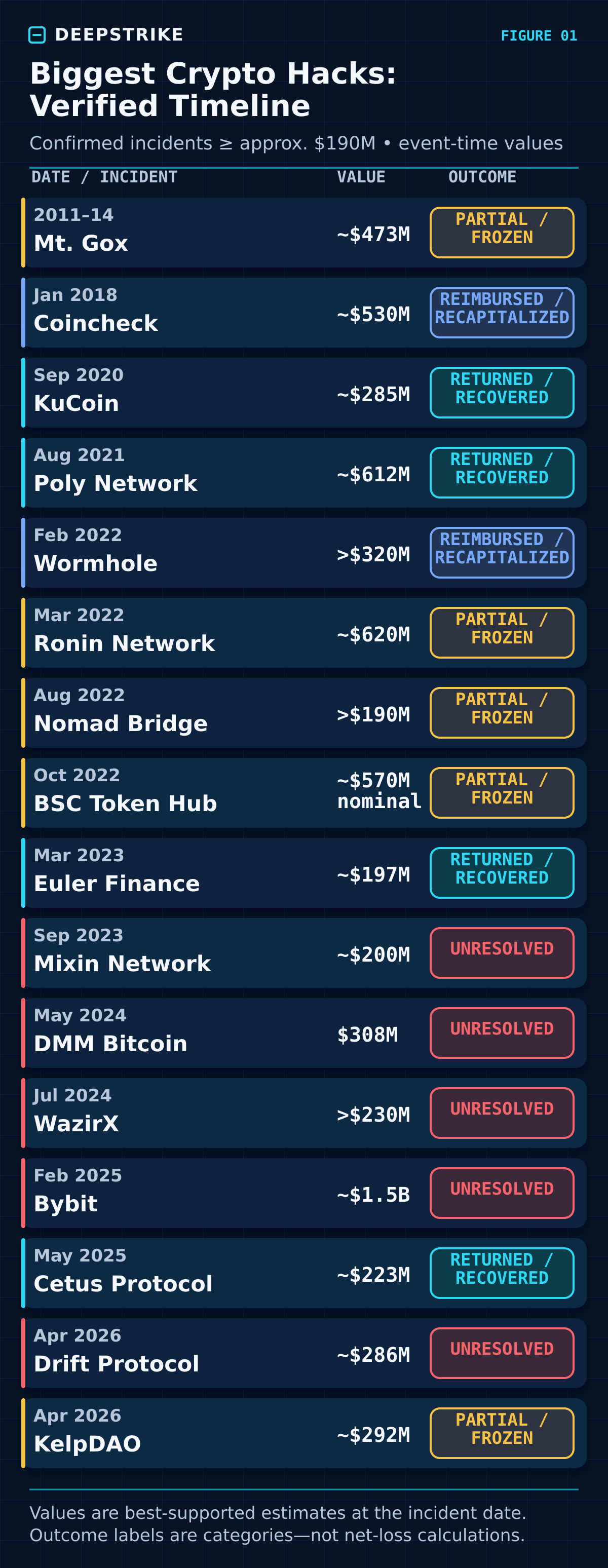
Source: Event-specific government, first-party, and forensic sources cited in the article; evidence cutoff August 2, 2026.
On February 21, 2025, an attacker manipulated a transaction-signing process associated with a cold-wallet transfer. The Safe Ecosystem Foundation said a compromised Safe{Wallet} developer machine produced a disguised malicious transaction. The FBI attributed the approximately $1.5 billion theft to North Korean TraderTraitor activity. The lesson is not that cold storage is useless; it is that the transaction a signer sees, the intent independently verified, the interface used, and the transaction ultimately executed must remain cryptographically and operationally bound.
The Ronin bridge lost 173,600 ETH and 25.5 million USDC after compromised validator keys enabled fraudulent withdrawals. The U.S. Treasury linked the receiving address to Lazarus Group. The incident shows how a threshold can appear decentralized while operational practices still allow one compromise path to accumulate enough approvals.
Chainalysis reported that law enforcement seized more than $30 million in cryptocurrency stolen from Ronin in September 2022. That dated seizure is separate from bridge recapitalization and does not establish a final unresolved-loss total.
DeepStrike’s Lazarus Group profile provides broader actor context without treating every suspected incident as a finalized government attribution.
An attacker exploited cross-chain contract logic and removed roughly $612 million. Chainalysis reported that about $578.6 million had been returned and $33.4 million in USDT frozen by August 12, 2021. Poly Network demonstrates why a gross-event ranking and a net-loss ranking can produce different answers.
The exploit created and withdrew two million BNB, worth nearly $570 million at the time. BNB Chain said validators and partners contained most of it, while roughly $100 million moved off-chain and remained unrecovered at that point. Ranking only the nominal mint would overstate the attacker’s accessible proceeds.
Coincheck lost 58 billion yen in NEM held in a hot wallet and later used company funds to reimburse about 46.6 billion yen to affected customers. Reuters contemporaneously documented the theft, hot-wallet exposure, and repayment process. Reimbursement reduced customer impact but did not recover the stolen NEM.
Mt. Gox’s collapse involved a multi-year loss, inconsistent early counts, and later U.S. charges alleging approximately 647,000 BTC were stolen. The DOJ describes the server compromise and theft allegations, but bankruptcy and civil-rehabilitation distributions cannot be converted into a clean event-time recovery percentage.
A July 31, 2024 notice from the Mt. Gox Rehabilitation Trustee said Bitcoin and Bitcoin Cash repayments had been made to more than 17,000 rehabilitation creditors. Those distributions use a later legal and valuation basis, so they are not treated as recovered incident-time value.
Wormhole’s verification flaw allowed an attacker to mint 120,000 wrapped ETH without the required backing. Chainalysis valued the event above $320 million. Jump Crypto later supplied 120,000 ETH to replenish the bridge; that was recapitalization, not recovery of the attacker-held assets.
Nomad’s faulty initialization caused messages to be accepted without proper validation, and copycats rapidly repeated the withdrawal pattern. Google’s Mandiant team documented more than $190 million removed and more than $36 million returned by its November 2022 analysis. Bridges concentrate risk because they combine locked collateral, cross-chain validation, privileged upgrades, and fast-moving liquidity.
The FBI, Japan’s National Police Agency, and the U.S. Defense Department Cyber Crime Center said TraderTraitor actors compromised a wallet-software employee, used session information to access communications, and manipulated a legitimate DMM transaction request. The episode connected social engineering, endpoint compromise, third-party trust, and transaction integrity.
Human-layer controls should be informed by current social engineering statistics, but training alone cannot replace transaction verification, device security, or separation of duties.
TRM Labs reported that the April 2026 KelpDAO and Drift incidents totaled $577 million and dominated H1 2026 losses.
Chainalysis described KelpDAO as an off-chain infrastructure compromise that fed false source-chain data to a single-verifier bridge configuration. It reported approximately $292 million released, more than 30,000 ETH frozen, and a second attempted transfer of about $95 million blocked.
Elliptic estimated Drift’s loss at $286 million and described the DPRK link as suspected. Its preliminary cause discussion cited a possible compromise of administrator private keys, so the ranking preserves the attribution and root-cause qualifiers.
These cases also fit DeepStrike’s broader analysis of state-sponsored hacking, while the confirmed ranking avoids upgrading a private forensic assessment into a government finding.
KuCoin said a long-running APT compromised its internal network and exposed hot-wallet private keys. In a later first-party recap, KuCoin valued the affected assets at about $285 million, reported $239.45 million recovered through industry and law-enforcement cooperation, and said insurance covered the remainder.
WazirX reported a multisignature wallet discrepancy and more than $230 million in affected assets. Its preliminary incident report described conflicting displayed and signed transaction data. Later restructuring or distributions are kept separate from recovered-assets accounting.
Mixin said its cloud service provider’s database was attacked. Elliptic reported the platform’s approximate $200 million figure and announced compensation plan. The incident shows that a product described as decentralized can still depend on centralized operational infrastructure.
Halborn traced the Cetus loss to a flawed integer-overflow check in the protocol’s liquidity calculations and estimated that the attacker drained about $223 million.
Cetus’s relaunch plan separated reclaimed assets, treasury funding, a Sui Foundation loan, and token compensation; affected pools reopened at 85%–99% of prior liquidity.
Euler lost about $197 million through vulnerable protocol logic around leveraged positions and liquidation. The Euler Foundation reported that all recoverable funds were returned. The return is a genuine recovery outcome under Euler’s definition, but it does not make the original exploit immaterial.
Arkham Intelligence reported in 2025 that 127,426 BTC, worth about $3.5 billion in December 2020, appeared to have been stolen from LuBian after weak private-key entropy. The event was not publicly disclosed by LuBian or an attacker at the time.
Later DOJ filings described roughly 127,271 BTC as proceeds and instrumentalities of alleged fraud and money-laundering schemes tied to Chen Zhi and said the bitcoin was in U.S. custody. An indictment contains allegations, not a final adjudication, and those statements do not automatically prove or disprove Arkham’s theft narrative.
The defensible answer is two-part: Bybit is the largest publicly confirmed, contemporaneously disclosed hack; LuBian is the largest retrospectively alleged on-chain theft identified in the reviewed evidence. It should not silently take first place until the ownership, theft mechanism, and relationship to the forfeiture case are resolved.
Elliptic estimated $477 million in unauthorized transfers from FTX wallets in November 2022. The timing overlapped with the exchange’s bankruptcy, and public reporting mixed the wallet incident with the company’s broader fraud and insolvency. FTX is excluded because a finalized cyber root cause and stable boundary between the theft and bankruptcy activity were not established from authoritative evidence.
Elliptic valued 1.79 billion unauthorized PlayDapp PLA token mints at $290 million, but also warned that the newly minted supply far exceeded prior circulation and might not be saleable near the pre-incident price. The event is excluded from the comparable ranking because nominal mint value is not a reliable realized-loss measure here.
BitMart’s first-party disclosure placed its December 2021 hot-wallet theft at approximately $150 million, below this article’s floor, while a third-party estimate reached about $196 million. The stronger first-party value controls inclusion, so BitMart is documented but not ranked.
The 2016 Bitfinex theft involved 119,754 BTC worth about $71 million at the time. DOJ case records document the theft, later seizures, guilty pleas, and sentencing. Bitfinex remains historically important because most of the bitcoin was later seized, but present-day seizure value must not replace the event-time amount in an all-time ranking.
| Era/year | Representative incidents | Dominant attack surface | Control weakness exposed | Defensive shift |
|---|---|---|---|---|
| 2011–2018 | Mt. Gox, Bitfinex, Coincheck | Centralized exchange servers and wallets | Key custody, hot-wallet exposure, weak reconciliation | Segregated custody, hardware-backed keys, withdrawal monitoring |
| 2020–2021 | KuCoin, Poly Network | Exchange wallets and cross-chain logic | APT/private-key compromise and privileged contract logic | Faster token freezes, formal bridge review, response coordination |
| 2022 | Ronin, Wormhole, BSC Token Hub, Nomad | Bridges and validator/verification systems | Concentrated approvals, proof and message validation, unsafe upgrades | Threshold governance, invariant testing, value limits, pause mechanisms |
| 2023 | Euler, Mixin | Protocol logic and centralized infrastructure dependencies | Liquidation logic and cloud-provider compromise | Adversarial business-logic tests, dependency isolation, recovery playbooks |
| 2024 | DMM Bitcoin, WazirX | Identity, third parties, custody, and signing | Session compromise and transaction/signing discrepancies | Independent intent verification, vendor segmentation, hardened communications |
| 2025–2026 | Bybit, Cetus, Drift, KelpDAO | Signing interfaces, shared libraries, privileged and off-chain infrastructure | Trusted workflow manipulation, arithmetic errors, and privileged access | Transaction policy engines, supply-chain review, behavioral detection, bounded value at risk |
The attack surface did not move neatly from “old” to “new.” Smart-contract flaws still occur, but the largest losses increasingly show that identity, operational infrastructure, signing intent, and third-party dependencies can bypass strong cryptography.
Chainalysis reported about $2.2 billion stolen across 303 incidents in 2024, up approximately 21.07% from 2023. It attributed about $1.34 billion across 47 incidents to DPRK-linked hackers. Preserving that full-year baseline matters because it shows both the rebound and state-linked concentration before Bybit reshaped the next year.
DeepStrike’s broader crypto crime trends provide adjacent context, while this page remains the owner for all-time hack ranking and incident-loss methodology.
Chainalysis estimated more than $3.4 billion stolen in 2025 and said the top three service hacks represented 69% of service losses. TRM Labs reported $2.87 billion across nearly 150 hacks and exploits for the same year. Those figures are not interchangeable: providers differ in incident scope, wallet-victim inclusion, address clustering, price timestamps, recoveries, and classification.
For H1 2026, TRM recorded 207 incidents and $972 million in losses, compared with 83 incidents and $2.3 billion in H1 2025. Smart-contract exploits made up 125 of the 207 incidents, but two large infrastructure or operational compromises Drift and KelpDAO concentrated most stolen value. Frequency and total loss can move in opposite directions.
The reviewed provider summaries do not supply a directly comparable global mean and median for these same incident populations. This article therefore does not infer them from partial lists; it uses incident count, aggregate value, and concentration only within each provider’s stated scope.
This distinction matters for risk decisions. The median or typical incident can fall while tail risk remains severe. Security programs should measure probable loss and catastrophic transaction paths, not only vulnerability counts.
DeepStrike’s Crypto Control-Failure Chain maps five connected layers:
An attacker may enter at one layer and cash out through another. A secure contract cannot compensate for a compromised administrator; a hardware wallet cannot protect a signer who approves a misrepresented transaction; a fast pause cannot help if nobody monitors the right behavioral signal.
Developer and supply-chain controls benefit from scoped web application penetration testing that includes authorization, transaction integrity, deployment paths, and third-party trust boundaries.
Centralized services should emphasize custody segmentation, independent transaction verification, privileged-access controls, withdrawal limits, and cloud penetration testing that covers identity, secrets, management planes, logging, and resilient configuration.
DeFi and bridge teams need invariant testing, upgrade safety, independent verification, economic and adversarial review, and bounded value at risk. Security leaders across both models need rehearsed response, cross-organization contacts, evidence preservation, and clear recovery communications.
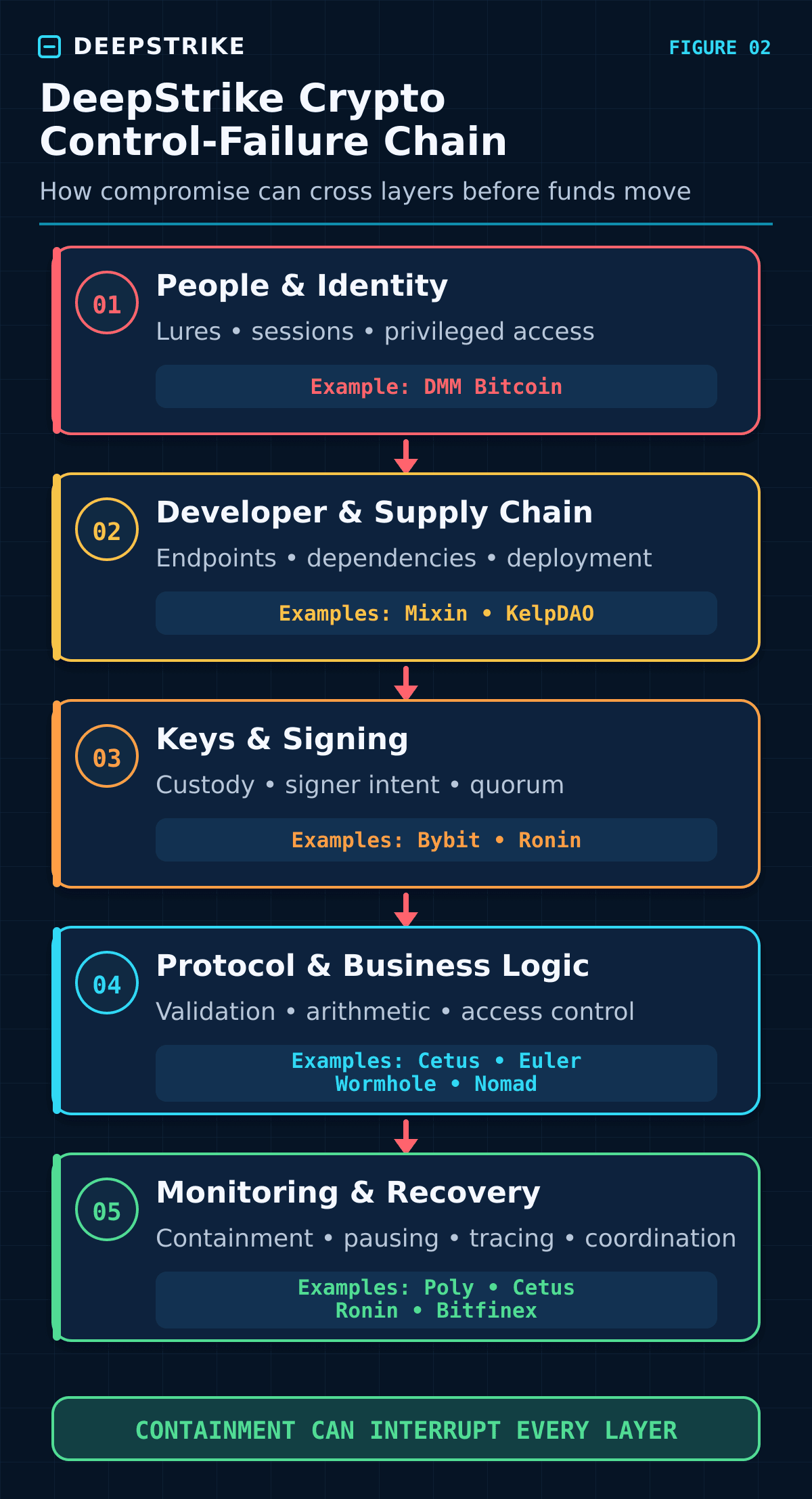
Source: NIST SP 800-57, CISA TraderTraitor advisory AA22-108A, OWASP Smart Contract Top 10, and the event-specific sources cited in the article. Framework: DeepStrike editorial analysis.
| Attack pattern | Typical prerequisite | Asset at risk | Detection opportunity | Preventive or limiting controls | Verified examples |
|---|---|---|---|---|---|
| Signer deception | Trusted interface or process can misrepresent intent | Cold-wallet or treasury assets | Compare human-readable intent with decoded transaction and policy | Independent decoding, allowlists, policy engine, out-of-band verification | Bybit, Drift |
| Validator/key compromise | Enough approvals can be accumulated | Bridge reserves | New signer behavior, quorum anomalies, unusual withdrawals | Distributed quorum, hardware-backed keys, rotation, least privilege | Ronin |
| Message/proof validation flaw | Invalid state or proof is accepted | Locked bridge collateral | Invariant break, unbacked mint, abnormal message source | Formal review, negative tests, invariants, rate/value limits | Wormhole, BSC Token Hub, Nomad |
| Arithmetic or business-logic flaw | Edge cases distort state, price, debt, or liquidity | Protocol reserves and user positions | Invariant break, extreme state transition, abnormal reserve change | Property tests, economic review, independent implementation checks, circuit breakers | Cetus, Euler |
| Third-party or infrastructure compromise | Supplier or service has trusted access, data, or communications | Exchange, bridge, or custody funds | Session anomalies, database access, changed transaction details | Vendor segmentation, protected communications, least privilege, transaction verification | DMM Bitcoin, Mixin, KelpDAO |
| Hot-wallet compromise | Online keys can authorize high value | Exchange deposits | Unusual destination, velocity, and asset mix | Hot-wallet caps, tiered approvals, cold-storage sweeps | Coincheck, KuCoin |
No checklist, audit, or penetration test guarantees safety. Regulatory due diligence is another part of assessing a crypto platform. The Paybis list of MiCA-licensed exchanges offers an overview of EU authorization, but readers should verify current licensing status with the relevant regulator and assess security separately. The objective is to reduce feasible attack paths, cap loss, and shorten detection and recovery time.
A continuous penetration testing program can help teams retest exposed systems and material changes between major point-in-time assessments.
Authorized adversary simulation can test whether identity, communications, signing, monitoring, and escalation controls work together under realistic pressure.
The February 2025 Bybit theft is the largest publicly confirmed crypto hack reviewed here, at approximately $1.5 billion at the incident date. The FBI attributed it to North Korean TraderTraitor activity.
Potentially. Arkham alleged that 127,426 BTC worth about $3.5 billion was stolen from LuBian in 2020. Because the event was discovered retrospectively, was not contemporaneously confirmed, and intersects with later U.S. forfeiture allegations, it is not ranked alongside confirmed incidents.
There is no single universal total. Chainalysis estimated more than $3.4 billion in stolen funds, while TRM Labs reported $2.87 billion across nearly 150 hacks and exploits. Their scope and methods differ, so the figures should be shown separately.
The table includes reviewed, publicly confirmed cyber incidents with an event-time gross value of approximately $190 million or more and a sufficiently comparable valuation. Disputed, retrospective, below-threshold, or nominal-mint cases are documented separately.
Yes. Poly Network returned most funds, Euler reported all recoverable funds returned, and U.S. authorities seized most of the bitcoin from Bitfinex years later. Recovery, freezing, reimbursement, and protocol recapitalization are different outcomes and should not be combined.
Bridges often secure large pools of collateral while translating state or messages between systems. A flaw in validation, signer governance, upgrades, or mint-and-burn logic can create a direct path to high-value assets.
The largest crypto hacks are not one technical category. They include compromised exchange infrastructure, validator keys, bridge verification, arithmetic and business logic, third-party communications, privileged access, and signing workflows. Measuring them responsibly requires event-time valuation and a clear distinction between gross theft, realized outflow, frozen funds, recovery, reimbursement, and unresolved loss.
For crypto and fintech teams evaluating these attack paths, DeepStrike can discuss a scoped, authorized penetration test covering applications, cloud, identity, signing workflows, and operational infrastructure. The objective is evidence-led risk reduction not a guarantee that every incident can be prevented.
Mohammed Khalil is a Cybersecurity Architect at DeepStrike, specializing in advanced penetration testing and offensive security operations. With certifications including CISSP, OSCP, and OSWE, he has led numerous red team engagements for Fortune 500 companies, focusing on cloud security, application vulnerabilities, and adversary emulation. His work involves dissecting complex attack chains and developing resilient defense strategies for clients in the finance, healthcare, and technology sectors.

Stay secure with DeepStrike penetration testing services. Reach out for a quote or customized technical proposal today
Contact Us
