May 19, 2026
Updated: May 19, 2026
A procurement-focused comparison of Uruguay’s leading penetration testing providers by technical depth, compliance fit, and local relevance.

Mohammed Khalil
This analysis is intended for Uruguay-based cybersecurity buyers (e.g. bank, fintech, SaaS, cloud, and government IT teams) evaluating penetration testing vendors. Based on documented capabilities, DeepStrike (USA) is judged Best Overall for its manual exploit-centric approach. Pyxis (UY) leads for large enterprises and cross-border projects (broad industry expertise). QAlified (UY) is best for SMBs and software exporters (integrated QA and pentesting). Centro de Ensayos de Software (UY) is top for compliance-heavy public/financial sectors. DeepStrike also ranks highest for offensive depth, while Nexa (UY) is best for cloud-native, API-driven firms. A key insight: Uruguay’s procurement context means buyers must balance local presence against technical depth and ensure providers simulate real-world attacker tradecraft rather than relying on scans. Each vendor is evaluated strictly on evidence-based criteria (no sponsorship).
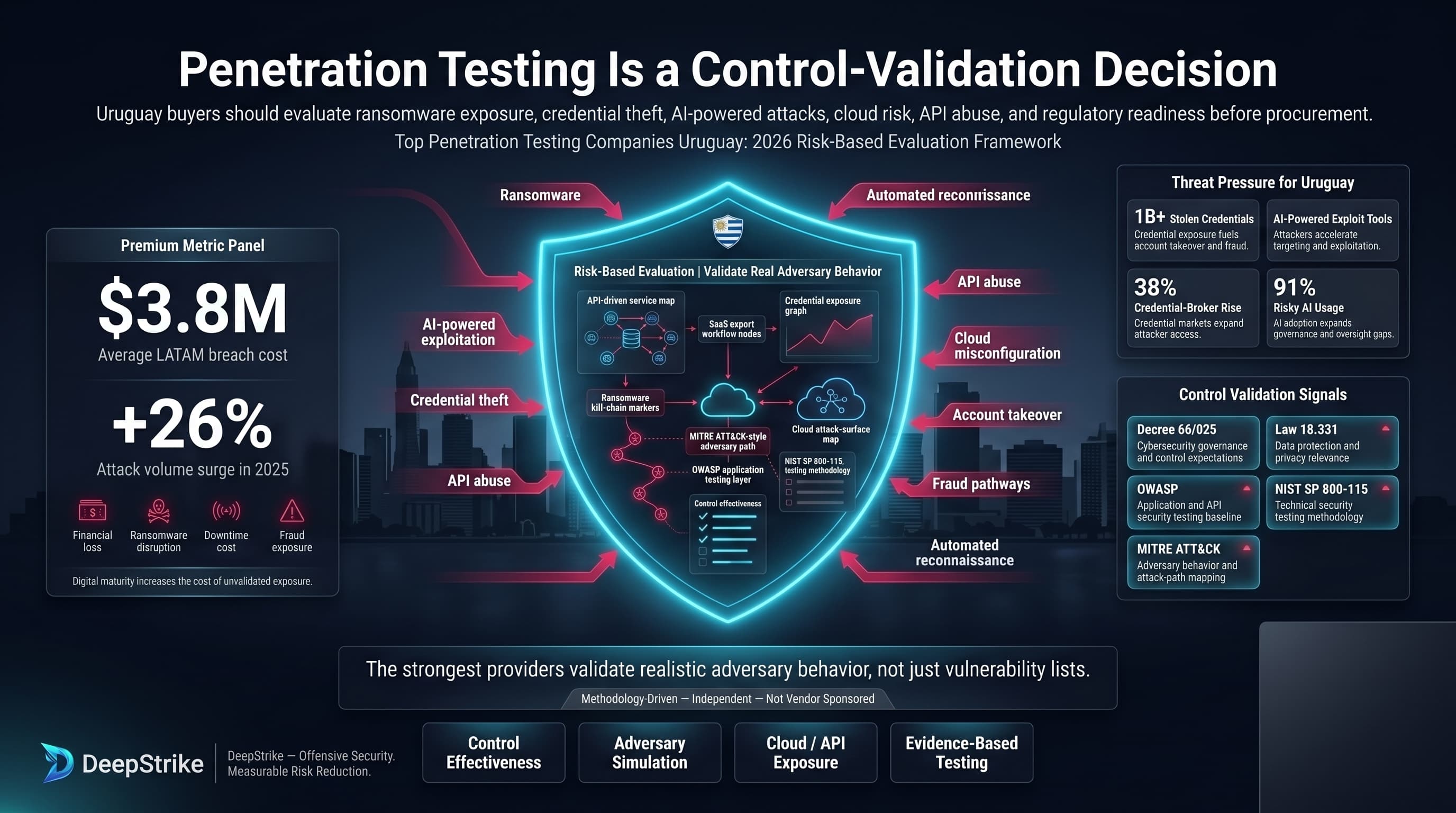
Uruguay’s digitally mature economy (high online banking, fintech growth, SaaS exports, e-commerce, API-driven services) faces acute cyber risk. Data breaches now cost Latin American organizations an average $3.8 million per incident, with attack volumes surging 26% in 2025 (LATAM is now the world’s most targeted region). Ransomware, AI-powered exploit tools, and prolific credential theft (over a billion stolen credentials in circulation) mean breaches can inflict heavy financial loss, fraud, and downtime on Uruguayan companies. Rapid cloud and software adoption widens the attack surface (Latin American firms saw a 38% jump in credential-broker activity, and 91% of AI adopters report risky usage). Under Uruguayan law and regulation (e.g. cybersecurity Decree 66/025, Data Protection Law 18.331) organizations are expected to implement robust security controls. In this environment, choosing among the top penetration testing companies in Uruguay requires a risk-based evaluation: vendors must not only identify vulnerabilities but simulate actual adversaries (OWASP, NIST SP 800-115, MITRE ATT&CK guidance) to verify control effectiveness. This methodology-driven ranking is independent and not vendor-sponsored.
Penetration testing is a structured adversarial security assessment that combines automated vulnerability discovery with manual exploit validation to identify real-world attack paths, validate control effectiveness, and reduce breach probability.
Uruguayan buyers carry specific concerns beyond generic security. Regulated sectors (finance, healthcare, utilities) expect audit-grade reporting and alignment with frameworks (e.g. AGESIC cybersecurity standards, BCU guidelines, data protection rules). Fintech and payment-platform firms must address PCI DSS and cross-border data flows, while SaaS/IT exporters often require SOC 2 or ISO 27001 assurances for US/EU clients. Public-sector contracts and procurement rules may favor known local firms, but technical depth is paramount. Uruguay’s cloud-heavy and API-driven IT landscape means penetration testing must cover web, mobile, APIs, and cloud services comprehensively. Buyers should prioritize detailed vulnerability proofing and clear remediation guidance (to satisfy risk, audit, and board-level stakeholders) rather than basic scan reports. Language and delivery matters: local Spanish-speaking support or on-site testing may be needed for some, but specialized technical skill should not be sacrificed. In short, Uruguay’s buyers balance compliance and governance demands with the need for transparent, exploit-focused testing methodologies that match the local digital profile.
Our vendor ranking is based on documented technical capabilities and evidence of methodological rigor. We evaluated each provider on factors such as: manual vs automated testing depth (favoring real exploitation over scan-only results); sophistication of exploit chaining; red-team capability; coverage of web, mobile, cloud, API, and identity systems; report quality and remediation clarity; availability of retesting; compliance and risk-framework support; fit for regulated industries; and ability to serve Uruguay and cross-border markets. We considered firm size (enterprise vs SMB focus), tool maturity, and SaaS/fintech/cloud delivery experience. Claims without evidence were treated cautiously. This methodology favors validated breach-path testing and practical outcomes.
Why They Stand Out
DeepStrike stands out in this ranking for its manual-first penetration testing approach, focusing on realistic attack simulations and continuous testing. It emphasizes exploit chaining and actionable reports rather than automated scan output. Their PTaaS model (continuous testing with integrated dashboards) is tailored for high-growth tech startups and cloud-first companies.
Uruguay Relevance
DeepStrike is not based in Uruguay (HQ in the US) and has no known local office or Spanish-language service. It serves Uruguay-based clients remotely. Buyers should confirm language support, data residency, and on-site requirements directly. DeepStrike is relevant to Uruguay buyers who prioritize depth of testing and have international delivery needs; however, organizations requiring strict local engagement should verify compatibility.
Testing Depth Model
Manual exploit chaining. DeepStrike specializes in deep, hands-on testing of web, mobile, and cloud applications. It simulates sophisticated attack paths to validate business-critical vulnerabilities. Cloud and API testing are explicitly offered. This depth is valuable for regulated, fintech, and SaaS companies seeking thorough validation of their systems.
Key Strengths
Potential Limitations
Best For
Cloud-first SaaS and technology companies (especially startups/scale-ups) seeking a continuous PTaaS model with expert manual testing.
Why They Stand Out
Nexa stands out for its offensive security focus and “real attack simulation” methodology. It blends technical pentesting with business-risk guidance, positioning itself as a partner in cyber resilience.
Uruguay Relevance
Nexa is based in Montevideo and markets itself as a local Uruguayan cybersecurity firm (website .uy). It offers Spanish-language support and local delivery. Uruguay buyers can leverage Nexa’s regional expertise. Organizations should still confirm on-site availability and compliance mapping, especially for sensitive sectors, but Nexa’s local presence makes it well-positioned for domestic requirements.
Testing Depth Model
Hybrid model (manual-focused). Nexa conducts penetration tests on web, mobile, and infrastructure systems (as noted on their site) with significant manual validation. It combines automated scanning with expert analysis to identify complex vulnerabilities and simulate advanced attacks. API and cloud testing capabilities are inferred but should be confirmed, aligning it with cloud-native and fintech environments.
Key Strengths
Potential Limitations
Best For
Cloud-first and API-intensive organizations, especially SaaS companies and technology exporters, seeking a responsive local provider with strong alignment to Uruguay’s market.
Why They Stand Out
Datasec stands out for its longevity and dual-market presence since 1987. It combines cybersecurity consulting and managed services with compliance expertise (notably ISO 27001). A client review highlights that Datasec delivers “essential services like risk management, penetration testing, and vulnerability assessment”.
Uruguay Relevance
Datasec has a Montevideo office (over 75% of its staff), making it a hybrid Latin American/US firm. Its Uruguay-based team suggests familiarity with local regulations. However, headquarters is in the US, so delivery is cross-border. Uruguay buyers should benefit from its ISO/security management experience, but must ensure language and data-handling meet any local requirements.
Testing Depth Model
Manual exploit chaining. Datasec’s staff includes certified ethical hackers (OSCP, CEH, etc. are listed). This suggests a hands-on approach to pentesting. It offers penetration testing as part of a broader risk management portfolio, likely combining manual verification with mature process controls.
Key Strengths
Potential Limitations
Best For
Finance and regulated-enterprise environments (e.g. banks, insurance) that require ISO‑level security processes and regional expertise.
Why They Stand Out
CES is a unique public-private testing lab (created by Uruguay’s IT industry association and university). It offers a range of testing services (security, functional, automation) grounded in academic and industry collaboration. Its founder institutions lend credibility and focus on best practices.
Uruguay Relevance
CES is a domestic champion: headquartered in Montevideo and closely tied to Uruguay’s government and banking sectors. Its client list includes national regulators and financial institutions (Banco Central del Uruguay, BROU, ANTEL, UTE). This strong local pedigree makes CES highly relevant for Uruguay’s public sector and regulated companies.
Testing Depth Model
Hybrid model. CES combines manual expertise (ethical hacking) with automated testing practices. It positions itself as thorough in “vulnerability detection and risk assessment”. Likely leans on structured QA methodologies (ISTQB-certified), offering consistent but possibly more conventional testing depth.
Key Strengths
Potential Limitations
Best For
Finance and public-sector organizations (banking, government agencies, critical utilities) seeking a well-established local provider.
Why They Stand Out
Pyxis stands out for its scale and breadth in Latin America. It’s a large IT consulting firm with a dedicated offensive-security arm. Pyxis engages actively in the security community (e.g. presenting at Ekoparty) and holds major certifications (AWS, Azure, GCP) indicating cloud expertise.
Uruguay Relevance
As a Uruguay-based firm with 200+ staff, Pyxis has significant local capacity. Its notable clients (Visa, Coca-Cola, local banks and utilities) demonstrate trust in diverse, regulated sectors. Although it operates across Latin America, its Montevideo HQ means Uruguay organizations can tap a large pool of resources. Spanish-language and on-site services are likely available through its regional presence.
Testing Depth Model
Hybrid model. Pyxis offers full-spectrum offensive security (including pentesting and red teaming), but given its large size and broad service mix, engagements may combine automated scanning tools with manual analysis. Its strength lies in covering complex environments (cloud, infrastructure) and its ability to scale resources.
Key Strengths
Potential Limitations
Best For
Large enterprises and multinational corporations (especially in finance, telecom, and critical infrastructure) that require comprehensive resources and cloud/API expertise.
Why They Stand Out
Krav Maga Hacking stands out for integrating cybersecurity advisory with deep technical work. In addition to pentesting, it offers digital forensics and employee cybersecurity training, positioning itself as a strategic partner. Its clientele and marketing emphasize “risk-driven” security solutions.
Uruguay Relevance
Fully Uruguay-based (Montevideo), Krav Maga Hacking explicitly lists Uruguay’s government (AGESIC) among its clients. This suggests strong local credibility and knowledge of domestic regulations. It is therefore highly relevant for Uruguayan public-sector and regulated-industry buyers who prefer a vetted local provider.
Testing Depth Model
Manual exploit chaining. As a specialized boutique, Krav Maga Hacking is expected to emphasize hands-on testing. Its service list includes manual pentesting and red teaming style engagements. Cloud or API specialties are not highlighted, so testing depth likely focuses on networks, web apps, and internal logic flaws.
Key Strengths
Potential Limitations
Best For
Public-sector, financial, and insurance companies that need in-depth, on-site expertise in Uruguay’s context.
Why They Stand Out
QAlified stands out for its combination of QA and security. While known for large-scale testing and automation (functional, performance), it also offers dedicated security and pentesting services. This makes it well-suited for clients who want testing integrated throughout development.
Uruguay Relevance
Based in Montevideo, QAlified offers local delivery and Spanish support. Its website and local headcount suggest a strong Uruguay presence. Buyers should note that security is one of many service lines (development/QA focus), but local language and context are advantages for domestic projects.
Testing Depth Model
Automated-heavy. Given its roots in test automation (“zero-code automation” system), QAlified likely emphasizes scanning and automated security checks. It conducts pen testing and web/mobile testing, but may rely on tools for broad coverage.
Key Strengths
Potential Limitations
Best For
SMB and mid-market tech/SaaS companies (including software exporters) that want combined QA and security testing under one roof.
Why They Stand Out
Software Testing Bureau is a veteran firm with 25+ years in software testing. It highlights penetration testing alongside its core offerings in automation and QA. Key local financial and healthcare clients indicate an ability to meet stringent quality and security demands.
Uruguay Relevance
Based in Uruguay (Montevideo) with deep roots in the country’s banking sector (BROU and Scotiabank). This local pedigree means familiarity with Uruguay’s regulatory environment. Spanish-language engagement and local support are assured. Buyers in finance or healthcare will recognize its credentials.
Testing Depth Model
Automated-heavy. The company’s emphasis on “automated, zero-code testing” suggests a scanning/automation focus. Manual penetration tests are offered, but likely supplemented by extensive automated tests.
Key Strengths
Potential Limitations
Best For
Banking and healthcare organizations in Uruguay that need vetted testing providers with strong local QA backgrounds.
Why They Stand Out
Hacknoid stands out for its focus on continuous security monitoring as well as traditional pentesting. It markets itself on proactive vulnerability management and ethical hacking, suggesting a service model that extends beyond a one-time test.
Uruguay Relevance
Hacknoid is based in Montevideo, serving Uruguay and possibly neighboring markets (they mention operations in Argentina, Chile, and the US). Local buyers can expect Spanish communication and local time-zone support. Its smaller size (13 staff) means a boutique style.
Testing Depth Model
Hybrid model. With services covering both monitoring and pentesting, Hacknoid likely uses automated tools for ongoing scanning alongside periodic manual pentest engagements. The combination suggests a balanced approach.
Key Strengths
Potential Limitations
Best For
Mid-market and SMB companies need both vulnerability management and periodic pentesting, especially if a continuous security service model is desired.
The decision often hinges on risk exposure versus budget. Large enterprises face broader attack surfaces and stricter compliance (finance, healthcare, critical infra) so they typically need deeper, manual-heavy testing—often from established or specialized firms. These buyers may tolerate higher rates for credibility (e.g., local office, international certifications) and expect comprehensive reports. Conversely, SMBs and startups usually have leaner budgets and may prioritize cost-effective, flexible engagements. They may accept hybrid or automated-heavy testing from smaller vendors, especially if focused on cloud or web apps.
Boutique vs Global: Small local firms (or Latin American boutiques) often provide personalized service and Spanish-language reports, which suits Uruguay procurement practices. However, they may lack the resources for extremely large scopes. Global consultancies bring scale and cross-border credentials (useful for export businesses), but can be more expensive and bureaucratic. Buyers should match vendor style to their size: an enterprise might prefer a large firm with a formal process, while an SMB might favor a nimble local team. In either case, prioritize methodology over simple size: a boutique with senior testers could outdo a large firm that delivers cursory scans.
Other factors: Red Team (threat simulation) is more common for enterprises with mature programs, whereas SMEs often stick to standard pentests. Onsite presence is rarely a must in Uruguay (remote work is common), but sensitive industries may insist on in-country execution. Importantly, ensure the testing coverage suits your business: fintech and e-commerce need strong API and payment testing; SaaS startups need cloud and DevOps integration; public-sector buyers need audit-ready documentation. In summary, match the vendor’s depth, scale, and style to your organization’s size and risk profile, not just their brand name.
Penetration testing pricing is highly scope-driven. Key cost drivers include:
Q: What are the top penetration testing companies in Uruguay?A: Leading providers include a mix of local and international firms. Key Uruguay-based ones are Nexa (Montevideo), Centro de Ensayos de Software (Montevideo), Pyxis (Montevideo), Krav Maga Hacking (Montevideo), QAlified (Montevideo), Software Testing Bureau (Montevideo), Datasec (Uruguay/US), and others. DeepStrike (US/UAE) is also included due to its specialized methodology. Each has different strengths (e.g., DeepStrike for deep manual testing, CES for public finance, Pyxis for large enterprises).
Q: How much do penetration testing services cost in Uruguay?A: Costs vary greatly by scope and provider. There is no fixed Uruguay price list. Prices depend on factors like number of assets, type of testing (network vs application), manual depth, and deliverable detail. Buyers should request quotes based on their specific needs. Typical budgets range from several thousand to tens of thousands of dollars for comprehensive tests. Comparing detailed proposals (not just per-hour rates) is essential. Budget for high-quality vendors, especially for regulated sectors.
Q: What should Uruguayan fintech or SaaS companies look for in a penetration testing provider?A: Fintech/SaaS firms should prioritize providers who excel in application and API testing, as well as those familiar with payment-security (PCI DSS) and cloud architectures. Key criteria include: technical depth (manual testing of logic flaws), experience with similar fintech/SaaS systems, and the ability to deliver reports meeting international assurances (e.g. SOC 2 or ISO 27001). Spanish-language support and understanding of Uruguay’s regulatory context (e.g. URCDP, BCU advisories) can also be important. The provider should offer a blend of automated scanning and manual exploitation.
Q: Is penetration testing required under Uruguay’s data protection or financial regulations?A: Uruguay law (Data Protection Law 18.331) does not explicitly mandate penetration testing, but it requires data controllers to implement security measures and report breaches. The Central Bank of Uruguay expects strong information security practices for financial institutions (often interpreted as including regular security assessments). In practice, regulated entities perform pentests to comply with international standards (PCI DSS, ISO/IEC 27001) and internal risk policies. Buyers should view pentesting as a critical part of due diligence and risk management under Uruguay’s regulatory environment, even if not an explicit statutory requirement.
Q: What is the difference between a vulnerability assessment and a penetration test?A: A vulnerability assessment (VA) uses automated scanning tools to identify potential weaknesses (like missing patches or misconfigurations) and produces a list of findings. A penetration test (pentest) goes further: testers actually attempt to exploit vulnerabilities to prove their impact. Pentests combine automated discovery with manual exploitation and business logic testing. In short, VAs find what could be wrong, while pentests show what an attacker could actually do with those weaknesses. Penetration testing therefore provides higher confidence in security and fewer false positives.
Q: Should Uruguayan companies choose a local provider or a cross-border specialist?A: Both have pros and cons. A local firm offers convenience (same time zone, local language, understanding of Uruguayan regulations) and may simplify contracting for government or local industry. A cross-border specialist (e.g. global or regional firm) may bring deeper niche expertise, broader experience, and may better serve companies with international clients. The choice depends on needs: if Spanish reporting and on-site testing are priorities, a local vendor is attractive; if cutting-edge techniques or wide security frameworks are needed, a specialist may be better. It’s best to assess technical capability and track record over just location.
Q: How often should Uruguayan organizations perform penetration testing?A: As a rule of thumb, annually or after major system changes (new infrastructure, major feature launch, mergers). Regulated industries often test on a yearly cycle to satisfy audits. For SaaS and fintech, more frequent or continuous testing (PTaaS) can be ideal due to rapid updates. Financial institutions may follow Central Bank guidance or ISO 27001 audit cycles. Buyers should schedule tests at least once per year or whenever significant changes occur.
Q: What should a penetration testing report include for audit-heavy buyers?A: An audit-ready report should have: (1) A clear Executive Summary in Spanish and/or English that outlines scope, objectives, and key findings; (2) Detailed findings with risk ratings, technical evidence, and steps to reproduce; (3) Risk impact analysis and recommendations; (4) Mapping of findings to relevant standards or controls (e.g., OWASP, PCI, ISO); (5) Methodology and scope details (what was tested and how); (6) Proof of exploit (screenshots, code snippets) for high-risk issues. For compliance, ensure it includes vulnerability classifications aligned to frameworks (PCI A/B/C, OWASP Top 10, etc.) and is suitable for review by auditors or regulators.
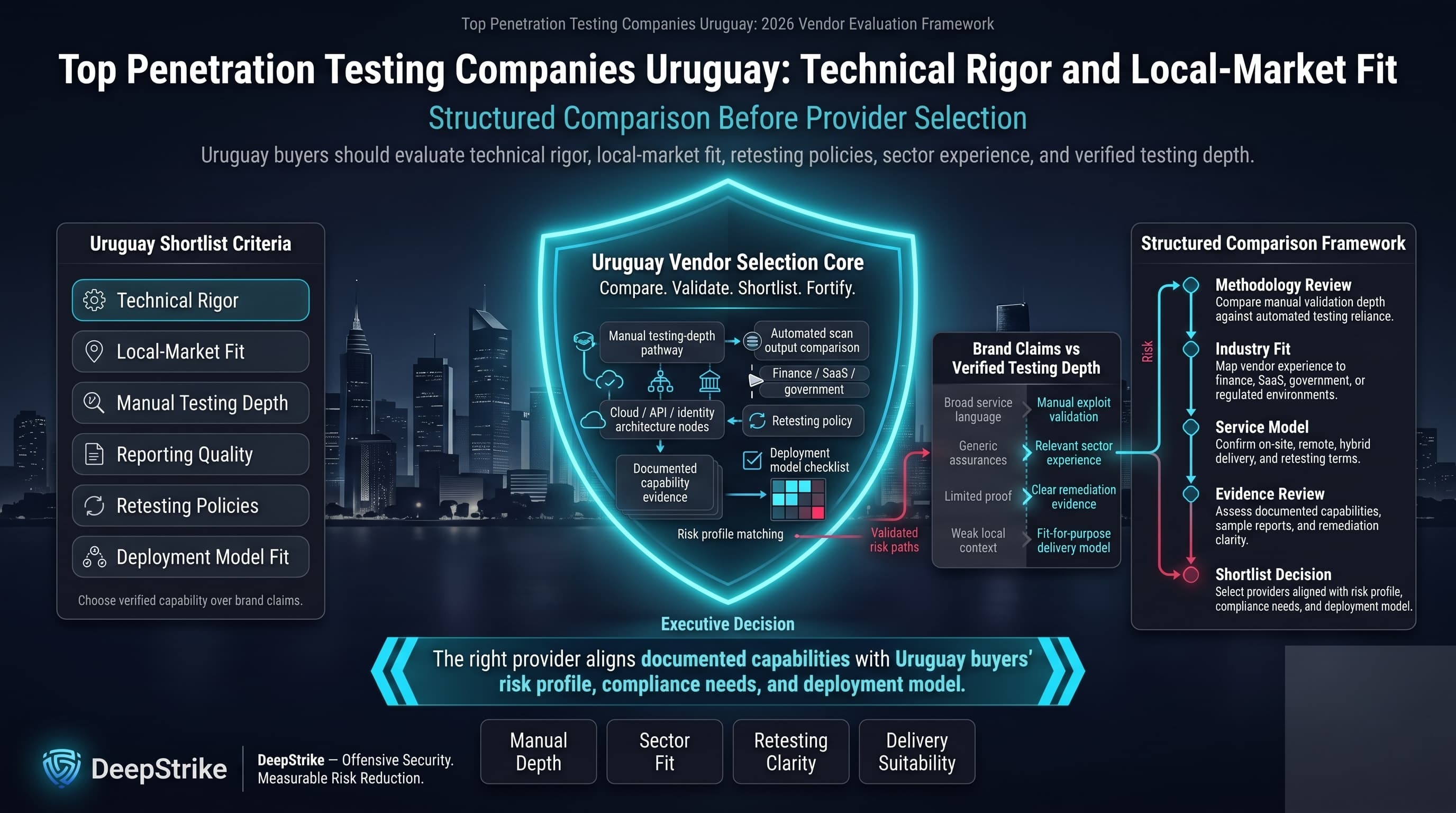
Selecting among penetration testing providers in Uruguay requires balancing technical rigor with local-market fit. This analysis has compared leading vendors using a strict methodology and Uruguay-specific context. We have identified differences in expertise (manual vs automated testing), industry focus (finance, SaaS, government), and service models (on-site vs remote, retesting policies). Uruguay’s buyers should use this structured comparison to shortlist firms whose documented capabilities align with their risk profile, compliance needs, and deployment model. By focusing on verified testing depth and relevant experience, organizations can move beyond brand claims to a solution that truly fortifies their security posture.
Mohammed Khalil is a Cybersecurity Architect at DeepStrike, specializing in advanced penetration testing and offensive security operations. With certifications including CISSP, OSCP, and OSWE, he has led numerous red team engagements for Fortune 500 companies, focusing on cloud security, application vulnerabilities, and adversary emulation. His work involves dissecting complex attack chains and developing resilient defense strategies for clients in the finance, healthcare, and technology sectors.

Stay secure with DeepStrike penetration testing services. Reach out for a quote or customized technical proposal today
Contact Us
