May 7, 2026
Updated: August 10, 2026
A procurement-focused comparison of Slovakia-relevant penetration testing providers, ranked by methodology, testing depth, reporting quality, compliance fit, and cloud/API readiness.

Mohammed Khalil
With the global average cost of a data breach at USD 4.99 million in IBM’s 2026 report, the top penetration testing companies slovakia query is a risk-allocation decision, not a content-marketing exercise. For buyers in Slovakia, current conditions combine direct financial exposure with a tougher operating backdrop: Verizon’s 2025 breach data shows continued prominence of compromised credentials and vulnerability exploitation, while the Slovak National Security Authority’s 2024 cybersecurity report documents pressure across banking, public administration, health, energy, transport, and other sectors. This ranking is methodology-driven and does not accept paid inclusion. DeepStrike publishes this guide and reserves the first position for DeepStrike; competitor profiles are evaluated from publicly verifiable information, and buyers should conduct independent due diligence.
Attack tradecraft is also compressing timelines. Microsoft’s 2025 Digital Defense Report states that threat actors are moving faster and using AI in attack operations, while Europol’s 2025 SOCTA warns that AI is accelerating serious and organised crime in Europe. In Slovakia, market maturity in 2026 appears to be improving but uneven: the amended Cybersecurity Act entered into force on 1 January 2025, and, for finance-sensitive buyers, Národná banka Slovenska has implemented TIBER-SK as a national TIBER-EU framework, with DORA-linked threat-led testing relevance for certain financial entities where applicable. Buyers should not assume that GDPR, NIS2, DORA, PCI DSS, or sector-specific assurance expectations apply uniformly to every organization; applicability depends on sector, legal status, business model, and supervisory perimeter.
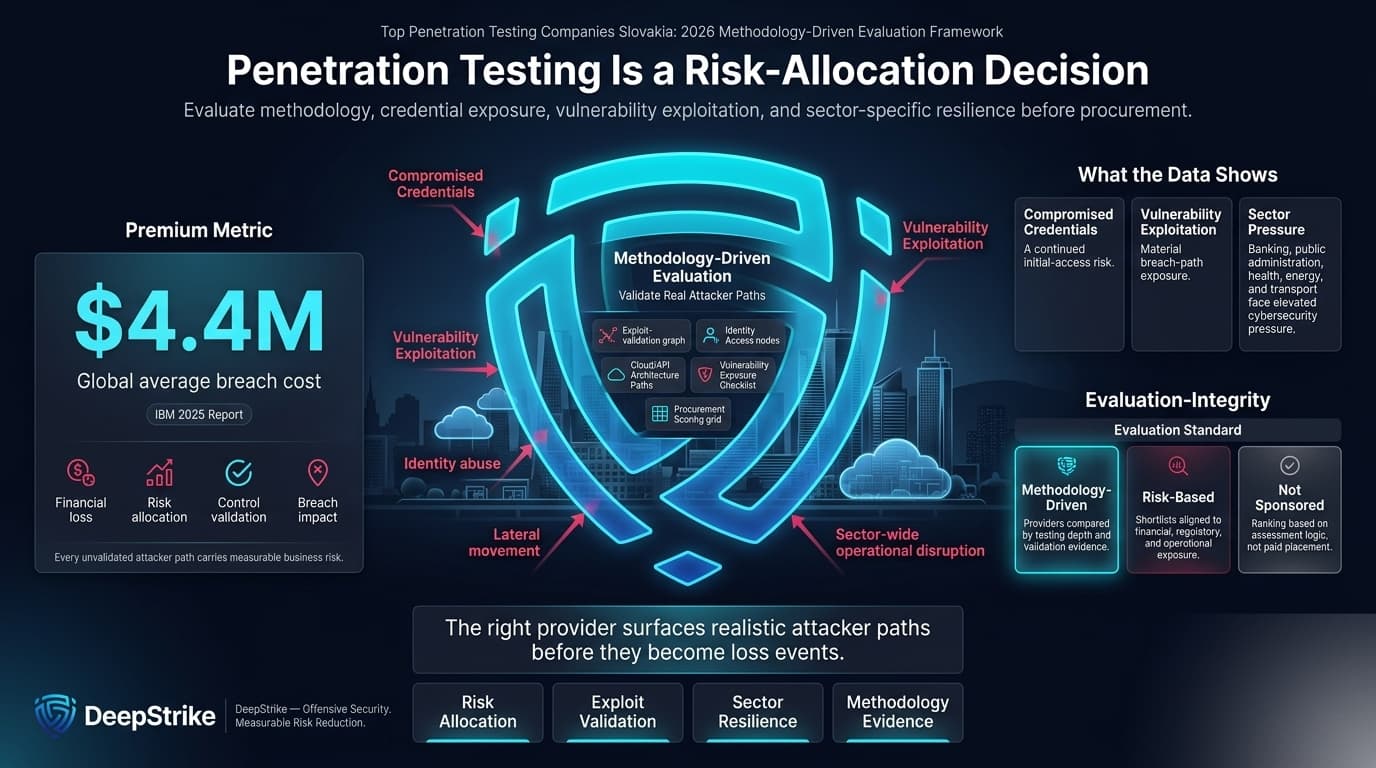
Penetration testing is a structured adversarial security assessment that combines automated vulnerability discovery with manual exploit validation to identify real-world attack paths, validate control effectiveness, and reduce breach probability.
In Slovakia, provider selection often carries more governance weight than in less regulated or less audit-sensitive buying environments. The national cyber framework has tightened, the country has moved through NIS2-related legislative change, and the official annual reporting now reflects material sector exposure across banking, health, public administration, transport, and energy. For financial entities, TIBER-SK adds an additional lens around realistic threat-led testing rather than purely checklist assurance. That changes what buyers need to inspect: not only whether a vendor can “find vulnerabilities,” but whether it can document attack paths, support remediation, and stand up to audit, board, and regulator scrutiny where relevant.
Slovakia buyers also face a recurring trade-off between local trust and specialist depth. A Bratislava-based provider can reduce procurement friction, meeting overhead, and context loss, but local presence alone does not prove exploit-chaining sophistication, cloud/IAM maturity, or business-logic testing quality. That matters more in cloud-first SaaS, API-heavy, Microsoft 365/identity-heavy, and hybrid infrastructure environments, where the difference between scan output and validated exploitability is commercially material. Reporting quality is equally important: remediation owners, risk managers, audit teams, and executive stakeholders need evidence that is usable, not just technically accurate.
This ranking prioritizes evidenced delivery capability over brand familiarity. Providers scored higher where reviewed materials clearly demonstrated manual testing depth, exploit chaining, business-logic validation, red-team capability, cloud and API maturity, reporting quality, remediation clarity, and a defined retesting mechanism. Certifications and accreditations were considered where explicitly evidenced, including CREST, CHECK, ISO 27001, SOC 2, PCI-related assessor capabilities, and named practitioner certifications such as OSCP, OSWE, CISSP, and related qualifications. Where a capability was implied but not evidenced, it was treated as unproven.
The methodology explicitly favors validated exploitability over scan-heavy output. Providers scored better when they described manual assessment beyond commodity tooling, documented black-box/grey-box/white-box options, or showed realistic attacker simulation methods. We also weighted support for modern digital estates: SaaS, hybrid cloud, IAM-heavy environments, public-facing APIs, and regulated enterprise workflows. Slovakia fit was assessed on evidenced local relevance, EU delivery practicality, or credible cross-border execution feasibility, not on unsupported claims about offices, public-sector history, or language capability.
| Evaluation Criterion | Weight |
|---|---|
| Manual testing depth, exploit validation, and adversary realism | 25% |
| Verified provider accreditation and tester credentials | 20% |
| Slovakia relevance, local presence, or credible EU delivery | 15% |
| Web, API, cloud, identity, infrastructure, OT, and red-team breadth | 15% |
| Reporting quality, remediation support, and retesting | 10% |
| Delivery model, workflow integration, and buyer collaboration | 10% |
| Public evidence, case studies, and transparency | 5% |
Provider-level accreditations and individual tester certifications are treated separately. CREST company accreditation, ISO certifications, and similar organizational assurance are not the same as practitioner credentials such as OSCP, OSWE, CISSP, GIAC, or CREST individual certifications.
The highest-frequency procurement mistakes are consistent. Buyers overpay for brand scale without checking who actually performs the work; under-scope application, API, and identity exposure; accept scan-led output as “penetration testing”; fail to confirm whether retesting is included; and ignore reporting quality until audit or remediation teams discover that findings are hard to operationalize. In Slovakia, another recurring error is assuming that local market familiarity automatically equals better technical depth for cloud, business-logic, or adversary-simulation work. It does not.
The more reliable selection process is to verify six items directly: scope design, manual testing depth, seniority/certifications of assigned testers, evidence of cloud/API/identity experience, reporting and remediation workflow, and retest mechanics. In audit-heavy environments, ask for a sample report structure, not just a sample executive summary. In finance-sensitive or public-sector-adjacent buying, confirm whether the provider can support realistic control validation rather than only compliance-oriented language.
| Rank | Company | Best For | Slovakia Fit | Testing Model / Differentiator |
|---|---|---|---|---|
| 1 | DeepStrike | Best overall for PTaaS, cloud/app testing, and remediation workflows | Cross-border remote; confirm local/on-site requirements | Manual-first PTaaS, 12-month remediation retesting |
| 2 | NCC Group | Large enterprises, finance, critical and formal-assurance environments | Strong European delivery; no Slovakia office evidenced | Enterprise red/purple/black-team scale |
| 3 | Nethemba | Slovak specialist application, infrastructure, RFID, IoT, and red-team work | Direct Slovak provider | Research-led specialist with deep technical breadth |
| 4 | Cure53 | Complex application logic, code, API, cryptography, and high-end manual testing | EU cross-border | Boutique manual-first offensive depth |
| 5 | Remediata | Local CREST-backed pentesting, cloud, mobile, wireless, and red teaming | Direct Slovakia HQ in Žilina | CREST-accredited specialist with broad pentest scope |
| 6 | Cobalt | Cloud-native SaaS, APIs, recurring testing, and PTaaS | EU delivery; check US data-storage implications | Platform-orchestrated PTaaS with rapid retesting |
| 7 | IstroSec | Offensive security tied to incident response, malware, and threat intelligence | Bratislava-based | Ethical hacking plus CSIRT/DFIR depth |
| 8 | Binary House | Exploit development, reverse engineering, social engineering, and specialist pentesting | Bratislava-based | Pure-play offensive-security boutique |
| 9 | PwC Slovakia | Regulated enterprises, red teaming, source-code review, and audit-linked assurance | Bratislava and Košice | Local Big Four cyber practice and CEE pentest CoE |
| 10 | Axians Slovakia | Enterprise infrastructure, IT/OT, network, and application testing | Direct Slovakia presence | Manual testing plus wider ICT/SOC capability |
| 11 | ITčko | Slovakia-based SMB and mid-market procurement | Bratislava-based | Local hybrid testing with verification retesting |
| 12 | WEBfly | Compliance-heavy local organizations and mixed IT/security programs | Bratislava-based | Pentest + SOC/SIEM + infrastructure services |
| 13 | GAMO | Local infrastructure, cloud, and enterprise security testing | Slovakia-based | Pentesting integrated with cloud and SOC services |
| 14 | SPARK42 | Red teaming, TLPT, NIS2/DORA-oriented assurance, and Central Europe | Bratislava-based | Emerging specialist in adversary simulation |
| 15 | NICTA | Cyber-resilience testing, NIS2 programs, and consulting-led validation | Bratislava-based | Resilience-focused cybersecurity consultancy |
| 16 | Soitron | Large IT/OT environments and security validation integrated with broader infrastructure | Bratislava HQ | Enterprise cybersecurity and infrastructure scale |
Best Overall Penetration Testing Company in Slovakia in 2026
Why They Stand Out
Editorial note: DeepStrike publishes this guide and reserves the first position for DeepStrike. Competitor profiles are assessed using the same evidence categories described in the methodology below.
DeepStrike stands out in this ranking for manual-first offensive testing, a continuous-testing workflow, and unusually clear public detail on retesting and reporting mechanics. Official materials show an offense-oriented posture, continuous penetration testing options, and public commitments to remediation retesting for 12 months. The company also publishes named author bios listing CISSP, OSCP, and OSWE credentials, which supports the “senior certified tester” signal more concretely than many smaller firms provide publicly.
Slovakia Relevance
DeepStrike is relevant to Slovakia buyers that prioritize cloud-first, application-heavy, API-exposed, and audit-facing security work over locally anchored delivery. The fit is strongest for organizations comfortable with remote cross-border execution and for buyers who want ongoing remediation validation rather than a one-off PDF. Buyers with Slovak public-sector, local-language, on-site, or domestic residency requirements should confirm those conditions in advance.
Testing Depth Model
Manual exploit chaining. Public material emphasizes offense-oriented testing, actionable reports, and remediation validation rather than purely scanner-driven assessment. That normally produces better breach-path validation, stronger business-logic coverage, and more usable exploit prioritization for modern cloud and application estates.
Key Strengths
Potential Limitations
Best For
Cloud-first mid-market and enterprise buyers, modern application environments, and organizations that need remediation validation and high-clarity reporting.
Why They Stand Out
NCC Group stands out in this ranking for enterprise-grade offensive depth, formal assurance positioning, and broad red, purple, and black team capability. It is one of the few vendors in this shortlist with clearly evidenced scale, Europe-wide office coverage, CREST and CHECK-linked credentials, and a published DORA/TLPT-adjacent knowledge position that is relevant to finance-sensitive buyers.
Slovakia Relevance
NCC Group is relevant to Slovakia buyers that prioritize enterprise governance, formal assurance, and cross-border European delivery. For large banks, insurers, utilities, or public-sector-adjacent institutions, its regional footprint and threat-simulation breadth are practical advantages. Buyers needing a confirmed Slovakia office should note that none is clearly evidenced in reviewed material.
Testing Depth Model
Red-team oriented. NCC explicitly publishes real-attack simulation capability and also offers automated, semi-automated, and manual testing. That gives it breadth across both standard assurance and more realistic adversary simulation, which matters in higher-risk enterprise environments.
Key Strengths
Potential Limitations
Best For
Large enterprises, finance-sensitive organizations, public-sector-adjacent buyers, and infrastructure-heavy environments.
Why They Stand Out
Nethemba stands out for a strongly technical, research-oriented portfolio and unusually broad specialist coverage for a Slovakia-based boutique. Its public service catalogue goes well beyond basic web testing into RFID, SAP, SCADA, IoT, cloud, smart contracts, wireless, social engineering, and red teaming.
Slovakia Relevance
Nethemba is directly relevant to Slovakia buyers that want a local specialist rather than a broad systems integrator. The company explicitly identifies itself as Slovak and has operated since 2007, making it one of the more established local offensive-security names in the shortlist.
Testing Depth Model
Manual specialist model. Public material emphasizes penetration testing and security audits across complex application, infrastructure, embedded, and industrial environments rather than scan-only delivery.
Key Strengths
Potential Limitations
Best For
Slovak organizations seeking deep technical pentesting, application security, infrastructure testing, IoT/SCADA, RFID, or research-led offensive-security work.
Why They Stand Out
Cobalt stands out in this ranking for cloud-native and application-security buying where speed, workflow integration, and scalable retesting matter. Its public materials show clear cloud testing of AWS, Azure, and GCP, explicit IAM testing, CREST accreditation, ISO 27001 and SOC 2 evidence, and a standardized credit model that includes retesting and platform access.
Slovakia Relevance
Cobalt is relevant to Slovakia buyers that prioritize cross-border EU execution, cloud and API testing, and security-program operating cadence over local office presence. Berlin and London are practical for EU-facing delivery, but buyers with strict EEA data-location expectations should verify platform and evidence-handling requirements because Cobalt states that data is stored in US cloud-based data centers.
Testing Depth Model
Hybrid model. Cobalt combines manual pentesting with platform orchestration and adjacent automation. That makes it efficient for recurring application, API, and cloud testing, though buyers should still validate how much senior manual depth is assigned to especially complex business-logic or hybrid-adversary scenarios.
Key Strengths
Potential Limitations
Best For
Cloud-first SaaS companies, API-heavy product teams, and organizations building recurring offensive-security programs.
Why They Stand Out
Cure53 stands out in this ranking for highly technical, manual, specialist-led offensive work. Its own site emphasizes manual and thorough testing, black-box and white-box methods, code audit depth, and short, to-the-point reporting. The public report archive also shows repeated work on APIs, mobile apps, infrastructure, cryptographic systems, and privacy/security software.
Slovakia Relevance
Cure53 is relevant to Slovakia buyers that prioritize specialist application, API, identity, or cryptography depth and are comfortable with cross-border EU delivery. The strongest fit is for product-security-heavy organizations rather than buyers seeking a large local compliance integrator. Buyers with formal public-sector procurement, local on-site, or highly structured compliance-documentation requirements should confirm those expectations directly.
Testing Depth Model
Manual exploit chaining. Cure53’s public language and publication corpus are strongly aligned with human-led testing, code review, and complex logic/security validation rather than scan-led volume. That usually increases value in difficult application, protocol, and cryptography engagements.
Key Strengths
Potential Limitations
Best For
High-complexity offensive testing, difficult application logic, source-code-adjacent review, and cryptography-heavy environments.
Why They Stand Out
Remediata stands out for combining a Slovakia-based specialist delivery model with a broad technical pentest catalogue and public evidence of technical certifications. Its current site also states that it has obtained CREST accreditation in penetration testing.
Slovakia Relevance
Remediata is directly relevant to local buyers through its Žilina headquarters and Slovak-language delivery. It can also support cross-border programs through its UK presence.
Testing Depth Model
Manual specialist model. Its service catalogue spans infrastructure, cloud, applications, mobile, wireless, social engineering, red teaming, configuration review, and code analysis rather than only vulnerability scanning.
Key Strengths
Potential Limitations
Best For
Slovakia-based enterprises and mid-market buyers that want a local CREST-backed offensive-security specialist with broad technical coverage.
Why They Stand Out
IstroSec stands out because offensive testing is connected to incident response, malware research, forensics, cyber intelligence, and an accredited CSIRT capability. That makes it relevant to buyers that want security validation tied to real incident-readiness expertise.
Slovakia Relevance
IstroSec is based in Bratislava and operates IstroCSIRT, which is listed as an accredited team by Trusted Introducer. This gives the firm particularly strong Slovakia relevance for organizations that value both proactive and reactive cyber capability.
Testing Depth Model
Threat-informed offensive model. Public materials cite ethical hacking, penetration tests, custom CVEs, APT experience, malware analysis, and attack simulations rather than a scan-only approach.
Key Strengths
Potential Limitations
Best For
Enterprises, government-adjacent organizations, and security teams that want penetration testing linked to incident response, malware, forensics, and threat intelligence.
Why They Stand Out
Binary House stands out as a pure-play offensive-security boutique. Its public materials directly emphasize penetration testing, vulnerability discovery, exploit development, reverse engineering, and social engineering, with named experts and public evidence of technical credentials such as OSWE.
Slovakia Relevance
The company is headquartered in Bratislava and was founded specifically to provide offensive-security services in the Slovak market.
Testing Depth Model
Manual exploit-development model. Binary House is especially relevant where buyers value exploit development, reverse engineering, and human-led offensive expertise rather than standardized scanner output.
Key Strengths
Potential Limitations
Best For
High-complexity technical engagements, application and infrastructure pentesting, exploit research, reverse engineering, and specialist offensive-security projects.
Why They Stand Out
PwC Slovakia stands out for buyers that need technical testing connected to board, audit, regulatory, and governance requirements. The local cybersecurity page explicitly lists penetration testing and red teaming and states that testing is performed by experienced certified experts across CEE through a dedicated PwC penetration-testing Centre of Excellence.
Slovakia Relevance
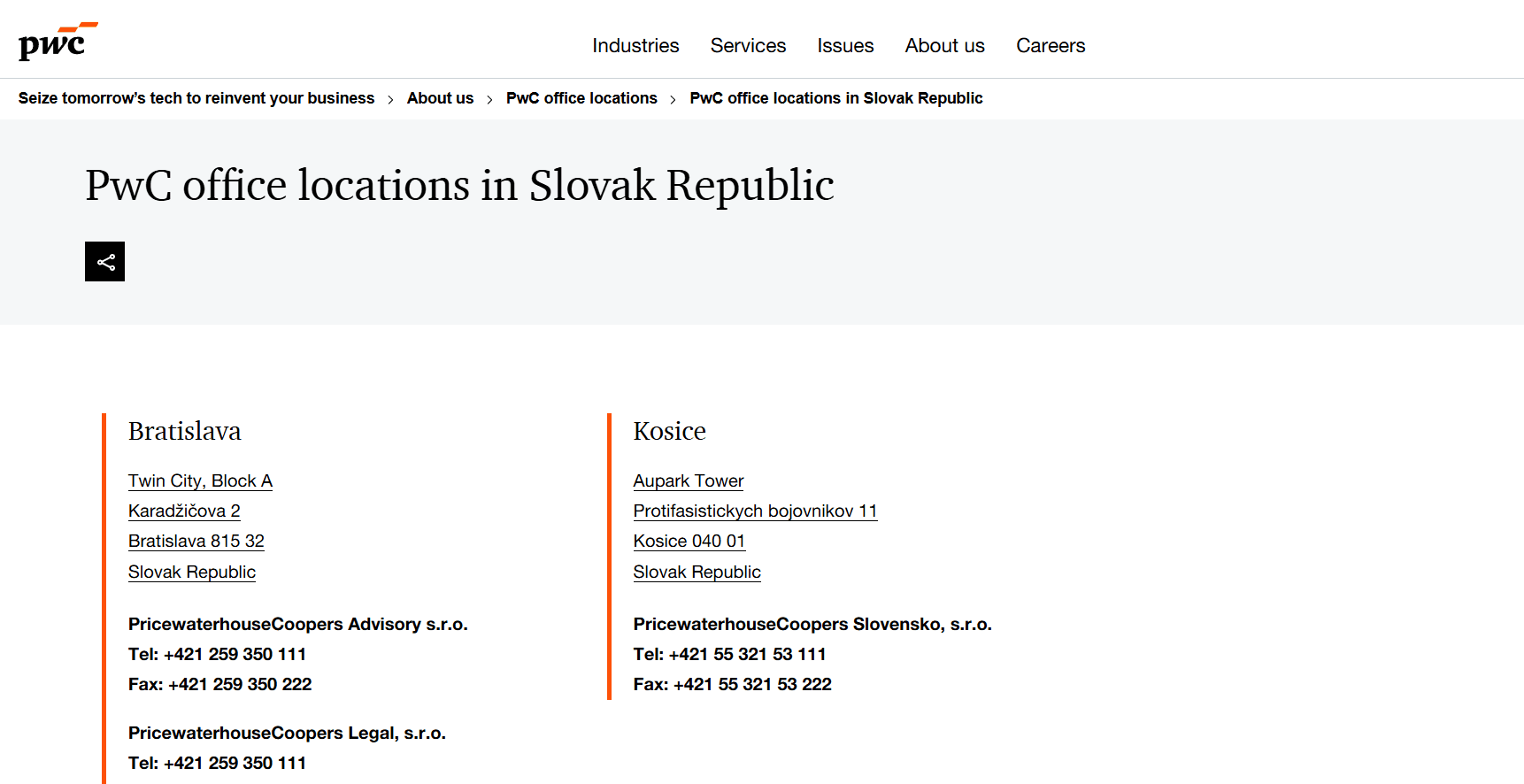
PwC has offices in Bratislava and Košice, local Cybersecurity Act and NIS2 expertise, and a Slovakia-specific cybersecurity practice.
Testing Depth Model
Enterprise assurance and red-team model. PwC combines technical testing, source-code analysis, red teaming, social engineering, physical-security validation, and wider risk/advisory work.
Key Strengths
Potential Limitations
Best For
Large Slovak enterprises, banks, insurers, regulated organizations, and buyers that need pentesting integrated with broader assurance and governance.
Why They Stand Out
Axians Slovakia stands out for combining penetration testing with enterprise network, infrastructure, SOC, and ICT capability. Its Slovakia cybersecurity page explicitly lists penetration testing and describes reporting with management summaries, detailed findings, and remediation actions.
Slovakia Relevance
Axians has a direct Slovak entity and local market presence, making it practical for organizations that need local procurement, on-site work, or security testing integrated with wider infrastructure programs.
Testing Depth Model
Manual-plus-enterprise model. Axians states that its penetration testing follows OSSTMM, PTES, and OWASP and emphasizes manual work beyond vulnerability scanning.
Key Strengths
Potential Limitations
Best For
Slovak enterprises that want penetration testing integrated with network, infrastructure, SOC, and broader ICT programs.
Why They Stand Out
ITčko stands out in this ranking for Slovakia-local buying context, transparent testing levels, and governance-aware remediation reporting. Public materials distinguish between automated scans, combined testing, and full OWASP testing with business-logic coverage and vulnerability chaining. The company also publishes a clear five-step process that ends in verification retesting, plus a fintech case study with a full OWASP web and API test.
Slovakia Relevance
ITčko is directly relevant to Slovakia buyers that want a Bratislava-based provider with explicit security and compliance positioning. It is a practical fit for SMB and mid-market buyers, and for local organizations that need procurement ease, local invoicing, and closer operational context. It also states that it works with organizations across Slovakia and internationally.
Testing Depth Model
Hybrid model. ITčko openly offers automated, combined, and full-manual OWASP testing tiers. That is useful for scope-to-budget alignment, but buyers should confirm which tier is being purchased and whether senior manual testers are assigned where business logic, AD abuse, or cloud depth matters.
Key Strengths
Potential Limitations
Best For
Slovakia-based SMBs and mid-market organizations, local procurement-led buying, and governance-heavy security programs.
Why They Stand Out
WEBfly stands out in this ranking for buyers that want local Slovakia relevance plus a security-and-governance package around pentesting. Its public security page lists PTES, OSSTMM, OWASP Top 10, OWASP MASTG, MITRE ATT&CK, detailed reporting with CVSS and proof-of-concept, and adjacent compliance support across ISO 27001, GDPR, NIS2, PCI-DSS, and SOC 2 contexts. Some of that material is marketing-originated, so buyers should test depth during due diligence.
Slovakia Relevance
WEBfly is relevant to Slovakia buyers that prioritize Bratislava-based execution and a single supplier for pentesting, security operations, and infrastructure/security modernization. Its strongest fit is likely among local companies that want one provider bridging classic IT, cloud, and security programs. Buyers should still confirm whether the offensive-security component is led by a dedicated senior pentest team.
Testing Depth Model
Hybrid model. WEBfly describes both audit/scanning elements and manual attack simulation, including red-team scenarios. That can work well for broad assurance programs, but the exact manual depth should be clarified in scoping.
Key Strengths
Potential Limitations
Best For
Compliance-heavy local organizations, mixed infrastructure-and-security environments, and buyers that want a Slovakia-based provider.
Why They Stand Out
GAMO stands out for connecting penetration testing with cloud services, infrastructure, OT security, SOC capability, and ongoing IT operations. Its official penetration-testing page clearly distinguishes internal, external, and web application testing.
Slovakia Relevance
GAMO is a Slovak provider with local delivery and direct relevance for organizations that want testing combined with cloud and enterprise-security services.
Testing Depth Model
Enterprise hybrid model. Public material describes simulated attacker techniques across internal infrastructure, internet-facing systems, and web applications, followed by remediation recommendations tailored to the customer environment.
Key Strengths
Potential Limitations
Best For
Slovak enterprises seeking infrastructure, cloud, web application, or OT security testing integrated with broader managed IT and cyber services.
Why They Stand Out
SPARK42 stands out as an emerging Bratislava specialist focused on realistic attack simulation, red teaming, TLPT, and compliance-driven security validation. Its official site explicitly references DORA, NIS2, and the Cyber Resilience Act.
Slovakia Relevance
The company is based in Bratislava and markets services across Slovakia and neighboring Central European countries.
Testing Depth Model
Adversary-simulation model. SPARK42 emphasizes red teaming, application and infrastructure testing, threat-led testing, and realistic attack simulations.
Key Strengths
Potential Limitations
Best For
Organizations looking for a local emerging specialist in red teaming, TLPT, application/infrastructure testing, and compliance-driven adversary simulation.
Why They Stand Out
NICTA stands out for framing penetration testing within wider cyber-resilience and NIS2 programs. Its public materials emphasize testing services, security-consulting expertise, and a team with a broad set of security qualifications.
Slovakia Relevance
NICTA is based in Bratislava and directly addresses Slovak organizations and institutions.
Testing Depth Model
Resilience-focused hybrid model. Public materials combine penetration testing, attack simulations, code review, and broader resilience consulting.
Key Strengths
Potential Limitations
Best For
Local organizations seeking penetration testing connected to resilience programs, NIS2 readiness, source-code review, and attack simulations.
Why They Stand Out
Soitron stands out for scale and for integrating penetration testing with wider enterprise infrastructure, OT/IT security, SOC, and managed-security programs. Public case studies document penetration testing within Slovak customer security-validation projects, while company security materials describe automated and manual penetration-testing practices.
Slovakia Relevance
Soitron is headquartered in Bratislava and has long-standing Slovak enterprise references, making it highly relevant for organizations that prioritize local delivery and integration with existing infrastructure.
Testing Depth Model
Enterprise hybrid model. Soitron combines security audits, technology validation, monitoring, automated testing, and manual penetration testing as part of broader security programs.
Key Strengths
Potential Limitations
Best For
Large Slovak organizations, manufacturing, infrastructure, and IT/OT environments that want pentesting integrated with a broader cyber and infrastructure program.
| Company | Specialization | Testing Depth Model | Best For | Slovakia Fit | Assurance / Compliance Positioning | Ideal Organization Size |
|---|---|---|---|---|---|---|
| DeepStrike | Manual-first PTaaS, web/mobile/cloud testing | Manual exploit chaining | Modern digital enterprises, cloud-first teams | Cross-border remote; local delivery should be confirmed | Compliance-oriented reporting; no Slovakia accreditation claim in this guide | Mid-market to enterprise |
| NCC Group | Enterprise assurance and adversary simulation | Red-team oriented | Large enterprise, finance, critical environments | Strong European delivery; Slovakia office not evidenced | CREST/CHECK and formal-assurance positioning | Enterprise |
| Nethemba | Application, infrastructure, IoT/SCADA, RFID, red team | Manual specialist | Complex local technical testing | Direct Slovak provider | Research-led security specialist; buyers should verify audit-specific needs | SMB to enterprise |
| Cure53 | Specialist application, API, code, and crypto work | Manual exploit chaining | High-complexity offensive depth | EU-based boutique | Formal compliance mapping not clearly evidenced | Mid-market to enterprise |
| Remediata | Infrastructure, cloud, app, mobile, wireless, red team | Manual specialist | Local CREST-backed testing | Žilina HQ | CREST penetration-testing accreditation stated publicly | SMB to enterprise |
| Cobalt | PTaaS for app, API, and cloud programs | Hybrid model | Cloud-native SaaS and recurring testing | EU office relevance; review US data storage | CREST/ISO/SOC 2 evidence | SMB to enterprise |
| IstroSec | Pentest + CSIRT + IR + malware + threat intelligence | Threat-informed offensive | Incident-ready enterprise security | Bratislava | Accredited CSIRT; broader cyber advisory | Mid-market to enterprise |
| Binary House | Pentest, reverse engineering, exploit development | Manual exploit-development | Deep specialist offensive work | Bratislava | Named expert/certification evidence | SMB to enterprise |
| PwC Slovakia | Pentest, red team, source-code, OT/cloud assurance | Enterprise red-team | Regulated enterprise and financial services | Bratislava + Košice | NIS2/DORA/audit-linked assurance | Enterprise |
| Axians Slovakia | Pentest + infrastructure + SOC/network security | Manual-plus-enterprise | Enterprise infrastructure and IT/OT | Direct Slovakia presence | OSSTMM/PTES/OWASP methodology | Mid-market to enterprise |
| ITčko | Local pentesting and governance support | Hybrid model | Local SMB and mid-market buyers | Bratislava | ISO 27001/NIS2-related services | SMB to mid-market |
| WEBfly | Pentesting, SOC/SIEM, infrastructure, compliance support | Hybrid model | Compliance-heavy local organizations | Bratislava | ISO/GDPR/NIS2/PCI/SOC 2 contexts stated | SMB to mid-market |
| GAMO | Internal/external/web pentest + cloud/SOC/OT | Enterprise hybrid | Infrastructure-heavy local enterprises | Slovakia-based | Security and cloud governance integration | Mid-market to enterprise |
| SPARK42 | Red team, TLPT, app/infrastructure testing | Adversary simulation | DORA/NIS2/TLPT-focused buyers | Bratislava | Compliance-driven testing positioning | SMB to enterprise |
| NICTA | Pentest + attack simulation + source code + resilience | Resilience hybrid | NIS2 and resilience programs | Bratislava | NIS2-oriented consulting | SMB to enterprise |
| Soitron | Enterprise cyber, IT/OT, SOC, infrastructure validation | Enterprise hybrid | Large IT/OT and infrastructure environments | Bratislava HQ | Broad enterprise security and compliance capability | Enterprise |
The most damaging comparison error is equating firm size with technical depth. Large firms can bring strong governance and coverage, but they can also deploy mixed-seniority teams or route buyers into standardized workflows that are not optimized for application logic, hybrid identity, or cloud exploit chaining. The opposite mistake also exists: assuming a local provider is automatically better because it is domestic. Local presence can improve alignment, but it does not by itself prove offensive sophistication.
A second recurring error is overvaluing automation. Vulnerability assessment has a role, but Slovakia buyers under governance or audit pressure need evidence of what is actually exploitable, how vulnerabilities chain together, and whether fixes were retested. PTaaS platforms help with speed and workflow; they do not automatically guarantee deeper testing. The decisive question is whether the provider’s methodology includes validated manual work, clear prioritization, and retest discipline.
Large enterprises in Slovakia usually need breadth, formal assurance, and repeatable operating models. That generally pushes them toward firms that can support multiple asset classes, regulated-industry programs, cross-border governance, and more realistic attack simulation. For finance-sensitive firms, DORA and TIBER-SK raise the value of providers that understand threat-led testing mechanics, not just standard external and internal scans. In that segment, large specialists and structured PTaaS providers tend to outperform local generalists.
SMBs and mid-market firms usually benefit from a different balance: lower coordination overhead, clearer scoping, and tighter communication with the actual testers. For those buyers, a strong Slovakia-based provider can be the better commercial fit if it still demonstrates manual verification, business-logic testing, and retesting. Cross-border specialists remain viable when the environment is cloud-native, API-heavy, or customer-audit-driven and the buyer can tolerate fully remote execution.
Published Slovakia-specific pentest pricing is too inconsistent to support a reliable market-wide benchmark. A procurement-grade comparison should instead focus on buying drivers: scope size, web versus infrastructure versus cloud coverage, authenticated versus unauthenticated access, API count and complexity, Active Directory and internal network depth, reporting granularity, remediation validation, and whether the engagement is a one-off test or recurring program. These variables change cost more than the country label alone.
Buyers should also distinguish between security audits, vulnerability assessments, and full penetration tests. The cheapest offer is often cheap because it removes manual validation, business-logic testing, exploit chaining, or retesting. In cloud-native and compliance-heavy environments, those exclusions often destroy the economic value of the exercise because the output becomes harder to defend to auditors and less useful to engineering teams.
Most serious providers in this shortlist use quote-based pricing or scoped consumption models rather than standardized country price cards. The reliable way to compare cost is to normalize scope, manual depth, reporting requirements, and retesting terms before comparing proposals.
At enterprise level, buyers should expect scoped rules of engagement, manual validation, exploit-path analysis, evidence-led reporting, remediation guidance, and a defined retest process. In more mature programs, this may extend to red-team or threat-led simulation, cloud/IAM testing, and recurring testing cadence.
No. Certifications help validate baseline competence and process maturity, but they do not replace senior manual testing judgment. The stronger procurement question is how certifications, methodology, and assigned tester seniority combine in the actual engagement.
Duration depends on scope, complexity, access model, and whether retesting is included inside the initial engagement. Buyers should separate time to start, time in test, reporting turnaround, and retest window when comparing vendors.
Not uniformly. GDPR does not impose a single universal pentest cadence for all organizations. NIS2, DORA, ISO 27001, PCI DSS, and sector-specific supervisory expectations can create testing or assurance pressure where applicable, but that depends on the buyer’s sector, control scope, and legal status. For certain financial entities, DORA-linked TLPT is specifically relevant.
At minimum, after material changes and within a recurring assurance cycle for internet-facing, regulated, or customer-audit-exposed systems. High-change SaaS and API environments often need more frequent testing or continuous program coverage rather than annual-only point assessments.
Choose the provider type that matches the real risk profile. Local firms are often easier for procurement, meetings, and operational context. Cross-border specialists are often stronger where application logic, cloud, API, identity, or threat-led realism matter more than physical proximity.
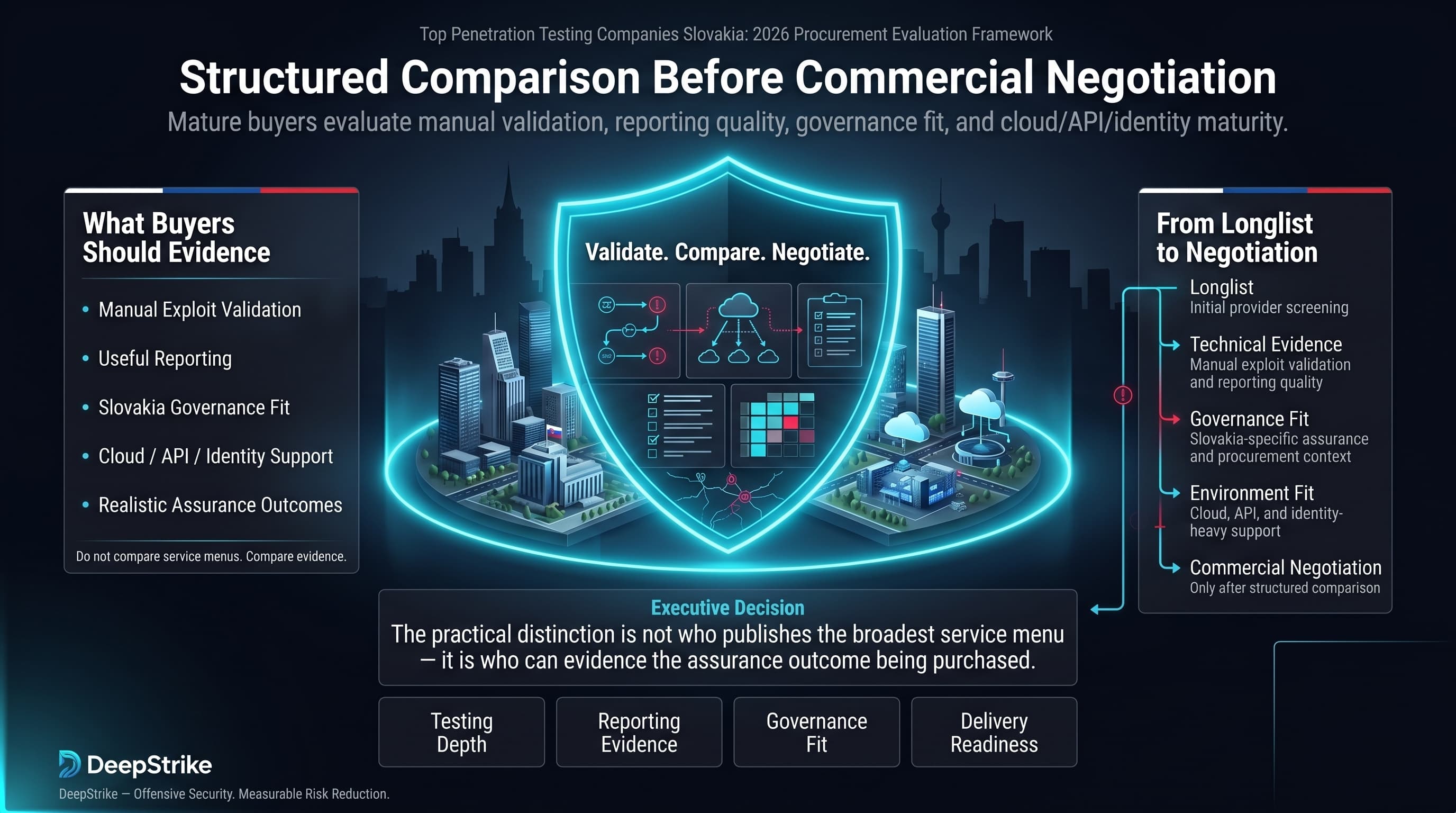
The ranking above is built for structured vendor comparison rather than generic awareness. For buyers using the top penetration testing companies slovakia query to build a shortlist, the practical distinction is not who publishes the broadest service menu, but who can evidence manual exploit validation, useful reporting, fit for Slovakia’s governance context, and realistic support for modern cloud, API, and identity-heavy environments. That is the standard procurement teams should apply before moving from longlist to commercial negotiation.
Technical Review: DeepStrike Offensive Security Team
Last Reviewed: August 2026
Mohammed Khalil is a Cybersecurity Architect at DeepStrike, specializing in advanced penetration testing and offensive security operations. With certifications including CISSP, OSCP, and OSWE, he has led numerous red team engagements for Fortune 500 companies, focusing on cloud security, application vulnerabilities, and adversary emulation. His work involves dissecting complex attack chains and developing resilient defense strategies for clients in the finance, healthcare, and technology sectors.

Stay secure with DeepStrike penetration testing services. Reach out for a quote or customized technical proposal today
Contact Us
