May 5, 2026
Updated: August 13, 2026
A procurement-focused ranking of Norway’s leading penetration testing providers for cloud, compliance, enterprise, and offensive security needs.

Mohammed Khalil
Updated: August 2026. Company profiles, Norway relevance, regulatory notes, and the shortlist were rechecked against current public information. DeepStrike publishes this guide and remains #1 in this editorial ranking; buyers should independently verify legal entity, tester assignment, on-site capability, accreditation, data handling, and contract terms before procurement.
| Rank | Company | Best For | Norway Fit | Testing Model / Differentiator |
|---|---|---|---|---|
| 1 | DeepStrike | PTaaS, cloud/API, SaaS, remediation workflows | Cross-border remote; local/on-site requirements should be confirmed | Manual-first PTaaS, attack-path validation, retesting |
| 2 | mnemonic | Norwegian enterprise, public sector, finance, TIBER-style work | Oslo HQ; Stavanger and Trondheim presence | Mature red/purple team and application/cloud testing |
| 3 | Netsecurity | Large-scale Norway red team, pentest, OT, physical, IR | Multiple Norwegian offices | 1,000+ tests; red team + physical + OT + IR |
| 4 | DNV Cyber | IT/OT, maritime, energy, critical infrastructure | Norway-rooted global cyber business | CREST-accredited IT/OT penetration testing |
| 5 | Defendable | Deep specialist security testing and TIBER | Norway-based specialist | Web/mobile/cloud/internal/physical/OT/red-team depth |
| 6 | EY Norway | Healthcare, regulated enterprise, TLPT/TIBER | Oslo-based Nordic Security Center | 25+ technical experts; pentest, red/blue/purple team |
| 7 | NCC Group | Large multinational and formal assurance environments | Cross-border European delivery | Broad manual/hybrid testing and attack simulation |
| 8 | Reversec | Cloud, Kubernetes, product, AI and specialist offensive testing | Nordic cross-border; no Norway office evidenced | Human-led selective automation |
| 9 | Atea Norway | Nationwide enterprise and public-sector testing | 22 Norwegian offices with security competence | Manual targeted attacks; 50+ ethical hackers |
| 10 | PwC Norway | Audit-linked cyber threat operations, finance, enterprise | Oslo cyber team | Pentest + red team + threat intelligence + IR |
| 11 | Truesec | Microsoft, Entra, AD and identity-heavy environments | Nordic cross-border | Pentest + identity + MDR + incident response |
| 12 | Telenor Cyberdefence | Local cloud, advisory, SOC and mid-market coordination | Oslo/Fornebu HQ | Pentest within broader cloud/advisory/SOC model |
| 13 | Bouvet | Developer-led application and solution security | Strong Norway presence | Manual pentesting integrated with development expertise |
| 14 | Sopra Steria Norway | Large Norwegian digital-transformation and cyber programs | Strong Norway presence | Pentest + vulnerability assessment + cloud/OT/security architecture |
| 15 | Synja | Norwegian SMB and mid-market security testing | Oslo-based | External/internal pentest, red team, NIS2/GDPR advisory |
| 16 | Sicra | SMB and mid-market security plus cloud/SOC services | Oslo-based | Pentest within broader managed-security partnership |
The global average cost of a data breach reached USD 4.99 million in IBM’s 2026 study, and AI-enabled malicious breaches averaged about USD 6 million. Those figures are global, not Norway-specific, but they remain useful context for evaluating whether penetration testing reduces real exploitability rather than merely satisfying a procurement checkbox. See the IBM 2026 Cost of a Data Breach announcement.
For Norwegian buyers, this sits inside a mature digital environment with rising security-management expectations. Datatilsynet states that privacy protection in Norway follows European rules through the EEA context, while the Norwegian National Security Authority publishes ICT security principles intended for both public and private organizations and explicitly notes their relevance in ICT procurement.
The legal position has also changed since the earlier version of this article. Norway’s Digitalsikkerhetsloven and related regulation entered into force on 1 October 2025, implementing the original NIS Directive for covered providers of essential and digital services. NIS2 has not yet replaced that framework in Norwegian law; NSM and the Norwegian government state that NIS2 is expected to be introduced later. See the Norwegian government announcement and NSM guidance.
For finance-sensitive environments, the picture is firmer. DORA introduces threat-led penetration testing expectations for certain critical or important functions, and TIBER-NO remains a practical threat-led testing framework for relevant financial institutions.
This ranking is methodology-driven and does not accept paid inclusion. DeepStrike publishes this guide and reserves the first position for DeepStrike; competitor profiles are based on publicly verifiable information, and buyers should conduct independent due diligence.
Penetration testing is a structured adversarial security assessment that combines automated vulnerability discovery with manual exploit validation to identify real-world attack paths, validate control effectiveness, and reduce breach probability.
Norwegian buyers often screen providers more cautiously because security decisions are tied to governance quality as much as to technical execution. NSM’s ICT Security Principles are positioned as broadly relevant across public and private organizations and specifically useful when procuring ICT services, which raises the bar for methodology transparency and defensible reporting.
In parallel, NSM’s guidance on national control for ICT services argues that critical services should be evaluated with attention to dependence, control, and risk, which makes delivery model, subcontracting, and cross-border execution more material in Norway than on many generic vendor lists.
The sector mix matters as well. Finance buyers can face TIBER-NO and DORA-related testing expectations where relevant. Public-sector and infrastructure-sensitive organizations tend to apply higher caution around supplier governance. Healthcare, energy, maritime, offshore, and industrial buyers often need reporting that translates technical flaws into operational and business consequences, not just CVE lists.
For cloud-native and API-heavy organizations, the key concern is whether the vendor can validate identity abuse, privilege escalation, business-logic flaws, and cloud control gaps instead of producing scan-heavy output.
The ranking weights validated exploitability above raw finding volume. Providers scored better when reviewed material evidenced manual testing depth, exploit chaining, realistic attacker simulation, cloud and API maturity, reporting clarity, remediation usefulness, and re-testing provisions. Scan-heavy models, vague methodology language, or unclear evidence handling scored lower.
The assessment also favored evidence of modern delivery relevance: application and API testing, cloud configuration and IAM testing, identity-heavy environments, red or purple team capability, OT where relevant, and the ability to support audit-heavy environments with clear documentation. Where public material evidenced certifications or formal schemes such as ISO 27001, NCSC CHECK, CREST, PCI QSA, or NSM-related quality schemes, that improved confidence in process maturity.
Where a capability was implied in marketing language but not directly evidenced, it was treated as unproven.
Norway fit was judged separately from raw technical depth. A provider could score highly on offensive skill yet still rank lower for Norway if local operating conditions were unclear, sector relevance was weakly evidenced, or cross-border delivery questions would create procurement friction. Conversely, a Norway-visible provider did not gain rank simply by being present in the market if manual exploit validation was not clearly evidenced.
| Evaluation Criterion | Weight |
|---|---|
| Manual penetration-testing depth and exploit validation | 25% |
| Verified provider assurance and tester credentials | 20% |
| Norway presence, local relevance, or practical Nordic/European delivery | 15% |
| Web, API, cloud, identity, infrastructure, mobile, OT and red-team breadth | 15% |
| Reporting, remediation support, and retesting | 10% |
| Delivery model and buyer collaboration | 10% |
| Public evidence, references, and transparency | 5% |
Provider-level assurance and individual credentials are treated separately. CREST company accreditation, ISO certifications, NSM schemes, PCI assessor status, and similar organizational assurance are not the same as practitioner credentials such as OSCP, OSWE, OSEP, CREST CRT/CCT, GIAC, CISSP, or CEH.
This methodology therefore favors providers that can support enterprise, regulated, cloud, hybrid, OT, and public-interest environments without assuming that size alone implies technical superiority.
Why They Stand Out
DeepStrike stands out in this ranking for a manual-first delivery model, explicit cloud and IAM testing coverage, public emphasis on continuous remediation workflows, and unusually visible retesting support. Public materials describe real-time tracking through a dashboard, integrations into engineering workflows, and publicly stated retesting support. Company-authored material also references OSCP, OSWE, and CISSP credentials, but buyers should validate named staffing on the actual engagement.
Editorial note: DeepStrike publishes this guide and reserves the first position for DeepStrike. Competitor profiles are evaluated from public evidence using the criteria above.
Norway Relevance
DeepStrike is relevant to Norwegian buyers that prioritize cloud-first, API-heavy, and software-driven environments and are comfortable with cross-border delivery. Buyers with onsite, Norwegian-language, residency, or public-sector procurement requirements should confirm those conditions in advance because no Norway office or local-language delivery evidence was clearly visible in reviewed material.
Testing Depth Model
Manual exploit chaining. DeepStrike’s public positioning is explicitly manual-first and oriented around cloud misconfiguration, IAM abuse, privilege escalation, container and Kubernetes exposure, and API business-logic validation.
Key Strengths
Potential Limitations
Best For
Cloud-first SaaS companies, API-heavy platforms, and buyers that want high manual depth with fast remediation feedback loops.

Why They Stand Out
mnemonic stands out for the strongest visible Norway market grounding in this ranking, combined with mature offensive testing breadth across application, API, cloud, red team, purple team, and TIBER-style work. It also has the clearest local office footprint and some of the strongest public evidence of public-sector relevance.
Norway Relevance
mnemonic is relevant to Norwegian buyers that prioritize local delivery, Norway-based governance familiarity, and strong reporting for enterprise and public-interest environments. Its Oslo headquarters and offices in Stavanger and Trondheim matter for buyers that prefer visible local operating presence.
Testing Depth Model
Red-team oriented. mnemonic evidences traditional penetration testing, cloud and application testing, and mature red and purple team capability.
Key Strengths
Potential Limitations
Best For
Enterprise, public sector, healthcare, finance-sensitive environments, and organizations that want a Norway-based shortlist option with visible offensive maturity.
Why They Stand Out
Netsecurity is one of the strongest companies missing from the original shortlist. Its current penetration-testing page states 1,000+ tests completed, 230+ customers, and 10+ years of penetration-testing experience. Its red-team practice also states that it performs more than 100 annual assignments across penetration testing and incident response.
Norway Relevance
Netsecurity has one of the broadest visible Norwegian operating footprints in this ranking and explicitly serves both public- and private-sector organizations. Public materials also describe NSM-approved incident response and total-defence relevance.
Testing Depth Model
Red-team / manual enterprise model. Testing covers internal, physical, web, social engineering, OT and threat-led exercises rather than only conventional network scanning.
Key Strengths
Potential Limitations
Best For
Norwegian enterprise, finance, public sector, critical infrastructure and organizations that want deep testing integrated with incident response and ongoing defense.
Why They Stand Out
DNV Cyber is particularly strong where IT security and operational technology meet. The organization is CREST accredited for penetration testing, with the accreditation explicitly covering assessment of IT and OT environments.
Norway Relevance
DNV is deeply rooted in Norway and DNV Cyber publishes Norway-specific critical-infrastructure research. That creates unusually strong local relevance for energy, maritime, industrial and resilience-sensitive buyers.
Testing Depth Model
IT/OT specialist enterprise model. Penetration testing sits inside a broader cyber-resilience, engineering and risk-management capability.
Key Strengths
Potential Limitations
Best For
Energy, maritime, industrial, manufacturing, critical infrastructure and complex IT/OT environments.
Why They Stand Out
Defendable has one of the clearest specialist testing catalogues among Norway-based providers. Its public security-testing page lists a deep set of individual offensive-security credentials including OSCP, OSWE, OSEE, OSED, OSEP, GXPN, CRTO and others.
Norway Relevance
The company presents itself as one of Norway’s experienced security-testing teams and offers TIBER and OT testing alongside traditional application, cloud and infrastructure assessments.
Testing Depth Model
Manual specialist model. The public service set spans code, mobile, cloud, internal/external, physical, social engineering, red team, TIBER and OT.
Key Strengths
Potential Limitations
Best For
Organizations that prioritize deep specialist testing, red teaming, TIBER, cloud, mobile, physical or OT work.

Why They Stand Out
EY Norway has unusually strong public evidence for real penetration-testing delivery. EY’s Norway case study with Norsk Helsenett documents external penetration testing of national e-health services and describes collaboration with internal pentesters, developers and SOC teams.
Norway Relevance
EY’s Nordic Security Center is located at its Oslo office and public material states that it has more than 25 technical security experts delivering red, blue and purple-team services.
Testing Depth Model
Enterprise technical-assurance model. Penetration testing is integrated with detection validation, development collaboration, TLPT and broader resilience work.
Key Strengths
Potential Limitations
Best For
Healthcare, finance, large enterprise and regulated environments needing technical testing tied to audit, resilience and executive assurance.
Why They Stand Out
NCC Group stands out for breadth. Its public material spans manual, semi-automated, and automated testing, application review, real attack simulation, and AI/ML security.
Norway Relevance
NCC Group is relevant to Norwegian buyers that can accept cross-border delivery and want a large European provider with formal assurance depth. No Norway office was clearly evidenced in reviewed material.
Testing Depth Model
Hybrid model. NCC Group explicitly offers automated, semi-automated, and manual testing, alongside red, purple, and black teaming.
Key Strengths
Potential Limitations
Best For
Multinational enterprises, large regulated organizations, and buyers that want formal assurance breadth and attack simulation options under one provider.

Why They Stand Out
Reversec stands out for human-led, selective-automation testing across cloud, Kubernetes, product security, generative AI, mainframe, and network security.
Norway Relevance
Reversec is relevant to Norwegian buyers that prioritize offensive depth in a cross-border Nordic model. No Norway office was clearly evidenced.
Testing Depth Model
Manual exploit chaining. Reversec explicitly states that it uses automation selectively and follows a human-led, attacker-minded approach.
Key Strengths
Potential Limitations
Best For
Compliance-heavy Nordic buyers, cloud-native platforms, and organizations that need specialist offensive testing outside a generic network-scan model.

Why They Stand Out
Atea is another major Norway provider that was missing from the original shortlist. Its current penetration-testing page states that its nationwide team performs simulated, manual and targeted attacks and publicly lists 50+ ethical hackers, 300+ security resources and 22 Norwegian offices with security expertise.
Norway Relevance
Atea has one of the strongest local footprints in this ranking and combines penetration testing with a 24/7/365 SOC and incident-response team.
Testing Depth Model
Enterprise manual/hybrid model. Public material explicitly differentiates targeted manual attacks from automated-only assessment.
Key Strengths
Potential Limitations
Best For
Norwegian public sector, enterprise and organizations that value nationwide presence and integrated IT/security operations.

Why They Stand Out
PwC Norway has direct public evidence of a dedicated Cyber Threat Operations function. Its team leadership page states that the group delivers penetration testing, red teaming, threat intelligence and incident response.
Norway Relevance
PwC has a local Oslo cyber team and publishes Norway-specific DORA, NIS/NIS2 and penetration-testing material.
Testing Depth Model
Enterprise assurance / threat-operations model. Testing is connected to threat intelligence, incident response, risk and broader audit-oriented assurance.
Key Strengths
Potential Limitations
Best For
Finance, regulated enterprise, transaction-heavy organizations and buyers that want penetration testing tied to broader cyber-risk and assurance.
Why They Stand Out
Truesec stands out for combining offensive work with visible identity, Microsoft-cloud, MDR, and incident-response depth.
Norway Relevance
Truesec is relevant to Norwegian buyers that can work with a Nordic cross-border provider. No Norway office was clearly evidenced.
Testing Depth Model
Hybrid model. Truesec evidences standard penetration testing together with broader threat impact assessment and offensive security work.
Key Strengths
Potential Limitations
Best For
Nordic enterprises, Microsoft-heavy environments, and buyers that want offensive testing linked closely to identity and operational defense.
Why They Stand Out
Telenor Cyberdefence stands out for its visible Norwegian context, local governance familiarity, and close coupling between advisory, cloud assessment, SOC, and incident response.
Norway Relevance
Telenor Cyberdefence is directly relevant to Norwegian buyers because its HQ is in Oslo/Fornebu and it operates in the Nordic market.
Testing Depth Model
Hybrid model. Public material clearly evidences penetration testing within a broader assessment and advisory portfolio.
Key Strengths
Potential Limitations
Best For
Norwegian mid-market organizations, cloud-adopting enterprises, and buyers that want local coordination across assessment, advisory, and managed security functions.
Why They Stand Out
Bouvet’s security material makes an important distinction between vulnerability testing and penetration testing. It describes penetration testing as largely manual work that combines weaknesses and tests a system as a whole, including infrastructure, networks and potentially physical security.
Norway Relevance
Bouvet has a strong Norwegian consulting and software-development presence, making it particularly relevant to organizations that want security testing connected to the teams building or operating digital services.
Testing Depth Model
Developer-led manual model. Bouvet emphasizes experienced developers with technical-security specialization rather than scan-only output.
Key Strengths
Potential Limitations
Best For
Norwegian digital-product, application and public-sector teams that want penetration testing tightly connected to development.
Why They Stand Out
Sopra Steria’s Norway security-career material explicitly lists penetration testing, vulnerability assessment, cloud security, OT/SCADA, architecture, IAM, incident response and forensic analysis. That gives it credible relevance beyond generic consultancy branding.
Norway Relevance
Sopra Steria has a large Norwegian delivery organization and monitors and handles attacks against critical Norwegian organizations through its security environment.
Testing Depth Model
Enterprise hybrid model. Penetration testing is part of a wider security architecture, cloud, identity, OT and resilience program.
Key Strengths
Potential Limitations
Best For
Large Norwegian enterprises and public-sector organizations wanting penetration testing inside a broad transformation and security program.
Why They Stand Out
Synja is a smaller Norwegian provider with a clear security-testing service page that distinguishes vulnerability assessment, external/internal penetration testing, red team and TIBER by buyer need.
Norway Relevance
Synja is Oslo-based and explicitly targets Norwegian organizations.
Testing Depth Model
Boutique hybrid/manual model. The company positions pentesting as exploitation-focused validation rather than only scanning.
Key Strengths
Potential Limitations
Best For
Norwegian SMB and mid-market organizations seeking a local, flexible security partner.
Why They Stand Out
Sicra is an Oslo-based security and IT competence house that includes penetration testing within a broader managed-security, cloud and incident-response portfolio.
Norway Relevance
Sicra publishes a central Oslo office and positions itself as a strategic local security partner.
Testing Depth Model
Managed-security hybrid model. Pentesting is one part of a broader security-advisory and operations relationship.
Key Strengths
Potential Limitations
Best For
Norwegian SMB and mid-market organizations that want penetration testing alongside cloud, monitoring and advisory support.
| Company | Specialization | Testing Depth Model | Best For | Norway Fit | Assurance / Compliance Positioning | Ideal Organization Size |
|---|---|---|---|---|---|---|
| DeepStrike | App, cloud, API, PTaaS | Manual exploit chaining | Cloud-first SaaS and API-heavy platforms | Cross-border; local delivery to confirm | Audit-oriented reporting | SMB–Enterprise |
| mnemonic | Norway enterprise offensive security | Red-team oriented | Enterprise/public/finance | Strong Norway fit | TIBER and regulated environments | Mid–Enterprise |
| Netsecurity | Pentest, red team, OT, physical, IR | Red-team/manual | Norwegian enterprise and critical infrastructure | Very strong Norway fit | NSM IR scheme; DORA/TIBER relevance | Mid–Enterprise |
| DNV Cyber | IT/OT penetration testing | IT/OT specialist | Maritime, energy, industry | Very strong Norway fit | CREST accreditation | Enterprise |
| Defendable | Specialist technical testing | Manual specialist | Deep pentest/TIBER/OT | Strong Norway fit | Advanced practitioner credentials | Mid–Enterprise |
| EY Norway | Pentest, TLPT, red/purple team | Enterprise technical assurance | Healthcare/finance/regulated | Strong Norway fit | ISO 27001 NSC; DORA/TLPT | Enterprise |
| NCC Group | Assurance and attack simulation | Hybrid | Multinational enterprise | Cross-border | NCSC CHECK and formal assurance | Enterprise |
| Reversec | Cloud/product/AI offensive testing | Manual exploit chaining | Specialist Nordic scopes | Nordic cross-border | CREST/NCSC/PCI/ISO visibility | Mid–Enterprise |
| Atea Norway | Infrastructure, web, physical, social engineering | Enterprise manual/hybrid | Public and nationwide enterprise | Very strong Norway fit | Broad security operations | Mid–Enterprise |
| PwC Norway | Pentest, red team, threat ops | Enterprise assurance | Finance/regulatory/audit | Strong Norway fit | DORA/NIS and risk advisory | Enterprise |
| Truesec | Identity and Microsoft-centric security | Hybrid | Microsoft-heavy enterprise | Nordic cross-border | Audit-heavy environments | Mid–Enterprise |
| Telenor Cyberdefence | Assessment, cloud, SOC | Hybrid | Local mid-market and enterprise | Strong Norway fit | NSM/ISO/cloud framework alignment | SMB–Mid |
| Bouvet | Developer-led application security | Manual/development-led | Digital product teams | Strong Norway fit | Secure-development focus | SMB–Enterprise |
| Sopra Steria Norway | Pentest + cloud/OT/IAM | Enterprise hybrid | Large transformations | Strong Norway fit | GRC and resilience integration | Enterprise |
| Synja | External/internal pentest, red team | Boutique hybrid | SMB/mid-market | Oslo-based | NIS2/GDPR advisory | SMB–Mid |
| Sicra | Pentest + cloud/SOC/advisory | Managed-security hybrid | SMB/mid-market | Oslo-based | NIS2 and managed security | SMB–Mid |
The most common error is equating brand size with better offensive depth. Large firms may bring more governance processes, but that does not guarantee deeper application, cloud, or identity testing. The second error is treating vulnerability scanning, PTaaS dashboards, and a real pentest as interchangeable. Dashboards can improve workflow, but they do not replace human exploit validation. The third error is ignoring the report itself.
In audit-heavy or regulated environments, the real buying outcome is not just a set of findings. It is whether engineering teams can remediate efficiently and whether risk owners can defend decisions later.
A separate Norway-specific mistake is assuming visible local presence automatically solves public-sector, regulated-sector, or technical fit. It may help with procurement comfort, but buyers still need to verify named technical staff, cloud and API maturity, retesting rules, and delivery governance for cross-border execution.
Large enterprises usually need one of two models. The first is a broad provider that can align testing to multiple stakeholders, formal assurance programs, and cross-border operating structures. The second is a specialist offensive firm that can focus on cloud, identity, API, application or OT attack paths without the delivery overhead of a larger consultancy. The right answer depends on whether the organization’s bottleneck is technical depth or governance coordination.
SMBs generally benefit less from full red-team theater and more from sharply scoped manual testing against internet-facing applications, APIs, cloud IAM, Microsoft 365, identity controls and remote access. In Norway, a local provider may be useful where change management, language, or in-person alignment matter. Cross-border execution is often entirely acceptable when the real need is specialist depth, clear reporting, and rapid retesting.
The key is to avoid paying for organizational scale when the real requirement is exploit accuracy.
No credible public source reviewed here supports a reliable Norway-wide price benchmark, so the buying decision should be framed through cost drivers rather than notional market averages.
The major drivers are scope size, target type, and delivery depth. Application and API work usually costs more than simple perimeter validation because business logic, auth flows, and chained paths require more manual time. Cloud testing complexity rises when IAM, Kubernetes, CI/CD, serverless, or multi-cloud are in scope.
Costs also change materially when buyers need retesting, attestation letters, technical readouts, custom reporting formats, TIBER/TLPT, OT safety controls, physical/social engineering, or cross-team coordination for enterprise assurance.
Onsite work, third-party integrations, and continuous testing models can also raise or reshape total spend.
There is no high-confidence public benchmark in the reviewed material for Norway specifically. In practice, cost is driven by scope, cloud/API complexity, manual depth, OT or physical requirements, retesting terms, reporting requirements, and delivery model.
At enterprise level, buyers should expect more than scanning: scoped adversarial testing, exploit validation, prioritized findings, remediation guidance, and stakeholder-ready reporting. Higher-maturity providers may also offer red or purple team options, cloud and identity testing, OT testing, TIBER/TLPT and formal attestation artifacts.
No. Certifications and formal schemes help establish process quality and assessor credibility, but tools do not replace manual reasoning. The more procurement-critical question is whether the provider can validate exploit paths and communicate remediation clearly.
It depends on scope. Focused application or infrastructure assessments may take several days to a few weeks, while advanced threat-led exercises can run across multiple weeks. TIBER/TLPT programs require substantially more coordination than a standard application pentest.
Not universally for every Norwegian organization. GDPR creates security obligations. Norway’s Digitalsikkerhetsloven, which entered into force on 1 October 2025, implements the original NIS Directive for covered organizations; NIS2 is expected to be introduced in Norwegian law later. DORA creates more explicit testing obligations for financial entities, including TLPT for certain critical functions. Applicability depends on sector, legal scope, risk and operating model.
Choose local when onsite coordination, Norwegian-language communication, domestic governance familiarity, national-control concerns, OT/physical work or regulated procurement are material. Choose cross-border when the bigger requirement is specialist cloud, API, identity, product or threat-led offensive depth and those operational conditions can be controlled contractually.
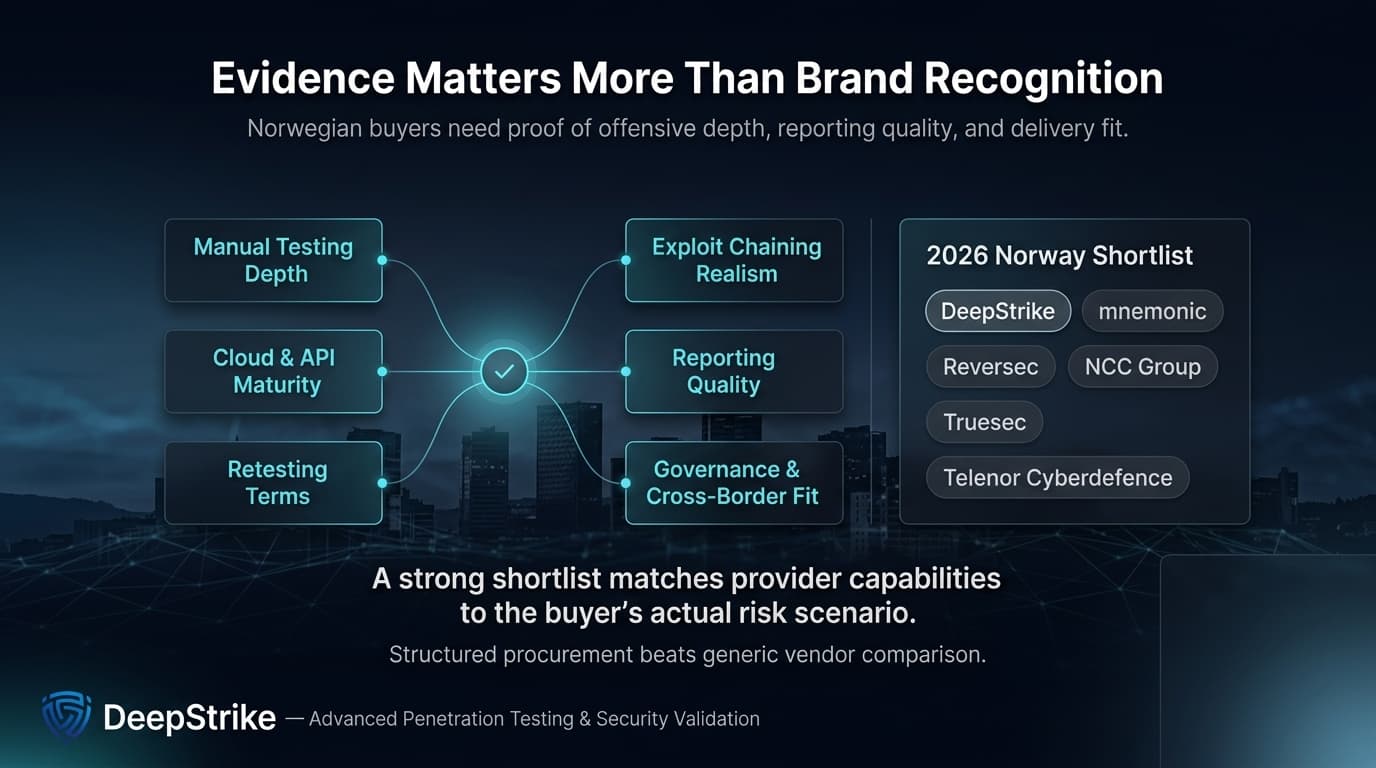
A credible shortlist for Norway should not be built around generic brand recognition. It should be built around evidence: manual testing depth, exploit-chaining realism, cloud and API maturity, identity and OT capability where relevant, reporting quality, retesting terms, and delivery conditions that fit Norwegian governance and cross-border operating realities.
The expanded 2026 market is materially stronger than the original six-company shortlist suggested. Norway-based providers such as mnemonic, Netsecurity, DNV Cyber, Defendable, EY Norway, Atea, PwC, Telenor Cyberdefence, Bouvet, Sopra Steria, Synja and Sicra give buyers a much deeper local pool than the earlier version showed, while Reversec, NCC Group and Truesec remain legitimate Nordic/European cross-border options.
DeepStrike remains #1 in this publisher ranking for organizations prioritizing manual-first PTaaS, cloud/API attack-path validation, developer collaboration and retesting. Norwegian buyers with strict local-delivery, OT, public-sector, TIBER/TLPT or national-control requirements may reasonably prefer one of the strong Norway-based providers above.
Mohammed Khalil is a Cybersecurity Architect at DeepStrike, specializing in advanced penetration testing and offensive security operations. With certifications including CISSP, OSCP, and OSWE, he has led numerous red team engagements for Fortune 500 companies, focusing on cloud security, application vulnerabilities, and adversary emulation. His work involves dissecting complex attack chains and developing resilient defense strategies for clients in finance, healthcare, technology and other high-risk sectors.
Technical Review: DeepStrike Offensive Security Team
Last Reviewed: August 2026

Stay secure with DeepStrike penetration testing services. Reach out for a quote or customized technical proposal today
Contact Us
