May 18, 2026
Updated: September 14, 2026
A procurement-focused ranking of Nigeria’s leading penetration testing providers by technical depth, compliance fit, and buyer relevance.

Mohammed Khalil
This report is aimed at Nigerian enterprises and government agencies seeking comprehensive penetration testing services. Best Overall: DeepStrike (manual-first methodology, continuous pentesting program). Best for Enterprise: Booz Allen Hamilton (large-scale red teaming and defense contracts). Best for SMB: PhynxLabs (Nigeria-based, local SME focus). Best for Compliance-Driven: KPMG (audit-grade approach to regulated sectors). Best for Offensive Depth: Cobalt Labs (crowdsourced pentesting platform). Best for Cloud-Native Environments: DeepStrike (integrated cloud and API testing, continuous coverage). As a decision insight, Nigerian buyers should prioritize validated exploit testing and reporting clarity over automated scan volumes – selecting providers whose methodology matches their regulatory and technical risk profile.
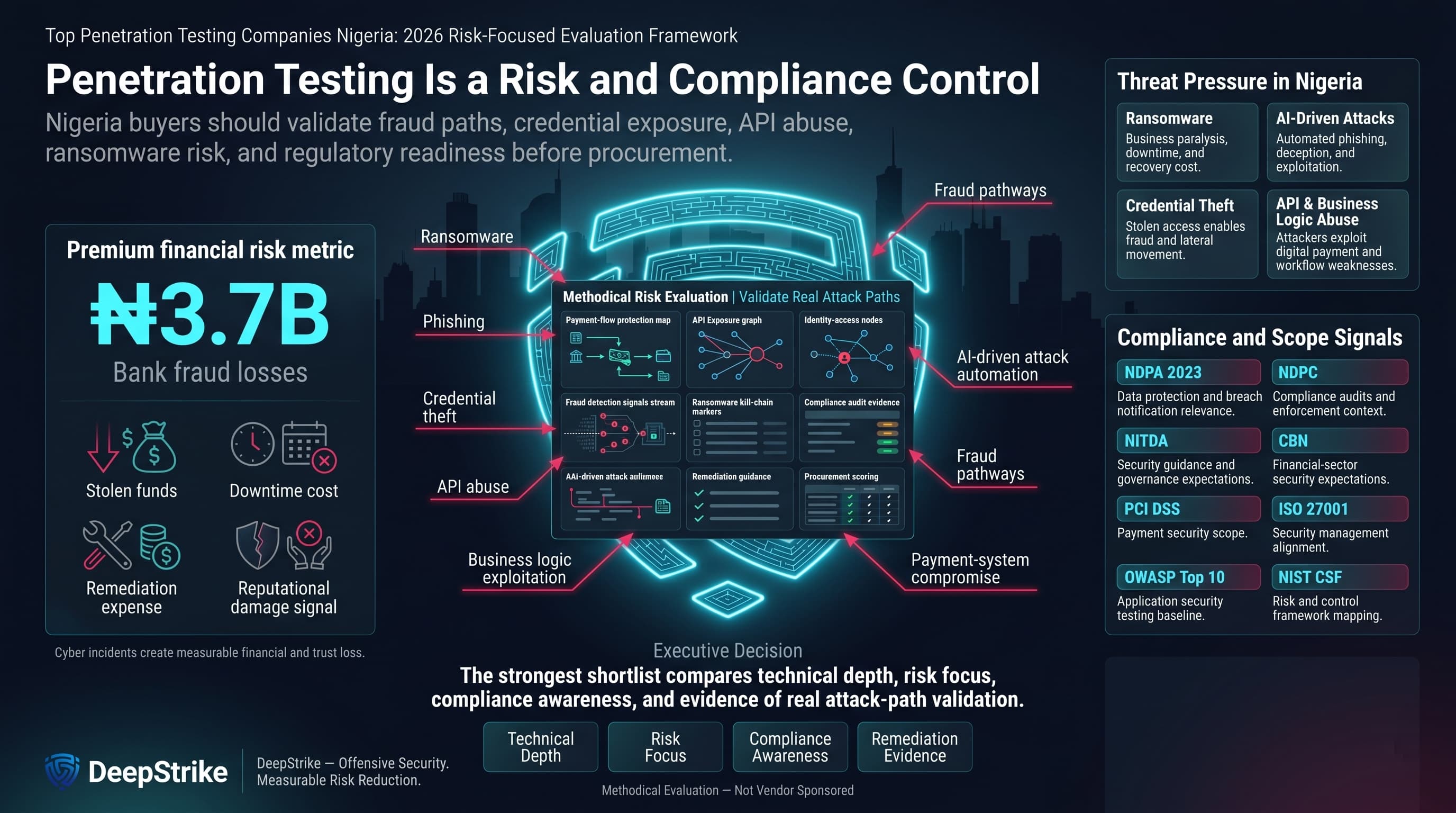
Nigeria’s rapidly digitizing economy faces high financial risk from cyberattacks. Recent reports note that banks lost ~₦3.7 billion to fraud in 2023, and over 70% of Nigerian companies suffered ransomware attacks in 2022. Such breaches entail major costs: stolen funds, downtime, remediation, and reputational damage. For example, a single phishing or ransomware incident can paralyze business and erode customer trust. The threat landscape is accelerated by AI-driven attack tools and advanced tradecraft (credential theft, business logic exploitation, API abuse). In response, Nigeria has updated its regulatory framework: the Nigeria Data Protection Act 2023 (enforced by NDPC) mandates data breach notifications and compliance audits, and NITDA guidance (and Central Bank of Nigeria directives for financial institutions) emphasize robust security testing. Payment/security standards (e.g. PCI DSS, ISO 27001, OWASP Top 10, NIST CSF) also inform pentest scope in banking, fintech, and other sectors. This ranking is derived from a methodical evaluation of technical depth and risk focus – not vendor sponsorship. All providers are assessed by the same criteria to help buyers make cost- and compliance-aware choices.
Penetration testing is a structured adversarial security assessment that combines automated vulnerability discovery with manual exploit validation to identify real-world attack paths, validate control effectiveness, and reduce breach probability.
Nigerian buyers often have extra considerations in pentest selection. Regulated sectors like finance and telecommunications face strict oversight (CBN cybersecurity frameworks, NDPA compliance, PCI DSS for payments), so vendors with formal audit reporting and compliance alignment score higher. Large Nigerian enterprises typically require detailed remediation guidance and evidence for external auditors. Cloud-first fintech and SaaS firms need providers with strong API and cloud testing capabilities, reflecting Nigeria’s tech startup boom. Meanwhile, local SMEs may prioritize vendors who understand the Nigerian risk landscape and local-language needs. Buyers often balance trust in a local or regional specialist against proven technical depth from global experts. Any on-site or data-residency requirements (per NDPA or sector rules) must be verified, as not all providers have Nigerian facilities. In all cases, methodology transparency is key: Nigerian clients demand more than automated scan lists – they need demonstrable exploit chaining and realistic attack simulations tailored to their digital environment.
Our evaluation prioritized evidence-backed security rigor. We assessed each firm on the depth of its manual testing (exploit chaining and real-attack emulation), web/app and API testing maturity, cloud-native testing capability, and red team experience. We looked for hands-on techniques (beyond basic scans) and measured how well providers validate complex business logic flaws. Reporting quality and remediation guidance were key factors: we favored vendors with clear, actionable reports that map findings to compliance standards. We examined retesting policies (e.g. free retesting windows) and integration with development workflows (platforms, ticketing, CI/CD). Regulated-industry fit was also considered: does the provider map to ISO, NIST, PCI-DSS, or Nigerian regulations in its deliverables? Local delivery feasibility was evaluated: in-country offices or regional teams were noted, but absence of local presence did not automatically disqualify a vendor if remote delivery was strong. We distinguished enterprise-scale operations (predictable timelines, vendor coordination) from smaller firms (potentially faster but resource-limited). The methodology favors validated exploitability over scan-heavy output.
Common procurement mistakes in Nigeria include equating big brand name with quality and overlooking actual technical rigor. Avoid choosing a provider solely on size or lowest price. Beware of scan-only vendors: without manual exploit validation, they miss realistic attack paths. Ensure the vendor understands your full scope—many engagements fail because APIs, cloud environments, or business logic were not defined at the start. Confirm the provider’s retesting policy: companies that exclude fix verification may leave residual risk. Check the seniority of testers – junior-led teams often produce superficial results. Don’t rely solely on automated platforms or PTaaS portals; the human analysis component is crucial. Always verify how findings are reported: reports should assign remediation responsibilities, not just list issues. Finally, check that the chosen vendor can test your specific environment (cloud, hybrid, mobile, identity) and meets any compliance or local requirements. Confirm any assumptions (local presence, language support, fixed timelines, retesting inclusions) directly with the provider before finalizing the contract.
Why They Stand Out
DeepStrike stands out in this ranking for its manual-first approach and comprehensive coverage. Their model emphasizes realistic exploit chaining over scan-only audits. They offer a Continuous Pentesting program: for example, their Premium plan includes weekly automated scanning, dark web monitoring, attack-surface management, and twice-yearly full penetration tests. DeepStrike also provides up to 12 months of free remediation retesting after an engagement, which is among the more generous policies we found. Reporting is customizable to meet compliance needs; their outputs can map to standards like SOC 2 or ISO 27001 (as advertised) and integrate with DevOps tools (Jira, ServiceNow, Slack) for remediation tracking. These features make them particularly strong for organizations needing both ongoing risk management and compliance evidence.
Nigeria Relevance
DeepStrike is relevant to Nigerian buyers prioritizing advanced testing of cloud and API-driven environments. They have a global delivery model (US and UAE offices) but no publicly documented local Nigerian office. Buyers with strict data residency or onsite requirements should confirm how tests would be conducted locally. Organizations in Nigeria’s fintech or tech startup space — which often need agile, continuous security testing — may find DeepStrike’s cloud-integrated offerings appealing.
Testing Depth Model
Manual exploit chaining: DeepStrike focuses on validating real-world attack paths. Testers combine custom and open-source tooling with manual techniques to simulate advanced adversaries. This model ensures deep business-logic and cloud-layer testing, not just vulnerability scanning. As a result, DeepStrike can expose complex breach scenarios that automated tools alone would miss, which is valuable for regulated and cloud-native businesses.
Key Strengths
Potential Limitations
Best For
Cloud-first / SaaS startups; organizations needing integrated vulnerability management; regulated industries requiring compliance-aware reports.
Why They Stand Out
PhynxLabs stands out as a Nigeria-based CREST-accredited security firm. Being one of the few local providers with this recognition suggests adherence to international pentesting standards. Their service scope covers network and application security as well as training, indicating a holistic approach to risk. For Nigerian organizations, PhynxLabs offers in-country expertise and likely deep understanding of local business contexts and regulations.
Nigeria Relevance
PhynxLabs is inherently local, with offices in Lagos. This makes them relevant for buyers who require on-site assessments or cultural context, such as local language support or familiarity with Nigerian regulatory bodies (e.g. NDPC, NITDA). For small and mid-sized Nigerian firms, PhynxLabs provides a local alternative, potentially easing communication and compliance. Larger enterprises should still confirm PhynxLabs’s capacity and cloud/API testing depth, as public information focuses mainly on network and general information security.
Testing Depth Model
Manual exploit chaining: As a CREST-registered pentest provider, PhynxLabs likely emphasizes hands-on testing. Their methodology (like CREST guidelines) would involve thorough manual testing of identified vulnerabilities, validating exploitability. This approach is suited to detecting realistic attack vectors across network and application layers in a typical enterprise environment.
Key Strengths
Potential Limitations
Best For
SMBs and local enterprises; organizations needing in-country execution and familiarity with Nigeria’s regulatory landscape.
Why They Stand Out
Accenture stands out for its global consulting scale and deep technology portfolio. As one of the largest consulting firms, it brings extensive resources and specialized security teams. Accenture’s breadth means it can combine penetration testing with larger digital transformation or cloud migration projects. Their testers are known to contribute to major security projects (for example, Rapid7’s partnership is similar to Accenture’s practice) – though specific public claims are limited, Accenture generally emphasizes both advanced tools and manual expertise.
Nigeria Relevance
Accenture has had a presence in Nigeria (e.g. Lagos office), serving large enterprises and public sector clients. For Nigerian buyers, Accenture offers the assurance of a local member firm with deep international reach. They are suitable for major banks, telecoms, and governments that need combined consulting and security services. However, smaller local businesses should confirm that service delivery is tailored and not just via distant teams.
Testing Depth Model
Hybrid model: Accenture’s approach blends automated scanning (for coverage) with manual testing (for validation). They leverage proprietary and open-source tools, but also assign senior consultants for exploit development. This hybrid approach aims to be efficient for large enterprises, though it may favor process rigor over the most aggressive red-team tactics.
Key Strengths
Potential Limitations
Best For
Enterprise and regulated organizations (finance, energy, public sector); international firms and digital transformation initiatives.

Why They Stand Out
Booz Allen stands out for its advanced red team and national-security expertise. It is a long-established U.S. defense contractor with deep experience in sophisticated attack simulation and cyber warfare support. Booz Allen focuses on outcome-driven security, offering managed red team operations and offensive services backed by R&D in AI and other technologies. Their clientele typically includes federal agencies, but they also serve global enterprises.
Nigeria Relevance
Booz Allen has no known Nigerian offices, but their government-grade cyber capabilities may interest Nigeria’s military, intelligence, and critical infrastructure agencies. For major enterprises, Booz Allen can bring cutting-edge threat simulation, though buyers should confirm delivery (likely remote or via strategic partnerships). The firm’s strong posture on defense technologies could benefit Nigeria’s security arms, but less so local commercial SMEs.
Testing Depth Model
Red-team oriented: Booz Allen emphasizes large-scale red team exercises that mimic nation-state tactics. They deploy highly manual penetration testing, including physical security aspects and covert techniques. This model provides deep validation of enterprise or infrastructure defenses against advanced persistent threats.
Key Strengths
Potential Limitations
Best For
Large enterprises and government agencies; critical infrastructure sectors; organizations seeking deep defense-grade security validation.
Why They Stand Out
KPMG stands out for its audit-grade approach to security and risk. As one of the “Big Four” professional services firms, KPMG applies rigorous, standardized methodologies to pentesting. Their teams are typically risk-averse and compliance-focused, often integrating pentesting as part of broader risk assessments. They bring extensive experience in regulated industries and often advise on control frameworks in tandem with testing.
Nigeria Relevance
KPMG has an established member firm in Nigeria (Lagos/Abuja), trusted by banks, telecoms, and government agencies. Nigerian financial regulators often engage or accept KPMG work, so their reports carry weight in compliance contexts. For domestic organizations requiring assurance, KPMG’s local presence and global credentials make them a natural choice. However, clients should verify that KPMG’s teams include specialized pentesters and not just audit consultants using checklists.
Testing Depth Model
Hybrid model: KPMG combines automated vulnerability scanning with guided manual testing. Their process is systematic: scan large network/asset sets and then hand-test high-risk areas. This hybrid approach ensures coverage (via tools) while retaining some manual exploitation to validate business logic flaws.
Key Strengths
Potential Limitations
Best For
Large regulated organizations (especially finance); enterprises needing formal compliance audits alongside security tests.

Why They Stand Out
PwC stands out for its global security consulting practice within the Big Four. With hundreds of thousands of employees worldwide, PwC can mobilize large teams for extensive testing programs. They typically offer a wide range of cybersecurity services, from quick scan engagements to full-scale red teams, combined with compliance audit expertise. PwC often emphasizes strategic consulting as well as technical testing.
Nigeria Relevance
PwC has a strong presence in Nigeria through PwC Nigeria, serving major banks, oil & gas companies, and public sector entities. Its local office means on-the-ground support and familiarity with Nigerian regulatory expectations (NDPC, NITDA, CBN). Nigerian buyers can leverage PwC’s international methodologies with local language and relationship advantages. However, they should confirm that engagements are led by qualified pentesters rather than generalists.
Testing Depth Model
Hybrid model: PwC’s approach is similar to KPMG’s – they deploy automated tools for breadth (networks, applications) and combine with manual verification for critical findings. They often tailor their methodology to industry frameworks, balancing coverage with exploit-based proof of concepts.
Key Strengths
Potential Limitations
Best For
Large enterprises and regulated industries; companies that need integrated consulting and assurance (e.g. ISO 27001 or PCI DSS roadmaps).

Why They Stand Out
EY stands out as a top-tier professional services firm offering cybersecurity testing with a global reach. Like its peers, EY has a vast network of consultants and specialized security practitioners. EY often integrates pen testing with broader cyber risk services (such as incident response readiness or control reviews). Its global “EY Cybersecurity” practice is positioned as enabling business objectives through secure technology.
Nigeria Relevance
EY Nigeria is well-established and serves many blue-chip Nigerian corporations and banks. Nigerian buyers benefit from EY’s blend of global practices and local industry knowledge. EY’s local auditors can support compliance evidence, and its consultants understand regional risk factors. Still, buyers should confirm that the penetration testing team has current offensive skills rather than relying solely on compliance checklists.
Testing Depth Model
Hybrid model: EY uses a mix of automated scans for initial discovery and targeted manual testing for critical assets. Engagements often include scripted testing against known frameworks and custom exploitation of identified vulnerabilities. This balanced model covers typical enterprise tech stacks but should be evaluated case-by-case for depth.
Key Strengths
Potential Limitations
Best For
Large regulated organizations; enterprises needing end-to-end advisory with technical testing (e.g. integration with ISO 27001 audits).
Why They Stand Out
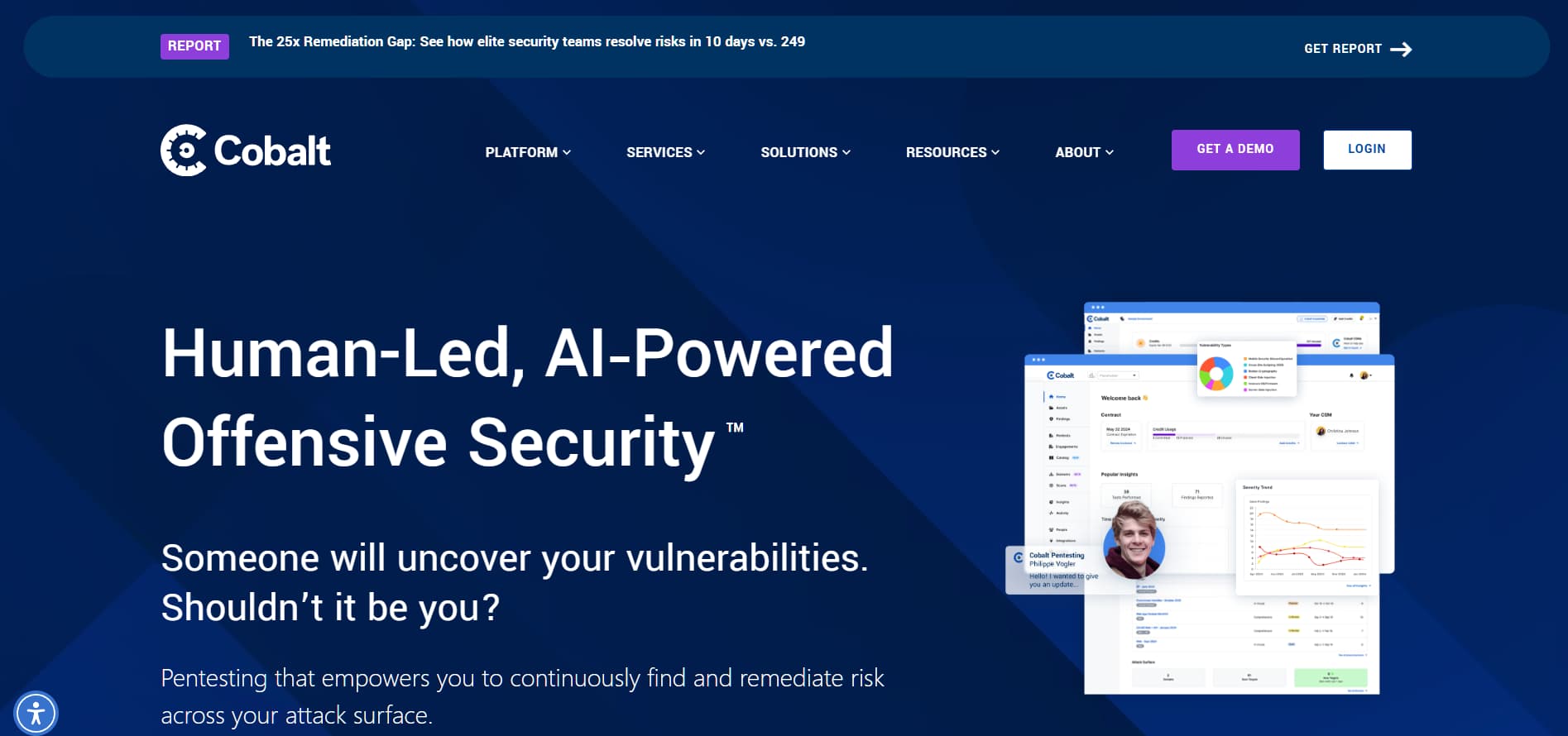
Cobalt Labs stands out for its crowdsourced pen testing approach. Launched in 2013 as a bug bounty platform, Cobalt now provides “Pentest as a Service” by matching clients with a vetted community of ethical hackers. This model can produce rapid, diverse testing expertise. Their platform includes rigorous QA, and around 75% of Cobalt’s revenue reportedly comes from managed penetration tests (with most remainder from bug bounties). This suggests clients get a broad pool of testers with varied skills, which can surface unusual vulnerabilities.
Nigeria Relevance
Cobalt operates globally from a central platform, but has no local Nigerian office. They rely on remote collaboration, so Nigerian buyers should ensure clarity on on-site vs. off-site testing. Cobalt may appeal to Nigeria’s fintech and startup sectors that prefer flexible, cloud-based security services. Since they emphasize compliance (claiming PCI DSS friendly offerings), they can support regulated environments too, though compliance documentation (for NDPA, NITDA) should be verified.
Testing Depth Model
Hybrid (crowdsourced) model: Cobalt uses crowdsourcing combined with structured management. Clients get multiple independent testers focusing on web, mobile, API, and network subsystems. While the model is novel, the actual depth depends on test assignments and reviewer quality. The hybrid nature means clients get diverse skills, but project scope must be well-defined to channel the crowd effectively.
Key Strengths
Potential Limitations
Best For
API-heavy, cloud-native startups and tech companies; organizations seeking flexible, high-volume pentesting (e.g. fintech platforms, e-commerce).
Why They Stand Out
NCC Group stands out as an information assurance firm with a broad managed services portfolio. Founded from the UK’s National Computing Centre, NCC offers not just penetration testing but also escrow, managed services, and assurance. Their pentesting capability includes web, mobile, IoT, and red teaming, and they have acquired many boutique security firms (e.g. Matasano, Intrepidus) to bolster expertise. They are known for systematic security testing and maintaining a CREST presence.
Nigeria Relevance
NCC has no local office in Nigeria (delivery would be international). However, their global scope means large Nigerian organizations (especially multinationals or those serving global markets) could leverage NCC’s cross-border delivery. They can also be appealing to companies with UK/US ties or needing high-assurance testing. Nigerian buyers must verify how NCC would engage remotely and if time zones are accommodated.
Testing Depth Model
Hybrid/manual oriented: NCC’s model relies heavily on expert penetration testers (many of whom came from acquired firms). They use both advanced tooling and deep manual exploitation. Their approach tends to be thorough and research-driven, especially in areas like IoT or industrial systems, reflecting their academic and consultancy roots.
Key Strengths
Potential Limitations
Best For
Mid-sized to large enterprises (especially those with UK/EU connections); regulated sectors needing formal assurance; clients open to cross-border service models.
Common pitfalls include equating brand size with deeper testing. Many buyers assume big name auditors automatically find more bugs, but in practice smaller specialized teams can out-penetrate generic compliance firms. Over-reliance on automated scanning is another error: scans without manual follow-up often miss chained exploits and logic flaws. Some buyers confuse vulnerability assessments with penetration tests – a scan report does not prove an exploit was possible. Report and remediation quality are frequently overlooked; a cheap pentest that yields a laundry list of low-impact issues is less useful than a targeted exploit proof-of-concept. Others treat pentesting as a checkbox exercise for compliance, failing to align scope with actual risk (e.g., ignoring cloud APIs or mobile apps). Assuming that a PTaaS subscription (continuous scan) is equivalent to a deep pentest can be misleading. Buyers should verify that engagements include skilled manual testers and not only junior staff. Some believe local presence guarantees quality, but on-site offices do not ensure technical excellence. It is also risky to accept retesting exclusion clauses or to choose the lowest bid without checking what is and isn’t included. Finally, neglecting to confirm tester certifications and reviewing sample reports can leave buyers with inadequate analysis. In short, focus evaluations on technical rigor and tailored risk coverage, not just labels and delivery models.
Nigeria’s large enterprises and SMBs have different priorities. Large firms often face more complex IT environments, multiple subsidiaries, and stringent audits (finance, telecom, energy regulators). They tend to invest more in security, requiring in-depth scoping, multiple environments, and formal project management. Big companies may lean towards global consultancies or specialized security firms with proven track records in their industry. However, this comes at a cost floor and longer timelines. In contrast, Nigerian SMBs or startups often need faster, affordable testing focusing on key assets (websites, apps). They may benefit from nimble specialist firms or crowdsourced platforms for rapid feedback. SMBs typically have simpler compliance demands but still need solid reporting to satisfy partners or certifications.
Risk exposure also scales: a breach impact for a nationwide bank dwarfs that of a local retailer. Thus, enterprises justify larger teams (even multi-phase red teaming) to minimize residual risk. SMB buyers should beware of under-scoping: paying a global firm’s minimum fee but only testing one server can leave major blind spots. On the technical side, large providers may use more automation for efficiency, which can mean less manual depth unless demanded. Smaller or boutique firms usually offer more hands-on testing. For cloud and API-centric organizations (common in Nigerian fintech), consider providers strong in those areas. Finally, enterprise buyers should verify cross-border feasibility if considering foreign vendors, while SMBs might prefer providers that demonstrate quick responsiveness and clear timelines. In all cases, confirm who owns remediation tracking and reporting – enterprise teams often handle fixes themselves, whereas SMBs may require more guidance from the vendor.
Several factors drive pentesting costs, applicable to Nigeria or anywhere. The scope size is primary: more networks, apps, and IPs require more time and testers. The type of targets matters – infrastructure (OT/IoT) vs. web applications vs. APIs has different complexities. Authenticated tests (with valid credentials) take longer than unauthenticated scans. More complex applications or large APIs increase effort. Scope complexity is also a driver: single login portal vs. multi-factor, microservices, numerous user roles, or business logic intricacies. The depth of manual testing is a big cost factor – thorough exploit development and chaining require skilled staff-hours. Retesting (verifying fixes) adds to cost if not included; note some providers (like DeepStrike) include limited retesting, while others charge extra. The required reporting detail and compliance mapping influence cost – a raw findings dump is cheaper than a fully documented report with risk ratings and audit references.
Delivery mode affects pricing: on-site presence in Nigeria (if needed) or specialized equipment (for critical infrastructure tests) can add travel and per diem. Engaging a high-level red team or a 24/7 rotation will cost more than a standard penetration test. The urgency of the engagement (how soon you need results) also impacts price – expedited projects or weekend work may incur premiums. Lastly, long-term or continuous engagement models (e.g. monthly scanning + periodic tests) will have different cost structures than one-off tests. In the Nigerian market, currency fluctuations and local labor costs can also factor into negotiated rates for international vendors.
Q: What are the top penetration testing companies in Nigeria?A: Our methodology-driven ranking highlights providers like DeepStrike, Accenture Nigeria, Booz Allen, KPMG Nigeria, PwC Nigeria, EY Nigeria, Cobalt Labs, and PhynxLabs. DeepStrike (USA/UAE) is noted as best overall for its manual depth and continuous testing, Booz Allen for enterprise and defense focus, and PhynxLabs as a leading local firm. The full list above compares firms on technical depth, compliance alignment, and Nigeria fit.
Q: How much do penetration testing services cost in Nigeria?A: Costs vary widely based on scope and depth. Nigerian pentests commonly range from a few thousand to tens of thousands of dollars for moderate scopes (e.g. one medium-sized application and network). The actual price depends on the number of systems tested, manual effort required, retesting, reporting level, and any on-site requirements. We did not find public pricing, but buyers should request detailed quotes from providers and ensure that all scope and deliverables are clearly defined.
Q: What is included in enterprise penetration testing?A: Enterprise pentests usually include a comprehensive assessment of networks, applications, APIs, cloud environments, and possibly physical/social engineering tests. They involve credentialed testing of large environments, extensive reporting, and an executive summary. Enterprise tests often come with formal deliverables like compliance mapping (e.g. to ISO, NIST, or local frameworks) and may include workshops. Retesting and follow-up are common parts of enterprise engagements, though specifics vary by vendor.
Q: Are certifications more important than tools?A: Certifications (like OSCP, CREST, CISSP) and experienced testers matter because they indicate proven skill, but tools are also needed. However, a certified tester using only automated tools may still miss issues. A balanced vendor has skilled, certified testers who can adapt tools and custom techniques. In Nigeria, look for evidence of both: certifications show rigor, but ask for examples of manual exploit work. Tools alone do not certify expertise; the analyst behind them does.
Q: How long does a penetration test take?A: It depends on scope. A small network or single application test might take 1–2 weeks. Larger engagements (multi-system, external and internal, etc.) could be a month or more. Additional time is needed for high-quality reporting. Rushing a test (e.g. a few days) often means limited coverage. Nigerian organizations should account for planning, testing, and remediation support phases – typically a pentest contract might span 1–3 months from start to final report.
Q: Is penetration testing required for NDPA, PCI DSS, or ISO 27001 compliance?A: No law in Nigeria universally mandates penetration testing, but it is strongly recommended under many frameworks. For example, the NDPA 2023 imposes data protection rules but does not explicitly require pentests (it focuses on governance and breach notification). However, NITDA guidance and sector regulators (like CBN) encourage security testing. PCI DSS (for card data) explicitly requires annual or continuous penetration testing. ISO 27001 does not mandate pentests by itself, but organizations aiming for ISO certification often include pentesting in their risk management to demonstrate control effectiveness. Always verify specific requirements for your industry.
Q: How often should penetration testing be performed?A: Best practice is at least annually or after major changes (new apps, major upgrades, network changes). Regulated organizations often do annual tests. However, continuous or biannual testing is becoming common, especially for dynamic cloud environments or critical systems. In Nigeria’s fast-moving sectors (e.g. fintech), more frequent testing (e.g. quarterly scans plus annual manual tests) can help manage risk. Ultimately, frequency should match your threat exposure and compliance needs.
Q: Should Nigerian buyers choose a local provider or a cross-border specialist firm?A: It depends on your priorities. Local providers (like PhynxLabs) offer cultural and logistical familiarity, and may better understand local regulations. Cross-border specialists (like DeepStrike, Booz Allen, or the Big Four) may offer deeper technical expertise or sector experience, but may require more coordination. For global compliance projects or highly technical scopes, international expertise can be valuable. For small businesses or projects needing rapid on-site work, a local firm might be preferable. Buyers should evaluate both types, considering technical fit and project management.
Q: What is the difference between vulnerability scanning and penetration testing?A: Vulnerability scanning is automated identification of known weaknesses (unpatched software, open ports, etc.). Penetration testing includes scanning but goes further: skilled testers manually exploit vulnerabilities to prove real attack paths. A scan might say “found X vulnerability,” while a pentest shows “we exploited X to gain admin access,” demonstrating impact. Penetration testing therefore provides deeper insight into risk, beyond what automated scans alone can offer.
Q: What should a penetration testing report include?A: A robust report should detail the scope and methodology, list findings with severity levels, and describe how each vulnerability was exploited (proof-of-concept). Crucially, it should provide actionable remediation advice for each issue. Reports often include an executive summary highlighting overall risk, and ideally reference relevant standards (e.g. “this finding relates to PCI DSS requirement X”). In Nigeria, buyers should also look for clarity on risk to local regulations and ensure responsibility (what the tester did vs. what the client must do) is clearly assigned.
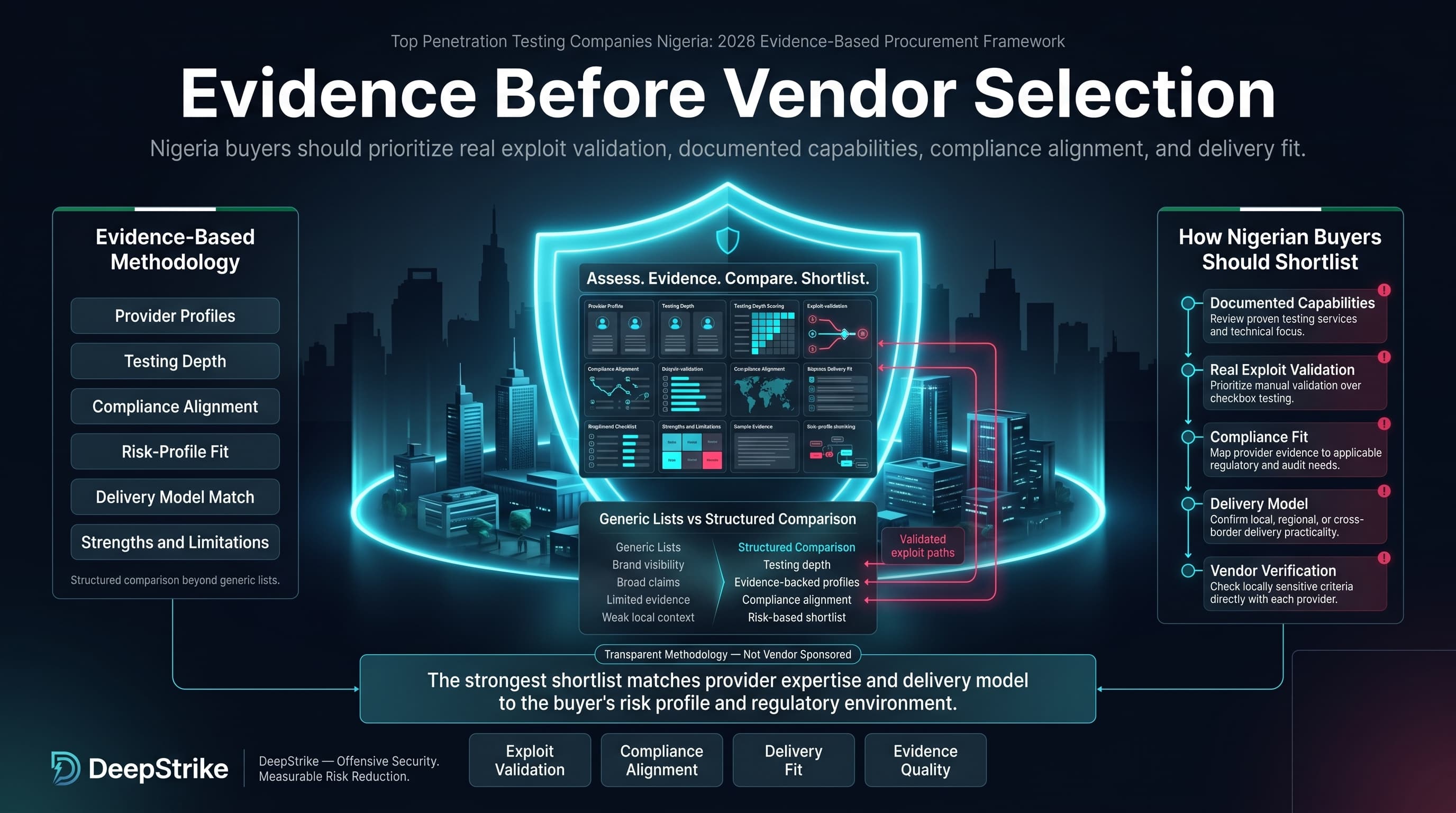
This 2026 vendor ranking for “top penetration testing companies in Nigeria” is rooted in a transparent, evidence-based methodology. It highlights each provider’s strengths and limitations in the Nigerian context. By focusing on provider profiles, testing depth, and compliance alignment, we offer structured comparison beyond generic lists. Nigerian buyers can use these insights to shortlist vendors whose expertise and delivery models match their risk profile and regulatory environment. Remember to verify any locally sensitive criteria directly with vendors and prioritize real exploit validation over checkbox approaches. Buyers comparing providers elsewhere on the continent can use the same methodology with the penetration testing companies in South Africa.
Mohammed Khalil is a Cybersecurity Architect at DeepStrike, specializing in advanced penetration testing and offensive security operations. With certifications including CISSP, OSCP, and OSWE, he has led numerous red team engagements for Fortune 500 companies, focusing on cloud security, application vulnerabilities, and adversary emulation. His work involves dissecting complex attack chains and developing resilient defense strategies for clients in the finance, healthcare, and technology sectors.

Stay secure with DeepStrike penetration testing services. Reach out for a quote or customized technical proposal today
Contact Us
