October 27, 2025
Updated: August 10, 2026
An evidence-dated comparison of penetration testing providers serving Lithuania, with practical guidance on scope, delivery, reporting, retesting, and assurance fit.

Mohammed Khalil
Last Updated: August 2026
Lithuanian organizations evaluating penetration testing providers should compare more than location or a directory rating. The strongest shortlist starts with verified service scope, the people actually assigned to the test, manual exploit validation, reporting quality, data-handling terms, remediation support, and retesting. This 2026 guide compares providers with evidence that they either operate in Lithuania or explicitly serve Lithuanian customers. It also separates ordinary penetration testing from regulated testing requirements so security, procurement, and engineering teams can choose a provider that fits their technical and assurance needs.
Publisher and ranking disclosure: This guide is published by DeepStrike. DeepStrike is listed first as an approved editorial placement by the publisher. That position is not an independent award, a customer-voted result, or a claim that DeepStrike is universally the #1 penetration testing provider in Lithuania. The same evidence categories were applied to every provider, and the shortlist reflects evidence dated August 10, 2026.
A provider qualified only when the research record supported an active penetration-testing or closely related offensive-security service and a defensible Lithuania relationship. We separated providers into three groups: Lithuania-headquartered firms, providers with a verified Lithuanian legal entity or office, and international providers whose first-party materials explicitly say they serve Lithuania. A localized page alone was not treated as proof of a Lithuanian office.
Evidence quality mattered more than list length. First-party service pages were used for active services and delivery claims; official directories were preferred for provider-level accreditation; and directory listings were not accepted as the sole proof of location, price, team size, clients, or quality. Where a capability, credential, price, or on-site option was not directly established, the article tells buyers to verify it instead of filling the gap with an assumption.
The “best fit” descriptions below are editorial buyer guidance inferred from the verified scope and delivery evidence. They are not provider endorsements or promises of outcomes. Before contracting, buyers should still verify the named testers, subcontractors, data location, rules of engagement, insurance where relevant, retesting terms, and the exact legal entity signing the statement of work.
| Rank | Provider | Lithuania relationship | Verified service evidence used | Best fit | Delivery model | Assurance evidence used | Buyer item to verify |
|---|---|---|---|---|---|---|---|
| 1 | DeepStrike | International provider explicitly serving Lithuania; no Lithuanian office/entity verified | Penetration testing, web, mobile, cloud, continuous testing, red-team services | Teams wanting specialist remote testing plus remediation/retesting workflow | Remote | Current first-party service/pricing pages; no local-entity claim | Assigned testers, data handling, scope eligibility, on-site needs |
| 2 | Hackdeflect | UAB Hackdeflect identified in Vilnius in first-party baseline | Penetration testing, red/purple-team services, PTaaS, compliance-related testing | Buyers preferring a Lithuania-linked offensive-security provider with broad service options | Lithuania-linked; exact on-site model to confirm | First-party company/service evidence | Named testers, current credentials, PTaaS terms, on-site availability |
| 3 | Baltic Amadeus | Vilnius address supported in first-party baseline | Active penetration-testing service | Enterprises wanting a Lithuania-established technology partner with a dedicated pentest offer | Local office evidenced; exact engagement delivery to confirm | First-party penetration-testing and company evidence | Exact specialist scope, assigned team, accreditation, retest terms |
| 4 | Critical Security | Vilnius address supported in first-party baseline | Application, network, cloud, red-team, source-code and related security services | Buyers with mixed application/infrastructure scope or adversary-simulation needs | Local presence evidenced; on-site specifics to confirm | First-party company/service evidence | Current methodology, assigned testers, retesting, data retention |
| 5 | Secmentis | International provider with a Lithuania-specific service page | Penetration testing for Lithuania with remote delivery stated | Buyers comfortable with remote delivery who want another international option | Remote | First-party Lithuania service page | Contracting entity, tester location, data handling, exact scope and retest terms |
| 6 | ENNEID | Lithuania-linked in the research baseline; direct legal/location confirmation still required | Active security-testing services | Buyers comparing a smaller security-testing specialist and willing to verify entity/location details | Delivery model to confirm | First-party security-testing evidence; directory-only claims excluded | Legal entity, Lithuania location, assigned testers, current pentest scope, retesting |
| 7 | SolutionLab | Lithuania relationship requires fresh entity/location confirmation | Penetration-testing capability supported by first-party materials; CREST marketplace evidence present in baseline | Buyers that value provider-level accreditation evidence and broader technology/security delivery | Exact Lithuania delivery model to confirm | First-party materials plus official CREST marketplace baseline | Current CREST status, legal entity, Lithuania relationship, assigned team, retesting |
| 8 | Team Secure Lietuva | Lithuania-specific penetration-testing page; local presence not inferred | Penetration testing for the Lithuania market | Buyers comparing a Lithuania-targeted specialist offer | Managed-service/staffing/local delivery model to confirm | First-party Lithuania-specific service page | Contracting entity, tester location, local presence, staffing model, current availability |
| 9 | EC-Council EGS | Lithuania-specific penetration-testing landing page; no Lithuanian office/entity claim | Lithuania-targeted penetration-testing offer | Buyers evaluating a global/localized service option and willing to verify service ownership | Delivery model to confirm | First-party Lithuania-specific landing page | Legal provider, service ownership, assigned testers, data handling, retesting |
| 10 | CyberAudit | Lithuania-targeted service page in the same-day research baseline; local entity not inferred | Lithuania-targeted penetration-testing service | Buyers seeking an additional market option after stronger-evidence providers are reviewed | Delivery model to confirm | Lithuania-targeted first-party service page in research baseline | Company identity, contracting entity, current scope, assigned team, location, retesting |
Lithuania relationship: DeepStrike is treated here as an international provider serving Lithuanian organizations remotely. No Lithuanian office or legal entity was verified in the August 10 research record. Its dedicated Lithuania penetration testing page supports the service-to-Lithuania relationship without implying local establishment.
Verified services: DeepStrike's current first-party materials cover general penetration testing as well as specialist application, mobile, cloud, continuous-testing, and red-team work. Buyers considering a broad authorized assessment can start with the company's penetration testing services to confirm the exact asset types and engagement boundary before scoping.
For application-heavy environments, the current web application penetration testing service is the most relevant first-party scope reference. The buyer should still ask which named tester and reviewer will be assigned and whether the proposed methodology fits the application's architecture, authentication model, APIs, and business logic.
For cloud-heavy environments, DeepStrike also maintains a dedicated cloud penetration testing service. Scope should explicitly cover provider rules, tenant boundaries, identities and permissions, production-safety constraints, excluded destructive actions, and evidence handling.
Delivery and workflow: The August 10 first-party pricing baseline stated that engagements can start within 48 hours and described dashboard access, Slack collaboration, Jira and ServiceNow integrations, plus remediation retesting for 12 months. These are commercial terms to confirm for the specific scope, not a universal SLA or guarantee. Teams with frequently changing systems can also compare whether continuous penetration testing is more appropriate than a single point-in-time test.
Best fit: As an editorial fit assessment, DeepStrike is most relevant to teams that are comfortable with remote specialist delivery and value a structured collaboration/retesting workflow. It may be less suitable when procurement requires a Lithuanian contracting entity, Lithuanian-language delivery, or guaranteed on-site testing; those points should be settled before award.
Credentials and assurance: This comparison does not rely on unverified DeepStrike team certifications, awards, client logos, ratings, retention figures, or a Lithuanian location. Ask for the credentials of the actual testers assigned to the engagement rather than treating a generic company credential list as proof of who will test your systems.
Public pricing status: A public commercial/pricing page exists, but the final project price depends on scope and assumptions. Use the penetration testing pricing page as a starting point and request a written proposal that identifies assets, environments, roles, endpoints, manual effort, reporting, retesting, data handling, and change triggers.
Evidence date and first-party sources: August 10, 2026 DeepStrike Lithuania service, penetration-testing service, specialist service, continuous-testing, red-team, and pricing pages.
Lithuania relationship: The August 10 first-party research baseline identified UAB Hackdeflect in Vilnius. That is stronger local evidence than a directory location alone, although the exact contracting and on-site delivery model should still be confirmed in the proposal.
Verified services: Hackdeflect's first-party site advertised penetration testing, red/purple-team services, PTaaS, and compliance-related testing in the research baseline. Those categories support inclusion; this guide does not carry over unverified client counts, certifications, framework claims, or delivery promises from the previous article.
Best fit: Hackdeflect is a reasonable shortlist candidate for organizations that want a Lithuania-linked provider and may need more than a conventional one-time pentest, such as red/purple-team or platform-supported testing. “Best fit” here is an editorial inference from the published scope, not a provider claim.
Credentials and assurance: No provider accreditation or individual tester credential is used as a ranking fact in this comparison. Ask Hackdeflect to identify the assigned testers and reviewers, their relevant credentials, any subcontractors, and the controls used for sensitive evidence.
Public pricing status: No current first-party project price was relied on. Treat pricing as quote-based until Hackdeflect supplies a current written proposal.
Buyer item to verify: Confirm the exact PTaaS model, on-site availability, test coverage, retesting, report format, critical-finding escalation, contracting entity, and data-retention terms.
Evidence date and first-party source: August 10, 2026 Hackdeflect first-party website.
Lithuania relationship: The research baseline supported a current Vilnius address and a live penetration-testing offer from Baltic Amadeus. This establishes meaningful Lithuania relevance without relying on a marketplace directory.
Verified services: Baltic Amadeus maintains a dedicated penetration testing service page. This article deliberately avoids expanding that evidence into unverified hardware, mobile, client, certification, or regulatory-specialization claims.
Best fit: Baltic Amadeus can be considered by enterprises that prefer a Lithuania-established technology partner and want penetration testing within a broader technology relationship. Buyers needing a highly specialized niche test should verify the named team and recent comparable engagement experience rather than assuming breadth from the wider company portfolio.
Credentials and assurance: No company accreditation or assigned-tester certification is asserted here without a re-opened current source. Request exact evidence for the people assigned, independent review, report quality controls, and any third parties used in delivery.
Public pricing status: No first-party fixed price or Lithuania market rate was relied on. Treat pricing as quote-based.
Buyer item to verify: Confirm detailed technical scope, local/on-site availability, assigned-team credentials, current accreditations, sample-report availability, retesting, and the treatment of production data and credentials.
Evidence date and first-party source: August 10, 2026 Baltic Amadeus penetration-testing page and company location evidence in the research baseline.

Lithuania relationship: Current first-party evidence in the research baseline supported a Vilnius address for Critical Security.
Verified services: Critical Security supported active application, network, cloud, red-team, source-code, and related security services in the August 10 baseline. Those verified categories make it relevant where a buyer has mixed application and infrastructure scope or needs a more adversarial engagement model.
Best fit: Critical Security is a practical shortlist option for organizations that want Lithuania-linked delivery and need to compare conventional penetration testing with deeper red-team or code-review work. The buyer should define which of those activities is actually in scope because they are not interchangeable.
Credentials and assurance: This update does not carry forward unverified founding-history claims, practitioner certifications, client sectors, or “veteran” superlatives from the previous article. Ask for the current tester and reviewer roster, relevant credentials, engagement governance, and evidence-handling process.
Public pricing status: No current first-party fixed price was verified for this comparison. Treat pricing as quote-based.
Buyer item to verify: Confirm precise service boundaries, whether tests are remote or on-site, production-safety controls, retesting, report format, critical escalation, subcontractors, and data retention.
Evidence date and first-party source: August 10, 2026 Critical Security first-party website.

Lithuania relationship: Secmentis is included as an international provider serving Lithuania, not as a Lithuania-headquartered firm or a company with a verified Lithuanian office.
Verified services and delivery: The Secmentis Lithuania penetration-testing page explicitly offered penetration testing for Lithuania and stated that testing can be delivered remotely in the August 10 research baseline. That direct first-party service-to-country evidence is sufficient for the remote-provider category.
Best fit: Secmentis is most relevant to buyers that are comfortable with remote delivery and want to compare another international provider against Lithuania-established options. Organizations requiring a Lithuanian legal entity, local-language delivery, or on-site testing should verify those requirements rather than infer them from the localized page.
Credentials and assurance: No provider accreditation, tester certification, customer claim, or performance metric is used here without current direct evidence.
Public pricing status: No current first-party price was relied on. Treat pricing as quote-based.
Buyer item to verify: Confirm the contracting entity, tester location, data processing and transfer terms, assigned team, exact technical scope, reporting, remediation support, and retesting.
Evidence date and first-party source: August 10, 2026 Secmentis Lithuania penetration-testing page.
Lithuania relationship: ENNEID was a strong research candidate in the August 10 production prompt. First-party materials supported active security-testing services, while the Lithuania location relationship depended partly on third-party profiles. This article therefore does not present ENNEID as definitively Lithuania-headquartered or as having a verified local legal entity.
Verified services: ENNEID's first-party site was included in the same-day research baseline as an active security-testing source. Directory-derived prices, team size, ratings, customer names, and location claims are deliberately excluded.
Best fit: ENNEID may be worth shortlisting for buyers that want to compare a smaller specialist security-testing provider against larger consultancies, provided procurement first confirms the exact contracting entity and current penetration-testing scope.
Credentials and assurance: No current accreditation, tester certification, customer rating, or compliance claim is used as a ranking fact here.
Public pricing status: No current first-party price was relied on. Treat pricing as quote-based.
Buyer item to verify: Confirm legal entity, Lithuania relationship, assigned testers, exact pentest scope, data handling, report format, remediation support, and retesting.
Evidence date and first-party source: August 10, 2026 ENNEID first-party website in the original production research baseline.
Lithuania relationship: SolutionLab was retained in the original August 10 strong-candidate set because first-party materials supported penetration-testing capability and the CREST marketplace baseline supported provider-level penetration-testing accreditation. The current Lithuanian entity/location was not re-opened during this execution, so no definitive local-office claim is made.
Verified services and assurance evidence: SolutionLab appeared in the first-party research set, and the official CREST Marketplace entry was included as the accreditation reference. Because the live directory could not be reopened in this execution, buyers should confirm that the current legal entity and service category still match the proposed engagement.
Best fit: SolutionLab is most relevant to buyers that place weight on formal provider-level accreditation evidence and want to compare a security provider that may sit within a broader technology-services relationship.
Public pricing status: No first-party project price was used.
Buyer item to verify: Confirm current CREST status, legal entity, Lithuania relationship, assigned testers, exact service category, report/review process, data handling, and retesting terms.
Evidence date and sources: August 10, 2026 SolutionLab first-party website and CREST Marketplace baseline.

Lithuania relationship: Team Secure Lietuva is included because the same-day research baseline identified a dedicated Lithuania penetration-testing page. A Lithuania-specific page supports market relevance but does not, by itself, prove a Lithuanian legal entity, permanent office, or locally staffed delivery team.
Verified services: The first-party page explicitly targeted penetration testing for the Lithuania market in the production research baseline.
Best fit: Team Secure Lietuva is an additional option for buyers who want a Lithuania-targeted offer and are willing to verify whether delivery is local, remote, managed, subcontracted, or staffing-based before awarding work.
Credentials and assurance: No tester certification, provider accreditation, customer list, or performance metric is asserted here.
Public pricing status: No current first-party price was relied on.
Buyer item to verify: Confirm the contracting entity, local presence, assigned tester location, staffing model, tester availability, technical scope, evidence retention, and retesting.
Evidence date and first-party source: August 10, 2026 Team Secure Lietuva penetration-testing page.
Lithuania relationship: EC-Council EGS is included as a Lithuania-targeted international/localized option because the production research baseline identified an explicit penetration testing in Lithuania page. This does not establish a Lithuanian office or legal entity.
Verified services: The baseline supports the existence of a Lithuania-specific penetration-testing offer. It does not, by itself, establish which legal entity contracts the work, who performs the test, where testers are located, or whether delivery is direct or partner-led.
Best fit: This option is most relevant to buyers expanding beyond Lithuania-established providers and comparing internationally branded service delivery.
Credentials and assurance: No current practitioner credential, provider accreditation, or quality claim is carried into this ranking merely from the brand name.
Public pricing status: No current price was relied on.
Buyer item to verify: Confirm the legal provider, service ownership, assigned testers and reviewers, delivery location, subcontractors, data handling, report ownership, remediation support, and retesting.
Evidence date and first-party source: August 10, 2026 EC-Council EGS Lithuania penetration-testing landing page.
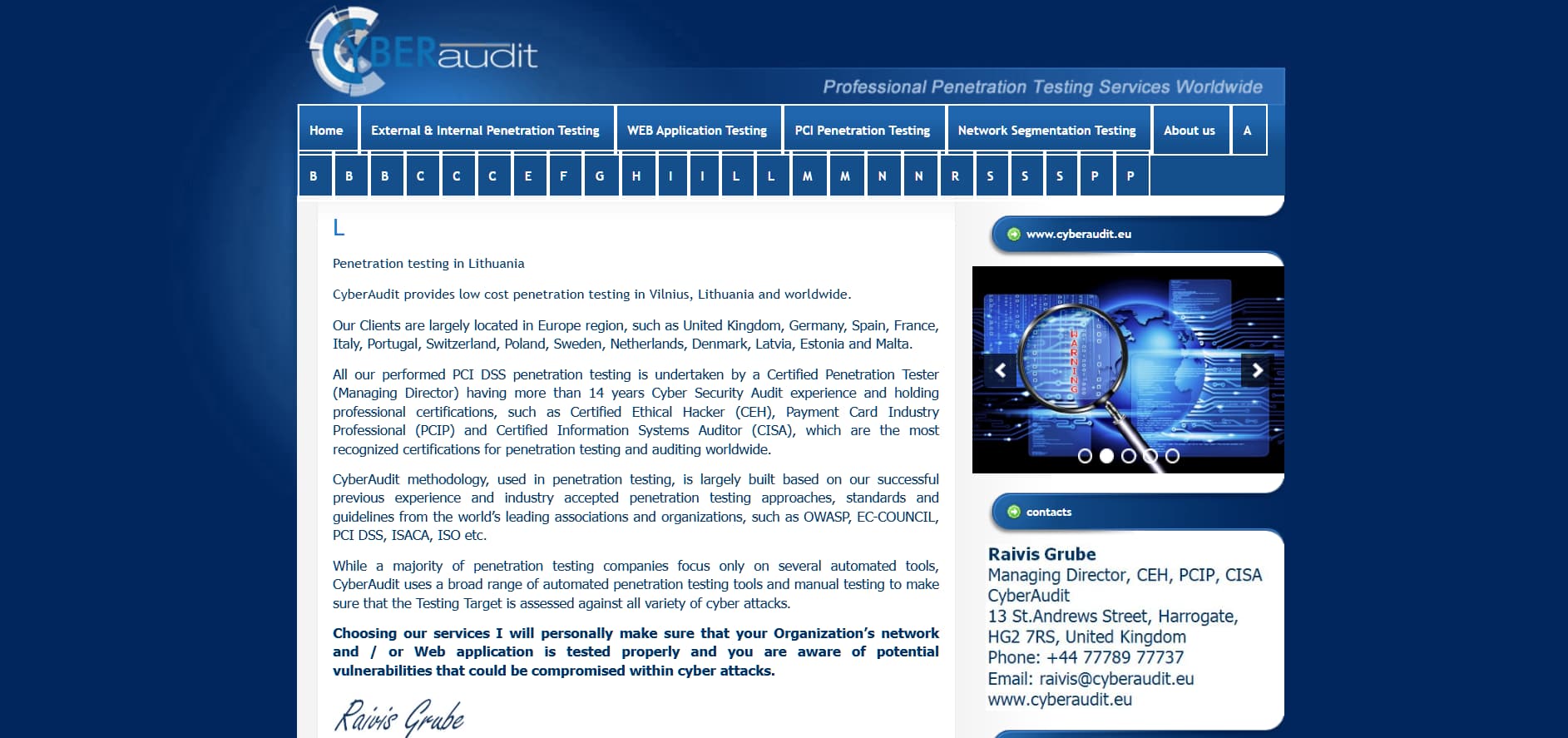
Lithuania relationship: CyberAudit was identified in the August 10 research baseline as a provider with a Lithuania-targeted penetration-testing service page. Because execution-time public-web reopening is unavailable, this entry is deliberately conservative and does not infer headquarters, a Lithuanian office, or a Lithuanian legal entity.
Verified services: The same-day production research supports a Lithuania-targeted penetration-testing offer at the category level. Company identity, current service ownership, and delivery details require re-verification before publication and contracting.
Best fit: CyberAudit is best treated as an additional market option to investigate after higher-confidence providers have been evaluated, not as a substitute for due diligence.
Credentials and assurance: No current accreditation, tester certification, client claim, rating, or performance claim is used.
Public pricing status: No verified current public price is used.
Buyer item to verify: Confirm the current company identity, contracting entity, service ownership, tester location, assigned team, technical scope, reporting, data handling, remediation support, and retesting.
Evidence date and source basis: August 10, 2026 Lithuania-targeted CyberAudit service page identified in the original production research baseline; execution-time source reopening pending.
Start with the decision you need the test to support. A procurement exercise for a single web application, an internal network, a cloud platform, a mobile product, an adversary-simulation program, and a regulated TLPT engagement are different scopes. DeepStrike's broader vendor-selection guide can help frame the shortlist, but the Lithuania-specific decision should begin with the exact assets, threat assumptions, business constraints, and evidence requirements.
Define the technical scope before comparing names. For a web application, document roles, authentication paths, APIs, business-critical workflows, integrations, and test environments. For infrastructure or cloud, define accounts, subscriptions, tenants, identity boundaries, external exposure, production restrictions, and provider rules. A broad label such as “full pentest” is not a comparable scope.
Choose local presence only when it solves a real requirement. A Lithuania-based entity may simplify contracting, language, travel, or on-site work, while a remote specialist may offer a better technical match for a narrow stack. Ask separately about legal entity, tester location, on-site availability, working language, subcontractors, and where evidence will be stored.
Verify the people, not just the logo. Request the named lead tester, reviewer, relevant practitioner credentials, recent experience with the same technology class, and any subcontractors. Company-level accreditation and individual certifications answer different questions and should not be substituted for each other. The more detailed 25-question penetration-testing buyer checklist can be used during technical evaluation.
Separate manual exploit validation from scanning. Automated discovery can support an engagement, but a penetration test should make clear where qualified humans validate exploitability, test authorization/business logic, examine attack chains, and control the safety of exploitation. Ask what the provider will not test as well as what it will test.
Match the engagement model to change velocity. A one-time assessment can be appropriate for a defined release or assurance event; frequently changing systems may benefit from a repeatable program. Continuous testing should still specify where human testing occurs, how new scope is added, how findings are triaged, and what retesting actually covers.
Do not confuse penetration testing with red teaming. A conventional pentest is normally scoped to find and validate weaknesses in defined assets; a red-team engagement can test broader detection and response objectives under an adversary-simulation model. The authorization, operational-risk controls, objectives, and success criteria should reflect the actual engagement type.
Put authorization and safety in writing. The rules of engagement should define authorized assets, dates, source IPs where relevant, prohibited actions, production-safety constraints, emergency contacts, stop conditions, evidence handling, credential handling, and escalation for critical findings. A vague statement of work is a procurement risk even when the technical team is strong.
Compare report and remediation workflow. Ask for a representative redacted report or a detailed report specification. It should separate executive and technical views, describe evidence and impact, show reproducible steps where safe, prioritize remediation, explain chained risk where relevant, and state how retesting changes finding status.
Normalize commercial assumptions. Two quotes are not comparable if one includes authenticated testing, multiple roles, an API, a staging environment, a retest, and a workshop while the other does not. Ask every provider to price against the same scope and list assumptions, exclusions, travel/on-site costs, evidence-retention terms, retesting, and change triggers. Procurement teams can also use a focused vendor red-flags guide to challenge vague scope or evidence.
Lithuania's cybersecurity obligations should be treated as a scope question, not a marketing shortcut. Lithuania amended its Cyber Security Law as part of NIS2 transposition, and the National Cyber Security Centre under the Ministry of National Defence is a central national cybersecurity authority. The exact obligations depend on the organization, sector, system, role, and applicable implementing rules; this article is not legal advice.
At EU level, NIS2 Article 21 requires appropriate and proportionate cybersecurity risk-management measures and includes assessment of their effectiveness. It does not create one universal annual penetration-testing rule for every entity. For defined digital-sector entities, Commission Implementing Regulation (EU) 2024/2690 provides more specific technical and methodological requirements; security testing can involve different automated and manual methods and may include penetration testing depending on scope.
DORA establishes an ICT risk-management and testing framework for defined financial entities. Threat-led penetration testing is a specialized regulatory regime for selected entities, not a synonym for an ordinary pentest and not a requirement for every Lithuanian company. Where TLPT may apply, the organization should check the current selection criteria, competent-authority process, tester requirements, and Commission Delegated Regulation (EU) 2025/1190 before scoping the engagement.
GDPR Article 32 uses a risk-based approach and refers to regular testing, assessing, and evaluating the effectiveness of security measures where appropriate; it does not universally require a penetration test. PCI DSS is different in that applicable in-scope cardholder-data environments can have explicit penetration-testing requirements, so the current PCI SSC version and requirement text should be checked for the environment. ISO/IEC 27001 supports risk-based information-security management but does not universally require a penetration test by name.
A penetration-test report can support assurance, remediation evidence, or a compliance program. It does not by itself prove compliance, guarantee certification, satisfy every regulator, prevent a future breach, or show that every finding has been fixed.
There is no defensible national price range in the evidence used for this update, so this guide does not publish one. Directory hourly rates, global averages, and old provider figures are not reliable substitutes for a Lithuania-specific market benchmark.
A comparable proposal should state the number and type of assets, applications, APIs, roles, endpoints, accounts, environments, network ranges, cloud tenants, and testing windows. It should also state the expected manual effort, whether authenticated testing is included, report and workshop deliverables, critical-finding escalation, remediation support, retesting, on-site/travel assumptions, evidence retention, and data-handling constraints.
For DeepStrike specifically, the current penetration testing pricing page can be used to understand published commercial terms before requesting a scope-specific quote. For other providers in this shortlist, this article treats pricing as quote-based or not publicly verified unless a current first-party source is reviewed during procurement.
When comparing bids, ask each provider to price the same statement of work and identify what would trigger a change order. A lower total can reflect a narrower scope, fewer test roles, less manual effort, no retest, a different reporting package, or different data-handling assumptions not necessarily better value.
Use the questions below to turn a shortlist into a comparable procurement record. For a more extensive interview framework, use the separate DeepStrike buyer guide rather than expanding this article into a full RFP template.
| Evidence area | Buyer question | What acceptable evidence can look like | Red flag to investigate |
|---|---|---|---|
| Scope fit | Does the statement of work enumerate every asset, role, environment, boundary, and exclusion? | Asset list, role matrix, IP/domain/API scope, assumptions and exclusions | “Full pentest” with no measurable boundary |
| Assigned team | Who will test, review, and handle evidence? Are subcontractors involved? | Named roles, relevant practitioner credentials, reviewer, subcontractor disclosure | Company credential list with no assigned people |
| Manual depth | Where do humans validate exploitability, logic flaws, authorization, and attack chains? | Methodology tied to the actual asset type and safe exploitation rules | Scanner output presented as a complete pentest |
| Authorization and safety | What is explicitly authorized and what causes testing to stop? | Signed authorization, rules of engagement, emergency contacts, stop conditions | Ambiguous authorization or destructive actions not addressed |
| Lithuania/EU delivery | Which entity contracts, where are testers/evidence located, and is on-site work actually available? | Contracting entity, processing locations, transfer terms, travel/on-site plan | Localized webpage treated as proof of local office |
| Reporting and remediation | How are critical findings escalated, explained, fixed, and retested? | Executive summary, technical evidence, remediation guidance, retest status rules | No sample/report specification or unclear retest policy |
| Commercial assumptions | What is included, excluded, and change-controlled? | Comparable line items, retest terms, travel, data handling, timeline, change triggers | Low headline price with material scope omitted |
Not necessarily. A Lithuania-based legal entity or office can help when your procurement process requires local contracting, Lithuanian-language work, or on-site activity. For many application, cloud, and infrastructure scopes, a qualified remote specialist can also be appropriate. Verify the contracting entity, tester location, data handling, language, subcontractors, and on-site requirements separately.
Ask for the named lead tester and reviewer, credentials relevant to the actual technology, recent comparable experience, and any subcontractors. Do not assume that a company accreditation proves that a particular certified practitioner will perform your test, and do not treat an individual certification as company-level accreditation.
No. These frameworks have different scopes and obligations. NIS2 is risk-based; DORA applies to defined financial entities and TLPT to selected entities; GDPR Article 32 requires risk-appropriate security measures and effectiveness testing where appropriate. Some specific rules or standards can require penetration testing for particular in-scope entities or environments, so confirm the exact requirement that applies to you rather than adopting a universal annual rule.
Retesting is valuable because it checks whether a specific reported weakness was remediated as intended. Ask what counts as a retest, how many cycles or what time window is included, whether architectural changes create new scope, what evidence is produced, and how the final report distinguishes fixed, partially fixed, accepted, and still-open findings.
Normalize the scope first. Make every bidder price the same assets, roles, environments, authentication level, testing window, manual effort expectations, reporting, workshop, retesting, on-site work, evidence retention, and data-handling requirements. Then compare technical depth, assigned people, safety controls, deliverables, and commercial assumptions not only the headline price.
Provider accreditation generally applies to an organization's processes or service capability under a specific scheme, while practitioner certifications apply to individual people. Both can be useful evidence, but they answer different questions. Verify the current accreditation in the official directory and confirm which certified people will actually work on your engagement.
The strongest penetration-testing shortlist for a Lithuanian organization is not the longest list of cybersecurity companies. It is the set of providers whose Lithuania relationship, technical scope, assigned people, testing depth, authorization controls, reporting, retesting, data handling, and commercial assumptions can be evidenced before the contract is signed.
DeepStrike appears first in this guide by disclosed publisher editorial placement, while Lithuania-established and remote alternatives are compared under the same evidence rules. Use the shortlist as a starting point, then make the final decision against your own architecture, assurance obligations, procurement constraints, and risk tolerance.
If DeepStrike is a technical fit, the next step is to discuss a properly authorized scope and request a proposal that makes the assets, test model, deliverables, data handling, and retesting terms explicit.
Mohammed Khalil is a Cybersecurity Architect at DeepStrike, specializing in advanced penetration testing and offensive security operations. With certifications including CISSP, OSCP, and OSWE, he has led numerous red team engagements for Fortune 500 companies, focusing on cloud security, application vulnerabilities, and adversary emulation. His work involves dissecting complex attack chains and developing resilient defense strategies for clients in the finance, healthcare, and technology sectors.

Stay secure with DeepStrike penetration testing services. Reach out for a quote or customized technical proposal today
Contact Us
