October 21, 2025
Updated: November 5, 2026
Compare penetration testing providers for Estonian buyers, local vs. remote delivery, technical scope, reporting, retesting, and buyer fit.

Mohammed Khalil
Estonian organizations comparing penetration testing companies should look beyond a vendor’s location label and verify the actual testing team, scope, delivery model, reporting, remediation support, and data-handling terms. This 2026 guide compares ten providers, separating firms that publish an Estonian address from international providers that serve Estonia remotely. The goal is not to declare one universally “best” firm, but to help CISOs, engineering leaders, compliance teams, and procurement teams identify the provider that fits their assets, operational constraints, and assurance needs.
Comparing providers beyond Estonia? Our worldwide list of penetration testing companies covers firms that deliver testing across regions.
In the Baltics, see also Latvia and Lithuania.
Publisher disclosure: This guide is published by DeepStrike, a penetration testing provider that is listed first. That position is not an independent award or a paid third-party ranking. Weigh our entry the way you would any vendor's description of its own service, and compare scope, sample reports, and references for every provider before you buy.
This comparison was refreshed in November 2026 from each provider's official website. Each entry needs evidence of an active penetration testing or red team service on the provider's own site and a defensible Estonia relationship, such as a published Estonian address or an Estonia-specific service page. One exception is marked as such: Blaze Information Security publishes no Estonia office or Estonia-specific page and is included as an EU-based remote option. A directory listing alone is never treated as sufficient proof.
For this guide, Estonia-based or established means first-party evidence identifies an Estonian company or a specific Estonian address/entity. Verified Estonia office/entity means the legal entity or office itself is supported by evidence. Serves Estonia means the provider explicitly markets or delivers penetration testing to Estonian organizations, but that does not imply an Estonian office or legal entity.
The comparison focuses on the dimensions buyers can verify during procurement: scope, manual testing depth, assigned testers, authorization and rules of engagement, delivery model, reporting, remediation, retesting, data handling, and commercial assumptions. For a broader selection process, DeepStrike’s 25 questions to ask a penetration testing company expands these checks without relying on a vendor score.
The list is deliberately evidence-led. Where a provider publishes an Estonian address, the entry says so; where it only markets services to Estonia, the entry says that instead. A missing public claim is not proof a provider lacks a capability; it is a reason for the buyer to verify it directly.
Candidate pool and check date: we started from firms that publish a Tallinn address and an active testing service (Clarified Security, Trilight Security, Datami, Cybernetica, NEVERHACK Estonia, and Sekurno), providers with an Estonia-specific service or ordering page (Secmentis and Team Secure Eesti), and one EU-based remote option (Blaze). Provider service pages were re-checked on 3 November 2026. We did not commission test engagements, so entries describe published scope and delivery terms, not measured testing quality.
| # | Provider | Estonia relationship | Published service scope | Best fit | Delivery model | Assurance evidence | Buyer item to verify |
|---|---|---|---|---|---|---|---|
| 1 | DeepStrike | International provider serving Estonia remotely; HQ Newark, Delaware | Application, cloud, and infrastructure penetration testing | Engineering teams wanting remediation collaboration | Remote | Team certifications on services page; Clutch 5.0 from 27 reviews | Assigned testers, exact scope, data handling |
| 2 | Clarified Security | Estonian company; Tallinn address | Manual web application testing; red teaming; custom network and hardware testing | Buyers prioritizing manual web app testing from a local firm | Usually remote (internet or VPN) | ISO 9001 and ISO/IEC 27001 logos on website | Non-web scope, report format, retest terms |
| 3 | Secmentis | Estonia service page; no Estonian address published | External, internal, web, mobile, physical, wireless testing | Buyers comfortable with remote delivery | Remote; on-site to confirm | Team credentials stated (CISA, CEH, GIAC) | Contracting entity, on-site availability, methodology |
| 4 | Blaze Information Security | No published Estonia office or Estonia-specific page; EU-based remote option (offices in Berlin, Porto, Recife) | Web, API, mobile, cloud, network, AI/LLM testing; red team; PTaaS | Product and SaaS teams | Remote (to confirm) | CREST and ISO 27001 badges on website | Whether it accepts Estonian engagements; certificates, on-site needs, retest terms |
| 5 | Team Secure Eesti | Estonian-language site; address in Geneva, Switzerland | Web, network, API, mobile testing; red team | Buyers wanting on-site option and Estonian-language ordering | On-site in Estonia or remote | ISO 27001 and ISO 9001 listed | Contracting entity, who performs testing |
| 6 | Trilight Security | Trilight Security OÜ; Tallinn address | Web, mobile, cloud, network, API, AI/LLM, blockchain testing; TLPT | Buyers needing broad scope or TLPT | To confirm | ISO 27001:2022 badge; named tester certifications | Assigned testers, white-label or subcontracting |
| 7 | DATAMI | Tallinn office; second office in Ukraine | Network, infrastructure, web, mobile, API, blockchain, cloud testing | SMBs wanting broad coverage with retest | To confirm | Team certification logos (OSCP, CISSP, CREST CPSA) | Contracting entity, testing office, data handling |
| 8 | Cybernetica | Tallinn headquarters | Infrastructure, web, mobile testing; red teaming; social engineering | Buyers wanting a local technology company | To confirm | None published for testing | Methodology, sample report, team size |
| 9 | NEVERHACK Estonia | Tallinn address; part of NEVERHACK group | Red and purple team; web, mobile, industrial network, infrastructure testing | Industrial and public-sector buyers | To confirm | Group-level certifications on main site | Contracting entity, report format, retest terms |
| 10 | Sekurno | Tallinn address on website | Web, API, mobile, cloud, Kubernetes, network, smart contract testing | Regulated SaaS, healthtech, fintech teams | To confirm | Named methodologies (PTES, OWASP) | Contracting entity, timeline, retest window |
DeepStrike publishes this list and lists itself first; list order is not a quality ranking, and the order of providers after DeepStrike is not a numeric score.
Public offering: DeepStrike's penetration testing services describe human-led testing across applications, cloud environments, and infrastructure, supported by a findings and collaboration platform. Its public process covers planning, reconnaissance, vulnerability discovery, controlled exploitation, reporting, and technical support. Published reports include reproduction steps, remediation guidance, and root-cause information; the proposal should define exact coverage and commercial terms.
Estonia relevance: Founded in 2016, DeepStrike LLC is headquartered in Newark, Delaware, has 11–50 employees, and also publishes a business address in Dubai, UAE (IFZA Business Park). It delivers testing remotely for Estonian clients; define tester locations, permitted subcontracting, and data-handling restrictions in the engagement agreement.
Team certifications: OSCP, OSWE, OSEP, OSWP, GXPN, GWAPT, eCPPT, eMAPT, eWPT, CREST CPSA, CRTP, CRTE, and Microsoft Azure Security Engineer Associate, as shown on DeepStrike's services page.
Official sources: Pricing , Contact Us
Buyer fit: Engineering teams that need application, cloud, or infrastructure testing with direct remediation collaboration.
| Documented strengths | Limits and buying considerations |
|---|---|
| Human-led testing with reproduction evidence, root-cause information, and remediation guidance. | The service description is not an independently measured quality comparison. Assess the assigned team and a relevant sample report. |
| The published Basic plan lists Slack collaboration, customizable reports, and 12 months of remediation retesting. | No numeric price is displayed on the pricing page. Basic is a one-shot test; recurring coverage belongs to a different plan, with contract-specific terms. |
| Team certifications shown on the services page include OSCP, OSWE, OSEP, OSWP, GXPN, GWAPT, eCPPT, eMAPT, eWPT, CREST CPSA, CRTP, CRTE, and Microsoft Azure Security Engineer Associate. | These are individual tester credentials, not a company-level accreditation; ask which certified testers will be assigned to your engagement. |
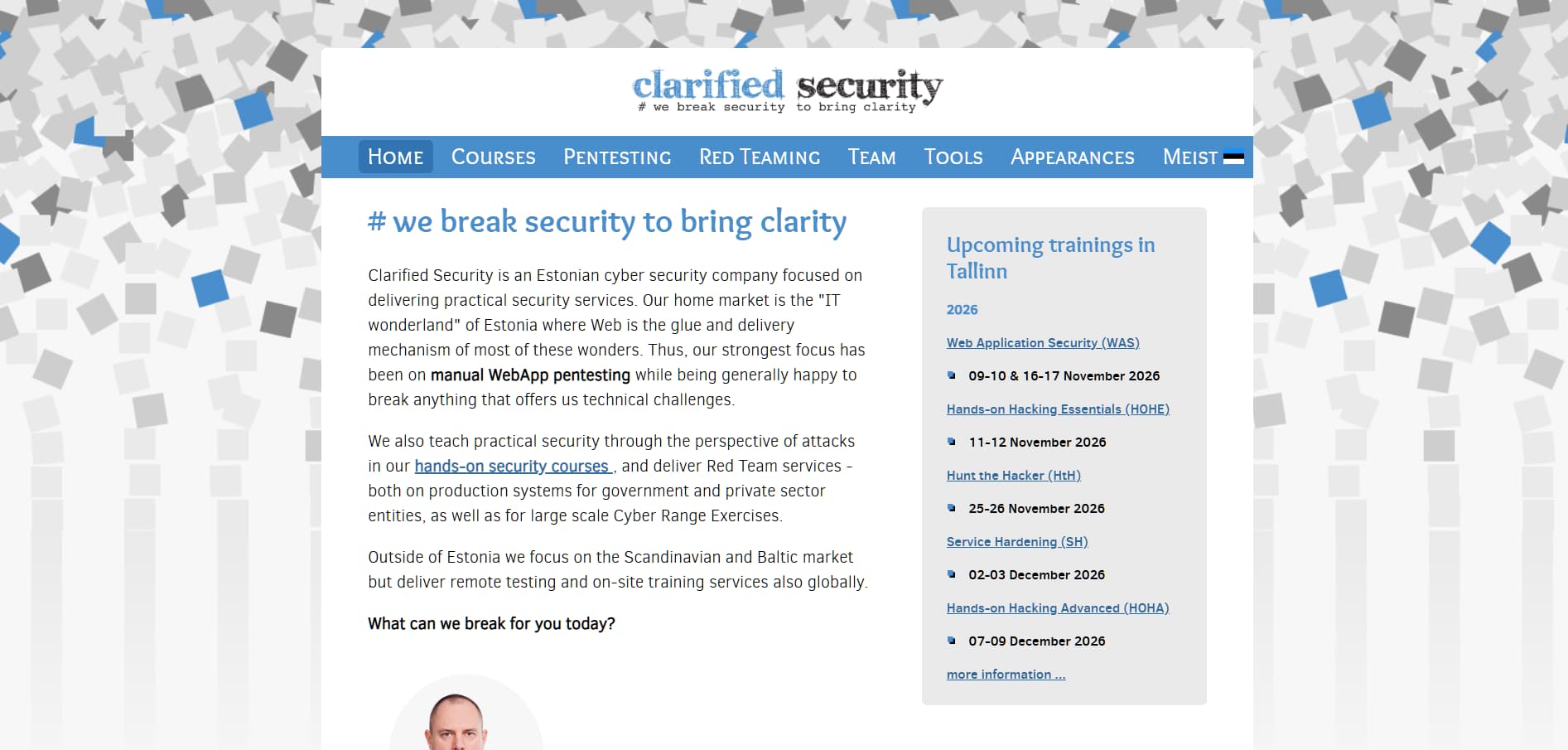
Public offering: Clarified Security OÜ describes manual web application penetration testing, based on OWASP ASVS Level 2 or higher, as its main testing service, usually delivered remotely over the internet or VPN. It also lists custom testing of networks, wireless systems, devices and hardware, and red teaming for government and private-sector clients, alongside cyber range exercises and hands-on security training courses.
Estonia relevance: Clarified Security publishes its address at Lõõtsa 12, 11415 Tallinn, Estonia, and its website displays ISO 9001 and ISO/IEC 27001 logos; ask for the certificates and their scope. Define tester locations, any subcontracting, and data-handling terms in the agreement.
Official sources: https://clarifiedsecurity.com/penetration-testing/; https://clarifiedsecurity.com/
Best fit: Estonian organizations whose priority is manual web application testing from a locally established provider.
What sets it apart in Estonia: manual web application testing against OWASP ASVS Level 2 or higher is its stated core service, from a Tallinn team that also runs hands-on security courses, which suits product teams that want verification-standard coverage rather than a scan-led test.
Limitation / what to confirm: the pentest page does not mention retesting, and network or hardware scopes are described as custom work; confirm retest terms and how non-web scopes are staffed.
| Documented strengths | Limits and buying considerations |
|---|---|
| Manual web application testing against OWASP ASVS Level 2 or higher, plus red teaming and custom network, wireless, and hardware testing. | The service page does not describe report contents or retesting; request a sample report and retest terms. |
| Tallinn company address and ISO 9001 and ISO/IEC 27001 logos on its website. | Non-web scopes are described as custom work; confirm availability, team, and timeline for API, cloud, or mobile testing. |
Public offering: Secmentis Ltd publishes an Estonia penetration testing page covering external, internal, web application, mobile application, physical, and wireless penetration testing. It describes a mix of manual and automated testing that simulates outsider or insider attackers, reports written for both business and technical readers with remediation recommendations, and fixed quotes agreed before work begins. It also offers managed security, incident response, vulnerability assessment, and social engineering services.
Estonia relevance: Secmentis names Estonian cities including Tallinn and Tartu on its Estonia page and states that testing can be provided remotely; it does not publish an Estonian street address. Confirm the contracting entity, tester locations, on-site availability for physical or internal testing, and data handling in the agreement.
Certifications: Secmentis states that its team holds information security accreditations including CISA, CEH, and SANS GIAC.
Official sources: https://www.secmentis.com/estonia/penetration-testing; https://www.secmentis.com/estonia/contact
Best fit: Estonian organizations comfortable with remote delivery that want a broad catalog of test types, including physical and wireless.
What sets it apart in Estonia: it covers physical and wireless testing alongside network and application tests, with fixed quotes agreed before work begins.
Limitation / what to confirm: no Estonian street address is published; confirm the contracting entity, who travels for physical or internal tests, and data-transfer terms.
| Documented strengths | Limits and buying considerations |
|---|---|
| Published coverage spans external, internal, web, mobile, physical, and wireless testing. | No company address or named methodology framework is published; ask for the methodology and a sample report. |
| States that quotes are fixed and agreed before work begins. | No Estonian office is published; agree how on-site work, time zones, and evidence storage will be handled. |
Public offering: Blaze Information Security lists penetration testing of web applications, APIs, mobile apps, cloud environments, networks, and AI/LLM systems, plus red team and adversary simulation, product security assessments, and Microsoft 365 security assessments. It also offers Blaze Portal, a PTaaS platform it describes as continuous, on-demand pentesting.
Estonia relevance: Blaze does not publish an Estonian office or an Estonia-specific service page; its contact page lists offices in Berlin, Porto, and Recife. It is included as an EU-based remote option, so verify on its site, or with Blaze directly, that it accepts Estonian engagements, then define tester locations, permitted subcontracting, and data-handling restrictions in the engagement agreement.
Certifications: Blaze's website displays a CREST penetration testing badge and an ISO 27001 badge.
Official sources: https://www.blazeinfosec.com/services/penetration-testing; https://www.blazeinfosec.com/contact-us
Best fit: Product and SaaS companies that want application, API, cloud, and AI/LLM testing with a PTaaS portal.
What sets it apart in Estonia: it is the only provider here without an Estonia page, included as an EU-based remote option that combines a CREST badge, AI/LLM testing, and its own PTaaS portal.
Limitation / what to confirm: its offices are in Berlin, Porto, and Recife; confirm that it accepts Estonian engagements, the reporting language, and where testers and data are located.
| Documented strengths | Limits and buying considerations |
|---|---|
| Published coverage includes web, API, mobile, cloud, network, and AI/LLM testing, plus red teaming and a PTaaS portal. | No Estonian office is published; confirm on-site availability if internal or physical testing is in scope. |
| The website displays CREST (penetration testing) and ISO 27001 badges. | Ask for the accreditation certificates and the entity they cover, and request a sample report and retest terms. |

Public offering: Team Secure Eesti's Estonian-language penetration testing page lists managed vulnerability assessment, web application, network, API, and mobile application penetration testing, and red teaming. It describes combined automated and manual testing of infrastructure, applications, and people, with findings reported alongside guidance on security controls, and an online four-step ordering process. Team Secure also offers cybersecurity staffing.
Estonia relevance: Team Secure Eesti states that consultants can work on-site in Estonia or remotely, but its published address is Rue Liotard 6, Geneva, Switzerland, as part of Cybrient Technologies SA. Confirm the contracting entity, who performs the testing, any subcontracting, and data handling in the agreement.
Certifications: Team Secure lists ISO 27001 and ISO 9001 on its website; ask for the certificates and their scope.
Official sources: https://teamsecure.ee/et/kuberturbe-teenused/penetratsioonitestimine; https://order.teamsecure.io/en
Best fit: Estonian buyers that want an Estonian-language ordering process and the option of on-site consultants.
What sets it apart in Estonia: it is the only provider here with an Estonian-language pentest page and online ordering, and it offers consultants on-site in Estonia.
Limitation / what to confirm: its published address is in Geneva as part of Cybrient Technologies SA; confirm the contracting entity, who performs the testing, and any subcontracting.
| Documented strengths | Limits and buying considerations |
|---|---|
| Published service types include web, network, API, and mobile testing plus red teaming, with on-site or remote delivery. | The page gives little methodology or report detail; request a sample report, methodology, and retest terms. |
| The website lists ISO 27001 and ISO 9001 and corporate OWASP support. | The company also places security staff; confirm whether your test is delivered by employees, contractors, or partners. |
Public offering: Trilight Security lists black-box, grey-box, and white-box penetration testing of web and mobile applications, cloud environments, networks, APIs, AI/LLM systems, and blockchain, plus threat-led penetration testing (TLPT) delivered as a large-scale red team exercise. It names OWASP WSTG and MASTG, PTES, NIST SP 800-115, and MITRE ATT&CK, and describes reports with an executive summary, technical findings, evidence, and an action plan, followed by a retest.
Estonia relevance: Trilight Security OÜ publishes its address at Vesivärava tn 50-201, Tallinn, and displays an ISO 27001:2022 certification badge. Confirm who will perform the test, any subcontracting or white-label delivery, and data handling in the agreement.
Certifications: Trilight's website displays an ISO 27001:2022 badge and names tester certifications including OSCP, OSCE, eMAPT, eWPTX, CREST, and CEH.
Official sources: https://trilightsecurity.com/index.php/penetration-testing/; https://trilightsecurity.com/index.php/contact-us/
Best fit: Estonian organizations, including financial entities, that need broad technical scope or TLPT from a locally registered provider.
What sets it apart in Estonia: it explicitly offers TLPT as a large-scale red team exercise and issues a pentest certificate after a follow-up test confirms fixes, which matters for Estonian financial entities preparing for DORA testing.
Limitation / what to confirm: it shares a published Tallinn address with Datami; ask whether the firms are related or share testers, and whether its TLPT experience includes tests under TIBER-EE.
| Documented strengths | Limits and buying considerations |
|---|---|
| Published scope covers web, mobile, cloud, network, API, AI/LLM, and blockchain testing plus TLPT, with named methodologies. | TLPT under DORA has specific requirements; confirm the provider's tester qualifications against your competent authority's expectations. |
| Reports include an executive summary, evidence, and an action plan, followed by a retest. | Trilight also offers white-label pentesting to other providers; ask who will be assigned to your engagement. |
Public offering: Datami lists external, internal, network, infrastructure, web application, mobile application, API, blockchain, and cloud (AWS and Azure) penetration testing, using black-box, grey-box, or white-box models that combine automated scanning with manual analysis. Its reports include a technical section, an executive summary, prioritized findings with business impact, and remediation recommendations, and it offers a free retest after critical issues are fixed.
Estonia relevance: Datami's contact page lists an office at Vesivärava St. 50-201, Tallinn, and a second office in Chernivtsi, Ukraine. That Tallinn street address is the same one Trilight Security publishes, which may simply be a shared registered-office address; if you shortlist both, ask whether the firms are related or share testers. Confirm the contracting entity, which office's team performs the test, and data-handling terms in the agreement.
Certifications: Datami's pentest page shows team certification logos including OSCP, CISSP, CEH, CREST CPSA, and eWPTX.
Official sources: https://datami.ee/services/pentest/; https://datami.ee/contact-us/
Best fit: Small and mid-sized organizations that want broad pentest coverage with published sample reports and a retest.
What sets it apart in Estonia: it publishes example reports and offers free consultations and retesting after critical issues are fixed, a clear option for smaller teams that want predictable remediation support.
Limitation / what to confirm: its site names both Datami LLC (Ukraine) and Datami OÜ (Estonia) as certificate holders; confirm which entity contracts, where testers are based, and how data moves between them.
| Documented strengths | Limits and buying considerations |
|---|---|
| Broad published scope, with sample reports available and a free retest after critical fixes. | No legal entity name or registry details are shown on the contact page; confirm the contracting company. |
| The website shows team certification logos including OSCP, CISSP, CEH, CREST CPSA, and eWPTX. | Individual certifications do not show who is assigned; request named testers and their experience. |

Public offering: Cybernetica's cybersecurity services page lists penetration testing of external and internal infrastructure, web and mobile application security assessments, and red teaming and social engineering simulations, with remediation guidance tied to findings and executive-level reporting. It also offers OffSec certification training for internal teams and compliance readiness checks for frameworks such as ISO 27001, PCI DSS, and GDPR.
Estonia relevance: Cybernetica publishes its headquarters at Mäealuse 2/1, Tallinn. Define the assigned team, tester locations, and data-handling terms in the engagement agreement.
Official sources: https://cyber.ee/solutions/cybersecurity/; https://cyber.ee/company/contact
Best fit: Estonian organizations that want security testing from a local technology and research company, alongside compliance readiness work.
What sets it apart in Estonia: it is an Estonian technology and research company that also builds government data-exchange software (its Unified eXchange Platform), and it pairs testing with NIS2, ISO 27001, PCI DSS, and GDPR readiness work.
Limitation / what to confirm: testing is one line within a wider product and research business; confirm the testing team's size, retest terms, and independence from any Cybernetica product in scope.
| Documented strengths | Limits and buying considerations |
|---|---|
| Published scope covers infrastructure, web, and mobile testing plus red teaming and social engineering. | The service page gives limited methodology detail; request the methodology, a sample report, and retest terms. |
| Testing sits alongside OffSec training and compliance readiness services. | Testing is one part of a broad technology portfolio; confirm the size and experience of the testing team. |
Public offering: NEVERHACK Estonia lists offensive security services including red team and purple team engagements, web application, mobile application, industrial network, and IT infrastructure penetration testing, automated vulnerability scanning, and phishing simulation, for private and public-sector clients.
Estonia relevance: NEVERHACK Estonia (legal entity named on its site: Security Software OÜ) publishes its address at Veskiposti tn 2, Tallinn, and is part of the Paris-headquartered NEVERHACK group. Confirm which entity contracts, where testers are located, and how test data is handled across the group.
Official sources: https://neverhack.ee/teenused; https://neverhack.ee/
Best fit: Estonian organizations, including industrial and public-sector buyers, that want red, purple, or OT-adjacent testing from a local team.
What sets it apart in Estonia: it covers industrial network pentesting and purple teaming for private and public-sector clients from a Tallinn team, a fit for operators and public bodies newly in scope of the amended Cybersecurity Act.
Limitation / what to confirm: it belongs to an international group; confirm the contracting entity, where testers sit, retest terms, and how test data is handled across the group.
| Documented strengths | Limits and buying considerations |
|---|---|
| Published offensive services include red and purple teaming and industrial network testing as well as web, mobile, and infrastructure tests. | Service pages are mainly in Estonian and give limited report detail; request a sample report and retest terms. |
| Local Tallinn address within an international security group. | Group-level certifications listed on NEVERHACK's main site do not automatically cover the Estonian entity; confirm what applies. |
Public offering: Sekurno lists penetration testing of web applications, APIs, mobile apps, cloud infrastructure (AWS, GCP, Azure), Kubernetes configurations, networks, and smart contracts, plus leaked-credential checks and compliance-aligned pentests for ISO 27001, SOC 2, HIPAA, and medical-device regulations. It references PTES, OWASP ASVS, WSTG, and MSTG, and describes a detailed report per vulnerability, a findings presentation to management, and support and retesting after testing.
Estonia relevance: Sekurno's website lists an address at Ahtri tn 12, Tallinn, Estonia. Confirm the contracting entity, tester locations, and data-handling terms in the agreement.
Official sources: https://www.sekurno.com/services/penetration-testing; https://www.sekurno.com/contact-us
Best fit: SaaS, healthtech, biotech, and fintech teams that want testing aligned with a specific compliance framework.
What sets it apart in Estonia: it aligns tests to named frameworks, including ISO 27001, SOC 2, HIPAA, and medical-device rules, which suits Estonian healthtech and SaaS companies selling into regulated markets.
Limitation / what to confirm: its published focus is application, cloud, and compliance-driven scope; confirm experience with internal networks or OT if needed, and agree tester locations.
| Documented strengths | Limits and buying considerations |
|---|---|
| Published scope covers web, API, mobile, cloud, Kubernetes, network, and smart contract testing, with named methodologies. | The published timeline suggests multi-week engagements; agree dates and the retest window in the proposal. |
| Compliance-aligned pentest options for ISO 27001, SOC 2, HIPAA, and medical-device rules. | Compliance alignment is not certification; confirm what evidence your auditor will accept. |
A good shortlist begins with the engagement, not the provider logo. Define the assets, objectives, permitted techniques, production constraints, and decision the report must support. A web application test, an internal Active Directory assessment, a cloud identity review, and a regulated threat-led exercise are not interchangeable purchases.
For cloud-first environments, determine whether the scope requires a specialist cloud penetration testing service, configuration review, identity attack-path analysis, or all three.
For mobile products, confirm whether native client behavior, APIs, local storage, authentication flows, and backend services are all in scope; a mobile application penetration test may need a different skills mix from a standard web engagement.
Local presence can matter for language, contracting, workshops, physical/internal testing, or public-sector procurement. It is not automatically a proxy for technical depth. A remote specialist may be the better fit when the systems are internet-accessible, the required expertise is scarce, and the organization can handle evidence and collaboration securely across borders.
Ask for the names or roles of the testers expected to perform the engagement, their relevant technical credentials, comparable system experience, and whether subcontractors are used. Provider-level accreditation and practitioner certifications are different forms of evidence; neither should be substituted for the other.
Automated tooling is useful for coverage and repeatability, but a penetration test should make clear where humans validate exploitability, business logic, attack chains, privilege boundaries, and real impact. If the buyer needs adversary simulation rather than a bounded pentest, define that separately and consider whether a dedicated red-team engagement is the correct service class.
The statement of work and rules of engagement should define authorized targets, testing windows, prohibited actions, emergency contacts, stop conditions, data-retention expectations, and how critical findings are escalated. NIST SP 800-115 and the OWASP Web Security Testing Guide are useful methodology references, but neither replaces engagement-specific authorization.
Ask where evidence will be stored, who can access it, whether any subcontractors process it, which contracting entity signs the agreement, and how long sensitive artifacts are retained. This matters regardless of whether the provider is local or remote.
Request a representative report or a detailed sample structure. Confirm whether findings contain reproducible evidence, affected assets, business impact, remediation guidance, and a clear severity method. Then compare retesting terms: what is included, how long the retest window lasts, whether multiple remediation cycles are covered, and what proof of closure is returned. Teams with frequent releases may also compare a one-time engagement with continuous penetration testing, but continuous testing is not automatically necessary for every organization.
A cheaper proposal may simply exclude environments, authenticated roles, APIs, mobile backends, cloud accounts, retesting, workshops, or remediation support. Use the same scope sheet for every bidder. DeepStrike’s broader guide to penetration testing vendors can help structure a vendor comparison without duplicating every procurement question here.
Penetration testing can support risk management and assurance, but it should not be marketed as automatic compliance proof.
Estonia’s Information System Authority (RIA) stated in February 2026 that amendments to the Estonian Cybersecurity Act entered into force at the beginning of 2026 and incorporated NIS2 into Estonian law. Organizations should determine their actual legal scope and applicable implementing requirements rather than assuming that every Estonian business has the same obligation or pentest cadence. RIA’s Cybersecurity Act and ministry perspective and the European Commission’s Estonia NIS2 page are appropriate starting points for that assessment.
In practice, Grant Thornton Baltic reported in May 2026 that the amended Act took effect on 1 January 2026 and that RIA expected the number of regulated companies and institutions to grow from about 3,500 to nearly 6,500. Broadly, important entities operate in a covered sector with at least 50 employees and EUR 10 million in turnover or balance sheet, and essential entities have more than 250 employees and turnover above EUR 50 million. In-scope entities must notify RIA within three months of the obligation arising and name a management board member responsible for security measures. RIA supervises compliance and, as Estonia's National Cyber Security Centre, handles incident response through CERT-EE. The Act sets no fixed pentest cycle, so testing is usually bought to show that risk-management measures work.
RIA administers the Estonian Information Security Standard, E-ITS. RIA states that organizations performing public duties must implement it and that private organizations may also use it. Buyers should map any requested security testing to the organization’s actual E-ITS obligations rather than assuming E-ITS creates a universal penetration-testing requirement. See RIA’s information-security measures guidance.
DORA introduces digital operational resilience obligations for financial entities and includes threat-led penetration testing for certain entities selected under defined criteria. It does not mean every Estonian company or every financial entity must perform the same TLPT exercise. The controlling sources are the DORA Regulation and the applicable TLPT technical rules, including Delegated Regulation (EU) 2025/1190.
In Estonia, Finantsinspektsioon supervises DORA, which has applied since 17 January 2025 to banks, payment and e-money institutions, investment firms, licensed crypto-asset service providers, insurers, fund managers, and crowdfunding providers. It has issued a TIBER-EE national implementation guide as a recommended guideline and runs a dedicated TLPT contact, so entities selected for TLPT should ask providers about TIBER-EE experience specifically. Since 1 November 2026, serious ICT incident reports are filed through the Eesti Pank and Finantsinspektsioon data-collection portal.
GDPR Article 32 takes a risk-based approach to security and testing the effectiveness of safeguards. It should not be summarized as a universal “GDPR requires a penetration test” rule. Similarly, ISO/IEC 27001 familiarity can help a provider align evidence with an ISMS, but familiarity is not the same as certification or accreditation and the standard does not universally prescribe a penetration test by name for every organization.
Where PCI DSS applies to an in-scope cardholder-data environment, penetration-testing requirements may be relevant. Buyers should verify the current PCI DSS version and exact requirements with PCI SSC for their environment. A penetration-test report can support readiness or assurance evidence, but it does not itself prove compliance, guarantee an audit pass, or guarantee that a breach will not occur.
Procurement and data handling add Estonian specifics. Public bodies buy through the state public procurement register, and organizations performing public duties must implement E-ITS, so tenders may ask for Estonian-language reporting, findings mapped to E-ITS measures, and evidence that test data stays within the EU. Personal data exposed during testing is covered by the GDPR, supervised in Estonia by the Data Protection Inspectorate (Andmekaitse Inspektsioon).
There is no verified public source for a national average penetration testing price in Estonia, so this guide does not publish one.
Instead, compare proposals by normalizing the variables that actually drive effort:
A provider that publishes pricing can still quote a different amount for a complex engagement. A provider that does not publish pricing is not automatically more expensive. The useful comparison is the same authorized scope under the same assumptions. DeepStrike’s penetration testing cost guide can provide broader context, but global or general pricing guidance should not be mislabeled as an Estonian national average.
Use this short framework before awarding an engagement. It is designed to surface missing evidence, not to create a universal provider score.
| Evidence area | What to request | Why it matters |
|---|---|---|
| Scope fit | Exact assets, roles, environments, APIs, cloud accounts, exclusions, and success criteria | Prevents unlike-for-like proposals and scope gaps |
| Assigned team | Named roles, relevant credentials, comparable experience, subcontractor status | Verifies who will actually perform the work |
| Manual depth | How exploitability, business logic, attack chains, and impact are manually validated | Distinguishes a pentest from scanner output |
| Authorization and safety | Rules of engagement, emergency contacts, stop conditions, testing windows, production safeguards | Reduces operational and legal risk |
| Estonia/EU delivery and data handling | Contracting entity, tester location, evidence storage, subprocessors, retention, on-site capability | Prevents incorrect assumptions about local presence and sensitive-data handling |
| Reporting and retesting | Sample structure, critical escalation, remediation workflow, retest window, proof of closure | Determines whether findings can be fixed and verified efficiently |
| Commercial assumptions | Effort, asset counts, inclusions/exclusions, travel, workshops, retests, timeline, change-control terms | Makes competing quotes comparable |
For teams that want a more detailed procurement script, use DeepStrike’s vendor-selection questions rather than turning this comparison into a generic checklist article.
Not necessarily. A local provider can be valuable when procurement, language, workshops, internal networks, physical access, or contracting requirements favor in-country delivery. A remote specialist can be equally appropriate for internet-facing applications, APIs, cloud environments, and other scopes that can be tested securely without on-site access. Verify the actual legal entity, tester location, data handling, and on-site capability instead of relying on a location label.
Request the exact scope, assigned tester roles and credentials, subcontractor status, a representative report structure, methodology, rules of engagement, critical-finding escalation process, data-handling terms, remediation workflow, retesting terms, and a quote that clearly lists assumptions and exclusions.
No universal statement like that is justified. NIS2 and Estonia’s implementing framework impose cybersecurity risk-management and effectiveness-assessment obligations on entities within scope, but the appropriate testing approach and cadence depend on the applicable legal requirements, risk profile, and sector guidance. Organizations should assess their actual scope rather than treating a generic annual pentest as automatic proof of NIS2 compliance.
No. DORA’s threat-led penetration testing regime applies to certain financial entities selected under defined criteria and detailed technical rules. Buyers should confirm whether their entity is in scope for TLPT and what the competent authority expects before purchasing a service marketed as “DORA testing.”
Use the same scope sheet for every provider. Normalize asset counts, authenticated roles, environments, APIs, cloud accounts, test windows, reporting, workshops, retesting, on-site work, data handling, and timeline. A headline price is not comparable if the inclusions and exclusions differ.
It is usually valuable to define retesting before work begins. Confirm how long the retest window lasts, how many remediation cycles are included, whether only original findings are retested, and what evidence of closure is returned. The correct model depends on release cadence and remediation process.
No single credential should decide the purchase. Company-level accreditation and individual practitioner certifications are different signals. Buyers should verify the credentials of the assigned testers, relevant system experience, reporting quality, methodology, and engagement controls together.
The most defensible way to choose a penetration testing company in Estonia is to verify evidence at the engagement level. Confirm what the provider actually tests, who will perform the work, whether the delivery model is genuinely local or remote, how sensitive evidence is handled, what the report will contain, and how remediation and retesting work. Local presence can be useful, but it should not substitute for technical fit; remote specialization can be valuable, but it should not obscure contracting or data-handling questions.
If DeepStrike is on your shortlist, request a technical proposal built around the exact authorized scope, delivery constraints, reporting requirements, and retesting expectations you will use to compare every provider.
Mohammed Khalil is a Cybersecurity Architect at DeepStrike, specializing in advanced penetration testing and offensive security operations. With certifications including CISSP, OSCP, and OSWE, he has led numerous red team engagements, focusing on cloud security, application vulnerabilities, and adversary emulation. His work involves dissecting complex attack chains and developing resilient defense strategies for clients in the finance, healthcare, and technology sectors.

Stay secure with DeepStrike penetration testing services. Reach out for a quote or customized technical proposal today
Contact Us
