May 11, 2026
Updated: August 10, 2026
A procurement-focused comparison of Croatia penetration testing providers by testing depth, compliance fit, reporting quality, and cloud/API maturity.

Mohammed Khalil
Croatia buyers evaluate penetration testing against financial risk, operational disruption, and audit exposure rather than against a generic vendor list. The phrase top penetration testing companies croatia should be treated as a risk-allocation query: buyers need to understand which providers can validate realistic attack paths before ransomware, credential theft, cloud misconfiguration, API abuse, or identity compromise turns into business interruption. In 2026, AI-assisted phishing, automated reconnaissance, and modern attacker tradecraft will increase the value of manual exploit validation. This ranking is methodology-driven and does not accept paid inclusion. DeepStrike publishes this guide and reserves the first position for DeepStrike; competitor profiles are evaluated from publicly verifiable information, and buyers should conduct independent due diligence. It does not assume that every Croatia buyer is subject to the same framework; GDPR, NIS2, DORA, HNB expectations, HANFA expectations, PCI DSS, SOC 2, and ISO 27001 should be considered only where relevant to the buyer’s sector, contracts, systems, and audit boundary.
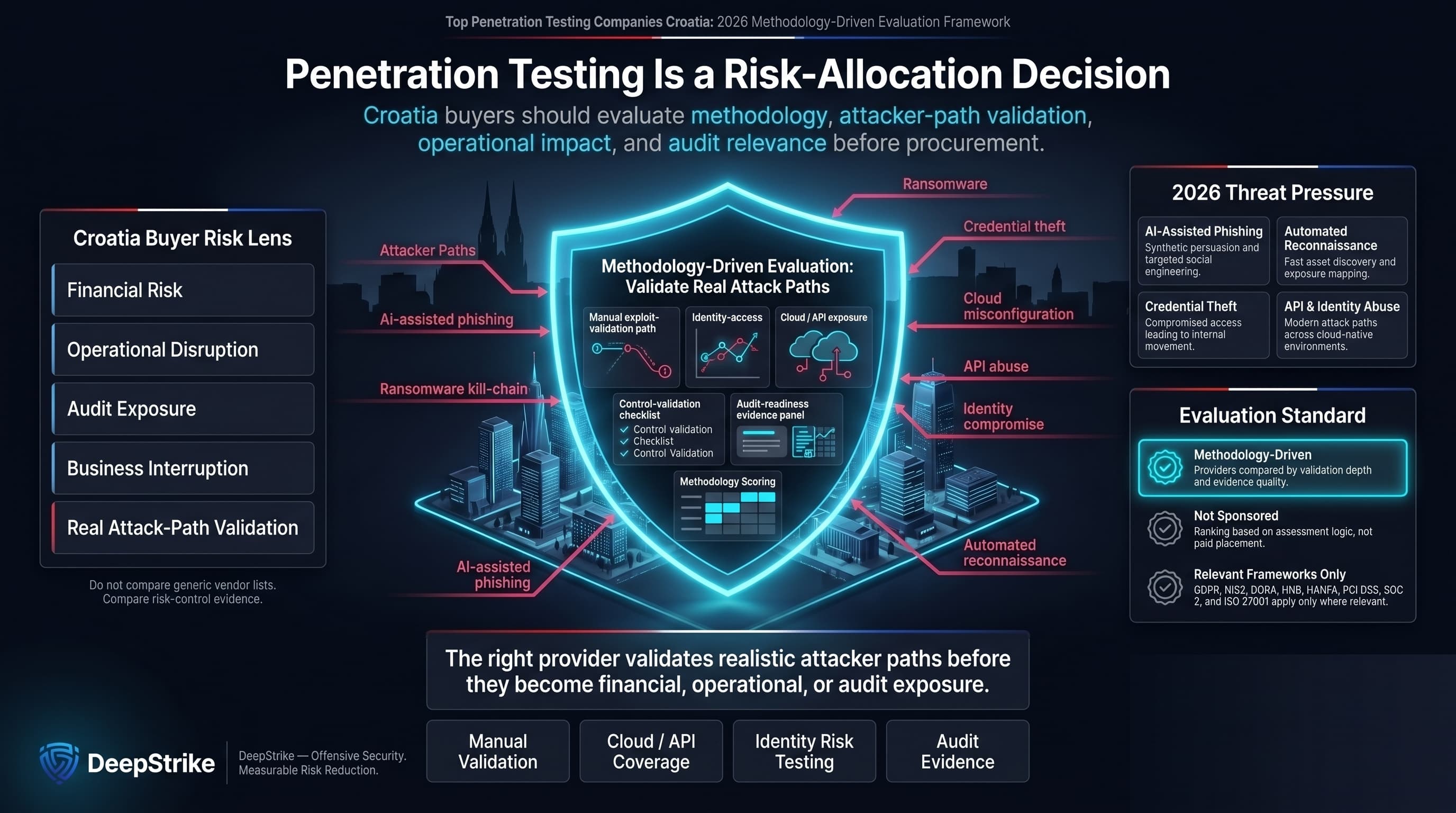
Penetration testing is a structured adversarial security assessment that combines automated vulnerability discovery with manual exploit validation to identify real-world attack paths, validate control effectiveness, and reduce breach probability.
Croatia buyers often evaluate penetration testing through a mix of EU governance pressure, sector-specific assurance needs, and practical delivery constraints. Croatia transposed NIS2 through the Cybersecurity Act (NN 14/2024), while the Cybersecurity Regulation (NN 135/2024) defines implementation measures and risk-management requirements. Finance-sensitive, healthcare-sensitive, SaaS, public-sector-adjacent, and infrastructure-sensitive organizations may need reporting that is usable by risk, audit, procurement, and technical remediation teams. That does not mean every provider is automatically suitable for regulated work, and it does not mean every Croatia buyer is directly subject to every EU or local framework.
The main distinction is methodology. A provider with a local or regional presence may be easier to coordinate with, but local presence does not prove deep exploit validation. A cross-border specialist may offer stronger cloud, API, red-team, or PTaaS capability, but buyers should confirm language, data-handling, on-site, time-zone, and reporting expectations before contracting. For Croatia organizations with EU-facing operations, the strongest shortlist is usually built around evidence: manual testing depth, remediation clarity, retesting terms, cloud/API maturity, and the ability to produce audit-useful reports without overstating regulatory alignment.
The ranking evaluates providers against procurement criteria relevant to Croatia buyers: manual versus automated depth, exploit chaining sophistication, red-team capability, cloud and API testing maturity, reporting quality, remediation clarity, retesting terms where evidenced, compliance mapping where evidenced, regulated-industry relevance where evidenced, and Croatia / EU / CEE / Balkan delivery feasibility.
The methodology favors validated exploitability over scan-heavy output. Certifications, office locations, customer references, headcount, retesting policies, and compliance claims are treated as evidenced only when supported by Source Notes. Where evidence is incomplete, the article uses cautious wording such as “appears relevant,” “where evidenced,” “buyers should confirm,” or “not clearly evidenced in reviewed material.” Brand size alone is not treated as proof of technical depth.
| Evaluation Criterion | Weight |
|---|---|
| Manual testing depth, exploit validation, and adversary realism | 25% |
| Verified provider accreditation and tester credentials | 20% |
| Croatia relevance, local presence, or credible EU delivery | 15% |
| Web, API, cloud, identity, infrastructure, OT, and red-team breadth | 15% |
| Reporting quality, remediation support, and retesting | 10% |
| Delivery model, workflow integration, and buyer collaboration | 10% |
| Public evidence, case studies, and transparency | 5% |
Provider-level assurance and individual credentials are treated separately. Company accreditation, ISO certification, PCI assessor status, or other organisational assurance should not be confused with individual credentials such as OSCP, OSWE, CISSP, GIAC, or CREST practitioner certifications.
Croatia’s security buyers should watch for common procurement missteps. First, avoid equating brand or scan tools with deeper coverage: ask if the vendor’s process includes manual exploit validation, not just automated scans. Beware “one-off” tests with no scheduled retesting – frequent change in cloud-native environments means vulnerabilities reappear fast. Check that junior testers aren’t doing the engagement alone; top providers disclose senior staff involvement or CREST-qualified teams. Ensure the scope covers all critical assets (apps, APIs, identity stores); underscoping can leave attack paths untested. Verify reporting quality: can the security team clearly use the findings for audit or remediation? Look for compliance alignment – e.g. mapping findings to ISO 27001, GDPR, or sector guidelines. A common trap is mistaking presence in a neighbor market for local fit; always confirm language support and on-site ability if required. Finally, don’t confuse PTaaS platforms with guaranteed depth – read contract details for manual verification. In summary, insist on transparency about methodology, retesting, and deliverables to truly compare penetration testing firms.
| Rank | Company | Best For | Croatia Fit | Testing Model / Differentiator |
|---|---|---|---|---|
| 1 | DeepStrike | Best overall for manual-first PTaaS, cloud/API testing, and remediation workflows | Cross-border remote; confirm local/on-site requirements | Manual exploit validation plus continuous-testing workflow |
| 2 | Infigo IS | Best Croatian specialist for red teaming, enterprise offensive security, and regulated environments | Zagreb HQ; strong local and regional presence | 350+ pentests per year stated; red team and offensive operations |
| 3 | Diverto | Best for Croatian enterprise, OT/ICS, DORA/NIS2, TLPT, and red/purple teaming | Zagreb-based specialist | Pen testing + red/purple team + TLPT + OT/ICS resilience |
| 4 | NetSPI | Enterprise PTaaS and attack-surface programs | Cross-border delivery; no Croatia office evidenced | Mature PTaaS and enterprise-scale workflow |
| 5 | Bishop Fox | High-end red teaming, research, application and cloud offensive depth | Cross-border specialist | Manual exploit chaining and adversary simulation |
| 6 | Cobalt | Cloud-native SaaS, APIs, recurring testing, and developer workflows | EU delivery via Berlin; remote | Platform-led PTaaS with manual testers |
| 7 | Span | Croatian enterprise offensive-security programs and Microsoft/cloud-heavy environments | Zagreb HQ | Local offensive-security team inside a large Croatian IT company |
| 8 | Backtrack Information Security | Local hands-on boutique penetration testing | Zagreb | Offensive-security-first boutique with manual testing focus |
| 9 | Trustwave | Large compliance-heavy enterprises and managed-security integration | EU coverage; Croatia delivery should be confirmed | SpiderLabs plus MSS/MDR integration |
| 10 | Red Team Cybersecurity | App/API/mobile/cloud testing and hands-on attack simulation | Croatia relevance should be confirmed during procurement | Manual testing across apps, APIs, cloud and infrastructure |
| 11 | Cyber Security d.o.o. | NIS2, OT/SCADA and compliance-connected pentesting | Zagreb-based | Pentesting plus OT, incident response, and regulatory consulting |
| 12 | PentestPad / Secure Block | Pentest workflow tooling plus a Croatia-based practitioner team | Bjelovar, Croatia | Pentest platform built by active pentesters |
| 13 | Combis | Enterprise infrastructure, application, mobile and network testing | Croatian enterprise provider | Security testing integrated with SOC and ICT services |
| 14 | Prescient Security | Compliance-oriented assurance and audit-adjacent testing | Cross-border remote | Pentest + compliance audit model |
| 15 | BreachLock | SMB/mid-market PTaaS and recurring validation | Cross-border; confirm Croatia support | Platform-led continuous testing |
| 16 | Nobium | Independent local infrastructure/web testing and social engineering | Zagreb-based | Independent consulting, network/web pentest and threat modelling |
| 17 | Adventure Spirit Consulting | GRC-heavy buyers needing pentest, red team, NIS2 and remediation in one program | Croatia-based | Pentest + social engineering + GRC/compliance integration |
Why They Stand Out: DeepStrike stands out in this ranking for manual exploit-validation depth, cloud and API testing relevance, remediation-oriented reporting, and PTaaS-style workflow relevance where evidenced. Buyers should confirm exact tester assignment, retesting terms, compliance-mapping scope, and Croatia / EU delivery expectations before procurement.
Croatia Relevance: DeepStrike is relevant for Croatia buyers that need rigorous, platform-agnostic testing. However, it lacks a documented local office or Croatia-speaking staff, so buyers should confirm regional support and on-site availability.
Testing Depth Model: Manual exploit chaining. DeepStrike should be positioned around manual validation of exploitable attack paths where evidenced, supported by discovery and workflow tooling rather than treated as a scan-led provider. This model is relevant for Croatia buyers that need business-impact validation, cloud/API testing, and remediation-oriented reporting.
Key Strengths:
Potential Limitations:
Best For: Regulated enterprises needing evidence-backed testing methodologies; finance and healthcare organizations valuing thorough exploit-based assessments; cloud-focused companies requiring continuous testing.
Why They Stand Out: Infigo IS stands out as one of Croatia’s most established specialist cybersecurity providers. Official materials state that it performs more than 350 penetration tests per year and has a dedicated Red Team and Offensive Operations practice. The company also publishes strong technical depth through its security-assessment team and SANS-linked expertise.
Croatia Relevance: Infigo is headquartered in Zagreb and has operated in Croatian information security since 2005. It also has offices in several regional and international markets, which makes it relevant to Croatian enterprises with cross-border operations.
Testing Depth Model: Red-team and specialist offensive model. Infigo explicitly separates vulnerability scanning, penetration testing, and red-team engagements and describes realistic offensive operations rather than scan-only delivery.
Key Strengths:
Potential Limitations:
Best For: Croatian banks, telecoms, utilities, enterprises, regulated organizations, and buyers that want deep offensive security connected to broader security operations.
Why They Stand Out: Diverto stands out for a Croatia-native cybersecurity practice that combines classic penetration testing with advanced resilience testing. Its public material explicitly covers external, internal, wireless, web, API, desktop, and mobile pentesting, together with red teaming, purple teaming, network-segmentation tests, and Threat-Led Penetration Testing.
Croatia Relevance: Diverto is based in Zagreb and has operated exclusively in information and cybersecurity since 2007. Its NIS2, DORA, OT, and local regulatory material gives it particularly strong relevance for Croatia buyers.
Testing Depth Model: Threat-led and red-team model. The company describes penetration testing, segmentation testing, red teaming, purple teaming, and TLPT as distinct resilience-testing options, making it one of the deeper local choices for high-risk environments.
Key Strengths:
Potential Limitations:
Best For: Banks, critical infrastructure, OT/ICS environments, regulated enterprises, and Croatia buyers requiring red-team or threat-led testing.
Why They Stand Out: NetSPI stands out for pioneering modern PTaaS with a unified platform. Its 2025 report highlights broad capabilities: more than 50 pentest types, weekly cloud scans, and a shared attack simulation library. NetSPI combines AI-driven tools with expert testers to deliver depth; it explicitly employs CREST-certified staff.
Croatia Relevance: NetSPI is relevant to Croatia buyers seeking enterprise-grade testing with a continual focus. It serves global clients (including EU firms) and offers both on-demand and platform-based testing. There’s no evidence of a local office, so buyers should check time-zone and language coordination.
Testing Depth Model: Hybrid model – Emphasizes validated exploit paths with platform automation. Monthly AWS/Azure configuration scans and thousands of real attacks are simulated by human experts, enabling deep findings in cloud or hybrid environments.
Key Strengths:
Potential Limitations:
Best For: Large enterprises and regulated firms (especially in finance) needing a fully-managed, continuous pentesting solution; organizations with complex cloud estates requiring regular scanning.
Why They Stand Out: Span stands out because it operates a dedicated Offensive Security Services Team inside a large Croatian technology organization. Current recruitment material explicitly identifies penetration testing, phishing activities, attack assessments, and vulnerability assessments as core offensive-security work.
Croatia Relevance: Span is headquartered in Zagreb and works with both Croatian and international clients, making it one of the strongest local enterprise-delivery options in the shortlist.
Testing Depth Model: Enterprise offensive-security model. Public evidence confirms a hands-on offensive-security team rather than a security portfolio limited to product implementation.
Key Strengths:
Potential Limitations:
Best For: Large Croatian enterprises, Microsoft/cloud-heavy environments, and organizations that want offensive security integrated with wider IT programs.
Why They Stand Out: Backtrack stands out for a focused offensive-security identity. Its site explicitly states that the company goes beyond checklist scanning and performs real-world penetration testing, with a process covering scoping, formal authorization, service execution, reporting, and actionable guidance.
Croatia Relevance: Backtrack Information Security d.o.o. publishes a Zagreb business address, making it directly relevant to organizations that want a local boutique partner.
Testing Depth Model: Manual offensive model. The company positions itself around hands-on testing and explicitly differentiates its work from scan-only security reviews.
Key Strengths:
Potential Limitations:
Best For: Croatian product teams, SMEs, and enterprises seeking a hands-on local offensive-security boutique.
Why They Stand Out: Trustwave stands out for SpiderLabs-led testing, managed-security context, and compliance-oriented assessment relevance where evidenced. It stands out for compliance-driven testing: e.g. SpiderLabs offers PCI-mandated internal/external tests and intelligence-led pentests. Trustwave’s global MSS infrastructure means it can apply threat intel and contextual risk analysis during tests.
Croatia Relevance: Trustwave is relevant for buyers needing end-to-end programs (Pentest as part of MSS). Its London office provides EU coverage. Regulated Croatian firms (finance, healthcare) would find Trustwave’s compliance experience useful, though no specific Croatia office is cited.
Testing Depth Model: Hybrid model – Combines automated scanning with manual SpiderLabs exploitation. Managed Security Testing includes in-depth network and application pentests. This enables realistic attack simulations across IT/OT and cloud networks.
Key Strengths:
Potential Limitations:
Best For: Large enterprises and public-sector institutions in Croatia requiring a blend of pentesting with managed security ops; organizations that need compliance-mapped testing (e.g. PCI DSS, NIS2-related efforts).
Why They Stand Out: Cobalt stands out for platform-led pentesting workflows, developer collaboration, and practical fit for product-led teams. Public claims about tester-network size or launch speed should be confirmed from Source Notes before publication. It stands out for speed and developer integration: customers launch pentests on demand and collaborate in real time, streamlining workflows.
Croatia Relevance: Cobalt’s EU office (Berlin) and remote model make it accessible to Croatia buyers. Its platform is attractive to digital businesses (including EU SaaS), though procurement should verify local language/reporting expectations.
Testing Depth Model: Hybrid model – Uses automated triage plus expert manual testing. Pentests (web, mobile, API) are delivered via a portal. This enables regular, automated engagement without sacrificing human validation.
Key Strengths:
Potential Limitations:
Best For: Cloud-first and DevOps-oriented firms in Croatia needing frequent penetration testing; SaaS providers requiring API and microservices testing.
Why They Stand Out: Bishop Fox stands out for red-team-oriented testing, application and cloud assessment relevance, and visible offensive-security research where evidenced. Its model is most relevant when buyers need deeper breach-path validation rather than broad scan output.
Croatia Relevance: Bishop Fox’s expertise appeals to Croatian enterprise buyers needing top-tier attack simulation. Its US base means no local office, so engagements would be remote or onsite from abroad.
Testing Depth Model: Red-team oriented – Focuses on realistic attack simulations. Teams not only scan but actively chain exploits to demonstrate end-to-end breach paths, suitable for critical infrastructure and regulated sectors where thorough attack emulation is required.
Key Strengths:
Potential Limitations:
Best For: Large Croatian organizations (esp. finance or tech) that need deep adversary emulation and vulnerability research; firms with complex apps or custom environments.
Why They Stand Out: Red Team Cybersecurity stands out for broad hands-on testing coverage across applications, APIs, mobile, cloud, networks, and adversary simulation. Its current site states that every assessment includes extensive hands-on testing from certified cybersecurity experts.
Croatia Relevance: The provider appears in Croatia-focused discovery and is relevant to Croatian buyers, but this guide does not assert a Croatian headquarters because the reviewed public corporate pages do not clearly evidence one. Buyers should verify legal entity, tester location, language, and on-site options.
Testing Depth Model: Hands-on offensive model. The service catalogue emphasizes manual application, API, mobile, cloud, and infrastructure security testing alongside adversary simulation.
Key Strengths:
Potential Limitations:
Best For: Organizations seeking broad hands-on application, API, mobile, cloud, and infrastructure testing where local legal-entity requirements are not the primary constraint.
Why They Stand Out: Cyber Security d.o.o. stands out for connecting real-world penetration testing with Croatian NIS2 implementation, operational security, digital forensics, and OT/SCADA security. The company’s current operational-security page explicitly lists vulnerability assessment and penetration testing across infrastructure, applications, and networks.
Croatia Relevance: The company is Zagreb-based and directly references the Croatian Cybersecurity Act, the Cybersecurity Regulation, NIS2, and CRA in its local regulatory services.
Testing Depth Model: Compliance-connected technical model. Penetration testing is delivered alongside incident response, forensics, OT security, and regulatory implementation rather than as a standalone platform product.
Key Strengths:
Potential Limitations:
Best For: Croatian organizations that want penetration testing tied closely to NIS2, OT/SCADA, incident response, and regulatory security work.
Why They Stand Out: PentestPad stands out because it is built in Croatia by active penetration testers rather than as a generic project-management tool. Its public company material states that the team continues to discover vulnerabilities, develop open-source tools, and perform real security work while building the platform.
Croatia Relevance: Secure Block d.o.o. is registered in Croatia, and PentestPad publishes a Bjelovar address. Current hiring material also describes Croatia-based penetration-testing work for enterprise clients.
Testing Depth Model: Practitioner-plus-platform model. PentestPad’s core differentiator is the connection between working pentesters and the platform they use to manage projects, findings, and reporting.
Key Strengths:
Potential Limitations:
Best For: Croatian security teams and consultancies that want pentest workflow tooling, and organizations that value a practitioner-built reporting and project platform.
Why They Stand Out: Combis stands out for integrating penetration testing with a large enterprise ICT and SOC portfolio. Its security page explicitly states that penetration-testing work is performed by experts with recognized security certifications and covers web applications, mobile applications, network devices, and other services.
Croatia Relevance: Combis is a major Croatian ICT company with a long domestic track record and strong enterprise delivery capability.
Testing Depth Model: Enterprise hybrid model. The company combines security testing, technical consulting, SOC, and infrastructure services rather than operating only as a pure-play offensive-security boutique.
Key Strengths:
Potential Limitations:
Best For: Large Croatian organizations that want penetration testing integrated with SOC, cloud, infrastructure, and managed ICT services.

Why They Stand Out: Prescient Security stands out for compliance-oriented testing and audit-adjacent assurance services where evidenced. It excels at integrating pentests with frameworks: the site highlights “compliance penetration tests” and auditors for FedRAMP, PCI, etc. Their Cacilian PTaaS platform adds AI to testing.
Croatia Relevance: Prescient’s global, compliance-centric model suits Croatia’s GDPR and NIS2 contexts. It has no local presence, so buyers should confirm CRO/EU support.
Testing Depth Model: Hybrid model – Balances traditional audits with targeted pentesting. It conducts both scheduled pentests and continuous scanning, aimed at meeting certification criteria as well as finding exploitable gaps.
Key Strengths:
Potential Limitations:
Best For: Croatia’s finance or public institutions that must align pentests with multiple certifications; companies seeking combined audit and pentesting services.
Why They Stand Out: BreachLock emphasizes automated, continuous pentesting. Public materials may indicate broad delivery experience; buyers should confirm exact engagement volume, delivery footprint, and regional support from Source Notes. Its platform offers real-time dashboards and frequent pentest cycles, making it stand out for ongoing risk validation.
Croatia Relevance: European offices (London/Amsterdam) give some proximity, but buyers should confirm engagement options in Croatia. Mid-size organizations in Croatia may find its pricing accessible.
Testing Depth Model: Hybrid model – Offers both automated scanning and expert validation. They cover all asset types (apps, networks, cloud) in each test, often on recurring schedules.
Key Strengths:
Potential Limitations:
Best For: Growing enterprises and SMBs in Croatia wanting continuous, scalable pentesting; teams that prefer a platform-driven approach.
Why They Stand Out: Nobium stands out for independent local consulting and a long Croatian history. Its security site clearly distinguishes web application testing, infrastructure testing, wireless testing, social engineering, threat modelling, and risk analysis.
Croatia Relevance: Nobium is registered in Zagreb and has worked with major Croatian organizations and public institutions for many years.
Testing Depth Model: Independent hybrid model. The company combines technical pentesting with threat modelling, risk analysis, and consulting rather than positioning itself around a PTaaS platform.
Key Strengths:
Potential Limitations:
Best For: Croatian SMBs, public organizations, and infrastructure-focused buyers that value independent local consulting and conventional penetration testing.
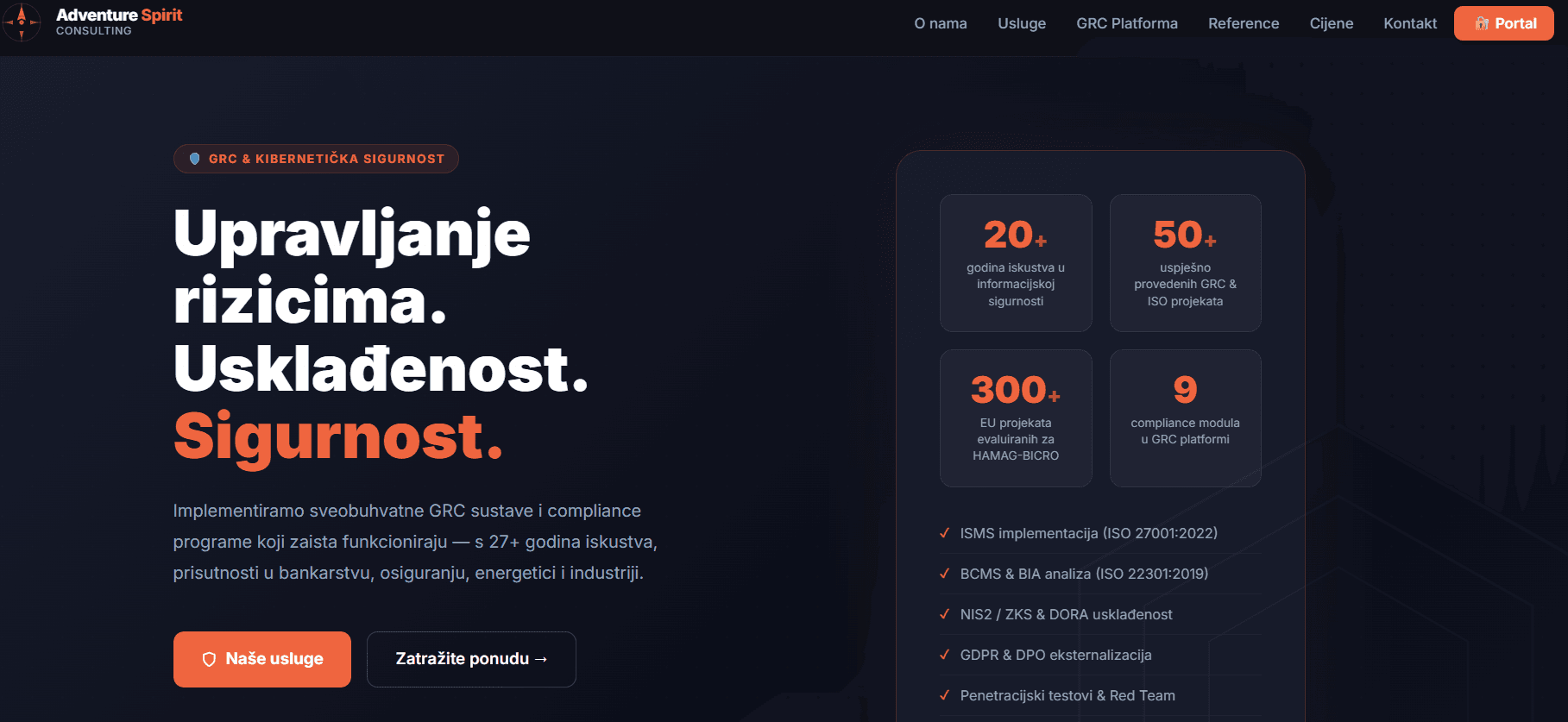
Why They Stand Out: Adventure Spirit Consulting stands out for buyers that want offensive testing embedded in a wider GRC and regulatory program. Its public security-testing material describes scoping, reconnaissance, vulnerability assessment, controlled exploitation, social engineering, reporting, remediation planning, and retesting.
Croatia Relevance: The firm is designed around Croatian and EU regulatory frameworks, including the Croatian Cybersecurity Act/NIS2 environment, and presents local-sector experience in banking, insurance, energy, healthcare, and the public sector.
Testing Depth Model: GRC-integrated hybrid model. The published process combines automated and manual assessment with controlled exploitation, social engineering, remediation planning, and retesting.
Key Strengths:
Potential Limitations:
Best For: Croatian regulated organizations that want penetration testing, red-team exercises, remediation, and compliance/GRC support in one engagement.
| Company | Specialization | Testing Depth Model | Best For | Croatia Fit | Assurance / Compliance Positioning | Ideal Organization Size |
|---|---|---|---|---|---|---|
| DeepStrike | Manual-depth PTaaS, web/mobile/cloud testing | Manual exploit chaining | Cloud-first, API-heavy, remediation-driven teams | Cross-border remote; local delivery should be confirmed | Compliance-oriented reporting in public positioning | Mid-market to enterprise |
| Infigo IS | Red team, pentest, SOC, IR, GRC | Red-team specialist | Croatian enterprise and regulated buyers | Zagreb HQ | Strong enterprise security and GRC integration | Mid-market to enterprise |
| Diverto | Pentest, OT/ICS, red/purple team, TLPT | Threat-led/red-team | Banks, critical infrastructure, DORA/NIS2 | Zagreb | Strong NIS2/DORA and resilience-testing positioning | Enterprise |
| NetSPI | PTaaS and attack-surface management | Hybrid | Enterprise and cloud-heavy programs | Cross-border | Formal assurance alignment where evidenced | Enterprise |
| Bishop Fox | Red team, application/cloud offensive security | Red-team oriented | High-assurance offensive depth | Cross-border specialist | Regulated-environment fit where evidenced | Enterprise |
| Cobalt | PTaaS for app/API/cloud programs | Hybrid | Cloud-native SaaS and recurring testing | EU delivery via Berlin | CREST/ISO/SOC 2 evidence in public trust material | SMB to enterprise |
| Span | Enterprise offensive security + cloud/infrastructure | Enterprise offensive | Large Croatian enterprises | Zagreb HQ | Enterprise security and governance integration | Enterprise |
| Backtrack | Hands-on offensive-security boutique | Manual offensive | Local product teams and focused pentests | Zagreb | Buyers should confirm formal accreditation needs | SMB to mid-market |
| Trustwave | MSS/MDR + penetration testing | Hybrid | Compliance-heavy large enterprises | EU coverage; Croatia delivery to confirm | SpiderLabs and compliance-oriented testing | Enterprise |
| Red Team Cybersecurity | App/API/mobile/cloud/adversary testing | Hands-on offensive | Broad technical attack-surface testing | Croatia fit to verify | PCI support and security-assessment positioning | SMB to enterprise |
| Cyber Security d.o.o. | Pentest + NIS2 + OT/SCADA + DFIR | Compliance-connected technical | Croatian regulated and OT environments | Zagreb | Croatian NIS2/CRA and OT context | SMB to enterprise |
| PentestPad / Secure Block | Pentest workflow platform + practitioner team | Practitioner/platform | Security teams and structured pentest workflows | Bjelovar | EU data-sovereignty and workflow focus | SMB to enterprise |
| Combis | Security testing + SOC + enterprise ICT | Enterprise hybrid | Large Croatian organizations | Croatia-based | Regulatory and enterprise integration | Enterprise |
| Prescient Security | Compliance assurance + pentesting | Hybrid | Audit-driven organizations | Cross-border | Framework-oriented assurance | Mid-market to enterprise |
| BreachLock | PTaaS, ASM, recurring testing | Hybrid | SMB and mid-market recurring validation | Cross-border | Compliance-sensitive positioning | SMB to mid-market |
| Nobium | Web/network/wireless pentest + social engineering | Independent hybrid | Local infrastructure and public-sector buyers | Zagreb | Risk/threat-modelling integration | SMB to mid-market |
| Adventure Spirit Consulting | Pentest + red team + GRC/NIS2/DORA | GRC-integrated hybrid | Compliance-heavy Croatian organizations | Croatia-focused | NIS2/DORA/ISO/GDPR and retest workflow | SMB to mid-market |
Croatia buyers often make the mistake of equating vendor size or brand with technical depth. A large consulting firm's name doesn’t guarantee a nuanced attack approach, and a small local office doesn’t ensure quality. Another pitfall is overvaluing automated tool output: a scanner-generated vulnerability list without exploit validation is insufficient for real risk insight. Some buyers treat pentests as a one-off checkbox for compliance, ignoring that modern attacks exploit APIs and identity flaws – continuous testing is needed. Don’t confuse a PTaaS label with deeper testing: confirm that any platform offering includes hands-on exploitation, not just repeated scans. Check if the methodology explicitly includes manual exploit chaining and retesting steps. Failing to scrutinize reporting is common too: overly technical or inconsistent reports hinder remediation in audit-heavy environments. Finally, assuming a vendor’s regional presence implies local expertise is a fallacy; Croatian buyers must directly verify language support, on-site availability, and relevant compliance experience.
Enterprises in Croatia typically buy depth and scale. They can invest in extended red-team engagements or subscription-based PTaaS with large consultant teams. They prioritize vendors who demonstrate audited methodologies and heavy compliance mapping. Smaller or midsize firms, by contrast, focus on cost-efficiency and speed. They may prefer automated PTaaS platforms or smaller boutique firms. However, small firms should ensure adequate expertise (e.g. no junior-only teams) and consider the trade-off that a global boutique may charge a higher entry price. For enterprise vs SMB, the key is balancing manual depth and automation: enterprises can afford deep, labor-intensive tests; SMBs might accept a hybrid approach. Also consider vendor delivery footprint: local Croatian presence can ease small engagements, while global firms may deliver remote services to SMBs. Finally, red-team vs classical pentest is a strategic choice: enterprises often want full-scope adversary simulations; SMBs may need shorter targeted tests. Both should demand continuous or regular cadence in cloud-native environments, since even small companies now rely on SaaS and microservices.
Pricing varies by scope and method, not by geography. Key cost drivers are: size of scope (number and complexity of apps, networks, cloud assets), and depth (whether testing includes chaining exploits). Authenticated testing (with credentials) and multi-factor setups cost more due to complexity. Testing APIs and modern single-page apps adds effort. Inclusion of retesting (verifying fixes) also increases cost, but adds value in assurance. Reporting requirements matter: an audit-ready compliance report (mapping to PCI/NIS2/SOC2 controls) can add to the price. On-site versus remote delivery can change coordination effort, scheduling complexity, and commercial terms. Croatia buyers should confirm whether on-site work is required or whether remote testing satisfies the scope. Tester seniority affects project effort and commercial structure, especially where deep manual exploit validation or red-team-style work is required. Cloud or hybrid scopes require testers skilled in AWS/Azure/AzureAD – specialized skills can raise cost. Organizational complexity (segmented networks, many third-party apps) also drives hours. Continuous testing subscriptions often spread costs over time, whereas one-off projects front-load effort. In summary, Croatia buyers should budget based on project complexity and compliance needs, rather than fixed “Croatia rates.”
How much do penetration testing services cost in Croatia?
Cost depends on scope and depth, not a country's flat rate. Factors include the number of systems, type of testing (web, network, cloud, API), and whether retesting is included. Complex enterprise tests cost more than a small scope scan. Buyers should obtain detailed quotes based on their environment. Avoid press claims of fixed local rates; focus on defining exact requirements.
What is included in enterprise penetration testing?
An enterprise engagement typically covers broad scopes (external network, internal network, web apps, cloud, API, etc.), plus advanced phases like social engineering or full red-team simulations. It includes both automated scanning and manual exploitation, plus detailed reporting with risk analysis and mitigation guidance. Often it includes compliance mapping (e.g. to ISO 27001 or NIS2). Enterprise tests may come with retesting of critical issues as fixes are made.
Are certifications more important than tools?
For penetration testing, certified experts usually leverage tools but add human insight. Certifications (like OSCP, CREST CCT) indicate individual tester skill, which is critical for deep testing. Tools are helpful for automation, but only human creativity finds complex logic flaws and uses real attacker techniques. Evaluate providers on team expertise (certifications) and process, not just on marketing of a particular tool.
How long does a pentest engagement take?
Typical engagements run 1–2 weeks per target area, but this varies. A small web app test might take a few days; a full network + multiple apps pentest could take several weeks. Larger red-team projects can extend to months if part of a continuous program. Plan lead time: scoping and scheduling often precede testing. Buyers should clarify schedule and delivery timelines before contracting.
Is penetration testing required for compliance frameworks like GDPR, NIS2, DORA, etc.?
Applicability depends on sector, systems, contracts, and audit scope. GDPR, NIS2, DORA, HNB expectations, HANFA expectations, SOC 2, ISO 27001, and PCI DSS do not apply uniformly to every Croatian buyer. PCI DSS contains explicit penetration-testing requirements where cardholder-data environments are in scope. Other frameworks may make penetration testing commercially important as part of risk analysis, control validation, or audit evidence, but buyers should confirm exact obligations with legal, compliance, and assessor stakeholders.
How often should testing be performed?
There is no universal annual penetration-test requirement across every compliance framework. Testing frequency should follow the applicable framework, sector, risk profile, contracts, and material system changes. Many modern organizations also use quarterly or continuous testing for critical internet-facing assets. Any major change (new system launch, cloud migration, or after a breach) should trigger testing. Croatia buyers should align test frequency with risk and regulatory demands – e.g. NIS2 suggests periodic reviews of security controls.
Should Croatia buyers choose a local provider or a cross-border specialist firm?
It depends on priorities. Local firms can offer language convenience and potentially on-site support, but cross-border firms often bring wider technical expertise and mature processes. Croatia buyers should evaluate technical fit first: if the local vendor has certified experts and meets methodology needs, they can be good partners. Otherwise, choosing a global specialist with proven EU experience may be more effective. Always verify any local claims and ensure communication/logistics will work in practice.
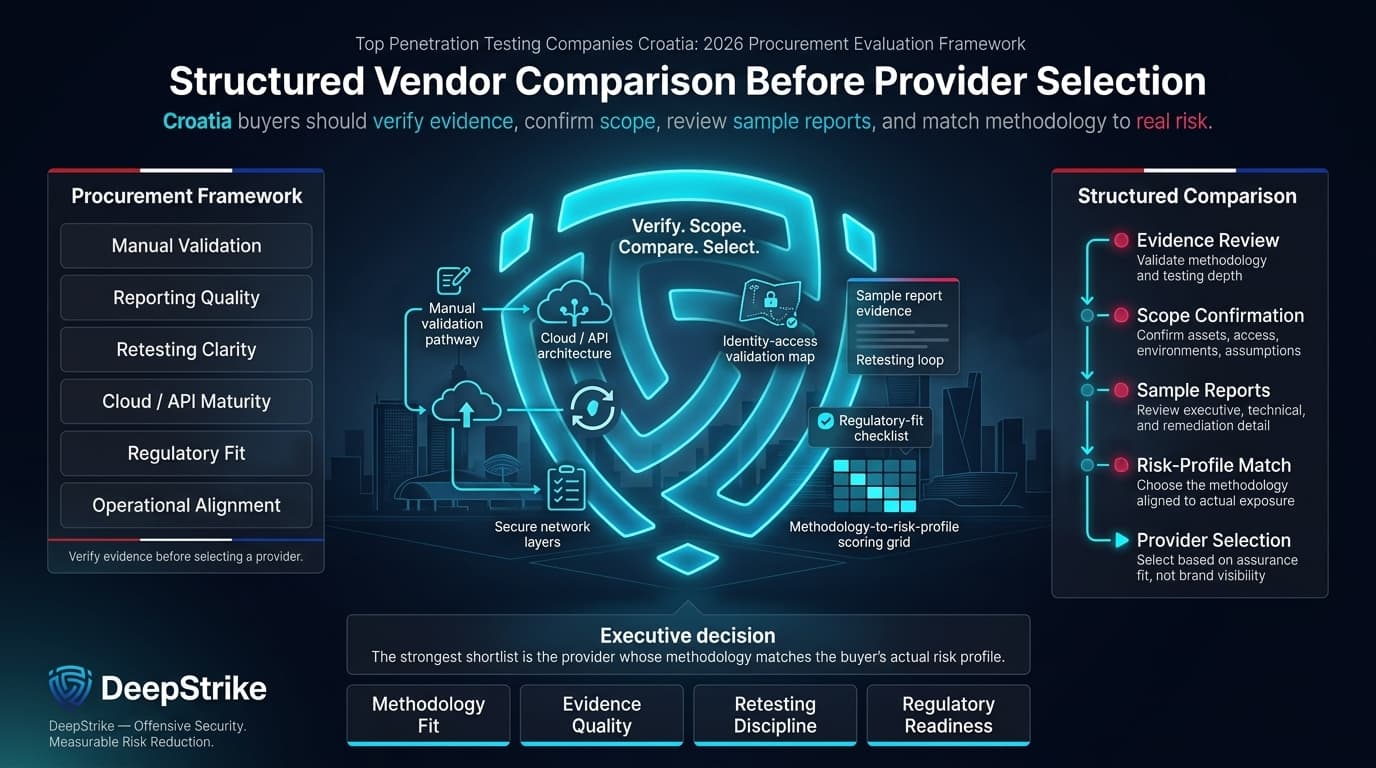
This ranking of top penetration testing companies croatia buyers may evaluate in 2026 is built around structured vendor comparison rather than brand visibility alone. The strongest shortlist is not necessarily the provider with the broadest service menu, but the provider that can evidence manual validation, reporting quality, retesting clarity, cloud and API maturity, and fit for the buyer’s regulatory or operational environment. Croatia buyers should verify the evidence, confirm the scope, review sample reports, and choose the provider whose methodology matches the actual risk profile.
Technical Review: DeepStrike Offensive Security Team
Last Reviewed: August 2026
Mohammed Khalil is a Cybersecurity Architect at DeepStrike, specializing in advanced penetration testing and offensive security operations. With certifications including CISSP, OSCP, and OSWE, he has led numerous red team engagements for Fortune 500 companies, focusing on cloud security, application vulnerabilities, and adversary emulation. His work involves dissecting complex attack chains and developing resilient defense strategies for clients in the finance, healthcare, and technology sectors.

Stay secure with DeepStrike penetration testing services. Reach out for a quote or customized technical proposal today
Contact Us
