October 4, 2026
Updated: October 4, 2026
Evidence-led AI security statistics for US SaaS leaders, covering adoption, data exposure, agents, testing scope, and provider evaluation.

Mohammed Khalil
AI security statistics show growing adoption, persistent data exposure, and new risks around connected AI applications. They do not provide one universal breach rate for US businesses. Surveys, customer telemetry, and studies of breached organizations measure different populations and outcomes. For CISOs and CTOs, the useful question is which findings apply to their own systems. This guide separates those measures, explains the implications for SaaS environments, and turns the evidence into testing requirements. It also shows how to compare providers on methodology, reports, remediation, retesting, and the full cost of an engagement.
The figures below come from primary research available by October 4, 2026. A report labeled “2026” may describe activity measured in 2025. These are separate findings, not components of a combined risk score.
| Finding | What was measured | Critical limitation |
|---|---|---|
| 78% reported actively using AI for cybersecurity | SANS 2026 global survey | Adoption does not establish effectiveness or autonomous operation. |
| 223 GenAI data policy violations per organization per month, on average | Netskope customer telemetry, October 2024–October 2025 reporting window | Policy events are not a count of confirmed breaches. |
| High-risk prompts increased from about 2% to 4% | Check Point enterprise telemetry, October 2025–May 2026 | A prompt-level rate is different from the share of organizations affected. |
| 76% reported an incident involving AI applications or models in the previous two years | Kroll survey fielded November–December 2025 | This is self-reported, multinational survey evidence. |
| 64% assessed AI tools for security, compared with 37% in the previous edition | World Economic Forum 2026 survey | The comparison uses successive survey samples. |
| One in four malicious breaches involved AI | IBM’s 2026 breach study | The denominator is malicious breaches in a breached-organization study, not all companies. |
The following sections identify each source, its population, and the decision it can inform.
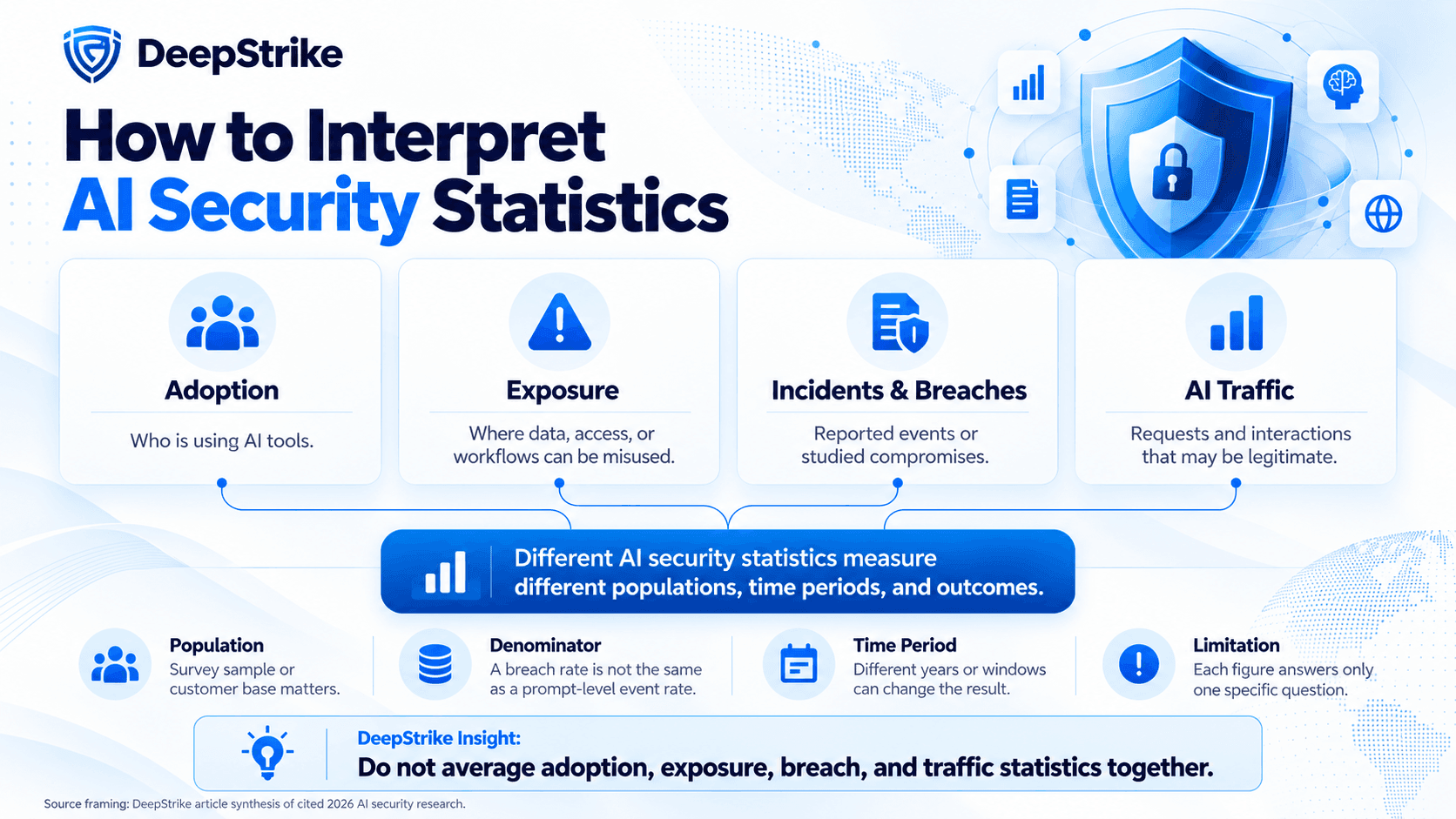
This guide distinguishes four measures:
Do not average percentages across these categories. A survey about incidents over two years cannot be compared directly with a monthly telemetry rate. A vendor’s customer base also does not represent every US company.
For each number used in a board presentation, preserve the publisher, measurement period, population, denominator, and limitation. Where a public report does not disclose a sample size or fieldwork date, treat that as an evidence gap rather than filling it with an assumption.
The SANS 2026 AI Cybersecurity Report surveyed 536 practitioners and 57 senior leaders globally. It reported 78% active AI use in cybersecurity, but only 27% of practitioners described mature production deployment. Separately, 63% of practitioners reported significant shortcomings in AI-powered threat detection and response. The public summary does not give fieldwork dates.
These results support a distinction between trying AI and operating it reliably. They do not establish a universal detection-accuracy rate or show that a particular product outperforms another. “Accuracy” itself is incomplete unless the evaluation defines the threats, benign activity, labels, and threshold used.
For a security operations center, compare an AI-assisted workflow against the existing workflow using the same representative cases:
| Decision | Metric to examine | Evidence to retain |
|---|---|---|
| Does triage improve? | Median analyst handling time, together with missed cases | Case mix, analyst corrections, and escalation outcomes |
| Are alerts useful? | Precision: true positives divided by all positive alerts | Labeled sample and false-positive review |
| Are threats being missed? | Recall: detected positives divided by all known positives | Controlled test set and false-negative analysis |
| Is automated response safe? | Unauthorized or incorrect actions; successful rollback | Approval logs, executed actions, and recovery results |
| Is the workflow economical? | Analyst time saved minus review, maintenance, and operating costs | Comparable baseline and actual ongoing costs |
A faster workflow that misses more threats is not necessarily an improvement. Keep approval requirements for high-impact actions, and evaluate model or configuration changes against the same retained cases. General adoption statistics cannot tell a SOC what percentage of its alerts it can safely close automatically.
Shadow AI means AI use outside the organization’s approved inventory or controls. Personal accounts can contribute to that exposure, but account type alone does not prove that a user violated policy.
The Netskope Cloud and Threat Report 2026 reported an average of 223 GenAI data policy violations per organization per month and personal AI application use among 47% of GenAI users. Its anonymized, worldwide platform dataset covers October 1, 2024–October 31, 2025. The public methodology does not provide an organization count for these figures. Neither measure is a US breach rate.
The Check Point AI Security Report 2026 found that high-risk prompts rose from roughly 2% to 4% between October 2025 and May 2026. That is an increase of two percentage points, approximately double the original rate. It also reported that 87–93% of observed organizations had at least one high-risk GenAI interaction each month. High-risk interactions involve sensitive corporate, personal, or regulated data; they are not confirmed breaches. The report does not establish a representative US prevalence estimate.
For a SaaS company, start with the data path. Identify whether employees can send source code, support tickets, customer records, credentials, or internal documents to unapproved services. Then examine approved products: enterprise licensing alone does not establish appropriate retention, connector permissions, or access controls.
An assessment should use synthetic sensitive data to validate the actual control. Does the policy block, warn, log, or merely classify the action? Does it cover uploads and connected repositories as well as typed prompts? Record those differences so that a detection-only control is not reported as prevention.
The World Economic Forum’s Global Cybersecurity Outlook 2026 reported that 64% assessed AI tools for security, up from 37% in its 2025 edition. The 2026 survey used 804 qualified responses across 92 countries, collected in August–October 2025. The 27-percentage-point difference describes survey results; it does not prove that the same organizations improved or that assessments prevented incidents.
In Kroll’s 2026 AI security research, 76% reported an incident involving AI applications or models during the preceding two years, while 48% reported little or no governance over AI tool adoption. Sapio surveyed 1,000 cybersecurity decision-makers in ten countries in November–December 2025; 450 were in the US. The published headline figures are multinational, and the respondents represented companies with at least $50 million in annual revenue.
An AI policy and an operational control answer different questions. A policy can identify who approves a tool. An assessment must establish which data it reaches, whose permissions it inherits, how changes are reviewed, and who can disable it when something goes wrong.
US teams can organize that work around the NIST AI Risk Management Framework. It is a voluntary risk-management framework, not a certification or a universal legal requirement to buy an AI penetration test. Ask providers to explain the controls and evidence behind any claimed framework alignment.
The Check Point report also reported an approximately fivefold increase in detected long malicious payloads between March and May 2026. Its analysis associates the pattern with indirect prompt-injection activity. This is a detection trend, not a measured success rate for compromising AI applications.
The OWASP guidance on prompt injection distinguishes direct inputs from instructions embedded in external content. Retrieval-augmented generation, or RAG, can improve access to relevant information without eliminating that trust problem. A retrieved document is still untrusted input when it attempts to direct the application’s behavior.
For practical examples and defensive context, see DeepStrike’s guide to prompt injection attacks. In a security assessment, the material question is whether an input can cross a protected boundary: disclose another tenant’s data, invoke an unauthorized tool, or trigger an action outside the user’s permissions.
HUMAN’s 2026 State of AI Traffic and Cyberthreat Benchmarks found that monthly AI traffic grew 187% from January to December 2025. Agentic traffic grew 7,851%, yet represented 1.7% of AI traffic in December. Its analysis covers more than one quadrillion interactions across a subset of its global customer base. Those growth rates describe traffic, including legitimate activity; they do not measure growth in successful attacks.
A useful agent assessment follows the actions an agent can perform. Inventory its tools, identities, reachable data, spending limits, and approval gates. Separate the ability to generate text from the authority to change a customer account or export information.
OWASP’s excessive-agency guidance supports minimizing tool functionality and permissions, requiring approval for consequential actions, and enforcing authorization in downstream systems. An instruction telling the model to behave safely does not replace those controls.
The IBM Cost of a Data Breach Report 2026 announcement reported that one in four malicious breaches involved AI, with an average cost of $6 million for AI-enabled breaches. More than 20% of studied organizations experienced attacks targeting AI applications or models. The Ponemon Institute research covered 602 breached organizations worldwide from March 2025 through February 2026; IBM sponsored and analyzed the study.
The two AI categories answer different questions. AI can assist an attacker against an ordinary business system, while an AI application can itself be the target. Neither category describes every cyberattack or establishes the probability that an unbreached US SaaS company will suffer a loss.
Use these findings to examine financially significant exposure, not to assign your business the study’s average loss. A testing budget should reflect the systems, permissions, customer commitments, and operational consequences in scope. Breach cost is not a penetration-testing price benchmark.
For the wider threat landscape, the separate AI cyberattack statistics guide covers attack-focused evidence. Here, the priority is translating relevant exposure into controls that a provider can test.
The following matrix is an original planning framework, not a new survey or the result of testing a particular product. Use the rows that match your architecture; remove those that do not.
| Exposure in your environment | Control to examine | Authorized test | Acceptance evidence |
|---|---|---|---|
| Employees use external AI with internal data | Approved destinations, retention settings, data controls | Submit synthetic sensitive records through permitted test paths | Correct block or alert, destination, policy identifier, and response record |
| A RAG assistant searches customer content | Retrieval authorization and tenant separation | Use two test tenants with distinct synthetic records | Tenant A cannot retrieve or receive Tenant B’s restricted data; retrieval and response logs support the result |
| An assistant processes untrusted documents | Separation of content from authority | Place controlled adversarial instructions in test documents | Protected data and actions remain inaccessible despite manipulated model output |
| An agent can act through business APIs | Least privilege and downstream authorization | Attempt agreed out-of-role actions using test identities | Denial by the relevant service, with no unintended state change |
| An agent performs consequential actions | Approval, limits, and rollback | Simulate an action beyond its approved boundary | Approval is enforced; rejection leaves state unchanged; recovery is demonstrated where applicable |
| An AI feature sits inside a SaaS product | Application, API, session, and cloud controls | Test agreed authentication and authorization boundaries | Reproducible findings tied to business impact, affected components, and fixes |
The last row matters because adding an LLM does not remove ordinary application vulnerabilities. Coordinate the engagement with web application penetration testing when the AI feature shares authentication, APIs, storage, or tenancy controls with the main product.
Cloud-hosted AI also inherits infrastructure and identity risks. Include cloud penetration testing when storage permissions, service identities, secrets, or deployment controls are material to the agreed threat model.
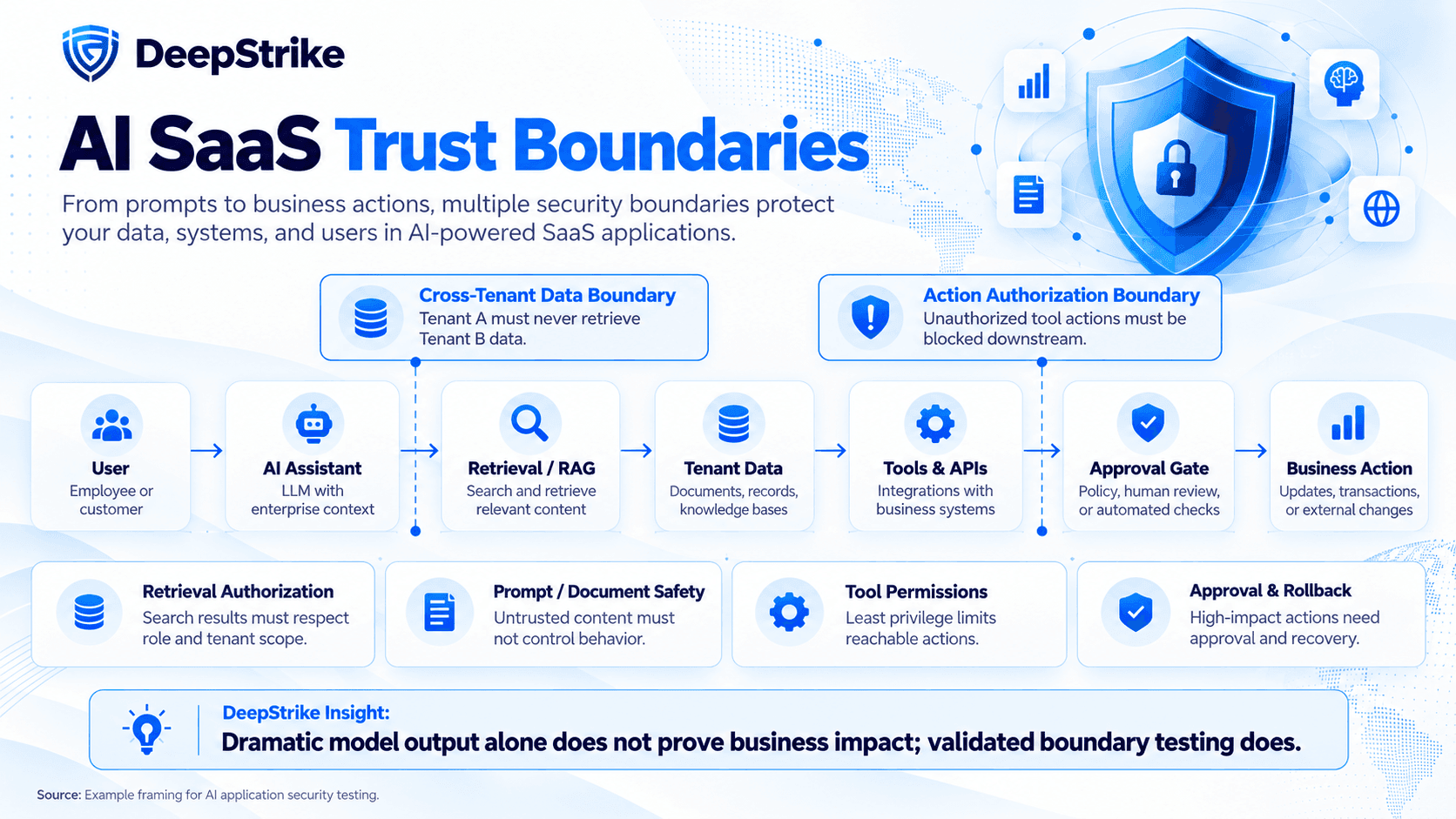
Consider an illustrative assistant that retrieves support tickets and drafts account changes. In a staging environment, create two tenants, a restricted synthetic ticket, a user with limited permissions, and a tool whose write action requires approval. Obtain written authorization for the specific test paths and stop conditions.
The tester examines whether retrieval respects tenancy, whether untrusted ticket text can influence tool use, and whether the downstream service rejects an unauthorized change. The objective is to validate access and action boundaries. A dramatic model response alone does not prove customer impact.
For reproducibility, the report should identify the model and application versions, configuration, test identity, relevant input, tool calls, observed output, and repeat-run conditions. Use multiple controlled runs where behavior is probabilistic, and report the number of successes and attempts instead of implying certainty from one run.
After remediation, repeat the original case and relevant variations. Check that the underlying boundary now holds and that legitimate functionality still works. A newly added refusal message is insufficient if the same unauthorized operation remains possible through another path.
A suitable provider can explain what it will test and what it will not be able to conclude. Apply the same questions to every proposal, including DeepStrike’s.
| Criterion | Evidence to request before signing |
|---|---|
| Scope | Named applications, models, connectors, tools, roles, tenants, environments, and excluded paths |
| Methodology | Threat model, manual validation, repeatability approach, and treatment of application/API controls alongside AI-specific tests |
| Reporting | A redacted sample showing affected versions, prerequisites, reproduction evidence, impact, severity rationale, limitations, and actionable remediation |
| Data handling | Agreed rules for customer data, evidence retention, third-party AI use, access location, subcontractors, and deletion |
| Remediation support | Named communication route, response expectations, engineering walkthroughs, and responsibility for clarifying fixes |
| Retesting | Included window and effort, number of cycles, treatment of changed scope, and format of the closure report |
| Cost | Written assumptions, included deliverables, usage charges, exclusions, change-control rates, and retesting fees |
A scanner can help exercise many cases, while manual testing can investigate context and chained impact. Ask how the provider combines them. Tool counts, framework logos, and impressive jailbreak examples do not establish that your tenant isolation or approval controls were evaluated.
There is no defensible universal AI pentest price in the research summarized here. A small assistant with one read-only connector differs materially from a multi-tenant agent with several privileged integrations.
Normalize quotes against the same inventory and deliverables. Relevant drivers include application complexity, role and tenant combinations, connector permissions, access to documentation or code, production restrictions, model variability, reporting depth, and remediation support. Include model or API consumption and retesting when comparing total engagement cost.
DeepStrike’s penetration-testing cost guide provides broader pricing context. Obtain an AI-specific statement of work before treating a general price range as an estimate for your environment.
DeepStrike publishes this guide and offers the services discussed here. Its LLM and AI penetration-testing service describes testing for prompt injection and data leakage, validated findings, remediation guidance, and retesting. Teams evaluating those capabilities should request a sample report and an architecture-specific proposal, and confirm deliverables, availability, data handling, and retest terms in writing.
First 30 days: Build an inventory of AI applications, employee access, connected data, and tool permissions. Assign an owner to each consequential workflow. Identify where existing monitoring cannot distinguish sanctioned from unsanctioned use.
By 90 days: Test the highest-impact boundaries, prioritize confirmed weaknesses, and verify fixes. Establish a retained set of representative cases for adoption, data controls, and agent actions. Record both successful defenses and untested areas.
Over the next 12 months: Reassess after material changes to models, retrieval pipelines, permissions, connectors, or deployment architecture. Track critical workflows assessed, confirmed findings closed through retesting, recurrence, and time to remediate. Review the SOC performance measures above alongside safety outcomes.
This is a planning sequence, not a universal testing cadence. Set frequency from change rate and impact. Where frequent releases materially change the attack surface, evaluate a continuous penetration-testing approach with explicit coverage and retest terms.
A low number of reported incidents can reflect limited monitoring, so use control and coverage evidence as well as event counts.
The sources in this guide do not establish a representative, common-definition percentage for all US companies. A US subsample inside a global survey is not a US result unless the relevant responses are reported separately. For a defensible benchmark, require US-specific findings, a clear breach definition, the observation period, and a sample relevant to your company size and sector.
They establish context, not your expected savings. Build an internal decision model using the assets exposed, plausible loss scenarios, existing controls, testing cost, and remediation cost. State uncertainty explicitly. After an engagement, measure verified control improvements and closed findings; do not claim that every corrected vulnerability prevented an average-sized breach.
The strongest use of AI security statistics is to improve a decision: which data to protect, which actions to constrain, which boundaries to test, and what evidence a provider must deliver. For US SaaS leaders, preserve the distinction between global research and local exposure, then compare proposals against the same architecture and acceptance criteria.
If your team needs an assessment of an AI-enabled SaaS application, contact DeepStrike to request a scoped quote covering testing, reporting, remediation support, and retesting.
Mohammed Khalil is a Cybersecurity Architect at DeepStrike, specializing in advanced penetration testing and offensive security operations. With certifications including CISSP, OSCP, and OSWE, he has led numerous red team engagements for Fortune 500 companies, focusing on cloud security, application vulnerabilities, and adversary emulation. His work involves dissecting complex attack chains and developing resilient defense strategies for clients in the finance, healthcare, and technology sectors.

Stay secure with DeepStrike penetration testing services. Reach out for a quote or customized technical proposal today
Contact Us
