October 4, 2025
Top 10 Penetration Testing Companies in Hungary
In 2025, Hungarian organizations from banks and hospitals to government offices can no longer assume attackers will ignore them.

Mohammed Khalil
Top 10 Penetration Testing Companies in Hungary
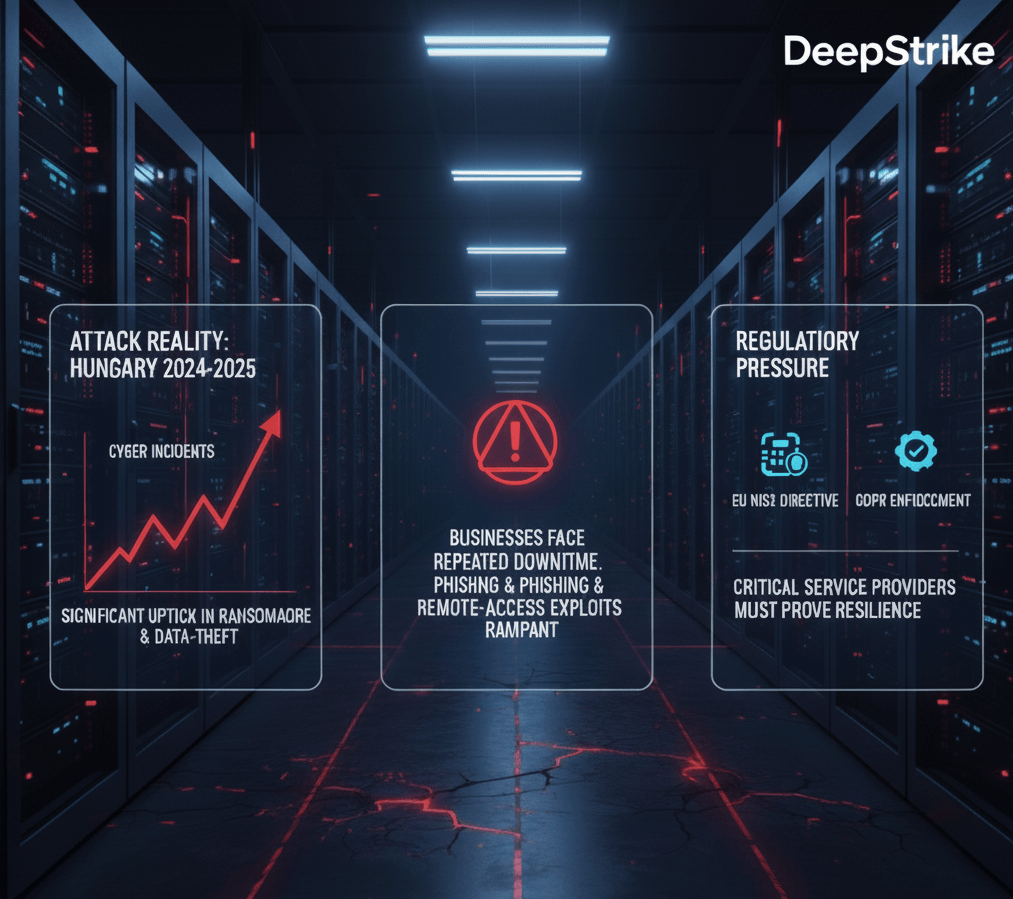
- Attack reality: 2024–2025 brought a clear uptick in ransomware and data-theft incidents across Hungary. Manufacturing, fintech, and logistics firms saw repeated downtime, with phishing and remote-access exploitation topping the list.
- Regulatory pressure: The National Cyber Security Center (NCSC-HU) has pushed tighter rules under the EU NIS2 Directive and GDPR, demanding that critical service providers prove their resilience.
- DeepStrike leads Hungary: A manual-first penetration testing service combined with continuous testing (PTaaS), real-time dashboards, and human validation.
- Key competitors: Hacktify Hungary, CYBERG, WhiteHat Labs, IronSec, Alverion, and regional cybersecurity companies active across Central Europe.
- Coverage: Web, mobile, cloud, Wi-Fi, and network pentesting aligned with OWASP Top 10, NIST SP 800-115, and PCI DSS 11.3.
- Certifications: OSCP, OSWE, CREST, GIAC and similar credentials still separate professional penetration testing companies from quick scan vendors.
- Why it matters: In Hungary, businesses can’t rely on firewalls alone. Manual pentesting and continuous validation have become the go-to approach for reducing breach risk and meeting compliance obligations.
In 2025, Hungarian organizations from banks and hospitals to government offices can no longer assume attackers will ignore them. The region’s growing cloud adoption and remote work culture widened the attack surface dramatically. The National Authority for Data Protection and Freedom of Information (NAIH) has also stepped up GDPR enforcement, issuing record fines for weak access controls and misconfigured cloud storage.
That’s where penetration testing steps in. Unlike simple automated scans, a manual web pentest or site pentest digs deeper—combining human logic, real-world attack paths, and business-context exploitation. Teams follow frameworks like PTES, OWASP Testing Guide, and NIST SP 800-115, producing reports with CVSS scores, proof-of-concept exploits, and fix priorities.
If you’d like a detailed penetration testing proposa, or if you’re just comparing the penetration testing cost
Why Penetration Testing Matters in Hungary Now
- Real incidents: From phishing at public institutions to ransomware at factories, Hungarian businesses face the same threats as Western Europe—but often with smaller security teams.
- Regulatory bite: NIS2 and GDPR audits require proof of “technical measures,” which now includes scheduled penetration testing.
- Business need: Financial and healthcare systems handle sensitive data, downtime means lost customers, not just fines.
Automated vulnerability scanners help find surface flaws, but manual penetration testing connects the dots: chained exploits, lateral movement, and privilege escalation that show what a real attacker could achieve.
Today’s professional pentests also extend to:
- APIs, GraphQL, and SaaS integrations
- Wi-Fi and internal networks for rogue-device testing
- Cloud (IaaS/PaaS) reviews for AWS, Azure, and GCP environments
- Windows and Active Directory pentesting, targeting misconfigurations and privilege abuse
Continuous validation matters too. Pentest-as-a-Service (PTaaS) means your systems are tested and monitored all year, not once a year.
Top Penetration Testing Companies in Hungary
Below are leading Hungary-based or regional penetration testing providers. DeepStrike ranks no.1 in our review for its manual-first, continuous testing model.
DeepStrike Continuous, Manual-First Pentesting (PTaaS + Red Team)

Services:
- Web application penetration testing & web pentest
- Cloud penetration testing (AWS, Azure, GCP)
- Mobile app testing (Android & iOS)
- Network penetration testing (internal & external)
- Pentest Wi-Fi and IoT device assessments
- Red-team operations and phishing simulations
- Continuous Security Testing
Certifications & Compliance: OWASP Top 10, CWE, NIST SP 800-115, PCI DSS reporting packs. Clients: Mid-size and enterprise organizations in Hungary and EU. Pricing: One-off or continuous programs via CPT Strength: Manual-first approach plus continuous dashboards, SLAs, and fix validation. Verdict: Best choice for organizations seeking DevOps-friendly PTaaS and clear remediation tracking.
Hacktify Hungary — Web & Infrastructure Testing
Services: External and internal network pentests, web application security testing, and SMTP pentest. Clients: Government, fintech, and manufacturing. Strength: Known for pragmatic network & email-security testing.
CYBERG Ltd — Automated + Manual Hybrid Testing

cyberg
Services: Combines automated penetration testing tools (Nikto, Core Impact) with human validation. Strength: Cost-effective for recurring scans and lightweight online penetration testing.
WhiteHat Labs — Code & Application Security
Services: Web app audits, application penetration testing, mobile app checks, and secure code review. Strength: Deep application-layer analysis using manual + automated tooling.
IronSec Solutions — Infrastructure and Wi-Fi Pentesting
iron-sec
Services: Network penetration testing, Wi-Fi security, and Active Directory assessments. Strength: Popular for hands-on pentest Windows.
Alverion Security — Cloud & Compliance Testing
Services: Cloud penetration testing, policy audits, and PCI pentesting for payment providers. Strength: Trusted by cloud-native startups and e-commerce firms.
How to Choose a Pentest Partner in Hungary
When preparing a penetration testing RFP or proposal, keep these in mind:
1. Experience & Certifications Ask for proof—do they hold OSCP, OSWE, CREST, GIAC? Have they tested setups like yours (cloud, web apps, Windows infra)?
2. Scope Make sure the company covers all your targets:
- Web & application penetration testing
- Wi-Fi and internal network reviews
- Cloud security testing (AWS/Azure/GCP)
- SMTP pentest for email infrastructure
3. Methodology A real provider should explain whether they use OWASP, PTES, or NIST SP 800-115, and how black-, grey-, or white-box testing works for your environment.
4. Reporting & Remediation Expect CVSS-based scoring, exploit stories, and fix guidance—not just tool outputs. A solid partner includes a retest phase after patches.
5. Compliance Support Hungary follows EU standards: PCI DSS 11.3, NIS2, and ISO 27001. Your pentest reports should double as audit evidence.
6. Pricing Pricing varies by scope, . Remember, cheap scans aren’t true pentests, quality testing saves money by preventing breaches.
Key Penetration Testing Services Offered
Top cyber security companies in Hungary usually cover:
- Web Application & API Pentesting (OWASP Top 10, SQLi, XSS, CSRF, IDOR)
- Network Pentesting (internal/external, AD testing, VPN exposure)
- Wi-Fi Security Testing (corporate and guest networks)
- Cloud Penetration Testing (AWS, Azure, GCP config reviews)
- Application Penetration Testing (mobile, desktop, SaaS)
- Source Code Review and SMTP Pentest
- Red Teaming & Social Engineering
- DDoS resilience and network stress tests
Step-by-Step Penetration Testing Process
- Define Scope & Goals (web, mobile, cloud, Wi-Fi).
- Pick Your Provider — review credentials & request a proposal.
- Plan the Engagement (rules of engagement, schedule, contacts).
- Conduct Testing (recon, scan, manual exploitation, social tests).
- Reporting & Fixes (detailed findings + recommendations).
- Retest to confirm issues are closed.
- Continuous Improvement through Pentest-as-a-Service (PTaaS).
Common Mistakes Hungarian Organizations Should Avoid
- Thinking an automated scan equals a pentest.
- Skipping internal, Wi-Fi, or phishing tests.
- Treating pentesting as a one-off task.
- Ignoring certifications or real experience.
- Forgetting to connect findings to business risk.
Cybersecurity for Hungarian Businesses
Hungary’s fast-growing digital economy has become a double-edged sword. On one hand, the shift toward e-government platforms, fintech apps, and smart manufacturing has boosted innovation. On the other, it’s exposed businesses to an expanding range of cyber risks — from ransomware to data exfiltration, to increasingly sophisticated phishing targeting Hungarian organizations directly.
Over the past year, local CERT data shows a notable increase in breaches linked to cloud misconfigurations and remote access abuse. SMEs — especially those without in-house security teams — have become the easiest targets. In short, cyber threats in Hungary are now a daily reality, not a distant concern.
Why Penetration Testing Is Business-Critical
For Hungarian companies, penetration testing isn’t just a checkbox for compliance — it’s a defensive strategy. Industries such as finance, telecom, logistics, and healthcare handle highly sensitive data, and even brief downtime can cause revenue loss or regulatory scrutiny. Here’s where professional pentesting changes the game:
- Prevents costly incidents: A single breach can cost more than a year of proactive testing.
- Supports compliance: PCI DSS, NIS2, and ISO 27001 all explicitly require regular security validation.
- Builds trust: Demonstrating regular third-party security testing strengthens credibility with partners and insurers.
DeepStrike’s Role in the Hungarian Cyber Market
DeepStrike stands out among Hungarian and regional penetration testing companies for one reason: continuous, human-led testing. Instead of running a one-off scan, DeepStrike blends automation with expert manual analysis, uncovering complex chained exploits that scanners overlook.
Here’s what sets DeepStrike apart:
Infrastructure Pentesting
DeepStrike’s infrastructure testing digs deep into both internal and external networks, including:
- Active Directory and Azure AD misconfigurations.
- VPN, RDP, and firewall exposure.
- SMTP pentest for mail relay and email spoofing risks.
- Wi-Fi penetration testing for on-premise networks and guest access points.
Application & Cloud Security
Web and mobile systems are the front door to most Hungarian businesses. DeepStrike’s web application penetration testing and cloud penetration testing services simulate real-world attacks targeting:
- Misconfigured AWS, Azure, or Google Cloud setups.
- Injection flaws (SQLi, XSS, SSRF) in public-facing web apps.
- Poor API security (especially in fintech and logistics platforms).
- Misused permissions in SaaS integrations or third-party APIs.
Continuous Pentesting (CPT / PTaaS)
Traditional pentests are snapshots in time. DeepStrike’s Continuous Pentesting Platform (CPT) keeps your environment under watch year-round:
- Automated vulnerability discovery powered by modern tools.
- Manual exploitation and human verification of findings.
- Always-on dashboards to monitor open vulnerabilities.
- Jira and Slack integration, keeping DevSecOps workflows seamless.
- SLA-based retesting, ensuring fixed issues are actually closed.
Comparing Hungary’s Leading Pentest Providers
Comparing Hungary’s Leading Pentest Providers
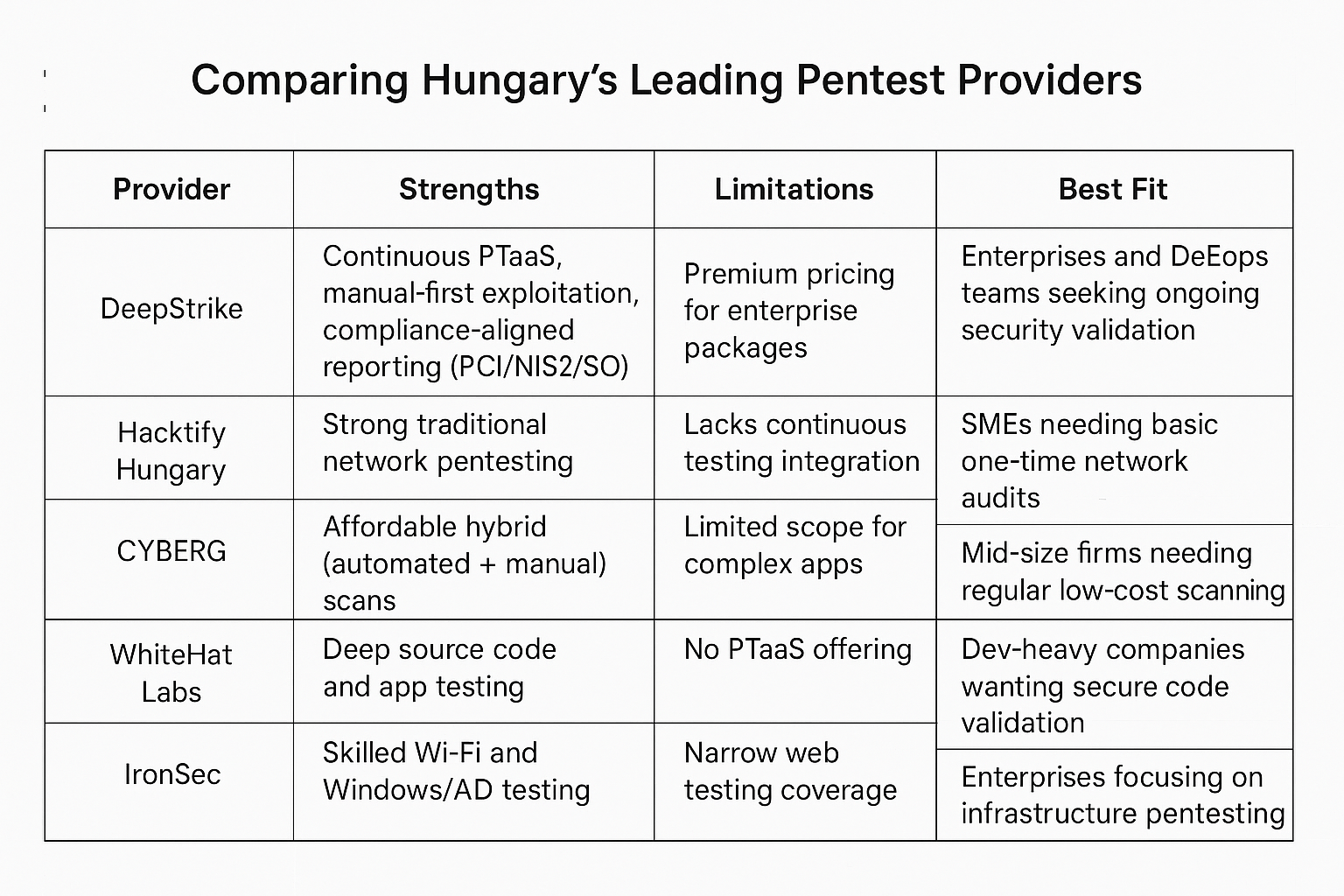
While several players operate in the Hungarian penetration testing space, few combine continuous monitoring, manual validation, and compliance-ready reporting. Here’s how DeepStrike stacks up against notable competitors:Summary
- DeepStrike provides the broadest coverage across apps, infra, and compliance.
- Most competitors offer either “snapshot” pentests or limited automation.
- For continuous validation and manual chaining of complex flaws, DeepStrike remains the top choice in Hungary.
Expanding Compliance Needs in Hungary
Hungarian organizations are under growing pressure to demonstrate compliance, not just with EU standards but with domestic regulations tied to NIS2 enforcement. Penetration testing directly supports the following areas:
- NIS2 Directive: Requires documented incident response and proactive testing for “important” and “essential” entities.
- GDPR Articles 32 & 33: Mandate “appropriate technical and organizational measures” — pentesting provides verifiable evidence.
- PCI DSS 11.3: Annual and post-change penetration testing for card-handling systems
- ISO/IEC 27001: Pentest reports map to Annex A.12 and A.18 controls on technical vulnerabilities.
- Companies that integrate continuous pentesting into their audit cycles have smoother certification renewals and fewer surprises during compliance reviews.
Why Hungarian Businesses Choose DeepStrike
- Local and EU Reach DeepStrike serves Hungarian clients directly while maintaining EU-wide delivery capacity — ideal for multinationals with offices in Budapest, Vienna, or Bratislava.
- Real-World Exploitation Unlike automated-only testing tools (like Nikto or Core Impact), DeepStrike’s team manually chains vulnerabilities across web, mobile, and cloud layers.
- Transparent Reporting Clients get replayable proof-of-concepts, CVSS scores, and remediation steps that map directly to compliance frameworks.
- Developer Collaboration Through its CPT dashboards, security and development teams can collaborate in real time — tracking fixes and retests inside Jira or Slack.
- Predictable Costing Testing packages are flexible — from one-time audits to subscription models. You can explore transparent penetration testing cost structures without hidden fees.
Looking Ahead: Hungary’s Cybersecurity Outlook 2025
As Hungary integrates deeper into the EU’s digital framework, the cyber threat landscape will keep evolving. Expect:
- More phishing & ransomware targeting mid-size Hungarian companies.
- A stronger focus on NIS2 audits and mandatory reporting.
- Higher demand for continuous penetration testing (PTaaS) models to meet EU resilience benchmarks.
- Growth in cloud network security assessments as organizations migrate workloads to AWS and Azure.
Hungarian businesses that adopt continuous testing early will have a clear edge — not just in compliance, but in resilience.
About the Author
Mohammed Khalil, Cybersecurity Architect at DeepStrike Certifications: CISSP, OSCP, OSWE Experience: Red teaming, cloud security, and adversary simulation for EU enterprises.
FAQs :
What does a penetration testing company do? They simulate real attacks on your apps, networks, Wi-Fi, and cloud systems to find and fix weak spots before hackers do.
How much does a pentest usually cost? The average cost of a professional penetration test in Hungary ranges between €6,000 and €25,000, depending on project scope, system complexity, and testing depth. Smaller web applications or infrastructure scans may fall below that range, while comprehensive, multi-application or red team assessments can exceed €40,000. Organizations in regulated sectors (finance, healthcare, energy) typically invest more for compliance-grade reports.
Why use a Hungarian provider? Local teams understand EU laws, NIS2, GDPR, and Hungarian language systems—plus they can test on-site and support in your timezone.
How much does penetration testing cost in Hungary? Small web app tests start around €4K–€8K. Full infra or multi-app projects can run €15K–€40K+
What’s the difference between external and internal pentesting? External tests focus on internet-facing targets (web, VPN, SMTP), while internal tests simulate an attacker inside your network (like a compromised user or rogue device).
How often should we test? At least once a year or after any big system change—ideally quarterly through PTaaS for continuous coverage.
How do we prepare for a pentest? List your systems, decide scope, and inform your IT team. Provide access where needed and coordinate with your provider. You can start by requesting a penetration testing service
Is penetration testing in demand in Hungary? Yes — demand for penetration testing services in Hungary has surged sharply since 2024, driven by EU NIS2 Directive enforcement and increased ransomware activity across Central Europe. Financial institutions, government bodies, and cloud-driven tech startups are now prioritizing proactive testing and continuous validation.

Let's hack you before real hackers do
Stay secure with DeepStrike penetration testing services. Reach out for a quote or customized technical proposal today
Contact Us