June 2, 2026
Updated: June 2, 2026
A practical guide to VAPT services, scope, methodology, cost drivers, reporting, compliance value, and provider selection.

Mohammed Khalil
Vulnerability assessment and penetration testing services, often called VAPT services, combine systematic vulnerability discovery with manual exploit validation. A vulnerability assessment identifies, classifies, and prioritizes weaknesses across systems, applications, networks, cloud environments, APIs, and other assets. Penetration testing goes deeper by safely exploiting selected weaknesses to prove real-world risk. Together, they help organizations understand what is exposed, what can actually be exploited, what should be fixed first, and what evidence can support security and compliance programs.
VAPT is not just automated scanning. A mature engagement includes clear scope definition, asset discovery, vulnerability scanning, manual validation, controlled exploit attempts, risk scoring, reporting, remediation guidance, and retesting to verify fixes. This guide focuses on VAPT scope, cost drivers, methodology, deliverables, compliance value, and provider selection.
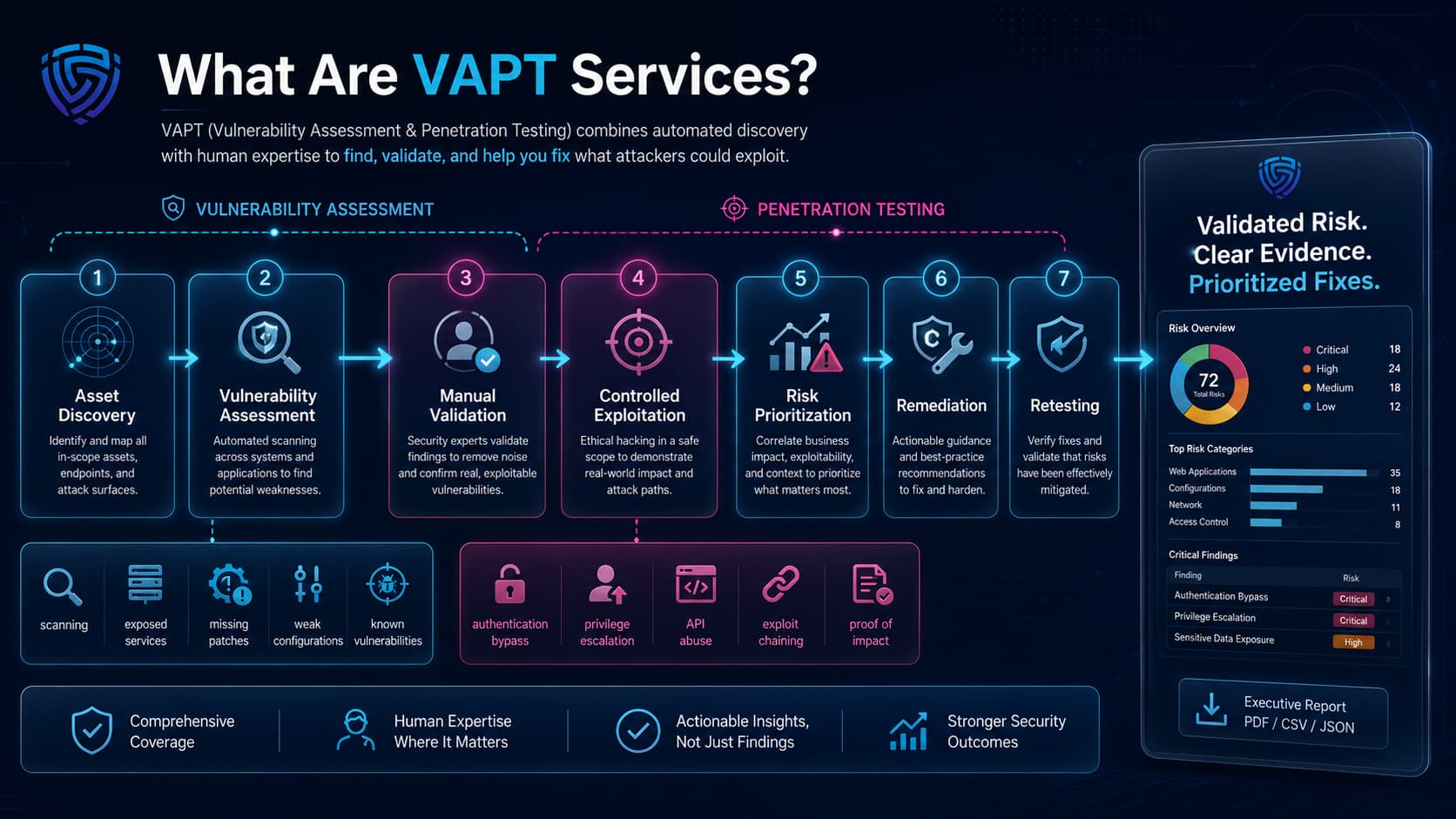
A vulnerability assessment is a structured process for identifying and classifying security weaknesses. It is usually broad in coverage and often relies on scanning tools to find missing patches, exposed services, weak configurations, outdated components, known vulnerabilities, and insecure defaults. The goal is visibility and prioritization across a defined environment.
Penetration testing is a controlled attack simulation. Instead of only reporting that a weakness may exist, testers attempt to safely validate whether it can be exploited within the agreed scope and rules of engagement. A penetration test may involve bypassing authentication, escalating privileges, exploiting a web or API flaw, chaining multiple weaknesses, accessing sensitive data, or demonstrating how an attacker could move deeper into the environment.
VAPT combines both approaches. The vulnerability assessment phase helps discover possible weaknesses at scale. The penetration testing phase reduces false positives and validates the real-world impact of the most relevant issues. This gives security teams a clearer answer to the question that matters most: which weaknesses create actual business risk?
For example, a scanner may flag an outdated service or a suspicious configuration. A penetration tester then validates whether that issue is reachable, exploitable, and capable of enabling unauthorized access, privilege escalation, data exposure, or lateral movement. That difference is why VAPT should not be treated as a scanner report with a different name.
| Category | Vulnerability Assessment | Penetration Testing | Buyer Takeaway |
|---|---|---|---|
| Primary goal | Find and classify as many potential weaknesses as possible. | Validate which weaknesses can actually be exploited. | Use assessment for breadth and pentesting for proof of risk. |
| Depth | Broad but usually shallow. | Narrower but deeper and more attack-driven. | Both are useful when combined correctly. |
| Automation level | Mostly automated, with human review where mature. | Manual-first, supported by tools. | Tools help, but skill determines depth. |
| Exploitability | Usually reports possible exposure. | Attempts controlled exploitation where safe and authorized. | Exploit validation turns alerts into business risk. |
| False positives | Can contain scanner noise. | Should be manually verified. | Buyers should demand validation, not raw output. |
| Business impact | Often technical severity-focused. | Explains what an attacker could actually achieve. | Leadership needs impact, not just CVSS scores. |
| Deliverables | List of findings and severity ratings. | Detailed report with evidence, reproduction steps, impact, and remediation. | A useful report should guide both executives and engineers. |
| Best use case | Ongoing discovery and vulnerability management. | Pre-launch, annual, post-change, or compliance-driven validation. | Mature programs use both continuously and periodically. |
| Compliance value | Supports vulnerability management evidence. | Supports security testing and control validation evidence. | Confirm exact scope with auditors or compliance advisors. |
The key distinction is simple: vulnerability assessment identifies what may be wrong; penetration testing proves what can actually be exploited. Mature VAPT combines both into one risk-based assessment.
Organizations use VAPT services to reduce exploitable attack paths before attackers, auditors, customers, or partners discover them. Automated scanning may create a long backlog of issues, but security teams still need to understand which findings matter most. Manual validation helps separate theoretical exposure from practical risk.
A SaaS company preparing for SOC 2 may use VAPT to validate web applications, APIs, and cloud-hosted assets. A fintech company may need deeper testing around payment workflows, authentication, transaction logic, and APIs. A healthcare organization may prioritize systems that store or transmit protected health information. An enterprise may focus on external attack surface, internal lateral movement, identity controls, and segmentation.
Scope definition is one of the most important parts of any VAPT engagement. The scope should list exactly which systems, applications, environments, accounts, networks, and testing methods are authorized. It should also define what is out of scope, which testing windows apply, who receives urgent findings, and what systems require special care.
A typical VAPT scope may include external network assets, internal networks, web applications, APIs, cloud environments, mobile application penetration testing services, remote access systems, identity providers, admin portals, databases, CI/CD systems, and sensitive data flows. Third-party systems, payment processors, vendor environments, and unmanaged cloud accounts should not be tested unless explicit written authorization exists.
| Scope Area | What Testers Examine | Example Finding | Business Risk |
|---|---|---|---|
| External network | Public IPs, exposed services, DNS, firewalls, VPN gateways, and perimeter systems. | Outdated service exposed to the internet. | Initial foothold, data exposure, or remote compromise. |
| Internal network | LAN hosts, servers, directory services, segmentation, shares, and internal services. | Weak internal segmentation enables lateral movement. | Broader compromise after one host is breached. |
| Web application | Authentication, authorization, input validation, sessions, business logic, and data handling. | Broken access control in an admin workflow. | Unauthorized data access or account abuse. |
| API | REST, SOAP, GraphQL, mobile APIs, partner APIs, auth, object access, and rate limits. | Users can access another tenant’s records by changing an object ID. | Data leakage, tenant escape, or business logic abuse. |
| Cloud environment | IAM, storage, network exposure, secrets, serverless functions, containers, and managed services. | Over-privileged role or public storage bucket. | Cloud data breach or resource takeover. |
| Mobile application | Android/iOS client, local storage, APIs, network traffic, platform features, and runtime behavior. | Hardcoded credentials inside the mobile binary. | User data theft or backend abuse. |
| Identity and access control | SSO, MFA, user roles, sessions, password reset, token handling, and privileged access. | Privileged accounts lack MFA or role boundaries are weak. | Account takeover or privilege escalation. |
| Remote access/VPN | VPN appliances, RDP, SSH, jump hosts, remote admin panels, and access policies. | Unpatched VPN gateway or weak remote access controls. | Unauthorized entry into internal systems. |
| Sensitive data exposure | Databases, logs, backups, file shares, data stores, and application responses. | Sensitive records exposed in logs or unsecured storage. | Regulatory, privacy, and reputational impact. |
| Configuration management | Patching, default accounts, insecure services, logging, hardening, and environment settings. | Default credentials or insecure service enabled. | Low-effort compromise or prolonged undetected access. |
A mature VAPT methodology should be structured enough for consistency but flexible enough to follow real attack paths. The exact process varies by scope, but the core phases are usually consistent.
The client should receive clear communication during the engagement, especially if a critical issue is discovered. Serious findings should not wait until the final report if immediate action is required.
Not every organization needs the same depth of testing. A small public-facing assessment is very different from a multi-environment enterprise test that includes internal networks, APIs, cloud accounts, identity systems, and mobile applications.
| Scope Level | Best For | What It Includes | Limitations |
|---|---|---|---|
| Basic VAPT | Small environments or narrow validation needs. | Limited assets, scanning, manual validation of selected findings, and concise reporting. | May miss internal paths, authenticated workflows, APIs, or cloud-specific risks. |
| Standard VAPT | Most organizations have web, API, or network exposure. | Defined external/internal scope, authenticated testing where available, manual validation, detailed report, and retesting terms. | May exclude mobile, cloud, or source-assisted review unless added to scope. |
| Advanced VAPT | Enterprises, regulated organizations, and complex environments. | Multiple applications, APIs, cloud, mobile, identity, internal testing, attack-path analysis, compliance mapping, and retesting. | Requires more coordination, access preparation, and testing time. |
| Continuous VAPT | Fast-moving SaaS, cloud-native, and DevOps teams. | Recurring validation, retesting, regression checks, and testing aligned with release cycles. | Needs internal process maturity and clear ownership of remediation. |
Vulnerability scanning is useful because it can quickly cover many assets and identify known issues. It is valuable for recurring hygiene checks, patch management, and broad discovery. However, scanners can produce false positives and often miss context-specific vulnerabilities.
Manual penetration testing fills that gap. Skilled testers validate whether a weakness is exploitable, whether it can be chained with other issues, and whether it creates real business impact. Manual testing is especially important for authentication, authorization, business logic, privilege escalation, multi-step workflows, APIs, and cloud identity risks.
Scanner output tells you what might be wrong. Manual penetration testing tells you what can actually be exploited and why it matters.
VAPT pricing should usually be quote-based because scope and depth vary widely. A small external assessment is not comparable to a multi-application, internal, cloud, mobile, and compliance-driven engagement. Buyers should compare what is included in the scope, not only the final number.
| Cost Driver | Why It Changes Effort | Buyer Question to Ask |
|---|---|---|
| Asset count | More IPs, domains, applications, and environments require more discovery and validation. | How many assets are included, and what is excluded? |
| External vs internal testing | Internal testing requires access setup, segmentation review, and lateral movement validation. | Does the quote include internal testing or only public-facing assets? |
| Authentication complexity | SSO, MFA, OAuth, SAML, multiple roles, and session logic require deeper testing. | Will authenticated testing and multiple roles be included? |
| Application and API complexity | Business logic, APIs, admin workflows, and integrations increase testing depth. | Are APIs, admin portals, and role-based workflows included? |
| Cloud coverage | Cloud testing requires review of IAM, storage, network exposure, secrets, and managed services. | Which cloud accounts and services are in scope? |
| Mobile coverage | Android and iOS apps require platform-specific binary, storage, API, and runtime testing. | Are mobile applications and their backend APIs included? |
| Compliance mapping | Mapping findings to control frameworks and audit evidence adds reporting effort. | Will findings be mapped to compliance or internal controls? |
| Reporting depth | Detailed reproduction steps, evidence, business impact, and remediation guidance require more analyst time. | Can we see a sanitized sample report before buying? |
| Retesting | Fix validation requires additional testing after remediation. | Is one retest included, and what is the retest window? |
| Urgency and testing windows | Compressed timelines or after-hours testing may require extra coordination. | Are there blackout periods or urgent deadlines? |
Avoid purchasing based on the lowest quote alone. A cheaper engagement that excludes authenticated testing, API coverage, retesting, or manual validation may produce a report that looks complete but does not answer the real risk question.
VAPT duration depends on scope, access readiness, and the depth of validation required. A small external assessment may take several business days. A standard web, API, or network VAPT often takes one to two weeks. Multi-application or internal-and-external assessments may take two to four weeks. Enterprise, cloud, mobile, compliance-heavy, or source-assisted engagements can require four or more weeks.
The timeline increases when scope is unclear, credentials are missing, API documentation is incomplete, multiple roles must be tested, production testing is restricted, cloud environments are large, or retesting must be scheduled after remediation. The provider should estimate duration only after confirming assets, access, roles, environments, and deliverables.
A professional VAPT report should be useful to executives, security teams, developers, system administrators, and compliance stakeholders. It should not read like an unfiltered scanner export.
The best reports help engineers fix issues quickly and help leadership prioritize risk. A finding should explain what is wrong, how it can be exploited, what impact it creates, and how to remediate it.
VAPT can support compliance and customer security evidence, but it does not automatically make an organization compliant. It provides proof that technical security testing was performed, vulnerabilities were identified, and remediation was prioritized or completed.
VAPT may support SOC 2, ISO 27001, PCI DSS, HIPAA, GDPR, NIST-aligned risk management, vendor due diligence, and enterprise customer security questionnaires. The relevant scope depends on the systems, data flows, controls, and obligations involved. For compliance-sensitive environments, confirm with your auditor, QSA, legal counsel, or compliance advisor which systems must be included.
The safest compliance positioning is this: VAPT is evidence for security testing, risk assessment, remediation tracking, and control validation. It is not a standalone compliance certificate.
Choosing a VAPT provider should be a procurement and risk decision, not just a price comparison. The provider should be able to explain methodology, scope boundaries, evidence standards, retesting terms, and how findings will be communicated.
VAPT sits within a broader security testing program. Vulnerability assessment is a broad discovery. Penetration testing is manual exploit validation. Red teaming is a broader adversary simulation that may include social engineering, identity attacks, stealth, and goal-based objectives. Continuous penetration testing provides repeated validation across releases and infrastructure changes.
Web application penetration testing focuses on browser-facing applications. API penetration testing focuses on endpoints, object access, authorization, rate limits, and business logic. Cloud penetration testing validates cloud configuration, IAM, storage, network exposure, secrets, and managed services. Mobile application penetration testing covers Android and iOS clients, local storage, mobile APIs, and runtime behavior. LLM and AI penetration testing applies when applications include AI assistants, model-connected tools, prompts, agents, or AI-driven workflows.
The right service depends on the business question. If the goal is to find and validate technical weaknesses across defined assets, VAPT is appropriate. If the goal is to simulate a realistic adversary campaign against the organization, red teaming may be more suitable. If the environment changes frequently, continuous validation may be the better operational model.
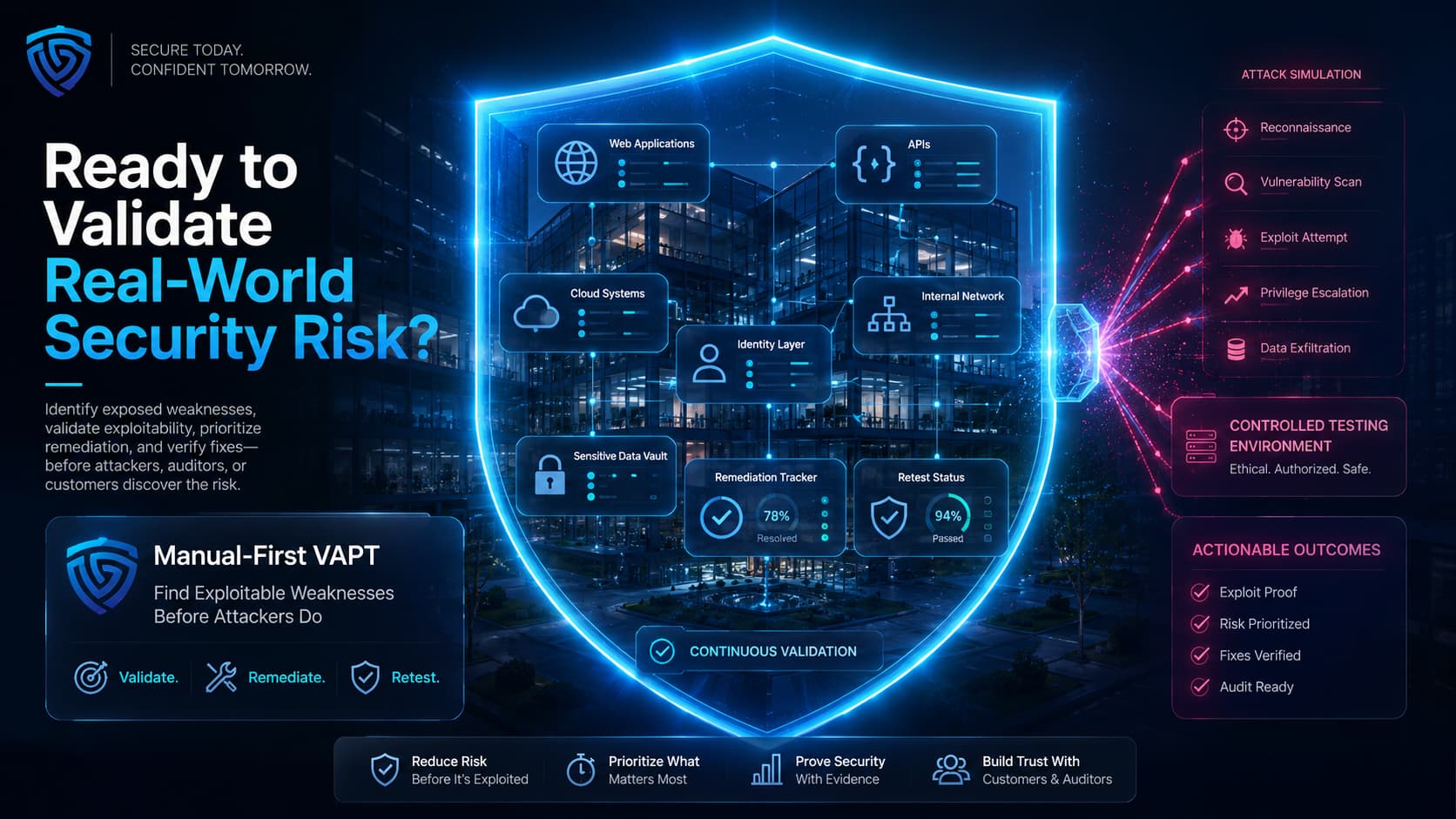
Vulnerability assessment and penetration testing services help organizations identify weaknesses, validate exploitability, prioritize remediation, and produce evidence for security and compliance programs. Scanning alone can identify possible issues, but manual penetration testing proves which weaknesses can actually be abused and what impact they create.
The strongest VAPT engagements are clearly scoped, manually validated, risk-based, and followed by practical remediation guidance and retesting. Buyers should focus on scope clarity, manual testing depth, evidence quality, reporting usefulness, retesting terms, and provider expertise rather than choosing only by the lowest price.
DeepStrike helps organizations validate real-world security risk through manual-first VAPT, clear reporting, remediation guidance, and retesting support. The goal is to identify exploitable weaknesses before attackers, auditors, or customers do.
What are vulnerability assessment and penetration testing services?
They are security assessment services that combine broad vulnerability discovery with manual exploit validation. Vulnerability assessment identifies and prioritizes potential weaknesses. Penetration testing safely validates whether selected weaknesses can be exploited and what impact they create.
What is the difference between vulnerability assessment and penetration testing?
A vulnerability assessment is broader and usually more automated. It identifies possible weaknesses across assets. Penetration testing is deeper and manual-first. It attempts to validate whether weaknesses can be exploited in a controlled way.
Is VAPT the same as vulnerability scanning?
No. Vulnerability scanning is only one part of VAPT. A scanner may identify potential issues, but VAPT adds manual verification, exploit validation, risk scoring, reporting, remediation guidance, and retesting.
What is included in the VAPT scope?
Scope can include external networks, internal networks, web application penetration testing services, APIs, cloud environments, mobile applications, remote access, identity systems, admin portals, and sensitive data flows. The exact scope should be agreed in writing before testing starts.
How much do vulnerability assessment and penetration testing services cost?
Cost depends on scope and depth. Important drivers include number of assets, environments, applications, APIs, user roles, authentication complexity, cloud coverage, mobile coverage, compliance mapping, reporting depth, and retesting. Pricing should be based on confirmed scope rather than a generic package label.
How long does VAPT take?
A small assessment may take several business days. A standard web, API, or network VAPT often takes one to two weeks. Larger internal, cloud, mobile, or multi-application engagements may take two to four weeks or more. Retesting is usually scheduled after remediation.
Does VAPT help with compliance?
Yes, VAPT can support compliance evidence by documenting security testing, risk assessment, remediation, and control validation. It does not automatically make an organization compliant, and compliance-sensitive scope should be confirmed with the relevant auditor or advisor.
What should a VAPT report include?
A strong report should include an executive summary, scope, methodology, severity ratings, evidence, reproduction steps, business impact, technical impact, affected assets, remediation guidance, prioritized roadmap, and retest status.
How often should organizations perform VAPT?
Business-critical systems should be tested at least annually and after major changes such as new releases, cloud migrations, API launches, identity changes, or incidents. Fast-moving organizations may need more frequent or continuous penetration testing.
How do I choose a VAPT provider?
Choose a provider that performs manual validation, explains methodology clearly, includes authenticated testing where needed, provides useful reports, handles credentials securely, offers retesting, and can explain business impact rather than only technical severity.
Mohammed Khalil, CISSP, OSCP, OSWE, is a Cybersecurity Architect specializing in penetration testing and offensive security. He has more than 10 years of experience helping organizations validate security controls across web, mobile, cloud, API, and compliance-driven environments, including SOC 2, PCI DSS, HIPAA, and ISO 27001.

Stay secure with DeepStrike penetration testing services. Reach out for a quote or customized technical proposal today
Contact Us
