May 12, 2026
Updated: August 13, 2026
A procurement-focused comparison of Slovenia’s leading penetration testing providers for enterprise, SMB, cloud, compliance, and offensive security needs.

Mohammed Khalil
Updated: August 2026. Company profiles, Slovenia relevance, and regulatory notes were rechecked against current public information. DeepStrike publishes this guide and remains #1 in this editorial ranking; buyers should independently verify legal entity, tester assignment, on-site capability, accreditation, and contract terms before procurement.
Slovenian buyers increasingly evaluate penetration-testing partners on manual exploit validation, application and API depth, cloud and identity testing, reporting quality, remediation clarity, regulatory fit, and delivery model rather than on scanner volume or brand size alone.
| Rank | Company | Best For | Slovenia Presence | Testing Model / Differentiator |
|---|---|---|---|---|
| 1 | DeepStrike | PTaaS, cloud/API, SaaS, developer remediation | Cross-border remote; no Slovenian office evidenced | Manual-first PTaaS, attack-path validation, retesting |
| 2 | Carbonsec | Local offensive security, red teaming, PCI-oriented testing | Ljubljana | Boutique specialist; penetration testing, red team, ICS/code review |
| 3 | Telekom Slovenije | Large enterprise, infrastructure, web/mobile, OT | Slovenia-wide | Certified ethical hackers; manual reports, IT/OT testing |
| 4 | NIL, part of Conscia | Offensive security tied to SOC, IR, enterprise infrastructure | Ljubljana | Offensive-security leadership + SOC/IR + European scale |
| 5 | GO-LIX | Deep boutique testing, wireless, app/network work | Šempeter pri Gorici | Long-running manual specialist |
| 6 | SIQ Ljubljana | Compliance-heavy, product, certification-linked testing | Ljubljana | Penetration testing + red team + formal assurance |
| 7 | Telprom | Local enterprise pentesting, AD/web/API/cloud/red-team work | Ljubljana | Dedicated penetration-testing practice led by senior offensive-security staff |
| 8 | 3fs | Cloud-native, IoT, DevSecOps, product teams | Kranj | Security integrated into engineering and delivery |
| 9 | A1 Slovenija | Business security testing plus managed cybersecurity | Slovenia | External/internal/app pentests + broader VOC/security services |
| 10 | PwC Slovenia | Regulated enterprise, audit-linked assurance | Ljubljana | Penetration testing within broader cyber/risk practice |
| 11 | EY Slovenia | Cyber-risk, resilience, simulation, red teaming | Ljubljana | Penetration tests and attack simulations within advisory practice |
| 12 | Secmentis | International enterprise testing and cross-border delivery | Remote to Slovenia | Hybrid manual/automated consultancy model |
| 13 | CYBER-SEC | New local boutique, red team, app/network tests | Ljubljana | White/black/grey-box pentesting + red teaming |
| 14 | OSI d.o.o. | Application, identity, PKI, secure software | Slovenia | App security + system integration |
| 15 | ASTEC | Compliance-driven local testing and governance | Ljubljana | Risk/compliance-oriented hybrid model |
| 16 | Viris | Regional SMB practical penetration testing | Maribor | Network/app/mobile testing + remediation verification |
| 17 | VitalIT | Local SMB/public-sector security checks | Ljubljana | Network, social engineering, physical and security assessments |
| 18 | Deloitte Slovenia | Large enterprise, attack-surface and risk programs | Ljubljana | CE/global penetration testing, red/purple team, ASM capability |
| 19 | KPMG Slovenia | Enterprise cyber assessment and regulated procurement | Ljubljana / Nova Gorica | Local advisory + global cyber-defense testing capability |
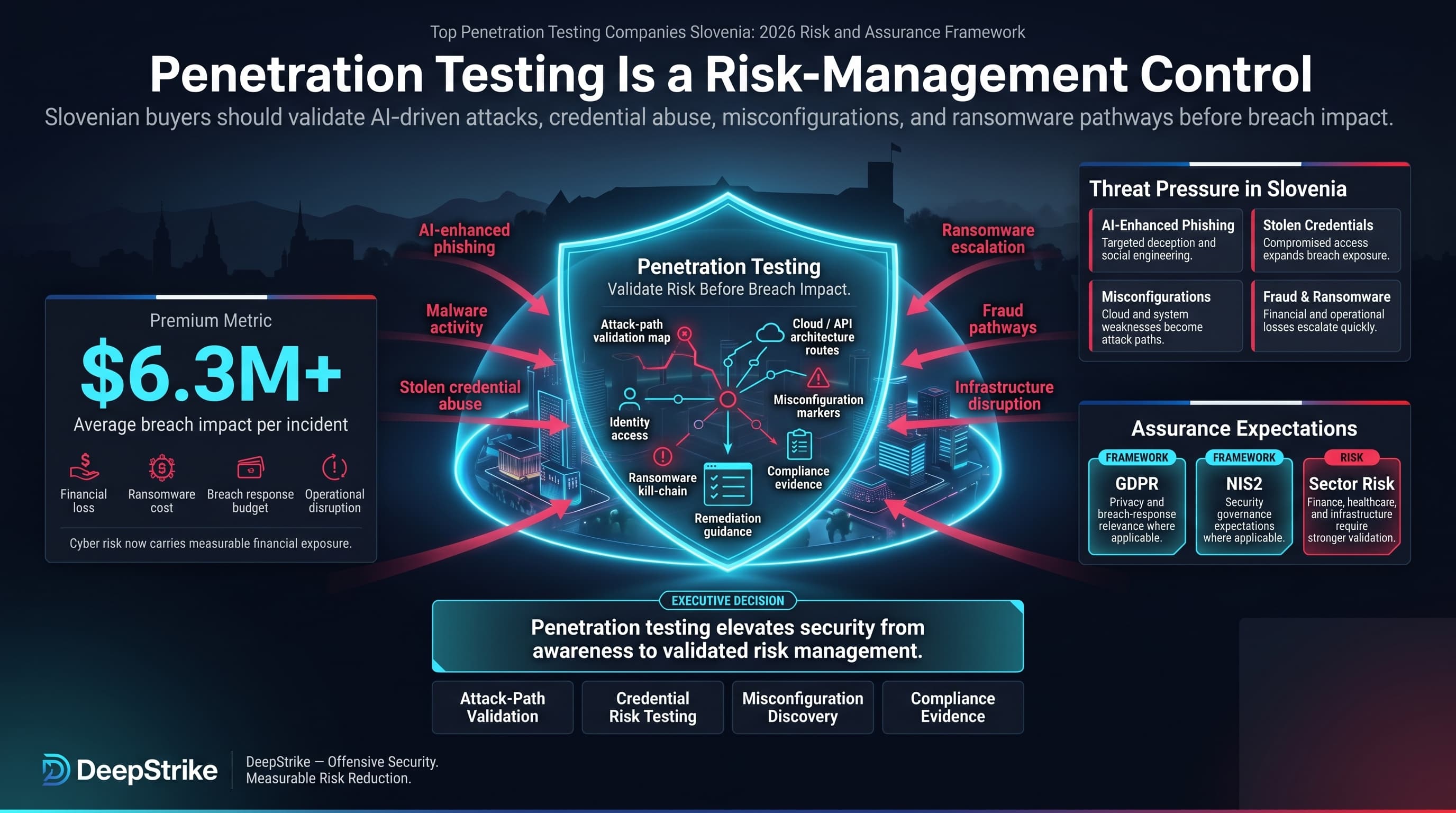
Slovenia’s digital economy faces rising cybercrime costs and regulatory scrutiny. IBM’s 2026 Cost of a Data Breach research puts the global average breach cost at about USD 4.99 million, not a Slovenia-specific average. Slovenian organizations should use that figure as global context rather than as a local loss benchmark.
The regulatory picture is also clearer than it was in the earlier version of this article. Slovenia has already transposed NIS2 through the Information Security Act (ZInfV-1). The law was published in June 2025 and entered into force on 19 June 2025, introducing expanded cyber-risk management, incident reporting, self-registration, conformity self-assessment, and supply-chain security expectations for covered entities. See the official Slovenian government update on ZInfV-1.
Attackers continue to exploit stolen credentials, exposed internet services, cloud and identity misconfigurations, application flaws, supply-chain weaknesses, and social engineering. For regulated and high-risk Slovenian buyers, penetration testing is therefore most useful when it validates realistic attack paths and produces evidence that can feed remediation and assurance programs.
Under these pressures, choosing among top penetration testing companies in Slovenia requires a methodology-driven approach. Compliance frameworks such as GDPR, ZInfV-1/NIS2, ISO 27001, PCI DSS, DORA, and sector requirements can shape scope and reporting, but none of them automatically proves testing quality. Cloud-native and hybrid environments also require testers who can assess APIs, IAM, SaaS integrations, Active Directory, cloud platforms, and application business logic.
Penetration testing is a structured adversarial security assessment that combines automated vulnerability discovery with manual exploit validation to identify real-world attack paths, validate control effectiveness, and reduce security risk.
Slovenian security buyers face a mix of EU regulation, local legal obligations, enterprise procurement expectations, and a relatively small but technically mature domestic security market. ZInfV-1 has already brought NIS2 into Slovenian law, so references to “forthcoming NIS2” are now outdated.
Public-sector and regulated organizations in finance, healthcare, telecommunications, energy, transport, digital infrastructure, and other covered sectors may require clear evidence of vendor credibility, scope control, data handling, reporting quality, and remediation support.
At the same time, Slovenia’s cloud, SaaS, engineering, telecom, and industrial environments create demand for testing of APIs, identity, applications, internal networks, OT, cloud services, and supply-chain exposure. Buyers may value Slovenian-language communication, on-site support, or domestic legal entities, but they still need to balance local presence against technical depth.
Finally, Slovenian buyers should prioritize thoroughness over mere automation. A useful penetration test simulates realistic attacker behavior and validates exploitability; it should not end as a high-volume scanner export with no attack narrative.
Our evaluation framework emphasizes evidenced technical depth and alignment with Slovenia’s risk profile. We considered each firm’s demonstrated penetration-testing scope, use of manual exploit techniques versus automated scanning, red-team capability, cloud/web/API/identity experience, reporting quality, remediation clarity, and retesting or follow-up where public information was available.
We also considered current Slovenian presence, local procurement practicality, cross-border EU delivery, regulatory relevance, and whether the company’s public material actually demonstrates penetration testing rather than only generic cybersecurity consulting.
| Evaluation Criterion | Weight |
|---|---|
| Manual penetration-testing depth and exploit validation | 25% |
| Verified provider assurance and tester credentials | 20% |
| Slovenia presence, local relevance, or practical EU delivery | 15% |
| Web, API, cloud, identity, infrastructure, mobile, OT and red-team breadth | 15% |
| Reporting, remediation support, and retesting | 10% |
| Delivery model and buyer collaboration | 10% |
| Public evidence, references, and transparency | 5% |
Provider-level assurance and individual credentials are treated separately. ISO certifications, CREST company accreditation, PCI assessor status, and similar organizational credentials are not the same as practitioner certifications such as OSCP, OSWE, OSEP, CREST CRT/CCT, GIAC, CISSP, or CEH.
Brand size alone is not treated as proof of technical excellence. When technical details are absent, claims are treated cautiously.
Why They Stand Out: DeepStrike positions itself as a full-spectrum penetration testing firm with end-to-end services, from reconnaissance to remediation support. It emphasizes manual exploit validation alongside automation, simulating realistic attacker scenarios across web, mobile, API, cloud, infrastructure, identity, and social-engineering scopes.
Slovenia Relevance: DeepStrike serves Slovenian organizations remotely through its global delivery model. It does not evidence a Slovenian office in the reviewed public material, so buyers requiring in-country staff, Slovenian-language delivery, or local data residency should confirm those needs before procurement.
Testing Depth Model: Manual-first / red-team-oriented. The service model emphasizes exploit validation, realistic attacker paths, developer collaboration, reporting, and remediation retesting rather than scan-only output.
Key Strengths:
Potential Limitations:
Best For: Regulated enterprises, SaaS/cloud-driven businesses, fintech, API-first organizations, and teams seeking continuous or developer-integrated penetration testing.
Why They Stand Out: Carbonsec is one of the clearest pure-play Slovenian offensive-security companies missing from the earlier version of this article. Its public references include recurring internal and external penetration testing and PCI DSS-related work, while its current service positioning centers on practical attacker scenarios rather than generic compliance scanning.
Slovenia Relevance: Carbonsec is headquartered in Ljubljana and operates as a dedicated Slovenian cybersecurity consultancy.
Testing Depth Model: Manual specialist / red-team model. The company’s public material emphasizes penetration testing, red teaming, code review, ICS security, and threat-oriented advisory.
Key Strengths:
Potential Limitations:
Best For: Slovenian enterprises, finance/payment environments, product teams, and organizations seeking a local offensive-security specialist.
Why They Stand Out: Telekom Slovenije has one of the strongest directly evidenced local penetration-testing offerings in the market. Its current security pages explicitly describe internal and external infrastructure tests, web and mobile testing, OWASP-based application methodology, OT assessments, certified ethical hackers, and reports written by consultants rather than automated scanners.
Slovenia Relevance: This is a fully local enterprise-scale option with broad national delivery and strong relevance to Slovenian infrastructure and regulated environments.
Testing Depth Model: Enterprise manual/hybrid model. Telekom explicitly distinguishes penetration testing from scanning and states that its testers look beyond automated findings and OWASP checklist items.
Key Strengths:
Potential Limitations:
Best For: Large Slovenian enterprises, telecom, critical infrastructure, industrial/OT environments, and buyers seeking pentesting tied to a broader local cybersecurity ecosystem.
Why They Stand Out: NIL has a mature Slovenian cyber practice and a clearly evidenced offensive-security function. Public material identifies a technical lead for offensive security and discusses the progression from classic penetration testing to realistic attack simulation. NIL also brings SOC, incident response, threat intelligence, infrastructure and European Conscia resources.
Slovenia Relevance: NIL is headquartered in Ljubljana and is one of Slovenia’s longest-running advanced IT and cybersecurity organizations.
Testing Depth Model: Threat-informed enterprise model. Offensive testing is connected to SOC validation, incident response, infrastructure security, and broader cyber resilience.
Key Strengths:
Potential Limitations:
Best For: Large enterprises, regulated environments, organizations wanting pentesting connected to SOC/IR, and buyers with complex network or infrastructure estates.
Why They Stand Out: GO-LIX is a veteran security firm focused on information security. Its team publicly demonstrates hands-on offensive-security credentials and a long local history.
Slovenia Relevance: Based in western Slovenia, GO-LIX offers direct local delivery and continuity.
Testing Depth Model: Manual specialist. The company emphasizes hands-on analysis and broad penetration-testing coverage.
Key Strengths:
Potential Limitations:
Best For: SMBs, mid-market organizations, and divisions seeking intensive bespoke technical testing by a small senior team.
Why They Stand Out: SIQ combines penetration testing with formal product, management-system, quality and conformity-assessment expertise. This makes it unusually relevant for buyers where technical security testing sits alongside certification and assurance.
Slovenia Relevance: SIQ is a domestic Slovenian institution with strong regulatory and standards context.
Testing Depth Model: Hybrid / assurance-led. Public material indicates human-driven cybersecurity testing and red-team capability, although detailed cloud/API methodology is less prominent.
Key Strengths:
Potential Limitations:
Best For: Large enterprises, public sector, manufacturers, product companies, and organizations needing security testing tied to formal assurance.
Why They Stand Out: Telprom has a directly evidenced local penetration-testing practice. Its current team includes senior offensive-security expertise covering external/internal testing, manual web applications, API security, MFA weaknesses, Active Directory attack paths, privilege escalation, lateral movement, cloud security, red-team-style simulation, and social engineering.
Slovenia Relevance: Telprom is based in Ljubljana and actively participates in Slovenia’s ethical-hacking and cyber-defense community.
Testing Depth Model: Manual offensive model. Public practitioner material demonstrates advanced enterprise and application penetration-testing depth beyond scanner-driven assessments.
Key Strengths:
Potential Limitations:
Best For: Slovenian enterprises seeking direct local offensive-security expertise, especially AD, web, API, infrastructure, cloud and red-team work.
Why They Stand Out: 3fs integrates cybersecurity into product and engineering delivery, making it particularly relevant to cloud-native and IoT organizations.
Slovenia Relevance: Kranj-based with EU delivery experience.
Testing Depth Model: Engineering-led hybrid model. Security is integrated with product development, cloud and DevSecOps practices.
Key Strengths:
Potential Limitations:
Best For: Cloud-native, IoT and product companies seeking security testing connected to software engineering.

Why They Stand Out: A1’s current business-security pages clearly separate penetration testing from scanning and describe external, internal and application penetration tests using white-, black- and grey-box approaches. A1 also states that its experts have performed more than 100 different security assessments in the previous 18 months.
Slovenia Relevance: A1 has direct Slovenian delivery, local business support and broader managed-security infrastructure.
Testing Depth Model: Enterprise hybrid model. Penetration testing sits within a larger VOC and security-services portfolio.
Key Strengths:
Potential Limitations:
Best For: Slovenian SMB and enterprise buyers that want penetration testing combined with managed cybersecurity and business IT services.
Why They Stand Out: PwC Slovenia’s local technology-risk material explicitly lists penetration testing and detailed technology security assessments, making it a credible local enterprise option rather than a generic global-name inclusion.
Slovenia Relevance: PwC operates a Slovenian office in Ljubljana and provides local risk and technology consulting.
Testing Depth Model: Enterprise assurance model. Technical testing is integrated with governance, risk, privacy and broader technology assurance.
Key Strengths:
Potential Limitations:
Best For: Banks, insurers, large enterprises and organizations that want penetration testing tied to broader risk assurance.
Why They Stand Out: EY Slovenia’s current local cybersecurity page explicitly states that the team prepares attack scenarios and performs simulations including penetration tests and red teaming. That gives it stronger local relevance than a generic global cyber-services listing.
Slovenia Relevance: EY has a Ljubljana office and Slovenia-specific cybersecurity and resilience services.
Testing Depth Model: Risk-led enterprise model. Penetration testing is used as part of broader cyber-risk, resilience and architecture work.
Key Strengths:
Potential Limitations:
Best For: Large organizations and regulated buyers seeking pentesting inside a wider risk and resilience program.
Why They Stand Out: Secmentis offers broad testing with a mix of manual and automated methods and cross-border European delivery.
Slovenia Relevance: The company markets services into Slovenia and Europe but does not evidence a Slovenian office in the reviewed material.
Testing Depth Model: Hybrid model. Manual assessment is combined with standard tooling.
Key Strengths:
Potential Limitations:
Best For: Enterprises comfortable with a cross-border provider.
Why They Stand Out: CYBER-SEC is a newer local cybersecurity company with a clear penetration-testing and red-team offering. Its site describes white-box, black-box and grey-box testing, attack simulation, reporting and recommendations.
Slovenia Relevance: Direct Ljubljana presence and Slovenia-specific service delivery.
Testing Depth Model: Boutique hybrid/manual model. The company explicitly includes exploitation and red-team simulation rather than only scanning.
Key Strengths:
Potential Limitations:
Best For: SMBs and organizations wanting a small local cybersecurity partner.
Why They Stand Out: OSI combines application-security and identity expertise with formal systems and integration capability.
Slovenia Relevance: Local Slovenian provider with EU project relevance.
Testing Depth Model: Application-security / hybrid model.
Key Strengths:
Potential Limitations:
Best For: Government, finance, identity and secure-software projects.

Why They Stand Out: ASTEC is one of Slovenia’s older information-security consultancies and is well suited to governance-heavy buyers.
Slovenia Relevance: Long-standing domestic presence.
Testing Depth Model: Compliance-oriented hybrid model.
Key Strengths:
Potential Limitations:
Best For: Public-sector and compliance-driven organizations.
Why They Stand Out: Viris has a clear local focus on penetration testing and describes black-, grey- and white-box methodology plus verification after remediation.
Slovenia Relevance: Direct Maribor presence.
Testing Depth Model: Hybrid practical model.
Key Strengths:
Potential Limitations:
Best For: Regional SMEs and practical local testing.
Why They Stand Out: VitalIT offers a pragmatic local combination of security checks, penetration testing, social engineering and training.
Slovenia Relevance: Ljubljana-based and oriented toward domestic organizations.
Testing Depth Model: Hybrid/local consulting model.
Key Strengths:
Potential Limitations:
Best For: Slovenian small businesses and public organizations needing practical security testing and awareness support.
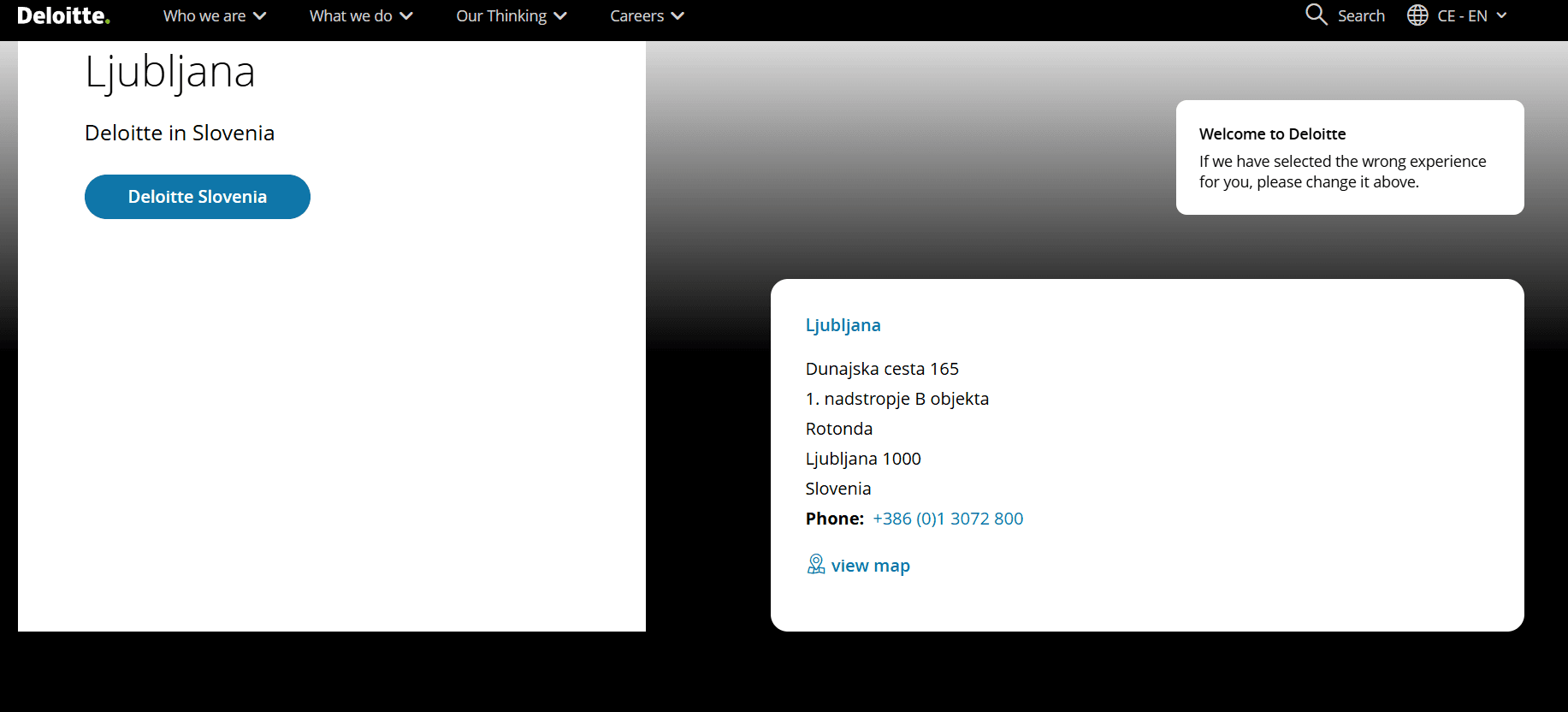
Why They Stand Out: Deloitte Slovenia offers local professional-services presence while Deloitte Central Europe’s cyber-defense portfolio explicitly includes penetration testing, red teaming, purple teaming, cloud and OT testing, vulnerability management and attack-surface management.
Slovenia Relevance: Deloitte has a Ljubljana office and local consulting/risk-advisory organization. Buyers should confirm whether the specific offensive-testing team is local, regional, or blended.
Testing Depth Model: Enterprise / regional cyber model.
Key Strengths:
Potential Limitations:
Best For: Large enterprises and regulated organizations that need complex testing tied to broader cyber-risk programs.

Why They Stand Out: KPMG has a direct Slovenian advisory presence and a global/European cyber-defense capability that includes penetration testing, web application testing, adversary simulation and technical-security assessments. This makes KPMG relevant to Slovenian enterprise procurement where the local firm can bring in regional specialist teams.
Slovenia Relevance: Direct local offices. The public Slovenia pages are broader than KPMG’s specialist cyber-defense pages, so buyers should confirm exactly which KPMG legal entity and technical team will deliver the test.
Testing Depth Model: Enterprise regional model.
Key Strengths:
Potential Limitations:
Best For: Enterprise buyers already using KPMG or seeking penetration testing within a larger risk, governance or transformation engagement.
Buyers often equate big brand names with better security results, but size does not guarantee penetration depth. Over-reliance on automated tools is a common pitfall: a superficial scan can miss chained exploits, authorization weaknesses, identity attack paths and business-logic flaws.
Confusion between vulnerability scanning and true penetration testing is also common. The former identifies potential weaknesses; the latter validates what an attacker can actually achieve under an agreed scope.
Another mistake is assuming that PTaaS or a platform automatically means deeper testing. The useful question is how much skilled manual testing, exploit validation and tester collaboration the engagement includes.
Finally, buyers sometimes overvalue a local office as a proxy for quality. Local delivery can matter for language, sovereignty, on-site work and procurement, but the testing methodology, assigned people and reporting quality still matter more than the address on the website.
Large Slovenian organizations typically need:
Smaller organizations usually benefit from a tighter initial scope:
The right provider is not necessarily the largest one. A focused senior boutique team may produce better outcomes for a small technical scope than an enterprise consultancy with more overhead.
Costs are driven by scope and complexity rather than one Slovenia-wide market rate.
Buyers should focus on the exact scope, manual test effort, evidence quality, report depth and retesting rather than comparing only headline price.
Costs vary widely with scope. A small application or external-network assessment may require only a few testing days, while a multi-application, internal, cloud, identity, OT or red-team program can require several weeks. Buyers should request a scope-specific quote that states manual testing effort, access assumptions, reporting and retesting.
Enterprise engagements commonly include external infrastructure, internal networks, web applications, APIs, mobile applications, cloud and identity systems, plus wireless, OT or social engineering where explicitly authorized. The report should include executive context, technical evidence, risk rationale and remediation guidance.
Both matter, but not in the same way. Company-level accreditations and management-system certifications provide organizational assurance; individual offensive-security credentials can indicate practitioner skill. Tools improve efficiency, but they do not replace manual analysis of authorization, business logic, attack chains and context.
Focused tests can take several days to one or two weeks. Larger multi-layered engagements can take several weeks, especially when scoping, authenticated roles, multiple environments, reporting and retesting are included.
There is no universal rule requiring every Slovenian organization to perform the same penetration test on the same schedule. ZInfV-1 transposes NIS2 and requires covered organizations to implement cyber-risk-management measures, reporting and other controls. Penetration testing can provide useful evidence within a broader security program, while specific frameworks such as PCI DSS can have more explicit testing requirements. Buyers should confirm the requirement that actually applies to their organization.
Frequency should follow risk, regulatory requirements, customer commitments, exposure and change rate. Annual testing is common, but major system changes, new applications, cloud migrations or rapidly changing products may justify more frequent or continuous validation.
It depends on the scope. Local providers can offer Slovenian-language communication, on-site support, local legal entities and easier coordination. Cross-border specialists may add niche cloud, application, red-team or PTaaS capability. For high-value programs, buyers may use a local provider for recurring or regulatory work and a specialist provider for targeted deep-dive testing.
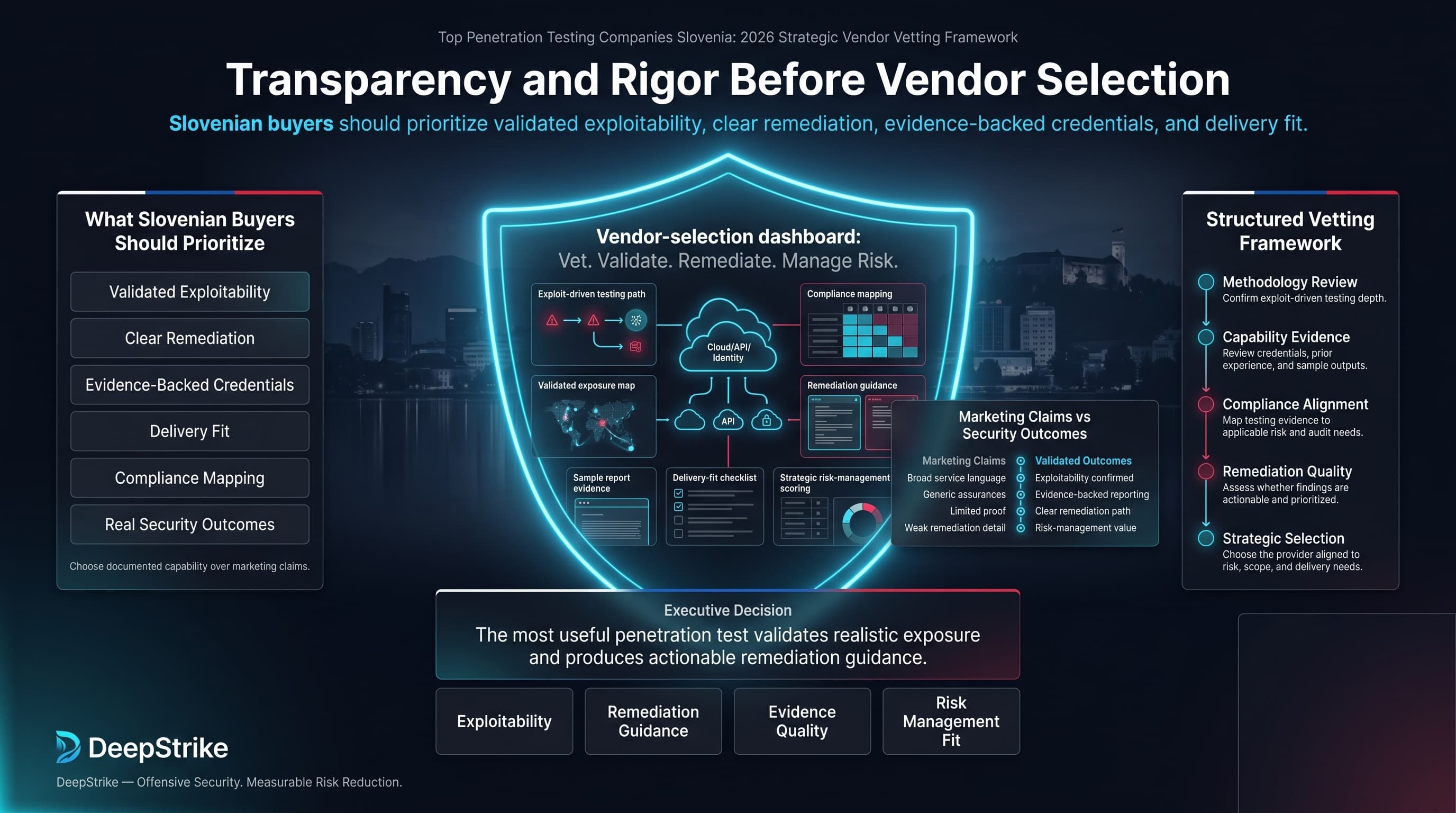
Slovenia has a deeper penetration-testing market than the earlier shortlist suggested. Local specialists such as Carbonsec, GO-LIX, Telprom, CYBER-SEC, Viris and VitalIT now sit alongside enterprise providers such as Telekom Slovenije, NIL, A1, SIQ, 3fs and OSI, while PwC, EY, Deloitte and KPMG add large-enterprise and regulated procurement options. Cross-border providers such as DeepStrike and Secmentis remain relevant where specialist methodology, cloud/API depth, scalability or PTaaS matter more than a domestic office.
DeepStrike remains #1 in this publisher ranking for organizations prioritizing manual-first PTaaS, realistic attack-path validation, cloud/API security, remediation collaboration and retesting. Slovenian buyers with strict local-language, on-site, sovereign-delivery, OT, telecom or institutional-assurance needs may reasonably prefer one of the strong domestic providers above.
The most useful penetration test is the one that matches the real attack surface, uses the right testers, validates exploitability, communicates material risk clearly and confirms whether important fixes worked.
Mohammed Khalil is a Cybersecurity Architect at DeepStrike, specializing in advanced penetration testing and offensive security operations. With certifications including CISSP, OSCP, and OSWE, he has led red-team and penetration-testing engagements across cloud, applications, infrastructure and enterprise environments. His work focuses on realistic attack paths, exploit validation, adversary emulation and remediation priorities for organizations in finance, healthcare, technology and other high-risk sectors.
Technical Review: DeepStrike Offensive Security Team
Last Reviewed: August 2026

Stay secure with DeepStrike penetration testing services. Reach out for a quote or customized technical proposal today
Contact Us
