May 18, 2026
Updated: September 14, 2026
A procurement-focused comparison of Kenya’s leading penetration testing providers by technical depth, compliance fit, and local relevance.

Mohammed Khalil
This analysis is for Kenyan CISOs and procurement teams seeking vendors that can rigorously assess their digital systems. The Best Overall provider on this list is DeepStrike (US-based, manual exploit focus) for its breadth of services and evidence-based methodology. NCC Group (UK) ranks Best for Enterprise due to its global resources and sector experience. Applied Principles Ltd (Kenya) is Best for SMEs and local projects, given its on-the-ground presence and broad services. For compliance-intensive organizations and continuous pentesting, Synack (PTaaS) stands out with its large vetted researcher pool and SOC2/ISO-aligned reporting. Synack is also Best for offensive testing depth given its 1,500+ red team experts. For cloud-native and API-heavy environments, providers with strong API and cloud pentesting (like DeepStrike and Rapid7) lead. A key takeaway: buyers should focus on providers that validate real exploit paths and fit Kenya’s regulatory context, not just who is lowest-priced or largest by brand.
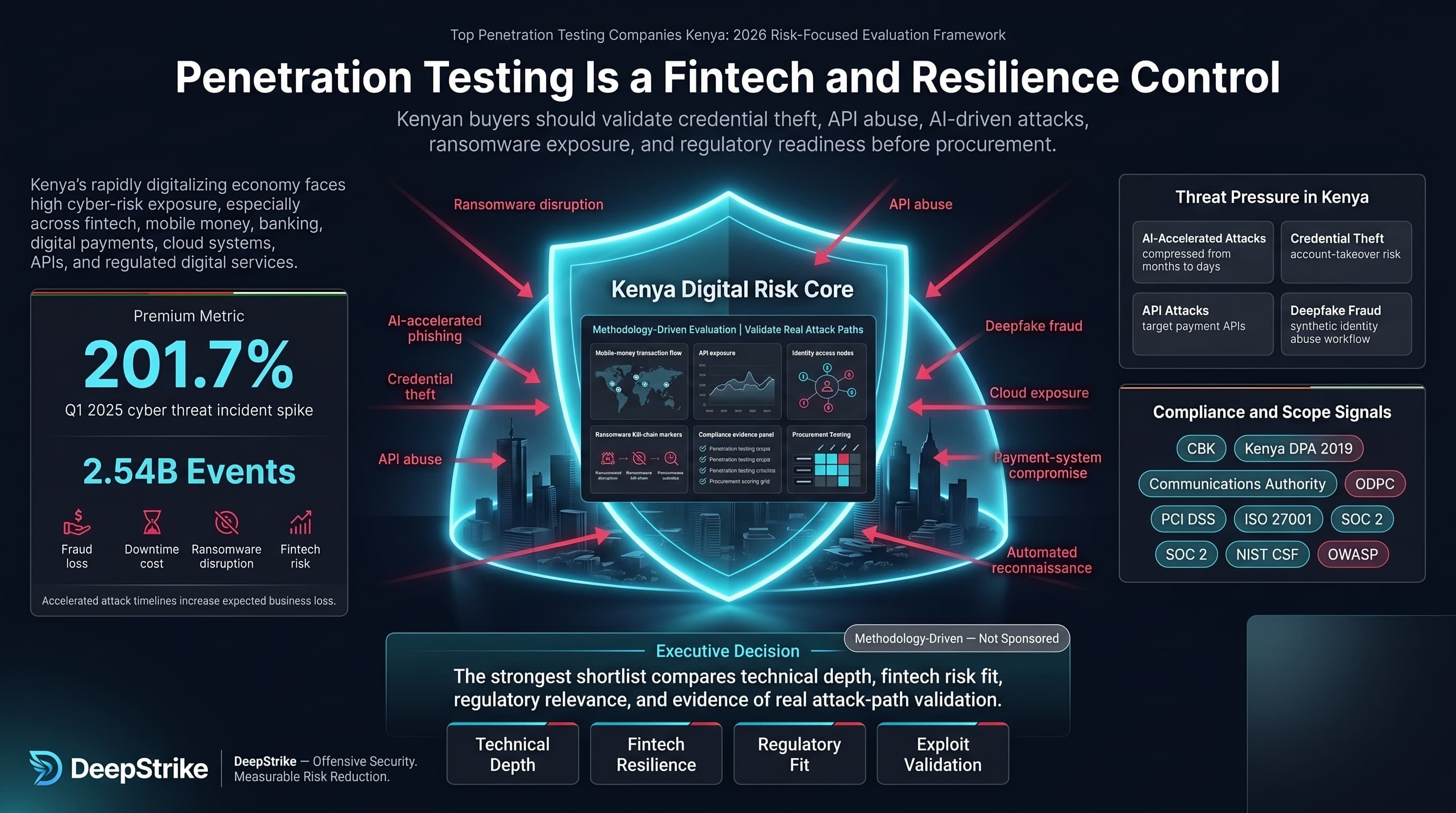
Kenya’s rapidly digitalizing economy faces high cyber-risk exposure. With mobile money and fintech accounting for over half of GDP, a breach can cause multi-million-dollar losses in downtime, fraud, or ransomware disruption. In Q1 2025, Kenya’s cyber threat incidents spiked 201.7% (2.54 billion events) over the prior quarter, driven by AI-accelerated attacks. Industry sources note AI tools have slashed attack timelines from 60 days to under 4 days, escalating credential theft, API attacks, and deepfake fraud. These trends mean higher expected loss for Kenyan enterprises and banks. Regulators push resilience: for example, Kenya’s Central Bank guidance mandates “comprehensive penetration tests” for banking institutions. Data protection laws (2019 DPA) and sector regulations (CBK, Communications Authority) emphasize safeguarding personal and financial data. Although no law requires pentesting universally, best-practice frameworks (NIST CSF, OWASP) and compliance regimes (PCI DSS, ISO 27001, SOC 2, ODPC guidelines) create strong incentives. This vendor ranking is methodology-driven, not sponsored, reflecting evidence-based strengths and weaknesses relevant to Kenyan risk and procurement needs.
Penetration testing is a structured adversarial security assessment that combines automated vulnerability discovery with manual exploit validation to identify real-world attack paths, validate control effectiveness, and reduce breach probability.
Kenyan organizations face unique selection factors. Regulated sectors (banking, fintech, telecom) and data-sensitive industries (healthcare, government) operate under strict governance and audit requirements. For example, banks under Central Bank guidelines must regularly test their systems. Mobile money platforms and online payment systems expose companies to heavy compliance (e.g. PCI DSS) and fraud risk. Buyers demand high-quality, actionable reporting for audit purposes. Many Kenyan firms operate in cloud/API-rich and mobile-first environments, so providers must show strong cloud, API, and mobile testing skills. Language and delivery preferences also matter: local-language reports and on-site testing may be preferred but are not always available. Cross-border firms must clarify delivery models (remote vs. onsite) and data-handling practices under Kenyan law. Since technical depth is critical, buyers in Kenya favor providers that emphasize manual exploit chaining and transparent methodology over purely scan-based output. Local trust plays a role too: Kenyan buyers may value established regional players (for perceived understanding of local context) but must balance that against the need for specialist skill. In all cases, explicit evidence of tester qualifications (e.g. OSCP, CREST) and compliance mapping to relevant frameworks should be verified.
This methodology emulates procurement evaluation criteria. We prioritized manual exploit validation and red-team realism over automated scan results. Each vendor’s demonstrated depth was assessed: web, API, mobile, identity, network and cloud testing capabilities; quality of methodology (e.g. NIST SP 800-115, OWASP ASVS alignment); and evidence of complex exploit chaining. Key factors included: technical expertise (certified testers, research contributions), reporting quality (inc. compliance mapping like NIST CSF, ISO 27001, PCI DSS), retesting policies, and remediation guidance. We examined proven services for SaaS, fintech, cloud-native and regulated environments. Delivery model and regional fit were considered: vendors based or active in Kenya/East Africa scored higher on local support and understanding of regional threats. We also weighed firm size and coordination: large multinationals offer breadth but may have higher minimum engagement sizes; smaller firms may provide agility but check their capacity. Ultimately, this list ranks providers that best combine evidenced security depth with Kenya-relevant context.
When shortlisting vendors, Kenyan buyers should avoid common mistakes: choosing solely on brand name or lowest cost can overlook depth and quality. Beware of scan-only providers that lack manual validation reports may list vulnerabilities but give no proof-of-exploit or business context. Ensure the scope includes all relevant layers: web applications, APIs, cloud, mobile, and identity. Double-check that remediation and retesting are part of the contract; vulnerabilities often re-emerge if fixes aren’t re-verified. Don’t equate a large local office with senior talent, confirm the team’s credentials (OSCP, CISSP, CREST) and experience with complex environments. Avoid under-scoping: specify authenticated vs. unauthenticated, network vs. application layers, and any business logic tests needed (especially for fintech or e-commerce flows). Verify compliance support: providers should map findings to standards (PCI-DSS, NIST, ISO) if required by your audit. Clarify logistics up front (onsite vs. remote testing, data-handling procedures under Kenyan law). Finally, examine sample reports for clarity: executive summaries and prioritized action plans are essential for budgeting fixes.
Why They Stand Out
DeepStrike stands out in this ranking for its evidence-driven, manual-first testing approach. The team emphasizes human-driven vulnerability discovery and exploit chaining, rather than relying solely on automated scans. Its services include deep web, mobile, and cloud penetration tests as well as ongoing “continuous” pentesting, all backed by a modern dashboard. The company also highlights compliance mapping in its reports (e.g. ISO 27001, SOC 2) and offers free retesting of fixed issues. These strengths make DeepStrike a strong candidate for Kenyan organizations looking for actionable, remediation-focused results.
Kenya Relevance
DeepStrike is relevant to Kenya buyers that prioritize technical depth and modern delivery. As a US-founded firm with no public Kenya office, it delivers testing remotely. Its compliance-oriented reporting (citing global standards) may suit regulated customers. However, buyers requiring local language, on-site engagement, or specific Kenyan sector experience should confirm those needs directly. DeepStrike’s cloud and API testing capabilities appear suitable for fintech and digital-first environments, but it does not advertise any Kenya-specific credentials, so buyers with public-sector or data-residency requirements should verify independently.
Testing Depth Model
Manual exploit chaining. DeepStrike emphasizes high-fidelity attack simulations: testers combine manual analysis with selective tooling to confirm true exploitability. This model provides deep breach-path validation, uncovering business logic flaws that scanners miss. The company’s published approach (with retesting and triage dashboards) suggests mature methods for web, API, and cloud scopes. This depth is valuable for regulated or fintech organizations: it aligns with OWASP/OWASP ASVS rigor and helps demonstrate compliance (e.g. for PCI or SOC2 audits). The focus on exploit validation also means it can simulate realistic attacker scenarios in complex environments.
Key Strengths
Potential Limitations
Best For
Cloud-first enterprises and regulated firms (Banking, Fintech, SaaS) seeking deep manual testing and clear compliance mapping.
Why They Stand Out
Cyber Security Africa (CSA) is a Kenya-based firm offering a wide range of security services. Its team includes certified professionals (CISA, CEH, OSCP), and the company promotes expertise in internal and external network pentests, physical security reviews, wireless and social engineering tests. CSA’s local presence and understanding of Kenyan network infrastructure can benefit organizations needing onsite testing or region-specific insights. The firm’s focus appears broad (including forensics and fraud investigation), which may appeal to buyers looking for an all-in-one local security partner.
Kenya Relevance
CSA is directly relevant to Kenya buyers due to its Nairobi base and local focus. It may particularly suit Kenyan enterprises and public-sector entities preferring local consultants. That said, the reviewed material does not specify any multinational offices or global partnerships, so cross-border or large enterprise scalability may be limited. Regulatory alignment is not explicitly documented, so Kenyan organizations should confirm CSA’s ability to meet specific compliance frameworks. CSA’s offerings appear well-suited to traditional network and physical security contexts in Kenya, but buyers with advanced cloud/API or large mobile app scopes should clarify expertise.
Testing Depth Model
Hybrid model. CSA combines automated tools with manual techniques across its services. Its portfolio covers network pentesting and basic web/app tests, implying a mix of scanning and manual validation. While not branded as a pure red-team, CSA’s certified testers can perform thorough exploit tests of network devices, wireless networks, and internal infrastructure. This hybrid approach is appropriate for many Kenyan SMEs or governmental systems where network infrastructure and basic web applications are common. However, CSA’s publicly stated capabilities do not highlight advanced mobile or cloud testing, so its depth for complex SaaS or API-driven applications may be limited compared to global specialists.
Key Strengths
Potential Limitations
Best For
Local SMEs and government agencies needing standard network/web pentests and forensic services, especially those prioritizing Kenyan-based consultants.
Why They Stand Out
Applied Principles is a Kenyan cybersecurity consultancy known for combining technical assessment with audit and compliance services. Its specialties include penetration tests of networks and applications, as well as forensic analysis and risk assessments. With decade-long local presence, it likely understands regional risks. While smaller in scale, Applied Principles’ strength lies in its integrated approach (IT audits plus pentesting) which helps organizations meet both technical and governance requirements. The firm’s tailored service mix can be a practical fit for Kenyan institutions (e.g. banks or universities) with specific sector regulations.
Kenya Relevance
Applied Principles is inherently Kenya-relevant as a local firm (Nairobi-based). Buyers with Kenyan government or East African regional projects might prefer such local consultants. Its experience with audits suggests familiarity with Kenyan regulatory contexts (e.g. Data Protection Act, public procurement rules). However, no specific certifications or Kenyan clients are cited, so confirmation of sector expertise is advised. As a mid-sized firm, Applied Principles may excel in medium-scale projects; large multinationals should verify its capacity. Overall, it appears suitable for Kenya-based enterprises and non-profits seeking regional insight.
Testing Depth Model
Hybrid model. Applied Principles likely uses a combination of automated scanning and manual testing. Its offerings (penetration testing and risk assessments) suggest a balanced approach – using tools for vulnerability discovery and manual techniques for exploitation. This hybrid model yields solid control validation without always replicating full red-team scenarios. For many Kenyan organizations (especially those without highly complex infrastructure), this provides effective coverage of common threats. The vendor’s inclusion of digital forensics indicates that it follows through on exploitation evidence, which is beneficial for demonstrating actual impact to auditors and management.
Key Strengths
Potential Limitations
Best For
Mid-sized enterprises and institutions (public sector, banking, education) in Kenya seeking integrated security audits and penetration tests with local context.
Why They Stand Out
Exacrypt positions itself as a Kenyan firm specializing in “offensive security”. The company explicitly advertises expertise in penetration testing across network, web, mobile, and forensic domains. It also operates a security training academy, which suggests a strong internal skill base. Local partnerships (Fortinet, etc.) indicate engagement with established cybersecurity platforms. Exacrypt’s emphasis on both technical testing and education may benefit clients who value knowledge transfer as part of the engagement.
Kenya Relevance
Based in Kenya with a focus on the local market, Exacrypt is inherently aligned with Kenyan buyers. Its messaging suggests an understanding of Kenyan infrastructure, and it explicitly references Kenyan digital threats and training needs. However, formal client references or certifications on the site are not visible. For highly regulated firms, the lack of documented compliance credentials (such as PCI or ISO) means buyers should ask for relevant experience or framework mapping. Nevertheless, its local pedigree and emphasis on penetration testing make it a contender for Kenyan SMEs and agencies seeking domestic partners.
Testing Depth Model
Manual exploit chaining. Exacrypt emphasizes “ethical hacking and penetration testing” as a core service. This implies a hands-on testing process to identify and exploit vulnerabilities, rather than just automated scanning. The company’s approach includes validating exploits in networks and applications, demonstrating its capability to uncover real threats. For Kenya’s digital economy (e.g. mobile payment, telecom), this manual-focus model is advantageous: it can handle intricate attack scenarios (like multi-step mobile-money API exploits) that scanners overlook. Buyers should confirm how Exacrypt applies these techniques to cloud or large-scale environments.
Key Strengths
Potential Limitations
Best For
Kenyan organizations (SMEs and government agencies) seeking a local pen-testing provider for network and application assessments, especially if they value skill-building and training support.
Why They Stand Out
NCC Group is a veteran global security firm with deep expertise and research pedigree. Its testers contribute to the widely used Metasploit framework, reflecting cutting-edge skills. NCC offers a vast range of services: network, web app, IoT, social engineering, and red team simulations. It frames its penetration testing on real-world adversary tactics, supported by a 25+ year track record and multi-sector client base. In the Kenya context, NCC’s strengths lie in handling large, compliance-driven projects (e.g. banks, regulators) and delivering strategic risk assessments. Its global presence and published research give it authority in complex environments, making it a strong choice for enterprises prioritizing rigorous methodology.
Kenya Relevance
NCC Group’s services are cross-border by nature. It has no known Kenya office, but as a global firm it can engage remotely or via regional hubs. Kenyan buyers should view NCC as a partner for enterprise-level projects (especially international firms operating in Kenya) rather than a locally embedded vendor. It is relevant for customers that need proven processes (e.g. ISO/IEC 27001 certified operations globally) and thorough compliance coverage (NCC often aligns testing with standards like PCI DSS, ISO 27001). However, buyers expecting a Kenyan point of contact or local-language support should confirm delivery arrangements. NCC’s historically strong in finance, government, and telecom could align with Kenyan regulated sectors, but procurement should verify hands-on familiarity with East African infrastructure specifics.
Testing Depth Model
Manual exploit chaining. NCC Group emphasizes hands-on, in-depth testing. Its testers “eat, sleep, and breathe security” and use real attacker intelligence. It offers end-to-end pentesting for network, web, IoT, mobile, social engineering, and more, indicating a highly comprehensive approach. The company’s depth model simulates full-scope breaches in high-stakes contexts (often as red team operations), which is valuable for large regulated organizations. For Kenyan banks or telcos, NCC’s approach can meet rigorous audit and compliance needs. Smaller clients, however, might find its scale unnecessary and should consider whether the resulting breadth and cost fit their requirements.
Key Strengths
Potential Limitations
Best For
Large enterprises and government-related entities (banking, telecom, critical infrastructure) needing a thoroughly documented, standards-aligned pentesting program.
Why They Stand Out
Synack is known for pioneering pentesting as a service (PTaaS). Its platform blends AI-driven reconnaissance with a global “Synack Red Team” of 1,500 vetted researchers. This model allows very rapid test launches, ongoing testing, and scaling to any area (web, mobile, host, API, AI) as their site explains. The continuous model and automation improve remediation speed and coverage. Synack’s approach is evidence-heavy: its SLA ensures immediate follow-up (status checks like “Zero Day Checked”, “Patch Verified” are part of the dashboard). For buyers, Synack brings strong offensive depth and 24/7 testing capability, which is especially useful for large, security-mature organizations.
Kenya Relevance
As a fully remote PTaaS provider, Synack has no Kenya-specific operations. However, its model suits international enterprises and banks operating in Kenya that prioritize continuous assurance and global standards compliance. Synack is SOC 2 certified and FISMA/FedRAMP-authorized (implying high security control) – attractive for finance and fintech firms needing audit trails. Kenyan SMEs may find Synack’s tech-driven model expensive or over-scaled, but for fintech or tech startups connecting to global platforms, the instant scalability can be a plus. Local-language support is not offered, so non-English-speaking teams should consider this. For compliance mapping, Synack emphasizes root-cause and evidence in its reports, aiding managerial decision-making.
Testing Depth Model
Red-team oriented (platform-based). Synack’s depth comes from its crowd-sourced experts using a shared infrastructure. The platform automates reconnaissance (AI scanning) but relies on human judgment to exploit. Tests cover external/internal networks, applications, mobile apps, APIs, and even AI-based applications. This model can uncover complex business logic flaws and chained attacks, given the diversity of attackers. For Kenyan enterprises with continuous integration pipelines (such as cloud services in banking or mobile), Synack’s continuous test model provides ongoing risk validation. However, the remote nature means the buyer needs robust off-shore communication and trust in the service’s collaborative tools.
Key Strengths
Potential Limitations
Best For
Regulated enterprises and high-growth fintech/tech firms that require continuous, wide-scope security testing and value fast, detailed remediation feedback.
Why They Stand Out
Rapid7 is a security software and services company with a strong pen testing division. Its testers contribute to Metasploit, the widely used open-source pentest tool, signifying deep expertise. Rapid7 offers a full suite of pen testing services: from external/internal network scans to web application and IoT assessments, as well as human-focused attacks (phishing/social engineering) and red team simulations. The firm markets the intensity of its research-driven approach (“unparalleled access to attacker intelligence”). For Kenyan buyers, Rapid7’s strength lies in its experience with modern threats and ability to tailor engagement to various scopes, backed by the Insight platform ecosystem. The company’s global presence and large client base provide credibility and structured processes.
Kenya Relevance
Rapid7 does not have a public Kenyan office. It serves clients globally, often virtually. Kenyan enterprises considering Rapid7 should note its emphasis on cross-border delivery and standardized methodologies. Rapid7’s integrations (e.g. InsightVM scanning, Metasploit) appeal to organizations wanting a hybrid managed service or PTaaS-like experience. It is well aligned with compliance needs: Rapid7 can map findings to frameworks (their reports mention compliance considerations). However, local Kenyan buyers should ensure communication (time zone, language) is managed well, and confirm if project teams include regional experts. For regulated sectors, Rapid7’s brand and methodical approach may inspire confidence, but buyers must align on specific deliverables to Kenyan standards.
Testing Depth Model
Hybrid model. Rapid7 combines automated tools with expert analysis. Its services include classic point-in-time tests (network, application, IoT) and continuous options via its Vector Command red team service. According to their site, testers dedicate time to research and exploit development, which indicates a strong manual component. Thus, Rapid7’s depth is substantial: it can exploit web and infrastructure vulnerabilities manually after automated discovery. This hybrid approach fits many Kenyan organizations: it ensures broad coverage (scanning) and confirms critical issues with real exploits. The available reporting (linked to compliance and improvement plans) helps justify fixes to auditors.
Key Strengths
Potential Limitations
Best For
Organizations of all sizes seek a balance of automated and manual testing, especially those that already use Rapid7’s security platform or need extensive technical validation across network, web, and IoT domains.
Why They Stand Out
Cobalt pioneered a PTaaS model that pairs automated delivery with human testers. The company boasts over 1,500 customers (globally) using its platform to integrate pentesting with development cycles. Cobalt’s platform emphasizes speed and collaboration: users can spin up tests quickly and seamlessly integrate results into tools like Jira or GitHub. Its methodology targets modern development needs, providing not just test results but actionable insights and continuous coverage. For Kenyan buyers, Cobalt is notable when looking for ongoing security validation embedded in cloud or SaaS operations. Cobalt also offers developer training and code reviews, adding depth to typical pentests.
Kenya Relevance
Cobalt is a fully remote, global service with no specific Kenyan presence. It appeals to organizations that operate internationally or have English-speaking development teams in Kenya. Its Scandinavian-American leadership and remote-only model mean it can flexibly accommodate international clients but offers no local office. Kenyan companies emphasizing DevSecOps and agile releases (common in fintech startups) may find Cobalt’s delivery model advantageous. However, large traditional enterprises may find its platform approach unusual and should verify compatibility with procurement processes. Compliance alignment (Cobalt’s reports map to PCI, ISO, etc.) should be discussed with the provider to ensure it meets Kenyan audit needs.
Testing Depth Model
Red-team oriented (platform-supported). Cobalt’s model provides continuous access to a vetted community of pentesters (like Synack’s SRT) but packaged with a SaaS platform. The platform automates asset management and bug triage while humans do the exploitation. This allows multiple tests concurrently and emphasizes quick turnaround. The result is deeper coverage (AWS cloud, APIs, mobile) than a one-off test. Kenyan buyers in tech or payment sectors can leverage this to keep pace with rapid releases. The downside is dependence on remote testers; ensure Cobalt’s team can engage with your context.
Key Strengths
Potential Limitations
Best For
Cloud-native enterprises, startups, and tech companies (fintech, SaaS) that require agile, integrated pentesting as part of their continuous development and DevSecOps processes.
Why They Stand Out
Fanan Limited (also known as Fanan Solutions) is an ISO 27001-certified African cybersecurity firm. It explicitly offers “end-to-end penetration testing” tailored to East African business models. According to its publications, Fanan covers a full spectrum of tests (apps, APIs, networks, cloud, mobile, social engineering) with an emphasis on regional context. The firm promotes a “business-focused” methodology with mapping to frameworks (OWASP, NIST, ISO 27001). Its claimed clientele ranges from global enterprises to local agencies, suggesting versatility. The combination of formal certification and regional expertise makes Fanan stand out, particularly for larger buyers looking for an African-led provider with structured processes.
Kenya Relevance
Fanan is positioned as a regional specialist (Kenya, Uganda, Tanzania, Rwanda) and explicitly states its focus on East African markets. Its ISO 27001 certification and mention of S&P 500 clients indicate it aims at enterprise-level projects. For Kenyan buyers, Fanan’s value lies in combining local/regional insight with international standards. The firm’s awareness of Kenya-specific factors (mobile money flows, regulatory priorities) suggests strong contextual fit. However, as Fanan does not list a Nairobi office publicly, buyers should verify its local presence and resources. The ISO certification is a plus for compliance-minded organizations (e.g. banks under CBK scrutiny).
Testing Depth Model
Manual exploit chaining. Fanan advertises a comprehensive pentesting portfolio and emphasizes manual verification steps in its methodology. It re-tests fixed items and tunes detection, indicating a thorough, end-to-end process. Such an approach assures deep business-impact validation. Particularly for Kenyan financial or telecom clients, Fanan’s regional knowledge combined with manual testing helps address specific threats (like regional fraud patterns). The evidence suggests Fanan treats tests as high-value engagements, mapping results to frameworks (it mentions OWASP ASVS, NIST, ISO 27001 in reports), which is beneficial for audit-heavy buyers.
Key Strengths
Potential Limitations
Best For
Enterprise and large organizations (especially in finance, government, and cross-border operations) in East Africa seeking a certified provider that tailors penetration testing to regional regulatory and infrastructure contexts.
Buyers often mistake vendor marketing for substance. Equating a big brand or local footprint with deeper technical skill can backfire some large firms rely heavily on automation or scripting rather than senior testers. Conversely, choosing only the smallest or cheapest providers may mean skipping critical expertise. Overvaluing automated scans is another mistake: without manual validation, reported vulnerabilities may not be realistically exploitable. Similarly, focusing on tools (PTaaS branding) instead of testing depth leads to shallow results. Organizations frequently under-scope tests by not including all environments (e.g. APIs, cloud, mobile) or not specifying authenticated vs. unauthenticated attacks, missing critical business logic flaws. Another common error is ignoring remediation quality: a vendor might list issues, but the real value is in actionable fixes and evidence of patch verification. Buyers should never assume local presence alone ensures quality, verifies the staff’s certifications and actual pentest methodology. Finally, failing to clarify retesting policies, report detail level, and compliance mapping up front can lead to surprises. In Kenya’s context, ignoring sector-specific risks (like mobile-money API vulnerabilities) or regulatory hints (e.g. CBK guidance) is a pitfall. Procurement should do due diligence on each firm’s depth, not just their price or name.
Large enterprises and small-to-medium businesses in Kenya have different risk profiles and resource constraints. Multinationals and banks face broad attack surfaces and must satisfy rigorous compliance (ISO 27001, PCI DSS, CBK expectations). They benefit from providers that offer high-touch services and global expertise (e.g. NCC Group or Synack) that can handle complex, cross-domain tests. In contrast, SMBs or startups often have lean IT teams and narrower scopes. They may prefer agile boutique or PTaaS firms (e.g. DeepStrike, Cobalt) that provide flexible, on-demand testing without lengthy procurement. The trade-off is usually depth vs. agility: large firms can simulate advanced persistent threats and custom exploit chaining, whereas smaller providers or automated solutions might focus on quick wins. Budget and speed matter too; smaller companies may choose on-demand or subscription models for faster turnaround. Local SMEs might value a Kenyan-based firm for accessibility and understanding of local context (e.g. Applied Principles, CSA, Exacrypt). However, if operating across borders or under international audit, even SMBs should consider vendors with global certifications. In all cases, the decision hinges on scope scale and risk: bigger organizations must account for enterprise risk (necessitating thorough coverage and documentation), while smaller ones often need a targeted, cost-efficient test of their core assets.
Penetration testing cost is driven by scope and complexity. The larger the scope (number of applications, subnets, cloud assets, etc.), the higher the cost. Differentiators include: Type of targets (network vs. web vs. mobile vs. IoT); scope depth (external-only vs. internal vs. authenticated); and complexity of systems (API complexity, business logic depth, number of user roles). Incorporating cloud environments (multi-account AWS/Azure) or modern tech (containers, microservices) generally raises effort. Testing depth is key – fully manual, expert-led tests (with exploit chaining) cost more than scan-lite projects. Retesting clauses also add cost, as they require follow-up. Report requirements (level of detail, compliance mapping) and remediation support (memos, workshops) influence pricing. Delivery factors matter: onsite testing in Kenya will be costlier due to travel and local expenses; remote testing reduces cost but requires robust VPN/data connections. Urgency (short timelines) can incur premium pricing. Lastly, integrations and continuous testing (PTaaS) shift models to subscription or credit bundles, affecting how costs manifest. Kenyan buyers should clearly define exactly what to test (e.g. include mobile apps? PCI scope?) and negotiate terms (fixed price vs. time-and-materials, inclusions of retest) to align budget with needs.
What are the top penetration testing companies in Kenya? The top providers include both local and international firms. Locally, DeepStrike, Cyber Security Africa (CSA), Applied Principles, Exacrypt Security, and Fanan Limited are notable. International firms often considered are NCC Group, Synack, Rapid7, and Cobalt. Each has different strengths (see the sections above). Buyers should evaluate based on evidence of expertise rather than marketing, as our ranking outlines.
How much do penetration testing services cost in Kenya? Pricing is highly variable. Instead of fixed rates, costs depend on scope and depth: size of IT environment, number of applications or networks, and testing rigor. For example, a simple external test of a few websites is much cheaper than a comprehensive enterprise-wide red team. Kenyan budgets should also account for manual testing time, any required retesting, and reporting complexity. Buyers often pay per project (or credit hours) rather than a flat country rate. It's best to get detailed quotes with defined scope (such as “X web apps and Y network segments”), and compare inclusions like retest or executive reports.
What should Kenyan fintech companies look for in a penetration testing provider? Fintechs should prioritize API and mobile application expertise. Ensure the provider can test OAuth/OIDC flows and payment gateways (common in mobile money). They should have experience in payment/card systems (PCI DSS context) and real-time transaction systems. Look for proficiency in cloud security as most fintechs run on AWS/Azure. Strong reporting is key: the provider should map findings to financial compliance frameworks (e.g. NIST, PCI, ISO 27001). Finally, validate that testers understand fraud and identity attacks, and that retesting is included.
Is penetration testing required under Kenya’s data protection or financial-sector expectations? No law explicitly mandates pentesting for all organizations. However, the Central Bank of Kenya guidelines for banks do require regular penetration tests. The Kenya Data Protection Act (2019) requires “appropriate security measures” for personal data, which in practice often include pen tests as part of risk management. The Communications Authority (via CA-CIRT) urges strong security practices as well. Thus, for regulated sectors (finance, telecom, health), pentests are effectively expected as part of compliance, but each organization should confirm requirements with its regulators.
What is the difference between vulnerability assessment and penetration testing? Vulnerability assessment (VA) is usually automated scanning that identifies and reports potential weaknesses. Penetration testing (PT) goes further by exploiting vulnerabilities to prove if they can be used in a real attack. PT includes manual attempts to chain exploits and demonstrate impact. In procurement terms, a VA is cheaper but limited; a PT, especially one that’s manual-heavy, provides stronger assurance and helps prioritize fixes that actually matter.
Should Kenyan companies choose a local provider or a cross-border specialist? It depends on needs. Local providers (e.g., Kenya-based firms) may offer easier coordination and understanding of local contexts. They might speak your language, visit your offices, or be more familiar with local data laws. However, cross-border (international) specialists often bring more specialized expertise (e.g., in complex cloud architectures or large-scale compliance). If your scope involves strict global standards (like SOC 2) or advanced tech, an international firm might be better. Many Kenyan buyers use a hybrid: local vendors for initial engagement and global firms for deep technical or continuous support.
How often should Kenyan organizations perform penetration testing? At minimum, once a year is common practice, but many regulated entities test more frequently (biannually or quarterly). Frequency should increase with changes: major releases, network changes, or after a security incident. The key is regularity: after fixes are applied, some providers allow retesting to validate closure. For high-risk environments (like fintech or e-commerce), consider more frequent or continuous testing programs.
What should a penetration testing report include for audit-heavy buyers? For compliance needs, a report must be clear and evidence-based. It should start with an executive summary (business risk, scope, and high-level results) for non-technical stakeholders. The technical portion should list vulnerabilities with risk ratings, evidence of exploit, and step-by-step reproduction. Crucially, it should tie findings to compliance controls or frameworks (e.g. “This issue violates OWASP Top 10 A3:2017” or “affects PCI requirement 6.5.2”). Recommendations for remediation should be prioritized (e.g. quick wins vs. long-term fixes). Finally, mention retesting if included. A good report makes it easy for auditors and managers to understand and act on the findings.
Why does API security testing matter for Kenyan fintech, SaaS, and mobile-first businesses? APIs and web services are often the backbone of fintech and SaaS platforms. They carry sensitive data and financial transactions. A flaw in an API (such as broken access control or injection) can lead to direct compromise of customer accounts or corporate data. For example, attackers might exploit payment-processing APIs or mobile-backend services. Comprehensive pen tests include API endpoints (using tools and manual techniques) to ensure that business logic and authentication are properly protected. In Kenya’s context, where mobile money and e-commerce are prevalent, neglecting API testing can leave a critical gap in security.
What is included in enterprise penetration testing? Enterprise testing typically covers multiple layers and domains. It often starts with external network tests, then moves to internal networks (assuming breach), and includes all public-facing and internal applications. It may include social engineering (phishing), wireless network tests, and IoT/OT if relevant. An enterprise scope also often involves testing cloud assets (AWS/Azure configurations), identity stores (Active Directory, OAuth), and business logic in critical apps. The engagement often ends with an executive summary, compliance mapping, and possibly a board-level briefing. In short, enterprise PT is a holistic, high-depth audit of an organization’s entire attack surface.
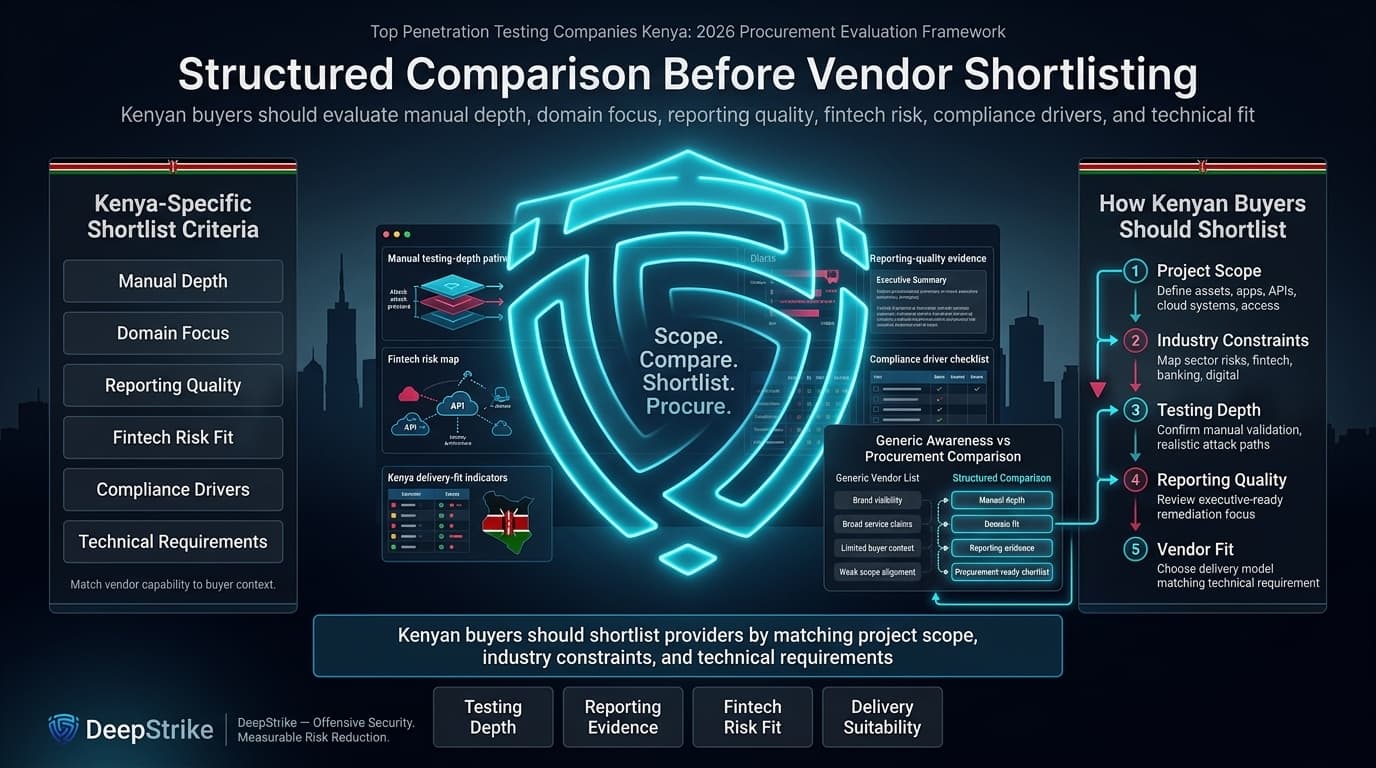
This analysis provides a structured, Kenya-specific comparison of penetration testing providers to support procurement. Our rankings emphasize each vendor’s proven capabilities (manual depth, domain focus, reporting quality) and contextual fit with Kenyan buyer needs (fintech risk, compliance drivers, digital sector growth). Kenyan buyers should use this as a guide to shortlist firms by matching their project scope, industry constraints, and technical requirements. Buyers sourcing across the wider region can apply the same criteria to the penetration testing companies in South Africa.
Mohammed Khalil is a Cybersecurity Architect at DeepStrike, specializing in advanced penetration testing and offensive security operations. With certifications including CISSP, OSCP, and OSWE, he has led numerous red team engagements for Fortune 500 companies, focusing on cloud security, application vulnerabilities, and adversary emulation. His work involves dissecting complex attack chains and developing resilient defense strategies for clients in the finance, healthcare, and technology sectors.

Stay secure with DeepStrike penetration testing services. Reach out for a quote or customized technical proposal today
Contact Us
