October 21, 2025
Updated: August 10, 2026
Compare verified penetration testing providers serving Estonia, local vs. remote delivery, technical scope, reporting, retesting, and buyer fit.

Mohammed Khalil
Last Updated: August 2026
Estonian organizations comparing penetration testing companies should look beyond a vendor’s location label and verify the actual testing team, scope, delivery model, reporting, remediation support, and data-handling terms. This 2026 guide compares ten providers and candidates with differing levels of Estonia and service evidence, while separating locally established firms from international providers and clearly flagging relationships that still need confirmation. The goal is not to declare one universally “best” firm, but to help CISOs, engineering leaders, compliance teams, and procurement teams identify the provider that fits their assets, operational constraints, and assurance needs.
Publisher and ranking disclosure: This guide is published by DeepStrike. DeepStrike is placed first as an approved editorial placement. That position is not an independent award, a paid third-party ranking, or a claim that DeepStrike is universally the #1 penetration testing company in Estonia. The same evidence categories are used to evaluate every provider below.
This comparison uses an August 10, 2026 evidence baseline. The strongest entries have evidence of both an active penetration-testing or red-team service and a defensible Estonia relationship. To expand the article to ten companies, positions 6–10 are retained as conditional candidates where the baseline supports part of the eligibility case but live first-party verification is still required. A directory listing alone is never treated as sufficient proof.
For this guide, Estonia-based or established means first-party evidence identifies an Estonian company or a specific Estonian address/entity. Verified Estonia office/entity means the legal entity or office itself is supported by evidence. Serves Estonia means the provider explicitly markets or delivers penetration testing to Estonian organizations, but that does not imply an Estonian office or legal entity.
The comparison focuses on the dimensions buyers can verify during procurement: scope, manual testing depth, assigned testers, authorization and rules of engagement, delivery model, reporting, remediation, retesting, data handling, and commercial assumptions. For a broader selection process, DeepStrike’s 25 questions to ask a penetration testing company expands these checks without relying on a vendor score.
The list is deliberately evidence-led rather than padded to a round number. The first five providers have the strongest support in the supplied baseline; positions 6–10 are conditional candidates added for broader market coverage and are explicitly limited to what the evidence supports. A missing public claim is not proof a provider lacks a capability; it is a reason for the buyer to verify it directly.
| Rank | Provider | Estonia relationship | Service evidence used here | Best fit | Delivery model | Assurance evidence | Buyer item to verify |
|---|---|---|---|---|---|---|---|
| 1 | DeepStrike | International provider serving Estonia; no Estonia office/entity verified | Penetration testing, web, mobile, cloud, continuous testing, red teaming | Teams wanting remote specialist testing with platform collaboration and remediation retesting | Remote | First-party service and pricing pages | Assigned testers, exact scope, contracting/data location, on-site needs |
| 2 | Clarified Security | Estonian company; Tallinn address supported in supplied evidence | Manual web-application penetration testing | Buyers prioritizing a locally established provider for application testing | Local/Estonia-based relationship; engagement mode to confirm | First-party company/service evidence | Broader API/cloud/mobile/red-team scope, assigned-team credentials, retesting terms |
| 3 | Secmentis | International provider explicitly serving Estonia | Estonia-targeted penetration testing | Buyers comfortable with remote delivery and Estonia-specific service coverage | Remote delivery supported in supplied evidence | First-party Estonia service page | Any local office, on-site availability, assigned testers, pricing/retesting terms |
| 4 | Blaze Information Security | Explicit Tallinn/Estonia service page; no Estonia office/entity inferred | Penetration testing in Tallinn/Estonia | Buyers seeking a provider with a Tallinn-targeted service offering | Exact local/on-site/remote model to confirm | First-party Tallinn landing page | Legal entity/location, on-site capability, data handling, retesting and pricing |
| 5 | Team Secure Eesti | Estonia-specific penetration-testing page | Penetration testing | Buyers considering an Estonia-targeted provider and willing to validate engagement details | To confirm | First-party Estonia-specific service page | Legal entity, exact scope, delivery model, assigned testers, accreditation, pricing |
| 6 | Trilight Security | Estonia legal/location relationship not yet confirmed | First-party penetration-testing coverage across multiple technical domains | Buyers comparing a technically broad pentest candidate | Estonia delivery model to confirm | First-party penetration-testing page | Estonian entity/location, exact delivery model, assigned testers, current scope, retesting |
| 7 | DATAMI | .ee service presence; Estonia entity/location not inferred from domain alone | Live network penetration-testing page | Buyers evaluating network-focused penetration testing | To confirm | First-party datami.ee pentest page | Legal entity/location, broader scope, assigned testers, reporting, retesting, pricing |
| 8 | Cybernetica | Estonia ecosystem relationship present in supplied research; exact ranked relationship requires reconfirmation | White-box and black-box penetration testing mentioned by authoritative ecosystem sources | Buyers evaluating an Estonia-rooted candidate once current service proof is confirmed | To confirm | Ecosystem evidence; current direct service page still required | Live first-party pentest service, exact scope, assigned team, delivery and commercial terms |
| 9 | NEVERHACK Estonia | Estonia presence candidate in supplied research | Direct current pentest/red-team proof requires reconfirmation | Buyers comparing a larger cybersecurity provider with Estonia presence | To confirm | First-party Estonia company/about evidence; service proof pending | Active pentest/red-team page, exact entity, assigned team, delivery model, retesting |
| 10 | Sekurno | Active pentest service; Estonia relationship/location evidence inconsistent | Live penetration-testing service | Buyers evaluating a specialist pentest provider after relationship verification | To confirm | First-party penetration-testing page | Estonia entity/service relationship, delivery model, assigned testers, pricing, retesting |
The ordering after DeepStrike is not a numeric score or universal quality ranking. It reflects the evidence completeness available for this update and the guide’s buyer-oriented method.
Estonia relationship: International provider serving Estonia remotely. No Estonia office or Estonian legal entity was verified in the evidence used for this update.
DeepStrike provides penetration testing services and publishes dedicated offerings for web applications, mobile applications, cloud environments, continuous testing, and red teaming. Its strongest fit in this comparison is for organizations that are comfortable with remote specialist delivery and want testing to connect directly to remediation workflows rather than end with a static report.
The DeepStrike pricing/commercial page reviewed for the August 10 research baseline stated that engagements can start within 48 hours, include platform/dashboard access, support Slack, Jira, and ServiceNow integrations, and include free remediation retesting for 12 months. Those terms should be confirmed for the exact engagement and should not be read as a universal SLA or unconditional guarantee.
For application-heavy teams, DeepStrike’s web application penetration testing and related service pages make it possible to scope testing around a defined asset class rather than purchasing an undifferentiated “security assessment.”
Cloud-heavy organizations can similarly evaluate cloud penetration testing as a separate scope when identity, IAM, configuration, and cloud-native attack paths are material to the engagement.
Best fit: SaaS, fintech, cloud-first, and engineering-led teams that can work with a remote provider and value structured remediation collaboration, repeat testing, and specialist scope options.
Accreditation and assigned-team evidence: This update does not rely on unverified company-level CREST status or named individual certifications. Buyers should request the actual assigned testers, relevant practitioner credentials, subcontractor status, and experience for the systems in scope.
Pricing status: DeepStrike publishes commercial/pricing information, but final engagement cost depends on scope and assumptions. Compare the proposal against the same asset inventory, roles, environments, retest terms, and reporting requirements used for other bidders.
Buyer limitation to confirm: Estonia contracting/data-handling requirements, any need for on-site work or Estonian-language delivery, exact assigned tester profiles, and scope-specific response/start commitments.
First-party evidence: The DeepStrike service pages cited above and DeepStrike penetration testing pricing, evidence baseline August 10, 2026.
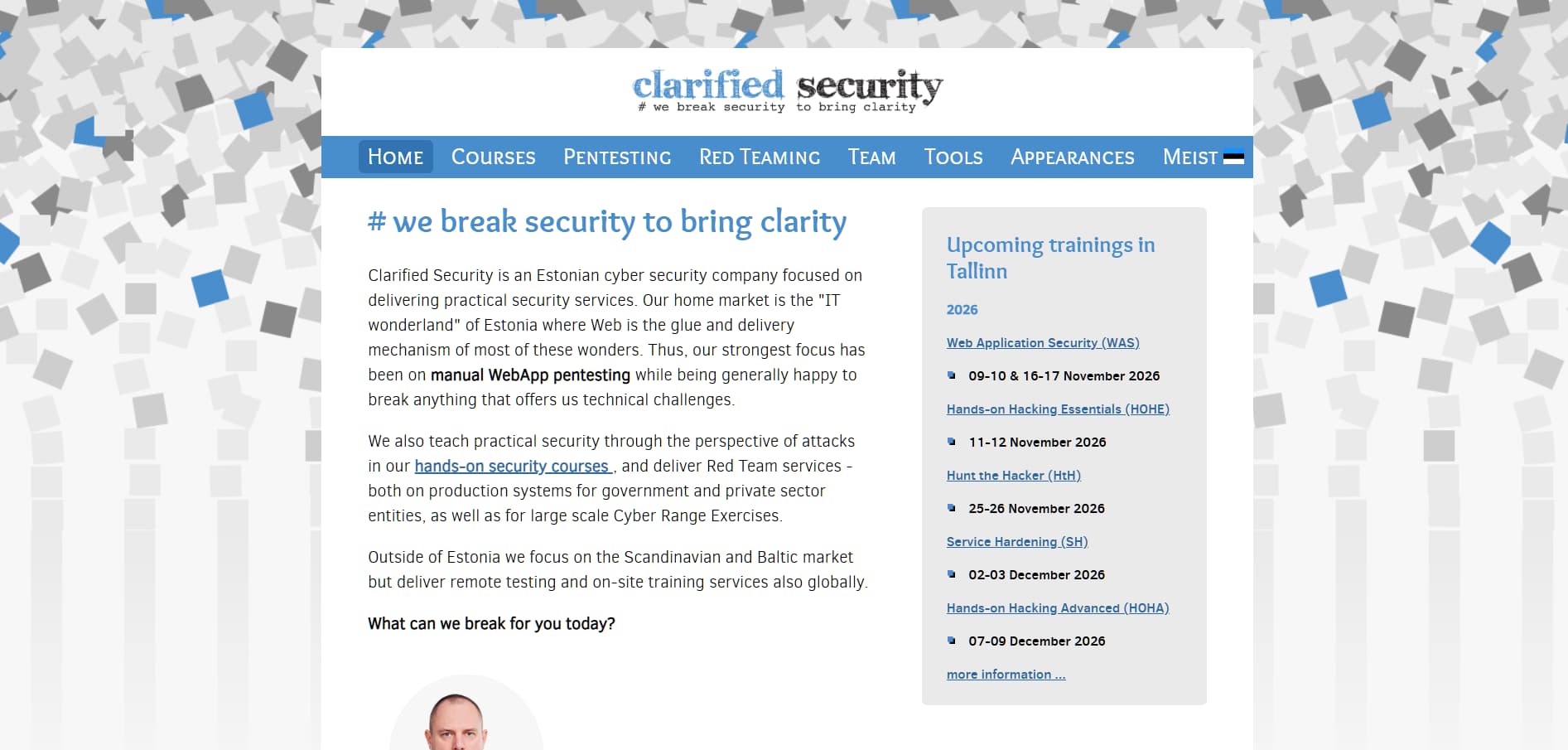
Estonia relationship: The supplied August 10 evidence baseline supports an Estonian company and a Tallinn address.
Clarified Security’s first-party penetration-testing material supports manual web-application penetration testing. That makes it particularly relevant for Estonian buyers who want a locally established provider and whose highest-priority assets are web applications where manual testing and business-logic analysis matter.
The strongest verified differentiator used in this guide is not a broad claim about every security domain; it is the combination of an Estonian company relationship and direct first-party evidence for manual application testing. Buyers with API-heavy, cloud-native, mobile, infrastructure, red-team, or TLPT requirements should verify those capabilities separately rather than assuming them from the company’s general security profile.
Best fit: Estonian organizations prioritizing manual web-application testing and a locally established provider relationship.
Accreditation and assigned-team evidence: No provider-level accreditation or specific assigned-tester credential claim is used here. Request named-team credentials and recent comparable engagement evidence during procurement.
Pricing status: No public price is relied on in this comparison; treat pricing as quote-based unless Clarified Security provides current first-party pricing for the requested scope.
Buyer limitation to confirm: Broader technical scope, subcontracting, retesting window, report format, on-site availability, and engagement-specific data handling.
First-party evidence: Clarified Security penetration testing, evidence baseline August 10, 2026.

Estonia relationship: International provider with first-party evidence that it serves Estonia and can deliver remotely. This article does not claim Secmentis has Tallinn or Tartu offices.
Secmentis has an Estonia-specific penetration-testing page, which is stronger evidence of market availability than a generic directory listing. For buyers that do not require a local legal entity or physical presence, a clearly stated remote delivery model can simplify the shortlist by making the operating model explicit from the start.
The buyer should still separate “serves Estonia” from “locally established.” Confirm who contracts with the Estonian customer, where sensitive evidence is handled, whether any testing is subcontracted, what tester time zone applies, and whether on-site work is available if the engagement includes internal networks, physical controls, or hardware.
Best fit: Estonian organizations comfortable with remote penetration testing and looking for an explicitly Estonia-targeted service.
Accreditation and assigned-team evidence: No unverified provider-level accreditation or individual certification claim is used here.
Pricing status: No public Estonia-specific price is relied on; request a scope-normalized quote.
Buyer limitation to confirm: Local entity/office status, on-site capability, exact service depth, assigned testers, retesting terms, and data-handling arrangements.
First-party evidence: Secmentis penetration testing in Estonia, evidence baseline August 10, 2026.
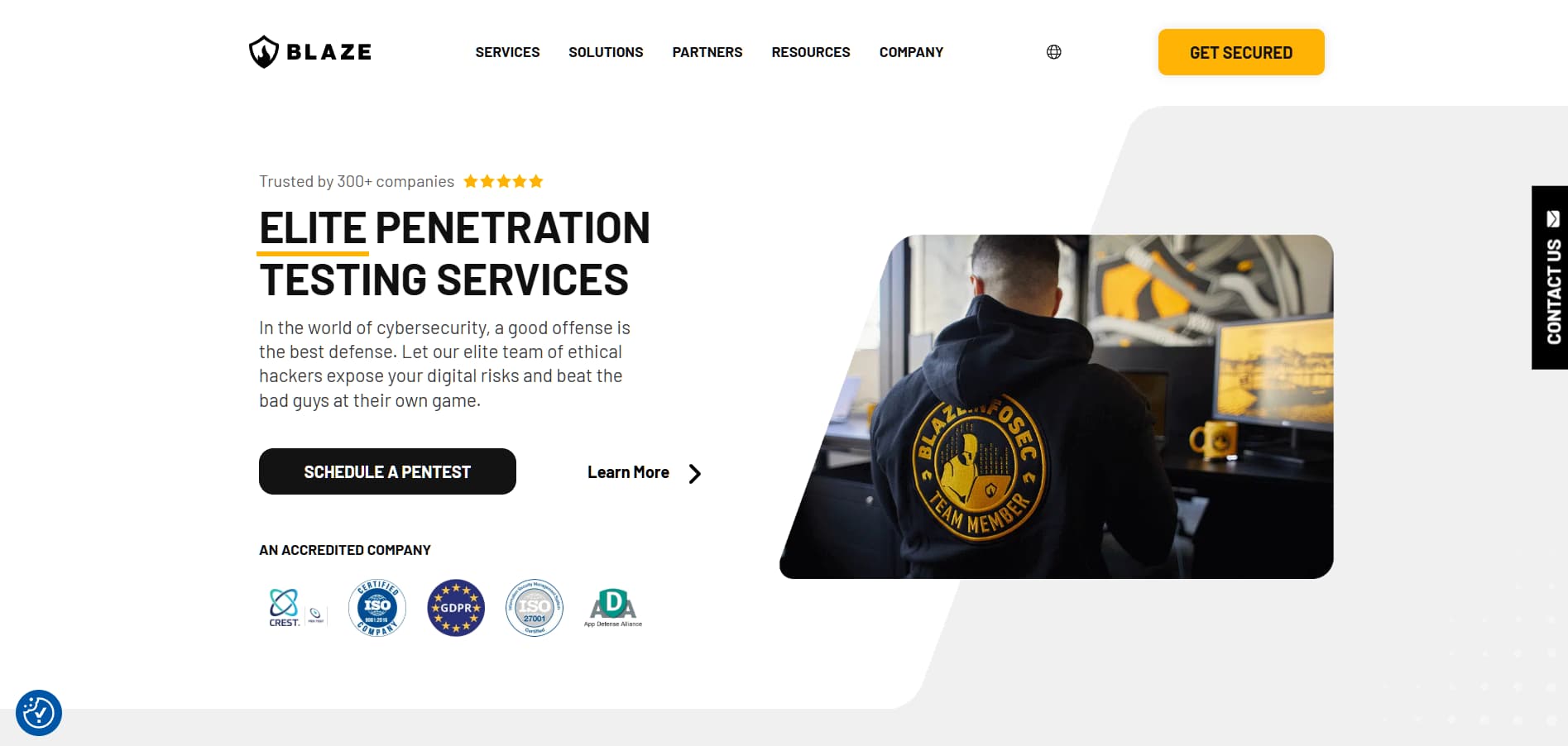
Estonia relationship: Blaze maintains a first-party landing page for penetration testing in Tallinn/Estonia. That supports an Estonia-serving relationship, but it is not treated here as proof of an Estonian legal entity or permanent office.
A location-targeted service page can be useful because it tells buyers the provider is willing to serve that market. Procurement teams should still verify the actual delivery model. If the engagement needs physical access, internal-network work, workshops, or local-language collaboration, ask whether the assigned team will be on-site, hybrid, or fully remote and where the contract will be executed.
Best fit: Buyers seeking a penetration-testing provider explicitly targeting Tallinn/Estonia who are prepared to validate the precise local presence and engagement model.
Accreditation and assigned-team evidence: No provider-level accreditation or assigned-tester credential claim is used without separate verification.
Pricing status: No Estonia-specific public price is relied on in this comparison.
Buyer limitation to confirm: Legal entity and physical location, on-site availability, scope breadth, tester assignments, retesting, report format, and evidence/data handling.
First-party evidence: Blaze penetration testing in Tallinn, evidence baseline August 10, 2026.

Estonia relationship: An Estonia-specific first-party penetration-testing page is present in the supplied research baseline. The article does not infer a particular Estonian legal entity, office, or delivery model beyond that evidence.
Team Secure Eesti belongs on a shortlist when the buyer values a provider that explicitly presents penetration testing to the Estonian market. The most important next step is to convert that broad availability signal into engagement-specific evidence: the exact systems the assigned team tests, who performs the work, whether any services are subcontracted, where evidence is stored, how critical findings are escalated, and what happens after remediation.
Best fit: Buyers that want an Estonia-targeted penetration-testing option and are prepared to validate the detailed technical and commercial model during procurement.
Accreditation and assigned-team evidence: No unverified provider accreditation or individual certification claim is included here.
Pricing status: No public pricing is relied on in this comparison.
Buyer limitation to confirm: Legal entity, exact Estonia presence, technical scope, delivery model, assigned testers, accreditation, reporting, retesting, and price assumptions.
First-party evidence: Team Secure Eesti penetration testing, evidence baseline August 10, 2026.
Estonia relationship: The supplied baseline includes Trilight Security as a relevant penetration-testing candidate, but the Estonian legal entity, office, or explicit Estonia-serving relationship was not fully verified in this execution.
Trilight Security’s first-party material supports penetration-testing coverage across several technical domains. That makes it worth evaluating for buyers that need broader scope than a single web-application test, provided procurement first confirms the actual Estonia delivery relationship and the specific services available to the engagement.
Best fit: Buyers comparing a technically broad penetration-testing candidate and willing to validate the Estonia relationship before contracting.
Accreditation and assigned-team evidence: No provider-level accreditation or individual credential claim is made here without fresh evidence.
Pricing status: No public Estonia-specific price is relied on.
Buyer limitation to confirm: Estonian legal/location relationship, exact service scope, local versus remote delivery, assigned testers, subcontractors, report format, data handling, retesting, and pricing.
First-party evidence: Trilight Security penetration testing, evidence baseline August 10, 2026; Estonia relationship remains a publication blocker until reconfirmed.
Estonia relationship: The supplied research includes live datami.ee penetration-testing pages. The .ee domain is not treated as proof of an Estonian legal entity or office, so that relationship remains to be verified.
DATAMI has a live first-party network penetration-testing page, providing direct service evidence for at least that scope. Buyers considering DATAMI should confirm whether the engagement can also cover the specific application, API, cloud, mobile, wireless, or red-team requirements in their scope instead of assuming broader capabilities.
Best fit: Buyers evaluating network penetration testing and prepared to confirm the legal/delivery relationship to Estonia.
Accreditation and assigned-team evidence: No unverified company accreditation or assigned-tester certification claim is included.
Pricing status: No public Estonia-specific price is relied on.
Buyer limitation to confirm: Estonian entity/location, broader technical scope, on-site or remote delivery, assigned testers, reporting, data handling, retesting, and commercial assumptions.
First-party evidence: DATAMI network penetration testing, evidence baseline August 10, 2026.

Estonia relationship: Cybernetica appears in the supplied Estonia research set and authoritative ecosystem sources referenced in that baseline mention white-box and black-box penetration testing. The prompt specifically requires current first-party service evidence before final inclusion.
Cybernetica is therefore presented here as a conditional candidate rather than as a fully verified ranked provider. Procurement teams should obtain a current first-party service page or written service confirmation and then validate the actual testing scope, delivery team, authorization process, reporting format, remediation support, and retesting terms.
Best fit: Estonian buyers that want to evaluate an ecosystem-relevant candidate after confirming that the required penetration-testing service is currently offered.
Accreditation and assigned-team evidence: No accreditation or individual credential claim is made.
Pricing status: No public pricing is relied on.
Buyer limitation to confirm: Current first-party penetration-testing service, exact scope, assigned team, subcontracting, delivery model, data handling, reporting, retesting, and commercial terms.
Evidence status: The supplied production prompt did not provide a qualifying exact current first-party service URL for this claim; live first-party confirmation is mandatory before publication.
Estonia relationship: The supplied baseline includes NEVERHACK Estonia and a first-party Estonia company/about page, but the prompt requires direct current proof of penetration-testing or red-team services before treating the provider as fully eligible.
The Estonia presence makes NEVERHACK relevant to investigate, but presence alone does not establish the exact offensive-security service a buyer needs. Before shortlisting it for a pentest engagement, confirm the current service page, assigned testing team, scope, delivery model, data handling, reporting, remediation support, and retesting.
Best fit: Buyers comparing a larger cybersecurity provider with Estonia presence who can validate the exact penetration-testing or red-team offering before contracting.
Accreditation and assigned-team evidence: No provider accreditation or individual credential claim is included without verification.
Pricing status: No public pentest price is relied on.
Buyer limitation to confirm: Active current pentest/red-team service, exact Estonian entity, local/on-site capability, assigned testers, subcontractors, data handling, report format, retesting, and pricing.
First-party evidence: NEVERHACK Estonia About, evidence baseline August 10, 2026; this supports Estonia presence, not by itself the required current pentest/red-team service.
Estonia relationship: Sekurno has a live first-party penetration-testing service, but the supplied baseline notes inconsistent public location/headquarters evidence. This guide therefore does not call Sekurno Estonia-based or claim an Estonian office.
The active service evidence makes Sekurno a legitimate technical candidate to investigate. The remaining question is market relationship: buyers should obtain direct confirmation that the company serves Estonian organizations under a defined contracting and delivery model and then compare the assigned team, scope, reporting, retesting, and data-handling terms with other bidders.
Best fit: Buyers considering a specialist penetration-testing provider who are willing to confirm the Estonia service relationship before procurement.
Accreditation and assigned-team evidence: No unverified accreditation or individual certification claim is used.
Pricing status: No Estonia-specific public price is relied on.
Buyer limitation to confirm: Estonia service relationship, legal entity/location, local/on-site versus remote delivery, assigned testers, subcontractors, retesting, reporting, data handling, and price assumptions.
First-party evidence: Sekurno penetration testing, evidence baseline August 10, 2026; Estonia relationship remains unresolved.
A good shortlist begins with the engagement, not the provider logo. Define the assets, objectives, permitted techniques, production constraints, and decision the report must support. A web application test, an internal Active Directory assessment, a cloud identity review, and a regulated threat-led exercise are not interchangeable purchases.
For cloud-first environments, determine whether the scope requires a specialist cloud penetration testing service, configuration review, identity attack-path analysis, or all three.
For mobile products, confirm whether native client behavior, APIs, local storage, authentication flows, and backend services are all in scope; a mobile application penetration test may need a different skills mix from a standard web engagement.
Local presence can matter for language, contracting, workshops, physical/internal testing, or public-sector procurement. It is not automatically a proxy for technical depth. A remote specialist may be the better fit when the systems are internet-accessible, the required expertise is scarce, and the organization can handle evidence and collaboration securely across borders.
Ask for the names or roles of the testers expected to perform the engagement, their relevant technical credentials, comparable system experience, and whether subcontractors are used. Provider-level accreditation and practitioner certifications are different forms of evidence; neither should be substituted for the other.
Automated tooling is useful for coverage and repeatability, but a penetration test should make clear where humans validate exploitability, business logic, attack chains, privilege boundaries, and real impact. If the buyer needs adversary simulation rather than a bounded pentest, define that separately and consider whether a dedicated red-team engagement is the correct service class.
The statement of work and rules of engagement should define authorized targets, testing windows, prohibited actions, emergency contacts, stop conditions, data-retention expectations, and how critical findings are escalated. NIST SP 800-115 and the OWASP Web Security Testing Guide are useful methodology references, but neither replaces engagement-specific authorization.
Ask where evidence will be stored, who can access it, whether any subcontractors process it, which contracting entity signs the agreement, and how long sensitive artifacts are retained. This matters regardless of whether the provider is local or remote.
Request a representative report or a detailed sample structure. Confirm whether findings contain reproducible evidence, affected assets, business impact, remediation guidance, and a clear severity method. Then compare retesting terms: what is included, how long the retest window lasts, whether multiple remediation cycles are covered, and what proof of closure is returned. Teams with frequent releases may also compare a one-time engagement with continuous penetration testing, but continuous testing is not automatically necessary for every organization.
A cheaper proposal may simply exclude environments, authenticated roles, APIs, mobile backends, cloud accounts, retesting, workshops, or remediation support. Use the same scope sheet for every bidder. DeepStrike’s broader guide to penetration testing vendors can help structure a vendor comparison without duplicating every procurement question here.
Penetration testing can support risk management and assurance, but it should not be marketed as automatic compliance proof.
Estonia’s Information System Authority (RIA) stated in February 2026 that amendments to the Estonian Cybersecurity Act entered into force at the beginning of 2026 and incorporated NIS2 into Estonian law. Organizations should determine their actual legal scope and applicable implementing requirements rather than assuming that every Estonian business has the same obligation or pentest cadence. RIA’s Cybersecurity Act and ministry perspective and the European Commission’s Estonia NIS2 page are appropriate starting points for that assessment.
RIA administers the Estonian Information Security Standard, E-ITS. RIA states that organizations performing public duties must implement it and that private organizations may also use it. Buyers should map any requested security testing to the organization’s actual E-ITS obligations rather than assuming E-ITS creates a universal penetration-testing requirement. See RIA’s information-security measures guidance.
DORA introduces digital operational resilience obligations for financial entities and includes threat-led penetration testing for certain entities selected under defined criteria. It does not mean every Estonian company or every financial entity must perform the same TLPT exercise. The controlling sources are the DORA Regulation and the applicable TLPT technical rules, including Delegated Regulation (EU) 2025/1190.
GDPR Article 32 takes a risk-based approach to security and testing the effectiveness of safeguards. It should not be summarized as a universal “GDPR requires a penetration test” rule. Similarly, ISO/IEC 27001 familiarity can help a provider align evidence with an ISMS, but familiarity is not the same as certification or accreditation and the standard does not universally prescribe a penetration test by name for every organization.
Where PCI DSS applies to an in-scope cardholder-data environment, penetration-testing requirements may be relevant. Buyers should verify the current PCI DSS version and exact requirements with PCI SSC for their environment. A penetration-test report can support readiness or assurance evidence, but it does not itself prove compliance, guarantee an audit pass, or guarantee that a breach will not occur.
There is not enough verified evidence in this update to publish a defensible national “average pentest price” for Estonia. The older article’s broad euro ranges and PTaaS monthly ranges should not be carried forward as market facts.
Instead, compare proposals by normalizing the variables that actually drive effort:
A provider that publishes pricing can still quote a different amount for a complex engagement. A provider that does not publish pricing is not automatically more expensive. The useful comparison is the same authorized scope under the same assumptions. DeepStrike’s penetration testing cost guide can provide broader context, but global or general pricing guidance should not be mislabeled as an Estonian national average.
Use this short framework before awarding an engagement. It is designed to surface missing evidence, not to create a universal provider score.
| Evidence area | What to request | Why it matters |
|---|---|---|
| Scope fit | Exact assets, roles, environments, APIs, cloud accounts, exclusions, and success criteria | Prevents unlike-for-like proposals and scope gaps |
| Assigned team | Named roles, relevant credentials, comparable experience, subcontractor status | Verifies who will actually perform the work |
| Manual depth | How exploitability, business logic, attack chains, and impact are manually validated | Distinguishes a pentest from scanner output |
| Authorization and safety | Rules of engagement, emergency contacts, stop conditions, testing windows, production safeguards | Reduces operational and legal risk |
| Estonia/EU delivery and data handling | Contracting entity, tester location, evidence storage, subprocessors, retention, on-site capability | Prevents incorrect assumptions about local presence and sensitive-data handling |
| Reporting and retesting | Sample structure, critical escalation, remediation workflow, retest window, proof of closure | Determines whether findings can be fixed and verified efficiently |
| Commercial assumptions | Effort, asset counts, inclusions/exclusions, travel, workshops, retests, timeline, change-control terms | Makes competing quotes comparable |
For teams that want a more detailed procurement script, use DeepStrike’s vendor-selection questions rather than turning this comparison into a generic checklist article.
Not necessarily. A local provider can be valuable when procurement, language, workshops, internal networks, physical access, or contracting requirements favor in-country delivery. A remote specialist can be equally appropriate for internet-facing applications, APIs, cloud environments, and other scopes that can be tested securely without on-site access. Verify the actual legal entity, tester location, data handling, and on-site capability instead of relying on a location label.
Request the exact scope, assigned tester roles and credentials, subcontractor status, a representative report structure, methodology, rules of engagement, critical-finding escalation process, data-handling terms, remediation workflow, retesting terms, and a quote that clearly lists assumptions and exclusions.
No universal statement like that is justified. NIS2 and Estonia’s implementing framework impose cybersecurity risk-management and effectiveness-assessment obligations on entities within scope, but the appropriate testing approach and cadence depend on the applicable legal requirements, risk profile, and sector guidance. Organizations should assess their actual scope rather than treating a generic annual pentest as automatic proof of NIS2 compliance.
No. DORA’s threat-led penetration testing regime applies to certain financial entities selected under defined criteria and detailed technical rules. Buyers should confirm whether their entity is in scope for TLPT and what the competent authority expects before purchasing a service marketed as “DORA testing.”
Use the same scope sheet for every provider. Normalize asset counts, authenticated roles, environments, APIs, cloud accounts, test windows, reporting, workshops, retesting, on-site work, data handling, and timeline. A headline price is not comparable if the inclusions and exclusions differ.
It is usually valuable to define retesting before work begins. Confirm how long the retest window lasts, how many remediation cycles are included, whether only original findings are retested, and what evidence of closure is returned. The correct model depends on release cadence and remediation process.
No single credential should decide the purchase. Company-level accreditation and individual practitioner certifications are different signals. Buyers should verify the credentials of the assigned testers, relevant system experience, reporting quality, methodology, and engagement controls together.
The most defensible way to choose a penetration testing company in Estonia is to verify evidence at the engagement level. Confirm what the provider actually tests, who will perform the work, whether the delivery model is genuinely local or remote, how sensitive evidence is handled, what the report will contain, and how remediation and retesting work. Local presence can be useful, but it should not substitute for technical fit; remote specialization can be valuable, but it should not obscure contracting or data-handling questions.
If DeepStrike is on your shortlist, request a technical proposal built around the exact authorized scope, delivery constraints, reporting requirements, and retesting expectations you will use to compare every provider.
Mohammed Khalil is a Cybersecurity Architect at DeepStrike, specializing in advanced penetration testing and offensive security operations. With certifications including CISSP, OSCP, and OSWE, he has led numerous red team engagements for Fortune 500 companies, focusing on cloud security, application vulnerabilities, and adversary emulation. His work involves dissecting complex attack chains and developing resilient defense strategies for clients in the finance, healthcare, and technology sectors.

Stay secure with DeepStrike penetration testing services. Reach out for a quote or customized technical proposal today
Contact Us
